
Showing posts with label Baltic Dry Index (BDI). Show all posts
Showing posts with label Baltic Dry Index (BDI). Show all posts
Friday, January 07, 2011


Thursday, January 06, 2011

Wednesday, January 05, 2011
Baltic Dry Index Plunges 4.5%
Blogged on the 23 Dec: The Baltic Dry Index (BDI) Is Not Too Happening

On Bloomberg:
- Freight costs fell as Queensland’s worst flooding for 50 years prompted buyers of the Australian state’s coal to cancel ship charters, intensifying competition for cargoes as the extra vessels become available.
Flooding has covered an area the size of France and Germany, damaging crops and cutting coal stockpiles for export as mines shut. Freight rates as measured by the Baltic Dry Index today slumped 4.5 percent to 1,693 points, taking the decline since Sept. 10 to 43 percent.
“There’s no doubt it’s going to be bearish,” said Stuart Rae, joint managing director of M2M Management Ltd., a London- based hedge-fund group that operates about 65 commodity transporters and trades freight derivatives. “It’s going to exacerbate a market that was already squirming.”
Queensland exports about 180 million metric tons of coal a year, or about a fifth of the global total, according to Sverre Bjorn Svenning, an analyst at Fearnley Consultants A/S in Oslo. The dry-bulk fleet expanded by 17 percent last year, outpacing an 11 percent increase in haulage demand, according to the research unit of Clarkson Plc, the world’s biggest shipbroker.
$18,697 a Day
So-called capesize vessels, the largest tracked by the Baltic Exchange, led declines today as daily rental rates slid 6.6 percent to $18,697. Costs fell 2.7 percent to $14,312 for panamaxes, lost 4.8 percent to $14,860 for supramaxes, and declined 2.9 percent to $11,805 for handysizes.
Total seaborne trade in dry-bulk cargoes, spanning commodities including coal, iron ore and grains, totaled 3.3 billion tons last year, London-based Clarkson estimates.
Queensland coal buyers already invoked force majeure, a legal clause giving them the right to cancel charters, according to Rae. The release of ships from charters will increase competition among owners for cargoes, he said.
Producers of power-station coal in Indonesia and South Africa are unlikely to have time to increase their output, potentially generating alternative vessel demand, because the Queensland disruption probably will be too short, according to Svenning at Fearnley.
“The coming four to six weeks are crucial,” he said. “I don’t think this is positive at all.”
There are 66 dry-bulk commodity carriers now located at Dalrymple Bay and Hay Point, coal-loading facilities about 490 miles north of Brisbane, according to ship-tracking data compiled by Bloomberg.
A capesize ship can haul more than 110,000 deadweight tons, according to Drewry Shipping Consultants Ltd. in London. By that definition, 31 of the vessels at Hay Point and Dalrymple Bay would be capesizes.
Today’s freight-rate assessments were the first published by the Baltic Exchange since Dec. 24. The Baltic Dry Index slid 41 percent last year after almost quadrupling in 2009.
Thursday, December 23, 2010
The Baltic Dry Index (BDI) Is Not Too Happening
It has been a real long time since I blogged on the Baltic Dry Index.
The BDI last closed at 1830!
It's now to happening.

Some recent commentary:
- The dry bulk market isn’t exhibiting a “festive” behavior, thus cheering ship owners and investors alike. Instead, the industry’s benchmark has been falling this week, with the Baltic Dry Index (BDI) retreating yesterday to 1,886 points, close to its 2010 lowest. Both the capesize and the panamax segments were among the main losing sectors yesterday. During the course of the previous week, the Baltic Capesize Index managed to put a halt in its demise, by posting a marginal increase of 1% on a weekly basis. According to a weekly report from shipbroker Barry Rogliano Salles (BRS), the improvement was mainly due to a surge in demand from the big miners in the Pacific in the later part of the week. However the Capesize 4TC is now hovering around US$25,000 per day, the lowest point since the summer and well down on the average for the year. In India, Karnataka ore sellers will have to wait until mid January to hear a decision on their bid to overturn the state’s export ban. This week India’s top court gave the state additional time to respond to the miners’ legal petition. The Federation of Indian Mineral Industries has already estimated the ban will reduce India’s ore exports by 38% to 66m tons in 2010. The Karnataka High Court earlier upheld the provincial government’s decision to halt shipments overseas” said BRS. (source: here )
Shipping stocks fall...
- Shipping stocks on the Indian bourses have lost between 11 and 23 per cent in the last one month as Baltic Dry index slumped to a four-month low. Overcapacity because of new vessels and expectation of fleet additions plunged the Baltic Dry Index, barometer of shipping business, to a four-month low of 1,955 points, down 2.2 per cent (44 points) from its previous close. (source: here )
Excess blamed...
- The Baltic Dry Index, a measure of commodity-shipping costs, fell to the lowest level in more than four months on a surplus of ships.
The index declined 19 points, or 0.9 percent, to 2,076 today, according to data from the Baltic Exchange in London. That’s the lowest since Aug. 6. Declines were led by rates to hire capsesize ships, the biggest in the gauge. They fell 2.1 percent to $24,852 a day.
“The dry bulk market is showing no signs of improvement,” Shalini Shekhawat, a Gurgaon, India-based analyst at Drewry Shipping Consultants Ltd., wrote in a report. “The remainder of the year will be no better, with iron ore and grain trade being insufficient to absorb the over-supply of tonnage in the market.”
Shipping rates have fallen 31 percent this year as new vessels entered the fleet. Capesizes will expand 24 percent in 2010, driving overall dry-bulk fleet growth of 17 percent, Clarkson Plc, the world’s largest shipbroker, estimates. Demand will grow 10 percent over the same time, Clarkson said. Capesizes mostly carry iron ore, used to make steel.
Source: here
Past postings on BDI: here
Tuesday, July 20, 2010
Oversupply Of Vessel Weighs Heavy On The Baltic Dry Shippers
I reckon I better make this posting since I had continuously highlighted drop of the Baltic Dry Index since it fell from a high of 4209 recorded on 26th May.
The Index had recovered slightly since hitting the low of 1709.
Here's the data of the Baltic Indices as at 19th July 2010. (Yes, the BDI is now up 2 days in a row. :D )
Baltic Indices
Baltic Dry 1,732 (+0.70%)
Baltic Capesize 1,698 (+1.31%)
Baltic Panamax 2,122 (+1.43%)
Baltic Supramax 1,664 (-0.30%)
Baltic Handysize 940 (-0.42%)
As of 07/19/10
Baltic Dirty Tanker 842 (+1.20%)
Baltic Clean Tanker 835 (-0.24%)
As of 07/19/10
Here's some research comments from Korean Shipping messenger.
- BDI losing streak ends
The Baltic Dry Index gained 1.2% in London Friday, breaking a losing streak which stretches back 35 consecutive trading days to May.
Still, with capesize vessels earning less than $13,000 daily, the fall has hit shipowners hard in the pocket and dented sentiment in the market.
Daniel Brebner, an analyst at Deutsche Bank, said: “We interpret the recent weakness in the Baltic Index as reflecting the early stages of a slowdown in Chinese steel demand.
“A slowdown in orders for steel products has resulted in a slowdown in orders for iron ore over the past month, resulting in a decline in shipping,” he said, according to Bloomberg.
Friday’s uptick ends the worst losing streak for the BDI since November 2005, when it fell for 48 successive days.
Shipowners including Sammy Ofer have anchored vessels after refusing to accept loss-making charters.
Jeffrey Landsberg of Commodore Research, said earlier this week: “The recent decrease in congestion combined with the continued delivery of a large amount of newbuildings is largely responsible for freight rates coming under recent pressure.”
According to Oppenheimer analyst Scott Burk around 100 capesize newbuildings have been delivered in the first half of 2010, compared with only 34 a year ago.
A further 206 capes are expected in the remainder of this year and 282 more are slated to arrive in 2011.
In a note to clients Burk added: “Additionally, the lack of scrapping activity has continued to exacerbate the vessel oversupply concerns.
“There have been no capesize demolitions since May 2009 as owners continue to operate old vessels because of rates above break-even costs.”
Burk says the US grain season in September and possible Chinese iron ore import increases in the fourth quarter of 2010 following a re-pricing of contracted ore could push rates higher.
And ....
- Analyst thinks drybulk shipping market bottomed
A Deutsche Bank analyst says he thinks the drybulk shipping market may have bottomed, a sign that global trade might soon improve.
THE OPINION: The Baltic Dry Index, which measures activity on major shipping lanes throughout the world, posted its first gain Friday in nearly two months. The index is a key measure of global trade because it indicates how well shipments of everything from coal to cement are moving. The gain was the first gain since May 26.
Analyst Justin Yagerman said in a client note Friday that rates for Capesize and Panamax vessels, two kinds of drybulk ships tied heavily to coal and iron ore trade, are up "considerably" -- both of them fetching rates more than twice their operating costs. Coal and iron ore are used in steelmaking. Coal is also used to generate electricity.
Capesize vessels are named because they are too big to fit through the Panama or Suez Canal and must instead navigate around the Cape of Good Hope or Cape Horn to travel between oceans. Panamax vessels are the largest ships that can fit through the locks of the Panama Canal.
THE STOCKS: Some drybulk shipping stocks gained Friday despite a lower broader market. Diana Shipping Inc. gained 27 cents, or 2.1 percent, to $13.37. Genco Shipping & Trading Ltd. was up 25 cents, or 1.6 percent, at $16.38
Source: here
Thursday, July 15, 2010
Baltic Dry Index Down Another 4.5%, Is The Index Not Relevant Anymore?
Here's the closing Baltic Indices numbers.
Baltic Indices
Baltic Dry 1,709 (-4.53%)
Baltic Capesize 1,653 (-10.11%)
Baltic Panamax 1,980 (+1.75%)
Baltic Supramax 1,717 (-2.44%)
Baltic Handysize 958 (-1.54%)
As of 07/14/10
Baltic Dirty Tanker 791 (+1.41%)
Baltic Clean Tanker 826 (+1.35%)
As of 07/14/10
Some small sign of relief for the Baltic Dirty Tanker Index but the Baltic Dry Index is absolutely getting hammered.
However, that wasn't too unexpected as highlighted in the posting on Tuesday Baltic Dry Index Crash: Who Would Be Hurting?
- “We don’t see anything in the next two to three weeks that’s going to turn the market around,” Guy Campbell, head of dry bulk at Clarkson Plc, the world’s largest shipbroker, said by phone. “Everything is centered on China. We are still watching China in terms of where the steel price is going.”
The longer it drags on, I fear for Greece, after all Greece is a maritime nation and coupled with the debt crisis, the current drastic plunge would probably not be doing the Greek economy any favours at all.
Here's some maritime news.
- Shipping Index, Once Global Trade Signal, Narrows In On China
A plunge in an index long seen as a barometer of trade trends is further evidence of waning raw-materials demand from China, but analysts aren't relying on the Baltic Dry Index for clear signals on the strength of the global economy.
The index, known as the BDI, has lost more than half its value since late May and on Tuesday fell for the 33rd straight day, by 2.7% to 1790.
The index historically has been seen as a proxy for the volume of international trade in commodities because it measures seaborne freight rates, the cost of shipping bulk goods such as iron ore, coal and grains by sea. It hit the most recent peak of 4209 on May 26. The December 2008 nadir, amid financial panic and cutbacks by companies, was 663.
While the latest plunge seems to be a flashing alarm about the global economy, analysts say the index no longer paints as broad a picture owing to recent developments within the shipping industry. While the index offers insights into a specific slice of China's economy, its reputation as a broader indicator has been dented by the large increase in the number of ships being built.
"The BDI shows the impact of demand in a stable demand environment," said Jeremy Penn, chief executive of the Baltic Exchange, which compiles the index. "At the moment, the supply situation is anything but stable."
Whether or not the global economy enters an extended slowdown depends largely on China, but the nation's own data process is riddled with inconsistencies. So, analysts and economists often look to discern how goods shipments in and out of China influence other parts of the worlds supply chain. The BDI is still useful in this respect.
The number and size of vessels being booked suggest that the fall in prices to transport seaborne freight and, correspondingly, the BDI, reflects weakening demand, said Melissa Kidd with Lombard Street Research.
This has been driven primarily by a lack of iron-ore imports by China's steel mills, which are struggling to cope with a tougher export environment, a new pricing system and policy moves to rein in excess construction.
China imported 47.17 million metric tons of iron ore in June, down 9.1% from May and 15% from a year earlier, according to preliminary data from China's customs authorities. It brought in 309.3 million tons in the first six months of 2010, up 4.1% from a year earlier.
"Steel production in China is not expected to collapse by any means, but we do expect it will decrease moderately in the short term," said Jeffrey Landsberg, an analyst with Commodore Research.
Other indicators point to moderation in China's commodity demand rather than a collapse. China's construction sector expanded in May, with new-construction starts doubling from last year. Chinese exports in June were better than expected, even amid the European debt crisis.
Concerns about having more ships than demand dictates has been an issue for the industry since the credit crunch, which spurred questions about how the record-setting number of vessels ordered when ship owners were flush with cash were going to affect shipping rates in a more-fragile demand environment.
Ships take about three years to build, historically making supply both easy to predict and relatively inflexible. Moves in the cost of shipping have, therefore, been largely the result of fluctuations in demand for the commodities they carry.
With uncertainties remaining about how many new ships will now be set afloat, what gave the index its forecasting element has withered. Iron-ore prices for import to China have been falling since April and recently stood at $117.60 a metric ton, the lowest since December, according to data from The Steel Index.
"The BDI has all sorts of distortions," said Julian Jessop, chief international economist at Capital Economics in London. "At the moment it's been moving in the same direction as other commodity prices. It seems odd to suppose this would be better at predicting the future than commodity markets themselves." ( source: here )
Tuesday, July 13, 2010
Baltic Dry Index Crash: Who Would Be Hurting?
The Baltic Dry Index has continued its free fall.

Here's the closing Baltic Indices.
- Baltic Indices
Baltic Dry 1,840 (-3.26%)
Baltic Capesize 1,949 (-7.28%)
Baltic Panamax 1,941 (-0.15%)
Baltic Supramax 1,789 (-1.54%)
Baltic Handysize 988 (-1.50%)
As of 07/12/10
Baltic Dirty Tanker 789 (-0.88%)
Baltic Clean Tanker 812 (-0.12%)
As of 07/12/10
The lack of demand for iron core and coal is clearly highlighted by the massive plunge in the Baltic Capesize Index. ( Capesizes usually haul the 150,000 tonne cargo such as iron core and coal)

The comparison YTD performance between Capesize and Dry Index.
No demand for iron core equals no demand for shipping!
- Commodity Shipping Slumps for Longest in 9 Years on China Steel
The Baltic Dry Index, a measure of commodity shipping costs, fell for the longest period in almost nine years as declining Chinese steel prices erode the nation’s iron ore demand.
The index of freight rates on international trade routes fell 38 points, or 2 percent, to 1,902 points today, according to the London-based Baltic Exchange. Today’s drop was the 31st straight decline. That’s the longest since the 34 sessions to Aug. 15, 2001, according to Baltic Exchange prices. Charter rates for all types of ships tracked by the exchange fell.
“We don’t see anything in the next two to three weeks that’s going to turn the market around,” Guy Campbell, head of dry bulk at Clarkson Plc, the world’s largest shipbroker, said by phone. “Everything is centered on China. We are still watching China in terms of where the steel price is going.”
The price of hot-rolled steel in China has declined 17 percent to 3,909 yuan ($577) a metric ton since rising to a 2010 high of 4,698 yuan on April 15, according to prices from Antaike Information Development. Some of the nation’s mills are shuttering blast furnaces for maintenance and others are relying on existing stockpiles instead of imports, Michael Gaylard, strategic director at Freight Investor Services Ltd., said by phone from Shanghai today.
Iron ore creates the single-biggest source of demand for dry-bulk shipping, according to data from Clarkson’s research unit. Trade in the steelmaking ingredient will total 996 million tons this year. Coal is second-largest at 865 million tons of seaborne trade. Grains are 315 million tons. ( source: here )
Recent postings on the current plunge..
- Baltic Dry Index Plunges But Container Rates Soars!
- Baltic Dirty Tanker Index And Baltic Dry Index Plunging.. What Does It Mean?
- Baltic Dry Index Continues To Plunge
- Time To Panic? BDI Down Over 40% In 20 Days! (June 24th )
- Baltic Dry Index Continues To Plunge! Are You Worried About the Possible Implications?
- Plunging Baltic Dry Index Reflects The Slowing China Commodity Demand
If we take Guy Campbell, head of dry bulk at Clarkson Plc, the world’s largest shipbroker, comments into consideration, that is, “We don’t see anything in the next two to three weeks that’s going to turn the market around,” then shouldn't we be concerned with the impact on the shippers. Surely idle ships for the next two to three weeks will not do any dry bulk shipper any good.
Posted on 13th May 2010, Baltic Dry Index Recovers An Impressive 45% And Offers A Ray Of Hope To The Greek Economy?
Now according to this Bloomberg news article, Greek Shipowners Waiting for Prices to Drop, RBS Says, Greece shipowners accounts for more vassels orders! And the longer the plunge its most likely RBS could be hurt also!
- The ratio of losses on RBS’s shipping loans has averaged 2 basis points, or 0.02 percent, in the past 20 years, according to Varnavides, who joined the bank’s shipping department in August 1974. He said he expects that trend to continue for the next several years. The bank’s shipping department is expanding lending, while the unit’s so-called non-core shipping lending has dropped, he said.
RBS has provided about $23 billion of credit to shippers, of which $20 billion has actually been borrowed, he said. In January last year, it had provided $25 billion of credit.
And the biggest Greece shipowner is Dryship and the strange thing was Dryship was downgraded last month, DryShips Stock Earns Downgrade and the downgrade was not based on dry bulk shipping but was based on its offshore oil deepwater drilling rigs!
Here's how Dryships is doing.
Not a bad or scary looking chart if you look at it from a 6 month's perspective but take a look at how Dryships had performed the past 3 years. It's a shocker...
Yup this stock once traded above 110. It's now less than 4 bucks! ( Blogged on Dryships back in 2008: Dryships, Maybulk and Dry Baltic Index (BDI) )
ps: Here's a screenshot of summary of ship sales...

Thursday, July 08, 2010
Baltic Dry Index Plunges But Container Rates Soars!
Hmm... I hope my following reply to the posting Baltic Dirty Tanker Index And Baltic Dry Index Plunging.. What Does It Mean? would not be too sensitive. Makes me wonder who is wearning the skirt. LOL! (Hey I am only sharing my opinion and if I may, I do hope that you would indulge in me again) :P
- but container rates are up.. now peak season
Firstly, the BDI closed down another 5% to close at 2018 last night! (hehe.. not shocked at all. Are you?)
Now since on 26 May 2010, the index was at 4209, surely this is a concern yes? Some might even panic. :D

Now back to container rates. Ok, I won't say I am aware but ... say I didn't. :P Well, my initial task is to ask myself, is the container rates up or down?
On 1st July 2010: Evergreen Marine raises shipping rates on European routes
- Taipei, July 1 (CNA) Evergreen Marine Corp. said Thursday it is raising its shipping rates on its European routes and will add surcharges during the current peak season.
The shipping company said the rates on its Europe- Mediterranean westward routes will be increased from July 1 by US$250 per twenty-foot equivalent unit (TEU) , a measurement for capacity of container transportation.
A peak season surcharge of US$300 per TEU will also be added..... "Strong demand for cargo transportation worldwide is likely to continue into the third quarter," he forecast
Here's another: CSCL to impose surcharges on cargo-box shortage
- China's second-largest cargo-box carrier, intends to impose additional surcharges on transpacific shipping next month due to a global shortage of containers..... CSCL suffered a net loss of RMB 6.49 billion and RMB 1.92 billion in last year and first quarter of this year, respectively. However, the company’s profitability is improving because of the growing demand, said Zhao.
And here's another snippet. From a WSJ article:
- FRANKFURT (Dow Jones)--TUI AG's (TUI1.XE) shares soared on Tuesday after it raised its guidance for its container-shipping operations, citing a recovery in global container shipping. ......... "Transport volumes and in particular freight rates have continually improved over recent months and are considerably up year-on-year," TUI said in a statement. ( date: 6 July. Source: here ) ( Hehe.. container shipper gave positive guidance and the stock soars. :P )
The next article was written on 7/7/2010: The BDI May Have Collapsed, But Check Out The Shipping Rebound Everybody's Missing
- What many have missed, however, has been the surging rates for container shipping, which primarily measure demand for products from developed nations (mostly the U.S. and Europe) against global container ship supply.


So the container rates are up since the start of the year. Assuming the chart is accurate, yes the index recovered but like many so-called recoveries branded around us, where the index is at now, pales in comparison to the previous years, yes? Look at the chart, exactly 2 years ago, the BOXi index was closed to 150. Now it is around 72++. Yeah same old same old. Have recovered nicely from the 'lows' but still pales in comparison verus its peak years. ( Now this is my interpretation, and if you think this interpretation of the above is wrong, do let me know.... why. Yeah, do explain why. :D )
Next, I would ask myself why the container rates are up? Is container shipment up because of the demand driven by lots of container shipments ( this would be great news, yes?) or is there some other reasons?
Here's an article posted on Tuesday: Baltic Dry Index Down, Container Freight Rates Up, What’s Going On?. Ah... it addresses the same issue.
The article notes the demand of container space... but importantly, the article states the following..
- but Nils Smedegaard Andersen the chief executive of A.P. Moeller-Maersk is quoted in a Reuters article as saying the increase in container freight rates is the result of a shortage of shipping containers, not a booming global economy.
Shortage of shipping containers! And not a booming global economy! Sounds like what we witnessed much earlier on the BDI incredible rebound.
Nils continues..
- During the last 19 months, container shipping companies didn’t order any containers. “Now the economy has picked up and that leaves us with a shortage of the containers. We hope at best for a slow recovery. We are not optimistic.”
Stuart Burns who writes the article, concludes..
- So all is not as it first seems. Bulk cargo rates are falling more because of vessel supply than a sharp decline in trade while container traffic rates are rising more because of a shortage of containers than a booming finished goods market. Not surprisingly the recovery continues to be a rocky road even if so far it appears to be heading more or less in the right direction.
And here's another article posted end of last month: What's Really Happening in the Transpacific Ocean Market
It's interesting because it talks about slow steaming vessels! LOL! Smart eh? Slow vessels movement when there is vessel and container box shortage!
- Slow Steaming impact a mess though expedient. Customers have been angry with the corner they’ve been pushed into. And slow steaming has wrecked havoc with container box availability as a result. We have had countless comments/queries on how some lines could not have seen this impact earlier. Vessels may have speeded up marginally but the liners fell into a good gimmick (lower fuel costs and lower capacity) at the expense of customer
Impact of no box. As a result, customers have been put on a shorter leash with no box choices. And rate upward momentum is firmer as a result. But customers don’t feel necessarily grateful if they get good equipment allocation. We think they have gotten the wrong end of the bargain.
Last but not least the Baltic charts...


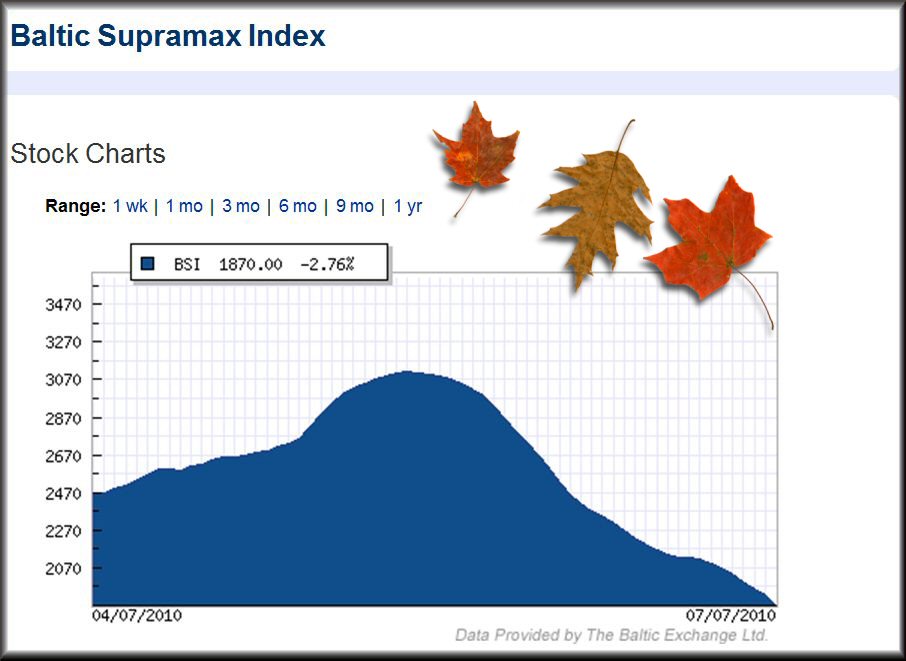
Here's the closing numbers of the Baltic Indices.
- Baltic Indices
Baltic Dry 2,018 (-5.12%)
Baltic Capesize 2,291 (-7.17%)
Baltic Panamax 2,081 (-5.02%)
Baltic Supramax 1,870 (-2.76%)
Baltic Handysize 1,029 (-1.25%)
As of 07/07/10
Baltic Dirty Tanker 814 (-0.73%)
Baltic Clean Tanker 818 (-0.12%)
As of 07/07/10
How? What are the indices suggesting?
Wednesday, July 07, 2010
Baltic Dirty Tanker Index And Baltic Dry Index Plunging.. What Does It Mean?
The Baltic Dry Index has closed at 2127, down another 4%!

Remember it was just 4209 points on 26 May 2010. The Index is now down 2082 points or some 49.4%!!!
Now the Baltic Dirty Tanker Index (BDTI) has not been faring well too. The BDTI measures the oil tankers rates or the shipping costs on 17 crude oil tanker routes have not been doing that well too.

And again reports are saying that there are more very large supertankers (VLCC) for hire than there are for the demand to ship crude oil!
Here's a clip last month.
- There are 5 percent more very large crude carriers, or VLCCs, for hire in the Persian Gulf over the next 30 days than there are cargoes that need shipping, according to the median estimate of three shipbrokers, one freight-derivatives broker and one owner surveyed by Bloomberg News today. (source: here )
And here is how the BDTI is faring the last 3 months.

And here is the comparison of the BDI versus BDTI on a YTD comparison.
Not looking great eh?
So is this an issue of over supply of ships? Or is this an issue of falling demand? Or a combination of both?
But the issue of over supply of ships is incredible, really.
For example: Samsung Heavy wins $1.7 billion shipbuilding deals
- Samsung Heavy wins $1.7 billion shipbuilding deals
(AFP) – 4 days ago
SEOUL — South Korea's Samsung Heavy Industries Co. said Friday it had won deals worth 1.7 billion dollars to build 19 vessels, as global demand for new ships recovers.
The country's second largest shipbuilder after Hyundai Heavy Industries Co. won a 1.03 billion dollar order from Taiwan's Evergreen Marine Corp., under which Samsung Heavy will build and deliver 10 container ships by November 2013.
Samsung Heavy has also clinched another 670 million deal from two unidentified Asian shipping firms to build nine oil tankers.
The two deals, signed on Friday, brought the total orders placed with Samsung Heavy to 51 ships valued at five billion dollars, accounting for 63 percent of the company's yearly target for orders.
In contrast, the company received just one order worth 700 million dollars during the same period last year.
South Korea overtook China to regain its status as the world's top shipbuilder in the first four months of this year thanks to a rise in demand from European shipping lines, the government said on Tuesday.....
And on the latest Korean Shipping messenger newsletter dated 6th July...
http://files.irwebpage.com/reports/shipping/V7ZeHnn7IC/SM-06-07-2010.pdf

And on page 3 of the report...
- .... But let's put it in perspective. This is nothing compared to the 95% drop the index saw before and during the financial crisis of 2008.
And by and large, analysts are saying that we don't need to get too worried about this sell off either. Why not?
The BDI measures the cost of shipping raw materials from one place to another. If the price of moving raw materials falls, then you'd assume that people are moving less stuff around the world. Presumably, that's because demand for finished goods is also slowing down. Therefore, a drop in the BDI suggests that the global economy must be slowing down.
That's all very logical. But it misses one point – the supply side. Because it measures the cost of shipping, the BDI might also be saying that there are simply too many ships. The BDI hit a record high in 2008, as demand for shipping rose far ahead of the supply of ships available.
So, as you'd expect, that meant that more ships were built. And fleets are still growing now, even although demand has fallen to more normal levels. More ships and static demand means shipping rates are falling.
As dry bulk researcher Derek Langston of Simpson Spence and Young told the Financial Times last month: "We still anticipate this year we will see a record year in terms of annual growth of trade. However, this is also accompanied by record growth in fleet supply."
So everything's just fine then? Well, we wouldn't go that far. Melissa Kidd at Lombard Street Research is rather less sanguine about the fall in the index. Sure, "the quality of the BDI as a leading indicator has been disrupted by an oversupply of shipping." But "the message of weaker global activity is supported by a range of other indicators."
Chinese growth is slowing
One big factor in the fall has been a drop off in Chinese steel mill demand for iron ore. Iron ore shipments fell year-on-year in both April and May, according to Bloomberg. Iron ore is of course, a key ingredient in steel manufacturing.
But domestic steel prices in China have been falling for the past ten weeks. This is partly down to tighter monetary conditions. The construction industry is the major driver of steel demand. China's attempts to curb the property market have hit steel consumption and therefore prices.
With iron ore prices remaining high, that's pushed steel makers into losses. As Andreas Vergottis at Tufton Oceanic tells Bloomberg, "Profitability of Chinese steel mills is zero now, we think."
The trouble, says Kidd, is that "China has been the world's engine of growth for… commodities over the last 12-18 months. A cooling off in Chinese demand growth – prompted by ongoing monetary tightening – will impact heavily on global price developments" in the commodities market.
And China's not the only one slowing down. "The JP Morgan Global Manufacturing PMI has fallen from a high of 60.9 in April to 57.0 in June." The reading for new orders was particularly hard hit, falling from 60.3 to 55.5 over the same time. "While a PMI of over 50 points to economic expansion rather than contraction, the drop in the index components points to a slowing down in the pace of recovery."
A turning point for the global recovery
What all this boils down to, says Kidd, is that "the global recovery has reached a turning point as the momentum provided by the inventory cycle wears off." In other words, company restocking is now ending, and we're waiting to see what sort of 'real' demand remains to pick up the slack once government stimulus is removed.
Just how bad things get remains to be seen. But even a slowing of demand doesn't bode well for hard commodity prices in the second half of the year
Saturday, July 03, 2010
Baltic Dry Index Continues To Plunge
Posted last week: Time To Panic? BDI Down Over 40% In 20 Days!
The BDI has closed much lower since.

At 2280, the index has lost 1929 pooints since hitting the high of 4209 on 26th May 2010.
And the reasonings are still very much the same.
- “In the dry bulk segment, China contributes 30% of the total trade. Japan has also curbed its imports. To add to this is the European crisis, which has led to a decline in shipment of dry bulk, thus impacting BDI to slip to this unit,” said an official with the largest shipping company in India.
- “We do not see a recovery in the charter rates for at least six months from now. There is a lot of pressure from the supply side (availability of ships). Unless we see some order cancellations or an ease in supply pressure, charter rates won’t improve,” said Param Desai, an analyst with Angel Broking. source: here
- The Baltic Dry Index is sharply down. This has little to do with overall shipping trends, but is due to a sharp slump in Chinese imports on which global shipping depends
- The shipping index has dropped significantly due to the slowdown in iron ore imports. “A fall in the Capesize Index has almost an equivalent effect on the BDI. The Capesize Index generally caters to iron ore demand, which is currently weak. There is excess steel capacity, therefore, China will now need to stabilise and not continue steel production like it has been producing in the past two months. It will either look at lowering its utilisation or shut-downs. This has caused a fall in iron ore demand, affecting the Capesize Index and the BDI in turn,” said Shraddha Shroff, research analyst, KR Choksey.
- “In addition to the current global steel production scenario, China has also scrapped its rebate policy on imports. This in turn has made Chinese steel lose its low-cost advantage. There is no significant cost-competitiveness left. China’s cap on real-estate prices has also depressed the country’s steel demand from the real-estate segment,” said Ms Shroff. The Chinese government, in one of its measures to curb inflation, is trying to curb real-estate prices. ( hmmm.. this is a 'new' reasoning given!)
At present, China has an excess of steel inventory. It is expected to slow down its steel production further, leading to lower iron ore imports by the world’s largest steel producer. It has already banned Chinese traders importing low-grade coal, in order to arrest the rise in steel prices. Baosteel Group Corp, the nation’s second-biggest mill, was quoted in an international daily, saying that steelmakers in China may cut output next quarter, because of “weak” demand from auto and appliance makers. ( source: here )
Thursday, June 24, 2010
Time To Panic? BDI Down Over 40% In 20 Days!
Time to panic? The Baltic Dry Index is down again.

And if you are counting, that's 20 day of consecutive losses.
Most recent high was 4209 and that was on 26th May 2010. The Index has lost a whopping 1694 points and that would be about 40% of its high recorded on 26th May 2010.
Some are suggesting that this now is a non issue as massive swings in the index seems to be a norm. Yeah, last month I wrote Baltic Dry Index Recovers An Impressive 45% And Offers A Ray Of Hope To The Greek Economy
And as mentioned earlier in the posting Plunging Baltic Dry Index Reflects The Slowing China Commodity Demand:
- I am aware the possibility that one of causes of the steep decline could be caused by the surge in the supply of vessels but what I am concerned about is the slowdown of China's purchase of commodities
This latest news clip from BusinessWeek confirms my double whammy suspicion.
Commodity Shipping Extends Longest Drop in 14 Months on Surplus
- June 23 (Bloomberg) -- Commodity shipping costs measured by the Baltic Dry Index extended their longest losing streak in 14 months because of an expanding surplus of vessels and declining Chinese imports of iron ore and coal.
Growth in China, the world’s biggest consumer of both commodities, will slow to 10.5 percent this quarter and 9.6 percent in the following three months, compared with 11.9 percent in the first quarter, according to the median forecast of 21 economists surveyed by Bloomberg. The nation’s coal and iron-ore imports fell in April and May, customs data show.
Shipping lines were counting on expanding demand to bolster business for new vessels joining the fleet. The global fleet of capesizes, which haul 170,000 metric-ton cargoes of iron ore and coal, was at 1,031 at the start of June, up from 950 in January, according to Arctic Securities ASA. That may reach 1,150 by the fourth quarter, Arctic estimates.
“There’s been a constant increasing pace of deliveries and China’s iron-ore imports have cooled down,” said Martin Sommerseth Jaer, an analyst at Arctic in Oslo who has followed shipping for six years. “The market is being hit from two sides. You have the supply side which is killing you and you have a break in demand.” .............
And the recent move by Beijing to scrap export tax rebate on steel and metal products isn't helping much either.
On WSJ: Asian Shares End Mostly Down; Tax Move Hits China Steelmakers
- .... Chinese steelmakers came under selling pressure after the Ministry of Finance said Tuesday it would scrap an export tax rebate on a variety of commodities, including steel and non-ferrous goods.
"The cancellation of the export tax rebate effectively raises the export tax on these products, hurting the prospects of the metal firms, but the impact would be capped as companies start to limit volume growth," said Wang Junqing, an analyst from Guosen Securities.
Baoshan Iron & Steel Co. dropped 2.7% in Shanghai, while Angang Steel Co. shares fell 2.4% in Shenzhen and 3.3% in Hong Kong.....
And I guess this will hurt the importation of iron core from China, which in turn would hurt the shipping industry too.

Thursday, June 17, 2010
Baltic Dry Index Continues To Plunge! Are You Worried About the Possible Implications?
The Baltic Dry Index has closed down again. If you are counting, that should be 14consecutive days of losses. And mind you, the losses are steep losses.


So what are the possible causes?
Ok, the over supply of the ship is one big issues. A simple supply and demand issue. When there are more supply of ships than actual demand of it, the shipping rates will come down.
But the biggest concern is the slowdown in China's imports.
Yes, as we are all aware, last year, China purchased a lot of raw commodity. Some called it stock piling but exactly a year ago, Andy Xie Called It Speculative Inventory And NOT Commodity Stockpiling!
Whatever the reason, perhaps China is finally using what it had purchased excessively previously and this could be the reason for the current slowdown in China imports. As highlighted in the posting Plunging Baltic Dry Index Reflects The Slowing China Commodity Demand- Imports of crude oil, refined fuel, copper, iron ore and rubber all slumped compared with April, giving little evidence of Chinese export strength feeding through into commodity demand.
- "Most of the deals were signed in March or early April when prices were still high and buying was active, but orders have dramatically fallen in May after prices plummeted," said an iron ore trader based in Ningbo.
And now the Baltic Dry Index has continued to plunge.
Are you worried about the possible implications?
Or do you reckon that things well resume back to normal once the inventory is cycled through?
Friday, June 11, 2010
Plunging Baltic Dry Index Reflects The Slowing China Commodity Demand
The Baltic Dry had been plunging since hitting a high of 4209 on 26th May.


Yes, I am aware the possibility that one of causes of the steep decline could be caused by the surge in the supply of vessels but what I am concerned about is the slowdown of China's purchase of commodities.
The following news clip posted on Reuters offers many suggestions.. China commodities demand slows despite export pickup
- By Polly Yam and Ruby Lian
Business Economy
HONG KONG/SHANGHAI (Reuters) - China's imports of industrial commodities slowed in May despite a leap of almost 50 percent in the country's overall export figures, which global markets took as an encouraging signal about the state of the global economy.
China's total exports rose 48.5 percent in May from a year earlier and imports were up 48.3 percent, China's customs office said on Thursday, giving China a trade surplus of $19.5 billion, up from just $1.7 billion in April.
Imports of crude oil, refined fuel, copper, iron ore and rubber all slumped compared with April, giving little evidence of Chinese export strength feeding through into commodity demand.
Crude oil exports slid 16 percent, copper shipments fell 9 percent, and rubber exports fell 36 percent compared with the previous month. Aluminium imports were flat on the month, but 72 percent down from May last year.
However, China's commodity exports did benefit from the jump in exports overall, with net exports of steel products rising by more than a quarter to almost 5 million tonnes, a reversal of China's unusual position as a net importer a year ago.
Within China, many commodity traders are nervous of demand falling off because of a slowing property market and cooling growth in car sales, as well as oversupply of materials imported in vast quantities when prices fell after the financial crisis.
China's buying power was boosted throughout 2009 by the relative weakness of most other economies, enabling it to snap up sought-after supplies with little competition. That honeymoon has now ended.
"Chinese copper firms reduced their copper buys in May after international copper prices fell, despite running rates at copper smelters remaining at high levels. This means they were using their inventories," said Fang Junfeng, an analyst at Shanghai Cifco.
"June copper imports are expected to remain at the same level as May. But imports could fall by about 10 percent in July when the peak demand season ends."
SLUGGISH DEMAND, TOUGH EXPORTS
China's huge steel sector, which produced almost half the world's steel output last year, is now facing rising costs and production cuts in the third quarter of the year.
Citi analysts said in a research note that despite a long period of destocking, current trader inventory levels were still 35 percent higher than the 2009 average.
"We believe steel prices have no way to go but to fall off in the third quarter. Weak seasonality, sluggish demand from downstream and tough exports are all driving prices downwards," they said.
Exports of coke, used by steelmakers, almost doubled to more than 20 times the volume shipped a year ago, despite a 40 percent export tax, implying a lack of domestic demand. Imports of iron ore also fell by 6.2 percent from April.
"Most of the deals were signed in March or early April when prices were still high and buying was active, but orders have dramatically fallen in May after prices plummeted," said an iron ore trader based in Ningbo.
Imports of soybeans also rose on the month, to 4.37 million tonnes, but some buyers are cancelling cargoes after overbooking imports, leaving ports swamped with supplies.
"We have not booked anything for August. There are too many supplies at home and crushing margins were negative, which could last for two months," said an official at a soy crushing firm in Dalian.
Thursday, May 13, 2010
Baltic Dry Index Recovers An Impressive 45% And Offers A Ray Of Hope To The Greek Economy
It's been ages that I wrote on the Baltic Dry Index (BDI) and in fact my last posting on the sector was on Feb 2010: Baltic Dry Index Plunges As Warned!
Anyway here's an update. The BDI did not die another day but it has been doing remarkably well since!

And here is the six month chart showing that the index has recovered pretty impressively.
Let's see, as per the posting on 4th Feb 2010, Baltic Dry Index Plunges As Warned!, the index was at 2673. Today the index is at 3888. (Yeah lovely number eh? :P). This is a recovery of 1215 points or an incredible 45%!!!
The first thing that came to my mind was .... hey Dryships is from Greece! It was once hit hard when the BDI collapsed. ( See Jan 2009 posting Baltic Dry Index Makes Impressive Rebound )
And on Wall Street Journal John W. Miller, sees a ray of hope for the Greek economy!!!!!
No joke.
- At least one part of the Greek economy stands a chance of escaping the country's crisis: its big shipping companies.
The top tier of the Greek shipping industry seems poised for a strong year thanks to its focus on tankers that transport oil and chemicals, and dry-bulk ships that carry commodities such as wheat and coal.
The industry, second only in economic importance to Greece after tourism, aims to cash in on the boom in shipping commodities to China. The shippers also are well-positioned because they lack exposure to the badly overextended container-shipping market.
"We are the truck drivers of the sea," said Nikolas Tsakos, chief executive and owner of Tsakos Energy Navigation, which operates 46 tankers.
Profiting from global trade while maintaining a strategic distance from Greece itself is a strategy perfected by the nation's great 20th century shipping tycoons, such as Aristotle Onassis and Stavros Niarchos.
The modern incarnation of Greek shipping was born in the late 1940s, when Greek entrepreneurs bought over 800 Liberty ships, U.S. wartime cargo vessels, at bargain prices. Specializing in dry bulk goods and oil, they benefitted from the booms in European manufacturing and Middle East oil in the 1950s and 1960s.
As they profited from hikes in shipping rates during the Suez Canal crisis in 1956, the 1960s boom and the Gulf wars, Greek shipping leaders built up operations in London and New York, retreating there during unrest at home caused by dictatorships, coups and political assassinations. They flagged their vessels in the Marshall Islands, Malta and Liberia, and stashed their money in Liechtenstein or the Caymans.
"They always have a place to go if things collapse," said Clay Maitland, managing partner of international registries of the Marshall Islands, which flags 12% of Greek ships.
Ironically, Greece's current financial mess could help shipping companies by deflating wage and real estate costs at home. Other Greeks will have to pay up as the government better enforces the tax code, but Greek shipping companies are exempt from paying corporate taxes, under so-called Law 89. That's unlikely to change, analysts and shipowners say, even as the International Monetary Fund and the European Union impose strict new discipline to accompany the nation's bailout.
Greek shipping companies now own roughly 4,800 vessels and control 15% to 20% of the world's shipping fleet by tonnage, according to analysts. Only Japan has a larger merchant fleet. Since the mid-1980s, over 20 Greek shipping concerns have become public-traded companies.
Despite the fact Greek ship owners avoid taxes they comprise a big portion of the nation's economy. The industry says it contributes about 5% of gross domestic product by employing 250,000 Greeks and using Greek ship-maintenance firms, lawyers, contractors and other service providers.
The global trade slowdown that started in 2008 hit Greece hard as shipping rates fell. The Baltic Dry Index, an indication of the daily rate for a ship carrying dry bulk, plunged to under 1,000 in late 2008 from a high of over 12,000. (The index has since recovered somewhat and is now over 3,000.)
But Greek shipping companies recovered better than others in 2009, primarily because they have relatively little presence in the container market, the market that suffered the most, said Anthony Zolotas of Eurofin Group, an Athens-based firm that advises companies on ship financing. Only 5.6% of the world's container ships are Greek-owned, compared to about 21% of oil tankers and 18% of dry-bulk vessels, according to Eurofin.
As the rest of the shipping world downsized last year, Greek ship owners bought up vessels at bargain prices. In 2009, they increased the number of ships they own by 218 to 4,763, according to N. Cotzias Shipping Consultants. Only China bought more second-hand dry bulk vessels.
While the top firms are doing well, smaller ones are now at risk after Greece's economic crisis triggered a wave of ratings downgrades and credit tightening.
Shipping depends on credit since firms borrow money to buy vessels. They charter out the ships to oil companies, coal brokers and other traders, then pay back their loans and pocket the margin. As access to funds has dried up, Greek banks have cut down on loans to small and midsized shipping firms. More than two-thirds of Greece's 1,100-odd shipping companies have fewer than five vessels and could go out of business if they can't borrow money to repair or replace old ships, analysts say. A few already have defaulted.
According to a Eurofin report, only a few big international banks are still "active" in international lending to shipping.
"Prior to the financial crisis you might have 40 institutions who would lend to shipping," said Mr. Tsakos, the shipowner. "Now you have about a dozen."
Big shipping companies still can get credit. Evangelos Marinakis, CEO of Crude Carriers Corp., said he had no problem getting a $150 million loan from Nordea Bank AB. He used the money to buy two used tankers for $66.2 million each, which he is leasing out at a daily rate of over $70,000, several times more than last year.
As the Greek economy slumps there is little doubt that salvation for the shipping companies lies in the Far East. With China continuing to grow at an annual clip of around 10% in gross domestic product, it is gobbling up increasing quantities of coal, iron ore, pig iron, coking coal and scrap, often through huge contracts in mineral-rich African countries.
Greek firms are set to benefit from their strength in dry-bulk shipping. "Even we've been surprised by the appetite for dry bulk in China," said Pankaj Khanna of DryShips Inc., a New York-listed Greek-based firm that operates 39 ships.
Thursday, February 04, 2010
Baltic Dry Index Plunges As Warned!
Previously: Could This Be The Start Of The New Leg Down For BDI?
That posting was posted on 28th Jan 2009, Baltic Dry Index then was at 3118.
Here's how the Index has been doing since then.


Time to bring out the goats again from the farm and start gloating eh?
As highlighted in the earlier posting Could This Be The Start Of The New Leg Down For BDI?
- The industry expects further weakening with the approaching Chinese New Year
- K S Nair, director of Shipping Corporation of India said, “There will be no trade to China now, and unless economies like the US and Europe open up to see more exports out of China, there will be a lull.”Besides, monetary tightening in China may also curb demand for more imports.
- Meanwhile, a slew of new ship deliveries in the next two to three years also loom hard on any expected revival in the shipping market and till economies like the US and Europe open up, shippers will face the heat of volatility.
The 'slew of new ship deliveries in the next two to three years' is rather interesting because as mentioned before this could "potentially equate to supply of ships more than the demand for the shipping."
Here's an article published on 25th Jan The Baltic Dry Index Is About To Be Crushed Once Again
- FTAlphaville highlights that broker Icap expects 1,400 vessels to be delivered in 2010, which equates to 120 vessels per month on average. (Even if in reality they won't be spread out evenly) How bad is 120 ships per month relative to what the market has had to deal with so far?
At no point during 2009 did the rate of delivery exceed 60 vessels in one month – but even if this rate of delivery were maintained throughout 2010 it would still equate to slippage of around 50 per cent. However, in light of the sheer size of the orderbook, and despite high levels of slippage, the market still faces the prospect of continued tonnage growth.
This doesn't mean every dry bulk company is toast, but it does mean that the Baltic Dry Index's strength can't be sustained forever, especially with China beginning to tighten its monetary policy and restrict economic growth. (China, as half of global steel demand, is the major driver for bulk shipping rates).
If a shipping stock makes sense after plugging-in half the rates it earns today, then it could be a decent value, but if it requires current rates to be sustained then it's a highly speculative bet going forward, where the odds are stacked against you.
120 new vessels is a lot, yes? One has also to consider the number of existing vessels too. And from the same article, the following chart of dry bulk carriers orderbook is another worry.

Thursday, January 28, 2010
Could This Be The Start Of The New Leg Down For BDI?
Had not made any update on the Baltic Dry Index for quite some time already.
My last posting was on 12 Nov 2009, The Baltic Dry Index Continues To Surge But Is it Sustainable?. BDI then closed at 3748 and the posting questions the sustainability of the surge.
Since then BDI had corrected quite significantly.
Yesterday I noted a stronger downward movement in the index. The Index closed at 3118, down some 2.7% and yes, I am wondering, would this be the start of a new downtrend movement?

The following news article was rather interesting: Shipping industry in choppy waters
- ... While large ships like Capesizes have lost sheen, the decline in the last few days was led by a 6.7 per cent drop in medium sized Supramax hiring rates.
The industry expects further weakening with the approaching Chinese New Year.
K S Nair, director of Shipping Corporation of India said, “There will be no trade to China now, and unless economies like the US and Europe open up to see more exports out of China, there will be a lull.”
Besides, monetary tightening in China may also curb demand for more imports.
Although analysts feel correction in short term may not be dramatic, any fall further from this level could be a cause of worry.
Vikram Vilas Suryavanshi, an analyst at Karvy Broking said, “There will not be too much left for shippers below 3,000 levels and then again dry bulk ships could be laid up.”
Meanwhile, a slew of new ship deliveries in the next two to three years also loom hard on any expected revival in the shipping market and till economies like the US and Europe open up, shippers will face the heat of volatility.
The Chinese New Year should indeed a factor but I found two interesting points being mentioned.
The monetary tightening in China is already considered to be an issue for the shipping industry. Hmmm... rather fast, eh?
And not helping.... a slew of new ship deliveries.... which would 'could' potentially equate to supply of ships more than the demand for the shipping.
How?
Subscribe to:
Posts (Atom)


 Posts
Posts


