Showing posts with label Zoola. Show all posts

Monday, March 04, 2013

Investing In A Relisted Stock?

  • "We study the past to understand the present; we understand the present to guide the future." -- William Lund.

Think about it.

In terms of the stock market, we need to study/understand the stock past. The stock history's tells us what has happened to the stock before and what had happened before could happen once again in the future.

An investor invests for the long term. The long term gives the investor the edge and allow the investor to reap the benefits of seeing the investment grow over time. The time factor is crucial.

However, what if.

What if the time factor turns out to be a risk?

For example, is it a good idea to invest in a stock which had been relisted again?

Think about it.

We are seen many companies whose stock was taken private cheaply in the past getting relisted once more. These companies have turned the stock market into their own playground where they can list and delist their stocks based on their own fancy.

That is the stock past.

The risk, of course, is the delisting could happen again in the future.. In such case, the time factor becomes a risk. The longer time the stock is listed, the greater the chance the stock could be taken private if the stock is trading cheaply.

You invest in Kow Kow stock at 2.00, which is a 10% discount over its relisting IPO price. Five years later, a crisis could happen to the stock market causing Kow Kow to trade at 1.20.

Yes, in most cases, when the stock trades at super low valuations, funds would come in and invest the stock. That's the mechanism of the stock market. Stock prices come up and they do come down. The problem is the owners see the cheap valuation too. Instead of implementing company stock buybacks, the owner do a private buyback. They buy back these shares but via a privatisation offer, benefiting themselves and not the minority shareholders. So the owner launches a privatisation bid at 1.56, which is a so-called impressive 30% premium over the stock price. But what good is such a premium to Kow Kow stock investor who had bought the stock at 2.00?

The investor can mount an outrage and then hope and pray that the privatisation bid fails.

But what good would it do?

Wouldn't it be better if the stock had taken the prevention is better than cure route?

Know the stock past. Don't let the stock past hurt us. Don't let a company who is a chronic privatisor fool you and your money.

Protect yourself is always much better than hope others to protect you.

Monday, September 26, 2011

Defensive And Attacking Stocks!

I am always bemused when I read financial articles asking investors to go for 'defensive stocks'.

Yo! Are we playing a game or what? Defensive stocks? I guess when markets are good, they would suggest investors to go for 'offensive stocks'? And then they might say, 'Oh, right now, your portfolio, needs to have an offensive line-up'.

Yeah, market is hot, let's buy some attacking stocks! Market is bearish, let's go buy some defensive stocks!

Me I don't like to judge just based on my mindset. I like to compare what was said versus what has happened or what is happening.

Recently on the 2nd Sept 2011, on the Edge business, there was this article saying: Sticking to defensive stocks

  • Sticking to defensive stocks
    Written by theedgemalaysia.com
    Friday, 02 September 2011 14:05

    KUALA LUMPUR: The outlook on the global economy and the European sovereign debt crisis remains hazy going into September especially after the selldown in global equities, says OSK Research.

    The research house said on Friday, Sept 2 that for September, it would continue to stick to its defensive top buys which have recession resilient business models and some capacity to rebound after the recent sell-off.

    It said despite the 6.5% drop in the FBM KLCI in August was in line with the global sell-off in equities, it believed the outlook on the global economy and the European sovereign debt crisis remained hazy.

    OSK Research said investors should avoid aggressive bottom fishing and it advised investors to stick to defensives with some rebound capacity, especially with 2Q2011 earnings looking decidedly weak.

    “We foresee a 1% - 2% cut in our earnings growth forecast and KLCI year-end target,” it said.

    The research house cautioned the selldown in global equities in August reflected uncertainties over global economic growth as well as the concerns over sovereign debt positions in Europe.

    “We believe these uncertainties have yet to be resolved,” it said.

    To recap, OSK Research said August, which was the month of Ramadhan, saw strong news flow in Malaysia.

    Among the corporate news were the share swap between shareholders of MALAYSIAN AIRLINE SYSTEM BHD [] and AIRASIA BHD [], the sale of ExxonMobil units to San Miguel, the award of a small field contract to Dialog and Sime Darby’s purchase of a 30% stake in Eastern and Oriental Bhd being amongst the more noteworthy news.

    OSK Research, which was scheduled to issue its full results round-up on Monday, Sept 5, said the preliminary indications were the 2Q2011 results were below expectations.

    “As such, we are likely to see a 1.0 to 2.0 percentage point cut in our 17.1% earnings growth forecast for 2011 and 12.8% estimate for 2012.

    “This will likely lead to a cut in our year-end 1557 pts KLCI target although we will likely leave our 2012 KLCI fair value of 1,466 intact on a higher price-to-earnings ratio (PER),” it said.

    OSK Research said despite the 6.5% fall in the KLCI in August, it believed that uncertainties on the global economic outlook would linger.

    It advised investors to continue to focus on defensive stocks while nibbling at some rebound plays in September.

    “For those with a higher risk appetite, trading in recession resilient Mid Caps that have been sold down such as AirAsia, KPJ Healthcare and Supermax is an option,” it said.

    It also advised strongly against aggressive bottom fishing at this level as yet.

    The research house said it continued to see a potential KLCI maximum for the remainder of the year at 1,557. The potential KLCI minimum for the remainder of the year was 1,378.

    As for 2012, the KLCI fair value was 1,466, it said.

    Despite the cautious outlook, OSK Research said a short term rebound was possible.

    “Given the reasonable rally in global markets over the past week when the KLCI was closed for holidays, a modest rebound in the KLCI is to be expected. Nonetheless, given uncertainties in the global economic outlook, we would caution against an aggressive bottom fishing strategy at this point in time,” it said.

    OSK Research said in view of the strong possibility of an early general elections by year-end, the re-election of the current Barisan Nasional government might spur a modest rally in the market post elections.

    Hence, its view was that a better time to bottom fish might be when profit taking accelerates ahead of the election date.

    “Some trading positions may be taken in Mid Caps. While we continue to advocate a generally Defensive strategy, investors with higher risk appetite may wish to trade in selected Mid Caps that have been sold down of late and might appear attractive,” it said.

    The research house advocated Mid Caps with longer term recession resilient business models such as KPJ Healthcare and Supermax.

    It explained bashed-down Mid Caps tend to outperform when a recovery sets given their high degree of recovery.
It mentioned AirAsia, KPJ and Supermax.

The closing day price for these stocks on 2 Sep 2011 was AirAsia 3.32, KPJ 4.35 and Supermax 2.80.

Ok, before I started comparing these prices to Friday's 23 Sep 2011 prices, I for one, had noted this market perspective had been repeated recently.

Yes, it wasn't a new idea!

Now this is important. I feel investors should always check the date of when the 'idea' was first suggested. Yes, when you read a stock tip on a forum or on a blog or on a twit or on facebook, which includes a research on the stock, pay attention to the date of the report. If the report is outdated (ie the report was written some 3 months or more ago) then it's very likely the recommendation could very well be unjustifiable because some events might have happened since then. Events that might cause the stock recommendation to be invalid!

That's my flawed thinking. Know when the report was written. Don't bet your investment based on outdated facts!

Check this out: On 6th Aug 2011, On Business Times:  OSK: Local stocks will keep climbing


  • It has recommended six alternative defensive stocks for the longer run that would benefit in the event a recession does set in early.

    The alternative stocks recommendation varies from airline, healthcare, media group, food, education and rubber glove stock. They are AirAsia Bhd, KPJ Healthcare Bhd, QL Resources Bhd, Media Chinese International Ltd, SEG International Bhd and Supermax Corp Bhd.

    "These stocks will benefit from a drop in incomes and commodity prices and are generally more inward looking as we believe domestic incomes should be more resilient," it said.

    OSK Research has given a "buy" call on the six stocks based on a 12-month outlook.
Ahem!

Six alternative defensive stocks! The nicely drawn table..


But that wasn't it.

A few days later, on Aug 10th: Resilient and defensive stocks to ride through the volatility

  • Resilient and defensive stocks to ride through the volatility
    Written by Chong Jin Hun
    Wednesday, 10 August 2011 12:50

    KUALA LUMPUR: As the prospect of a weaker global economic landscape batters global stock markets, the experts are recommending a defensive stance in their investment strategy.

    While analysts and fund managers believe Asian equities might see a rebound after the sharp correction in the last two days, they are also mindful that these gains might be technical and temporary as they factor in the still weak global economic backdrop as growth slows in advanced economies.

    Below are several stocks recommended by OSK Research for their longer term prospects:

    AirAsia Bhd
    The largest low-cost carrier in Asia will gain from declining jet fuel prices in tandem with the fall in crude oil rates. Although an economic downturn will result in less travel, the drop in corporate and personal income may prompt business and leisure travellers to switch from full-service to budget airlines.

    Trading of AirAsia was suspended in conjunction with a share swap exercise with rival Malaysian Airline System Bhd. Prior to the suspension, AirAsia’s last traded price was RM3.95 per share as at last Friday. The stock has gained 56% this year.

    KPJ Healthcare Bhd
    The largest private hospital chain in Malaysia will continue to see good business in spite of an economic downturn due to the relatively recession-proof nature of the healthcare sector. While some may argue declining income may prompt consumers to switch from private to public healthcare, analysts said the disparity between the two in Malaysia is quite large.

    With the lower cost advantage in Malaysia, it is believed KPJ will lure back Malaysians who used to seek treatment abroad and attract cost-sensitive medical tourists. KPJ shares closed unchanged at RM4.50 yesterday. The stock has advanced 21% this year.

    Media Chinese International Ltd
    The largest Chinese newspaper company in Malaysia is expected to gain from declining commodity prices, which in turn lead to cheaper newsprint, a major cost component. Demand for newspapers is anticipated to stay firm in the event of an economic downturn given the relatively inelastic purchase of newspapers. Media Chinese shares ended unchanged at RM1.09 yesterday for a year-to-date (YTD) advance of 27%.

    QL Resources Bhd
    The country’s second largest producer of chicken eggs and Southeast Asia’s largest producer of fish paste could see demand for its products increase as consumers downtrade to cheaper food products during an economic downturn.

    While QL’s expansion plans in Indonesia and Vietnam may slow down, earnings from domestic operations would be enough to sustain the company. QL shares fell five sen to close at RM2.93 yesterday. The shares have gained 0.34% this year.

    SEG International Bhd
    The country’s largest private education provider with a student base of 23,000 is expected to gain from more students seeking more affordable courses locally as a possible recession and a stronger US dollar will inflate the cost of overseas education. SEGi saw its shares decline six sen to RM1.83 for a YTD gain of 71%.

    Supermax Corp Bhd
    The world’s second largest rubber glove producer by capacity is expected to gain from cheaper natural rubber in tandem with declining crude oil prices. Analysts said cheaper raw materials will improve the company’s profit margins as demand for healthcare-related rubber gloves remains resilient. Supermax shares shed 18 sen to RM3.26 yesterday for a YTD decline of 18%.

    This article appeared in The Edge Financial Daily, August 10, 2011.
Same report re-broadcasted a few days later.

How?

And needless to say, the article headlines was rather amusing.

On the 6th Aug 2011, the chosen headline was OSK: Local stocks will keep climbing

On the 10th Aug 2011, the chosen headline was Resilient and defensive stocks to ride through the volatility.

From climbing to resilient.

So this morning I did a comparison of three set prices.

First set price was based on 6th Aug's prices. Next set was based on 2 Sep prices. Last set was based on 23 Sep prices.

So AirAsia: 3.95 vs 3.32 vs 2.82 means AirAsia was 3.95 on 6 Aug. On 2 Sep AirAsia prices was 3.32 and on AirAsia closed at 2.82 on Friday, 23 Sep.

The current results:


  1. AirAsia: 3.95 vs 3.32 vs 2.82
  2. KPJ Healthcare: 4.60 vs 4.35  vs 3.93
  3. QL Resources: 3.09 vs 2.95 vs 2.58
  4. Media Chinese: 1.19 vs 1.13 vs 0.935
  5. SEG: 1.90 vs 1.82 vs 1.77
  6. Supermax: 3.61 vs 2.80  vs 2.37
Like how these defensive stocks are faring?

Ok, I am aware that these stocks were recommended based on a 12 month outlook and it would be fair that I compare the results next Aug 2012. Nonetheless, what do you think of the current performances of these so-called 'defensive' stocks?

Me?

I am not a fan of 'defensive' and 'offensive' stocks.

In my flawed opinion, there always should exist a better reason to own a stock than this. Yeah, a stock should be invested based on its own merits.

Wednesday, August 24, 2011

So How Now?

Exactly.

:)

Let me try something new.

This is an open post. Got an idea or stock tip to share?

Everyone who is willing to share their ideas and opinions please do post here.... :)


ps: 13845454760825339051 and 08674531928566826301 ... don't bother la.

Saturday, July 30, 2011

DCF Can Lead To Large Mistakes!

Saw the following posting on Nakedcapitalism.

http://www.nakedcapitalism.com/2011/07/cash-flow-discounting-leads-to-astronomically-large-mistakes-over-the-long-term.html

Some points to highlight...

  • In calculating this average, some paths turn out to contribute far more than others. In particular, paths that descend into relatively low rates and stay there for many years have a disproportionate effect — a path at 1 percent for 50 years, for instance, counts 20 times as much as a path running along at 7 percent. Change 50 to 500 years, and the difference becomes 10 trillion times.


    This demonstrates how simple thinking about the future can lead to terrific mistakes

Now I had made two postings on    (Discounted Cash Flow) before..

  1. DCF (Discounted Cash Flow) example
  2. Using the DCF
Let me reproduce the postings again...
1.  DCF (Discounted Cash Flow) example

Dedicated to Anon who asked about DCF.

I remembered this Wallstraits write-up on
GHL Systems way back in May 2003.

Here is a snippet of what they wrote back then.

  • Valuation Simulation This is not a forecast or recommendation
    GHL is likely to experience close to 100% growth again in the current year, 2003, and then growth will slow, we will assume to a sustainable 20% annual rate over the next nine years in this simulation. Current year (2003) full-year net cash flow from operations is estimated at RM 0.04 per share (adding RM 3.5m depreciation back to RM 6.5m net earnings-- RM 10m CF / 250m shares = RM 0.04). We will also assume a 5% discount rate (US Treasury risk free rate) and no terminal value of the business after year 10.

  • Given these assumptions (you may want to recalculate this simulation using your own cash flow, growth and discount rate assumptions), GHL’s intrinsic business value based on discounted cash flow expected to be produced from 2003 to 2012 is RM 74.5, which is approximately a 72% discount to the current market share price of around RM 0.21.

    PE check: If GHL does achieve cash flow per share of 8.3 sen in 2007 (5-years forward), and at that time GHL is valued by the market at 10-times cash flow, the share price would need to appreciate from 21 sen today to 83 sen, or an appreciation of nearly 300% in 5-years. Of course, GHL has only been listed on Mesdaq for a month, so our assumptions will likely need refinement as the quarters and years pass.
Firstly, do remember that this was a stimulation only done by Wallstraits.com.

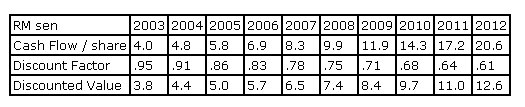
Anyway, I reckon that what interests you is how they did the cash flow table. Below is their table again:


Ok let me share with you my understanding of what is being done by Wallstraits.

1. Cash Flow.
First of all, for 2003, that 4.0 sen cash flow is derived from the following manner according to Wallstraits.
  • Current year (2003) full-year net cash flow from operations is estimated at RM 0.04 per share (adding RM 3.5m depreciation back to RM 6.5m net earnings-- RM 10m CF / 250m shares = RM 0.04).
So they added the 3.5 million depreciation back to their projected earnings of 6.5 million. Which will equal to 10 million. Divide that by 250 million shares, you would get a cash flow per share of 4 sen for 2003.

(What could go wrong here? The projected earnings of 6.5 million. Just for the record GHL did about 6.0 million (see here ))

2. DF or Discount Factor is assumed at 5%.

So a 5% discount of 1 would equal 0.95

(So far, a 5% discount factor still seems to be fair... but if the interest rates
were to increase some more... it would disrupt the whole table)

3. DV or Discounted value

The discounted Value = 4.0 x 0.95 = 3.80

Next column. We need to remember the next assumption made by Wallstraits.
  • we will assume to a sustainable 20% annual rate over the next nine years in this simulation.
1. Cash Flow.
In 2003, the calculated cash flow is at 4 sen. A 20% annual growth rate would see the cash flow increase by 4.0 x 20% = 4.8 sen.

2. DF
The discount factor was set at 5%. So the discount factor for 2004 = 0.95 less 5% = 0.91 (rounded up)

3. DV
The DV equals 4.8 * 0.91 = 4.36 (or 4.4 rounded up).
and so on... and so on...

So what could go wrong in these series of calculations?

the starting point of course. The staring point or the initial projected cash flow is utmost important. Put in an optimistic starting value, and you would get a rather optmistic end result.

the annual growth rate. Here Wallstraits assumes a 20% annual growth rate. Try a different growth rate, and you would get a total different value.

the discount rate. here it is assumed to be 5%. what if there is a drastic change in the midst of this time frame?

hope this helps...

cheers!

---------------------
2. Using the DCF

Dedicated to farnaway:

Using the same stimulation done by Wallstraits on GHL.

First of all here is Wallstraits table again.


And here is their interpretation of the table:

  • Given these assumptions (you may want to recalculate this simulation using your own cash flow, growth and discount rate assumptions), GHL’s intrinsic business value based on discounted cash flow expected to be produced from 2003 to 2012 is RM 74.5, which is approximately a 72% discount to the current market share price of around RM 0.21.
The total discounted value is calculated by adding all the sum of the DV from 2003 to 2012. Which they get a value of 74.5 sen per share. And when one compare this value to the market price of GHL in May 2003 of 21 sen, one would see that it is trading at a discount of 72%.

And from a Price earnings perspective, this is what Wallstraits had to say...

  • If GHL does achieve cash flow per share of 8.3 sen in 2007 (5-years forward), and at that time GHL is valued by the market at 10-times cash flow, the share price would need to appreciate from 21 sen today to 83 sen, or an appreciation of nearly 300% in 5-years. Of course, GHL has only been listed on Mesdaq for a month, so our assumptions will likely need refinement as the quarters and years pass.
Sounds fair, right?

now GHL latest quarterly earnings announced in Feb saw it reporting a net profit of 11.656 million. Depreciation was reported to be 6.368 million. Giving GHL a free cash flow of 18.024 million. And if one continued to use Wallstrait numbers, ie number of GHL shares at 250 million, this would equate to a free cash flow of 7.2 sen. And what was Wallstraits numbers? 5.8 sen. How?

And to complicate matters, GHL had a series of 1 for 4 bonus issue and also a 3 for 5 rights issue. All in which bloated the current number of shares to 551.480 million shares. And based on the enlarged share base, GHL free cash flow should be 3.3 sen for its fiscal year 2005.

Now, if i redo the whole table... using 10 million as the starting total cash flow and based on 551.480 million shares, the starting cash flow should be 1.8 sen.

And here is how the table should look like.


Let's look at the 2005 results. The stimulation showed cash flow per share to be at 2.59 sen. Actual? 3.3 sen.


Here's more intresting stuff... create a same table under Excel and play with some numbers...


The above was set using the initial cash flow at 5 sen. End result? total discounted cash flow f rom 2003 to 2012 would work out to 91.85 sen. (compare to 74.5). And at 2007, total cash flow is at 10.4 sen. (compare to wallstraits 8.3 sen).

Now let me change the starting point to 3 sen. And the below is the end result.


Total cash flow from 2003 to 2012 equals 55.11 (compare t0 74.5 sen) and 2007 cash flow per share is at 6.22 sen (compare to 8,3 sen). See how much difference it makes by changing the starting terminal point?

Ok. How about changing the annual growth rate? remember Wallstraits used 20% per annum.

Here is how the table would look like using a 25% growth rate and using 4 sen as the intial starting point.


The total discounted cash flow from 2003 to 2012 would now total 92.74 (compare to 74.5) and 2007 cash flow would equal 9.77 sen (compare to 8.3 sen)

Or how about just a 12% per annum growth rate instead of 20%?


End result? Total discounted cash flow would now total 51.03 sen (compare to 74.5) and 2007 cash flow per share is only 6.29 sen (compare to 8.3 sen)


See how complicated things get?

Ahhh... I could continue by changing the discounted factor... and the end result would differ greatly.

Hope this posting helps!

Cheers!

------------------------------------------

And how is GHL System doing?

http://investing.businessweek.com/research/stocks/financials/financials.asp?ticker=GHLS:MK

As you can see, GHL is losing money since 2008.

************************************

Here's another good recommended posting: http://cgmalaysia.blogspot.com/2011/07/abolish-dcf-models-in-circulars.html

Sunday, July 24, 2011

A Letter From A Truly Disappointed Ex Minority Shareholder Of Bumi Armada

Got reconnected and received a note from an old pal of mine. He had participated and given his feedback on Corporate Governance Blue Print 2011

There was this section on the Delisting of Bumi Armada (there's one on Maybulk too - maybe later) which I certainly feel should deserve more readership (and for those who are interested, his letter was send to some newspapers too)

>>>>>>>>>

Delisting of Bumi Armada (Barmada):


In 2003 Barmada’s Minority Investors received a notice that there would be a GO for their shares, that the Majority Investors had no intention to continue with the listed status of the company, that no dividends might be paid, that rights issues might be necessary for further funding and that shares would be mandatory acquired. Please note that the GO in itself is good, but the company should not be allowed to use the delisting threat. This is the kind of deal Minority Investors are scared of, we invest for the long-term in good quality companies at a cheap price, and hate it when we are forced to sell, especially if the price is unbelievable cheap. In this case the offer was for only RM 7, with net earnings of RM 1 and growing nicely, an excellent balance sheet and one of the highest Return on Equity’s (more than 20%) of the whole BM. The offer price was horrific low by any standard, there was no premium, the share price had been clearly higher before at which price I (and other Minority Investors) had not sold my shares. The PE of about 7 compared with PE’s of 15 to 20 of similar, much lower quality companies, etc, etc, etc. The circular was as usual of very low quality, lots of important information was left out, lots of unimportant information was added. In this case the Majority Investors try to paint as bleak as possible picture of the company’s future (to try to convince the Minority Investors to sell at the low price), and they did an excellent job.

I filed a complaint with the SC, was asked to come to the office twice, but these talks turned out to be fruitless. I pointed at the following very important rules (emphasis is mine):

(a) that the shareholders and directors of an offeree and the market for the shares that are the subject of the take-over offer

(i) are aware of the identity of the acquirer and offeror;

(ii) have reasonable time in which to consider a take-over offer (A); and

(iii) are supplied with sufficient information (B) necessary to enable them to assess the merits of any take-over offer;

(b) that, so far as practicable, all shareholders of an offeree have equal opportunities to participate in benefits accruing from the take-over offer, including in the premium payable for control (C);

(c) that fair and equal treatment of all shareholders, in particular, minority shareholders (D), in relation to the take-over offer, merger or compulsory acquisition would be achieved; and

(d) in its response to, or making recommendations with respect to any take-over offer, merger or compulsory acquisition, the directors of the offeree and acquirer shall act in good faith (E) to observe the objects, and the manner in which they observe the objects, specified in this subsection,

and that minority shareholders are not subject to oppression or disadvantaged by the treatment and conduct of the directors (F) of the offeree or the acquirer.

[CMSA 2007, part 6, paragraph (5)]

My comments regarding the implementation of these rules in the Barmada case:

(A): the time to consider the take-over offer, to study the documents, to try to rally other Minority Investors, to contact the MSWG, to try to write articles for newspapers & magazines was extremely short and definitely nor reasonable, and the important “independent” report was send even much later to the Minority Investors, there was hardly any time to react on it.

(B): lots of important information was missing, like: What is the sales pipeline? What are the profit projections for the coming years? No recently audited P&L or BS was given, no proper reason for the delisting, etc, etc, etc.

(C): there was no premium at all let alone for control, the price was based on an artificial low price at which certain bondholders of Barmada’s parent company were prepared to sell.

(D): this rule, which is so clear and important is never ever used by SC/BM. It should however, in any case where there is doubt, and in the advantage of the Minority Investor.

(E): by cutting the dividend, not giving as reason for that and providing inadequate information directors clearly acted in bad faith, and breached the listing rules that explicitly require this information.

(F): again, it cannot get clearer than this rule, why is it never used by SC/BM?

I contacted the MSWG, was supposed to meet the CEO but only met two analysts who didn’t know anything about the case. Later there was supposed to be a meeting with other fund managers, but I never received an invitation. MSWG did not put up any fight at all, all extremely disappointing.

My complaints to SC and BM lasted a very, very long time, no information was ever given in the meantime, and finally both came to the same conclusion, nothing wrong had happened. First of all very strange given all the clear evidence I had given of the opposite, also SC/BM both didn’t want to point out the reasons for its decision. I was clearly stonewalled by both institutions, the standard technique that SC/BM uses in handling of Minority Investor complaints. I was warned before by my Malaysian friends, and as usual, they were right, although many had helped me to write my complaint to SC/BM.

Barmada has since relisted recently. After taking into account the bonus and rights issues, the current price corresponds to about RM 140 in 2003 terms, in other words a 20-fold increase in price, for each lot of 1,000 shares investors would not receive the paltry RM 7,000 but RM 140,000 (my friends, my wife and my company owned dozens of lots). The difference between the two amounts was pocketed by the Majority Investor. In the relisting exercise, it was important for the Majority Investor to paint a picture as rosy as possible, and needless to say, they did again an excellent job there. The contrast with the GO brochure of 2003 was very stark. SC/BM, who should look into this and assure that information is of the same level, turned their heads the other direction. The whole affair with the delisting in 2003, the reason why they wanted to delist, the horrible low delisted price (at current diluted amount of shares only RM 0.20), the pressure that was put on the Minority Investors, the way Minority Investors were treated in the past, all was conveniently left out of the relisting circular although the circular contained hundreds of pages.

I have filed another complaint about this matter to SC/BM, I expect to be stonewalled again, as usual, and am confident that no action will be taken again.

The total value of the shares that were forcefully acquired by the Majority Investor from the Minority Investors has increased by RM 2,500,000,000!

Another very black page of Malaysia’s CG book. 

>>>>>>>>>>>>>>>>>

ps: due to the poor corporate governance, my pal will not invest in Malaysia stock market anymore.

ps: Here's the link to SC's website on Corporate Governance Blueprint 2011: http://www.sc.com.my/main.asp?pageid=1088&menuid=332&newsid=&linkid=&type=S

And as stated:

The SC welcomes feedback from all interested parties and the public on the Blueprint. All feedback can be emailed to CGblueprint@seccom.com.my by 15 September 2011 or provided in writing to:


CG Blueprint Team
Securities Commission Malaysia
3, Persiaran Bukit Kiara, Bukit Kiara
50490 Kuala Lumpur, Malaysia

ps:  Do read the blueprint documents on the link below - it's highly recommended!

http://www.sc.com.my/main.asp?pageid=1087&menuid=&newsid=&linkid=&type=

Saturday, July 23, 2011

I Am Not Wrong So Why Should I Sell My Stock?

There are so many reasons to sell a stock.

Yes, even Warren Buffett does sell his stocks.

And there is no sin in selling a stock either and I, for one, feels that stocks should be bought and sold for the correct reasoning. From the investing perspective, there are many valid reasons to sell their stock and one of the best single advice ever given is:

  • A stock that begins to show decaying fundamentals, such as lower profit margins or lower return on invested capital should be sold.
The decaying fundamentals would suggest that company that we had invested isn't the same anymore. It used to be good but the decaying fundamentals/business economics could turn the company to a poor company and the longer we hold on to the stock, the greater the chances the market could punish our mistake for thinking that the company is still a great company. And we know how the market is always very unforgiving to the investor holding on to such stocks. And yes sometimes stubbornly holding on to a stock for all the wrong reasoning could wipe the investor out of the game.

Having said that, knowing what needs to be done and actually doing it is rather difficult..

Yes, it's easier said than done.

For this is where it gets extremely tricky.

Why?

The Es comes to play.

E as in emotions. Ms. Emotion. All of us have different emotions and for many of us, emotions is a deadly hindrance in the stock market for it prevents the investor of doing what needs to be done, which is acknowledging and rectifying the mistake(s) made in the investment(s).

How could one do what is needed to be done, like selling the stock, when one does not want to admit that perhaps they are wrong in their reasoning, their stock selection?

And then there is the other E. The Mr. Ego who is never ever wrong.

I am never wrong.

My decision to buy the stock is correct!

The company is owned by Mr. So and Mr. So. How could I go wrong?

Or one buys a stock because it's a growth stock. But if the growth ends, then what comes may of one's investment? To hold on to the stock, one reverts to the growth issue and declares that there's still value in the stock. Of course there's always some sort of value in any stock.

See how the reasoning to invest in the stock had changed? From growth investing to value investing. And some would correctly point out that the great Warren Buffett has said that growth is an integral part of value, hence they should not sell.

However, Buffett's insistence on growth is an integral part of value,  for how could a company be considered a great company if it has no growth?

Ah... see the difference? Without the growth, how then would you define a company with declining profitability? Would it still be a great company? If no... then...?

And yes, needless to say  that Mr. Pasar views strongly against company with declining profitability. Have we not seen how a 'growth' company like Hai-O traded very much lower once the growth story ended? ( posted on March 2011: Looking Back At Hai-O Then And Now. ) Or the recent decline of the rubber glove stocks.

But the greatest obstacle in selling is Mr. P or Mr. Price.

Price in my opinion is the greatest hindrance to an investor.

The investor could easily reason out what's happening to their investment and they could clearly see the decaying fundamentals but once they look at Mr. P, all logic goes out of the window.

Which is why, there's one teaching where one should try to leave out Mr.P when one buys or sells a stock!

Oooh... that sounds rather crazy but the reasoning in this is by leaving out the price, the decision to buy or sell a stock is based solely on the investing reasoning or the fundamentals of the stock. For example, if the stock begins to show decaying fundamentals, such as lower profit margins or lower return on invested capital, the stock should be sold right there and then, in regardless of the traded price.

Wednesday, July 13, 2011

Buy That Chinese Stocks Cos Of The PE Is Very, Very Low

Many of us are taught that low PE stocks are a buy. Some even add in yardsticks like ROE and cash per share. And as long as these requirements are met, they believe that they have a safety margin for their investment.

Me say? I feel the investors should look deeper. Understand the business and understand the company's books. Don't just simply invest in a stock because of the yardstick.

I believe more in practicals than theories.

I look for examples and as long as I could find an example that proves the theory wrong, then I feel one should be cautious.

Let me use .... Chinese listed stock (S-Chip) in Singapore as an example.

Take this OLD report from UOB Kay Hian back on April 2008. http://sinotechfibre.listedcompany.com/misc/UOBKH_SINBuyS-chips_030408%282%29.pdf

Let's look at page 14 of that pdf file.


Look at the data.

China Milk was trading then at S$0.675.

It has a ROE (%) 32.4 and net cash per Share (Rmb) 1.07.

UOB Kay Hian gave it a target price of S$1.32.

UOB reasoned...
  • Outlook. Demand for dairy products in China remains strong. C Milk has adopted a multi-prong strategy to steer growth and to better leverage on domestic consumption. The strategy includes the following: a) improving herd quality to bolster production of semen and embryos so as to expand margins, b) moving downstream to produce processed milk, and c) developing herd size through internal breeding, the import of highly-productive herds, and even possibly mergers and acquisitions. We expect a smooth implementation of all these plans, backed by the Rmb1.8b cash in hand.

    Cheaper way to milk China dairy theme. C Milk is a cheaper way to ride on the rising dairy product consumption trend in China. The stock is trading at an undemanding 5.9x FY08 PE and 4.7x FY09 PE. Our DCFbased target price is S$1.32, representing 11.5x FY08 PE. Maintain BUY.
Trading at undemanding 5.9x Fy08PE and 4.7x Fy09 PE.

Sounds good, no?

Low PE, high ROE, got strong cash per share too....

What could ever go wrong?

Just about everything! Look at how China Milk Products shares have performed since April 2008!


The stock was suspended on Feb 2011!

And the story?

Scandal!

http://nextinsight.net/index.php/story-archive-mainmenu-60/912-2011/3971-shame-on-china-milk-management


From the article:
  • This was a company that once commanded a market capitalisation of S$1 billion and, since its listing in 2006, had wow-ed a lot of investors with its supposedly immense profit margin, its profitability and cash hoard.
Great profit margins and cash hoard!
  • The hard truth started to emerge when China Milk's convertible bond holders decided to redeem their bonds.

    The company at first claimed it had the US$170.56 million to meet its obligations on the convertible bonds. It just needed time and special approval of the authorities to remit the money out of the country.

    After all, it had said in its financial results announcement that as at end-September 2009, the group’s cash and cash equivalents stood at 2 billion yuan (S$409.7 million).
S$409.7 million in cash and cash equivalents. The bonds was only US$170.56 million.
  • As matters worsened, the Singapore Exchange directed the company to appoint a Special Auditor.

    KPMG was the chosen one and it found a company whose cash hoard had been milked in major ways.
    When it repeatedly asked the Group to arrange an interview with its bank manager in China, KPMG was told that the manager had no time and could not assist.

    When KPMG asked to interview the main contractor which did US$72.9 million worth of improvement works, they were presented with a Mr Zhang Hong Tao who came across as being unfamiliar with the works done.

    In the first place, he didn’t own a construction company.

    The Group had commissioned improvement works to the farm and facilities and paid USD72.9 million over a period of 5 – 6 months ending in or around March 2010.

    When KPMG visited the sites, it was unconvinced.

    “One would expect salubrious farming facilities after spending USD72.9 million. However, the buildings and its facilities cannot be said by any stretch of reason to be no more than basic or at best average.”  .....
And do read for from the shocking full report from KPMG posted on SGX website.

http://info.sgx.com/webcoranncatth.nsf/VwAttachments/Att_B8AB2097A023C947482578AA00383459/$file/2011_06_07_ChinaMilk_FinalReport_Executive_Summary.pdf?openelement

So how?

In China Milk Products we have seen how the sad outcome of an investor who invests in the stock based solely on yardsticks.

Investing solely based on yardsticks is never enough.

I strongly one have to really understand the business and with China stocks listed abroad, you just got to be more careful because you never really know if those numbers (cash included) could be trusted!

I know that last statement is rather ... tricky. Look, I am not insinuating that all Chinese listed stocks are scams but with all the accounting fraud going on .... how can one be sure?

How?

Yeah... yeah... no risk no gain babe! No sugar no honey! ..... but is this the risk you want to take?

--------------------------------------------------------------------------------

Here's another article : http://www.sharesinv.com/articles/2011/03/25/s-chips-to-buy-or-not-to-buy/

  • Interestingly, one distinctive characteristic about these S-chips is that they hold a lot of cash. This is evident from the financial statements of China Hongxing Sports and Hongwei Technologies, which had Rmb1,738m and Rmb145m respectively as at 30 Sep-10. As such, investors are spooked by two basic questions: Is the cash really there at all? And is it true that buying into an S-chip, will generally turn into a bad investment strategy?
  • Detecting Red Flags
    As you may sympathize, many of the minority shareholders in all of the companies above as well as China Hongxing Sports & Hongwei Technologies have invested in good beliefs. As such, is there any method for those investors with limited analytical skill in detecting the potential red flag on S-chips?

    To put it simply, a company that has a lot of cash but refuses to give out handsome dividend may prompt the question on whether the cash is there in the first place, as in the case of China Milk. David Gerald, the president of Securities Investors Association (Singapore), said that companies with burgeoning cash balances should provide reasons why they are not declaring a cash dividend.
    Moreover, many S-chips are making cash calls even though they are already cash-rich. As such, this could be an indication that the management lacks capital discipline or that the company’s growth is not sustainable. Furthermore, an ‘unreasonably high’ capital expenditure (capex) also signals that the firm may poorly manage their manufacturing capacity and their budget. More often, an unreasonably high capex is often linked to other issues such as inflated profits.
    To top things off, JPMorgan Chase (JPMC) indicated that half of the S-chips are audited by a ‘Big Four’ accounting firm. And by contrast, three-quarters of Hong Kong-listed China firms do so. Astonishingly, the firms which do not hire ‘Big Four’ auditors are 60% more likely to fail than those who do, added JPMC.

Thursday, July 07, 2011

Drop More Buy More?

Why the need to average down?

Cos ... the stock went lower. :P

But why la did the stock go lower?

Bad market sentiments mah...

If the sentiment is bad, why didn't we see it coming? Didn't they teach prevention is much better than cure?

What's that two Sun Tzu's Art Of War, timeless concepts mentioned many, many, many times before?

  • Think before you act.
  • Act only when you have the confidence to win.
If we had thought and reasoned it out carefully, won't it help eliminate the need to buy more because the stock went lower?

Of course, some will say, lower prices means more offer. True. But how long can we continue to say 'drop more buy more'? Are our pockets really deep enough?

But even if our pockets is really deep and we can afford it, shouldn't we think what we are actually doing here? Think about the stock we are buying. What if the stock is only considered good in our own shallow opinion and what if our opinion is wrong?

Does two Wong make a Wright?

What if we make a mistake with our stock selection?

Dare we say we will never make a mistake with our stock selection?

Yes dear, what if we bought the wrong stock?

And if so, doesn't buying more means we are buying more of the wrong stock?

And if the wrong stock is caused by our initial investment mistake, buying more means buying more of our mistake?

And if so, by averaging down, aren't we saying we can correct our mistake by buying more of our mistake?

oO

Think about it...

Mr. Soros became rich because he insisted he knew when he was wrong.

Mr. Buffett knew the only the way to get out of a hole is to stop digging.

Think about it.

What does one do when one make a mistake? Don't we want to rectify it? And isn't the best way to rectify it is by stop being wrong?

Yeah, instead of averaging it down, why don't we seriously consider if we did screw up with our stock selection or not?

And if we did... isn't cutting loss (ie rectifying our mistake) ... the logical thing to do?

And oh I do know... the tricky part here of course is.... determining if we are correct or we are wrong!
Me? I am not a fan of the averaging down.

Tuesday, July 05, 2011

Did We Screw Up With Our Stock Selection?

Digging and reading thru some old stuff, I found the following set of writings. No, they are not mine they are from an investing forum based in Singapore but unfortunately that forum, wallstaits, has since closed down. (iinm the writings were from 2005)


----------------------


Investment lessons learnt this year and advice for newbies

When I just started investing late last year, this was the first investment website I stumbed upon. I was greatly influenced by its FA bent and the eloquent arguments from fellow forummers.

I have some advice for newbies from personal experiences as a newbie.

There are certain practices advocated by FA proponents that newbies need to be careful of.

The first one is with regards to averaging down. FA proponents like to say when the share price of one of your holdings goes down, you should buy more because it has become cheaper. So, when prices are depressed, you should be happier because you can buy more of the same good thing more cheaply.

You could try that if you have sufficient grounds to be so confident of your investment. But if you are just starting out as a newbie like me, please cut your losses and don't compound your mistake. You make a purchase, the share price goes down -> probably you made a mistake. Who are you, little junior, to argue against the market? If you are a newbie, assume you are an idiot waiting to pay school fees and don't average down. Cut your losses!!

Perhaps the most valuable advice that I have received from FA proponents is to know your investments very well and avoid those which you only vaguely understand. If you know your investments with the depth that Warren Buffett has with his, then you can average down with less worry.

One of my mistakes was to make investments based on superficial understanding. True, I read prospectus, annual reports and even taught myself accounting so that I could understand financial reports better. Most of my investments were made based on favourable financial ratios without a deep understanding of the business nature. I did not try out the company's goods and services. I don't know if the company's customers, employees, suppliers are satisfied with it.

My main fault as a newbie was to be over-confident. I thought after reading and learning so much, I was ready. I thought I could be as good as the masters and followed one of their strategy -- concentrate your eggs in one basket and watch that basket carefully. Once again, I reiterate that such a strategy is meant for the masters. If you are an amatuer, it is safer to assume that you are an idiot and to protect yourself from stupidity, please diversify. By putting all your eggs in one basket, you may have fatally injured yourself by catching all the falling knives with one hand.

Some FA practitioners do not have a stop-loss policy. They use a similar argument - if a good thing becomes cheaper, I should buy more instead of selling it away.

The TA approach "Cut your losses and let your profits run" is worth considering. It is a safe way to protect your capital. Sell after your losses reach 10% of the intial capital outlay no matter what. After all, he who fights and runs away may live to fight another day. In fact, by adopting such an approach, you could protect yourself against CAO, Informatics and Auston.

Unfortunately, I did not follow the advice above. I waited until fundamentals have clearly decayed before thinking of selling. In the meantime, I continued to average down as the price slided down. When the financial report was out, fundamentals did look bad but ALAS!!, it is too painful to sell now.

This is one of the problems with FA. You can only make decisions an a quarterly or half-yearly basis which by then, the price may have slid to a psychological unacceptable level to sell.

FA proponents like to say making decisions based on price movement is nonsense. Say, the management has been trying to hide important fundamental data from the financial reports for as long as they can. The silent accomplices - auditors and independent directors - who are on their payroll prefer to close one eye or both eyes as long as they have ready excuses to plead ignorance and other disclaimers when the situation implodes.

The poor FA practioner will continue to average down, thinking that he is profiting at the expense of the foolish irrational market. Meanwhile, the insiders are selling the stock down to the sucker - that foolish guy averaging down.

In such a situation, the TA practioners will be safe. Having observed that the price has been in a downtrend caused by insiders selling down, they would have already sold out before the bombshell explodes. In the cases of CAO, Informatics and Auston, the price chart has shown an obvious downtrend before the explosive truth was out.

Are there any other advice and warnings fellow forummers can share with future newbies?

PS: I do not want to get into a TA vs FA debate. If any FA proponent thinks I am wrong, please point it out objectively without making personal remarks. I am still learning and am considering using a mixture of both FA and TA at the moment.


----------------------- another posting ------------------------

I agree that averaging down is a scary thing. When you buy a stock like you buy a business (which means price is only one small component of your overall analysis) and the price falls-- what I do is ask myself "if the business is failing"? A falling stock price may be a sign of danger as other savvy investors see flaws with the business model, increasing competition (usually seen as narrowing profit margins), etc. Or, sometimes it is an over-reaction to what you believe is a temporary setback, like rising commodity prices.


If, after raising your skeptical antenna, you continue to believe your business is on track to continue its long term growth and build shareholder value... than the proper (if corageous) thing to do is buy more shares at the now more attractive price. After all, it is the same business you previously liked at a higher price.

If, on the other hand, your heightened skepticism results in some important questions needing answered-- maybe about intensifying competition or rising raw material costs-- you might want to sit back and wait and study further. But, cut loss on rumors and whims isn't likely to make you wealth. Often, you will be selling into weakness with the irrational crowd without confirming any business weaknesses. A cut-loss system, or any other system that doesn't require careful analysis and thought, is not very wise and not very FA-ish.

An example... Warren Buffett accumulated shares of the Washington Post during the 1970s recession, and bought more during a newspaper union employee strike. He saw these as temporary troubles, while others were cutting losses. He is now up more than 10-fold. He bought American Express during troubled times, he bought Geico Insurance when it was in trouble too. He looked at the falling share prices in each case, and decided to buy more, because he believed the businesses were sound and their troubles temporary. He was usually right.

Most important aspect of FA... be careful you only buy good businesses at fair prices. If you get this right, you eliminate most worries about cutting losses. Step 2... remember Ben Graham's advice... "Never buy a stock simply because it has risen sharply in price or sell one because it has fallen sharply in price. The opposite advice would be wiser."


-----------


My comments:

Excellent advice!!!


And more so I believe in that one Mr.Soros quote "I am rich because I know when I am wrong"

So when the stock you purchased, tanks after your purchase, don't just blame it on bad luck but ask oourself this simple question:  Did we screw up with our stock selection?

And if you did, averaging down means u are buying more shares in a wrong investment!

Doesn't make sense, does it? Remember CUT YOUR LOSSES!!!!

And Warren Buffett use to say "The most important thing to do when you find yourself in a hole is to stop digging!"

Doesn't it make sense?
Think about it. What does one do when one make a mistake? Don't we want to rectify it? And isn't the best way to rectify it is by stop being wrong?

Do think about it.

So the next time you see losses for a stock in your portfolio, instead of buying more, ask yourself a simple question, 'did you screw up'?

Or perhaps the stock selection might be good, but if you overpay for your investment then the chances of success in this investment would be very slim, yes?

But then... I know .... some would not agree.

They will just HOLD long la. Be patient la. The stock market bull will come and if if you hold it long enough, you can sell your mistake without a loss.

This is their version of buy and hold.

Yes that's so possible and since in a bullish market, most stocks do stand a chance of making a comeback.

But... isn't such a strategy a game of chance then?

Aren't we hoping that the bull market will be kind and help correct the stock selection mistake?

And to make it a bit more complicating.....  in a bull market .... have you consider that it's possible to have individual stock crash(es) ?

How?

I dunno ... me just mumbling ya.