Showing posts with label Michael Hartman. Show all posts

Thursday, November 23, 2006

US Dollar Getting Whalloped!

In today's market wrap, Michael Hartman talks about Economic Reports and White House Say Economy Will Slow .

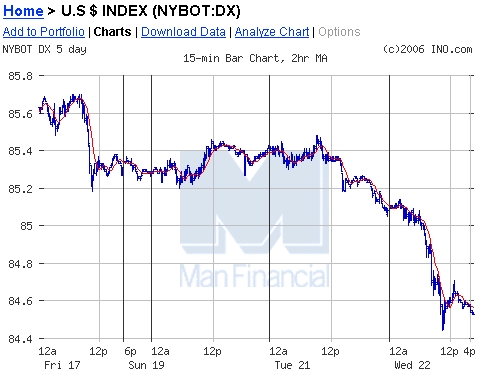
  • Investors are jamming the exit doors for the U.S. dollar this morning as three economic reports came out with a negative bias, with the only positive report coming from the Energy Department. Stock prices are struggling to move higher from yesterday’s close and bond prices are catching a modest bid to push yields lower with the economic slowdown moving into the spotlight. Most investors, including myself, expected lower volatility today going into the holiday weekend, but this development in the foreign exchange market is quite significant. The dollar is really getting whacked! Yesterday the U.S. dollar index closed at 85.12, but this morning it gapped-down to open at 84.77 and is still getting pounded lower to 84.32, touching a six-month low versus the euro.

    The first surprise that seemed to have the biggest impact on the dollar was the increase in unemployment claims from 309,000 to 321,000. Analysts’ consensuses were looking for a number closer to 310,000. To add fuel to the fire, Alcoa announced they would be sending another 13,000 workers to the unemployment lines with a reduction of workforce. The unemployment numbers hit the dollar, but stock futures were not affected much.

    Thirty minutes before the bell rang on the floor of the NYSE the University of Michigan released their index of consumer sentiment. Last month the index had a reading of 93.6 and analysts were expecting 93.3 for November, but the number came in lower than expected at 92.1. The slumping consumer confidence numbers aided the dollar decline, but this time around stock futures also moved lower.

    The third report adding fuel to the dollar decline came from the Mortgage Bankers Association saying their application index was 3.7% lower last week even though the 30-year fixed rate dropped to 6.13%. This is the lowest rate since January and below the rate from a year ago at 6.26%, but mortgage applications are declining nonetheless.

    The only report that would have offered some support for the dollar came from the Energy Department with an unexpected build in crude oil and unleaded gasoline inventories. Analysts expected a build of approximately 500,000 barrels in crude, but the number came in much higher than expected at 5.1 million barrels. Prior to the report, some analysts were expecting energy prices to rise as traders cover their short positions to square-up prior to the long weekend. Just the opposite is actually occurring. As I write, crude is down $1.42 to $58.75. I expect these low prices to last for another month, and then we move higher into the first quarter around the $60 to $65 a barrel range, but no blow-out back to $80 until later next year.

So how weak is the USD.

Have a look...

Thursday, August 17, 2006

Spin masters keep spinning:

The following was taken from Mike Hartman's FSO Wrap Up.

I guess I always seem to get a bit suspicious and skeptical whenever the mainstreamers parade Abbey Joseph Cohen of Goldman Sachs out on CNBC to tell everyone where stock prices should be. Bottom line…she says stock prices should be 15% higher than they are today. If she is correct, the SPX should move from 1,290 to 1,483. It may sound far-fetched, but that’s her story and she’s sticking to it! Realizing the consumer is all but tapped-out, Ms. Cohen believes the driver to move stocks higher will be increased capital spending from corporate America and increased export sales due to a lower dollar and increased economic activity from overseas. Thanks Abbey, but I think I’ll stick with the resource sectors (things people need) because understated inflation is baked in the cake!

Here is where I believe she came up with the notion that stock prices are undervalued by 15%. If you look at stock prices relative to inflation, stocks are clearly underperforming. The S&P 500 Index moved through the 1,300 mark back in March of 1999. We are now more than seven years down the road and the index is once again approaching 1,300. Just to break-even against inflation, the index would need to stand at 1,483 to represent the same value it did back in 1999. The number is actually higher, but I base it on inflation adjusted numbers through 2005 provided by the Inflation Calculator at http://www.westegg.com/inflation/. I plugged in the data and the calculator reported as follows:

What cost $1300 in 1999 would cost $1482.68 in 2005.

Also, if you were to buy exactly the same products in 2005 and 1999,
they would cost you $1300 and $1139.83 respectively.

The S&P 500 needs to run 15% higher from where it is just to keep pace with inflation. Earlier I made the point that wages are actually negative relative to inflation, and now you can see that stock prices are also negative when adjusted for inflation. Most commodity prices are 200% to 400% higher than they were just a few short years ago, but wages and stocks are flat to negative. Higher mortgage rates, higher energy costs, record high debt burdens, and slowing home price appreciation are taxing the consumer’s discretionary spending. I can clearly see where the Perma-Bulls would like to take this stock market, but to see it happen we will need to see corporate America increase capital spending in the face of a slowing economy. We will also need to export some real goods to the rest of the world rather than simply continuing to increase our export of debt paper.

The Bulls could get their way with some improvements to the economic data, while at the same time maintaining the notion that inflation is not a problem. Frankly, I’m actually expecting just that between now and election time. “The economy is slowing but stable, and inflation is under control,” will be the mantra as we move into the Fall Season. Hey, crude oil even came down again in price today…no inflation with crude back down to the bargain price of $71.80! Politics and Wall Street spin are still ruling the roost in the financial markets as we move through these most uncertain and turbulent times.

The gains on Wall Street stuck like glue as Main Street begins to feel the crunch of a slowing economy! Just a couple weeks ago the Bears were telling everyone to be prepared with their crash helmets. Now we get some solid weakness in economic reports and the markets rally higher! The crash helmets have covered and today we see the Dow Industrials pounding higher by 96 points to 11,327, the NASDAQ Composite closed 34 points higher at 2,149 and the S&P 500 closed above key resistance with a gain of nine points to 1,295. The next few days should tell us if this is the beginning of the ramp-job into the elections, or if it’s just a nasty head-fake higher to flush-out the shorts! The Bears have a great case to present, but for now I wouldn’t underestimate the salesmanship of Wall Street Spin-masters to move stock prices higher.

==>>

See the case Mike is making?

Solid weakness in economic reports.

What does this mean?

Doesn't it mean that there is a strong solid chance that market earnings won't be good in the near future?

So why should the market run because of the solid possibility of weaker earnings?

Oh, the great Abbey Joseph Cohen came out guns blazing on CNBC saying that stock prices should be 15% higher.

And the spin masters keep on spinning.