Showing posts with label Yi-Lai. Show all posts

Monday, February 22, 2010

Investing In A Stock For Its Dividend Yields

Mr said...

  • Dear Mr Moolah,

    Sorry, but I don't know how to reach you and so, I am doing this here.

    Would like to seek your expert opinion on High Dividend Yield stocks to invest in Bursa.

    I am a 43 year old family man with a very busy full time job, and no time nor interest to monitor the stock market. A long time ago, a very successful and elderly friend of mine urged me to invest in a basket of High Dividend Yield stocks, and just collect its dividends over the years. Sadly, he passed on recently.

    I am now at the stage where I am struggling what to do with my funds. Savings accounts only pay 0.5% p.a. Fixed Deposits only pay 2% or 2.5% for 12 months. This is very, very small. How to survive on this?

    What do you think of PBBANK? A friend of mine swears by it. Can you recommend a few high dividend yield stocks for me to consider? And what prices would be a good price to enter? I plan to start with RM50k, and invest in 5 stocks with RM10k each. I can only monitor the stock market maybe once or twice a month. I do not know about trading, and plan to invest in these stocks for a very long time. My goal is to collect the dividends, hopefully, it will grow with time to beat inflation and fixed deposits. Things keep getting more expensive by each year due to inflation.

    I have also asked Mr Dali about this. So, please feel free to publish my query. I may check in again in a couple of weeks time.

    Would sincerely appreciate your thoughts. I know the final responsibility to invest is mine and mine alone.

    Thanks and kind regards,
    Mr Teoh

Mr. Teoh,

Do realise that I am not an investment advisor. Hence, whatever you read on this blog, do take it with some massive pinches of salt. Simple reasoning is that I could always be wrong.

However, this morning, I am willing to share some opinions or two on the issue of high dividend yield stock.

A dividend yield is a simple. It's basically the dividend paid divided by price of the stock you paid.

But strangely I find that many do not explain the risk involved in such an investment. This is not a risk free investment. The fact the dividend paid is never constant. As much as the dividends go increase, there is always a possibility that it could always shrink! And not forgetting the fact that any given stock can go up or DOWN at any given day. Meaning to say, there's no divine right stating that high dividend yield stocks cannot go down! It could go down as much as it can go up!

Let me use an REAL example on this stock called Uchi Tech. Why? Cos I had blogged on it couple of times before. So data to the stock is easily referred to.

Take 2007.

So what was UCHI's dividend history?

In 2006, it paid the following:

If my data collection and counting is not wrong, that's 20 sen paid in dividends.

So this company pays good dividends. And how was the company? Was it making good money? Last year, on 26th Feb 2009, I wrote Would You Buy Uchi For Its Dividends? The company's earnings track record is tabled here

Now in 2007, the stock was trading between 3.42 and a low of 2.40.

Uchi usually announces its dividend payment dates for its yearly first batch of dividends in April.

Now I will make 2 assumptions. Firstly, a buyer for Uchi its dividends in 2007 will be in between Jan to April 2007. Lowest traded price of Uchi then was 2.98. I would use simply use 2.98 as a reference point. With a past dividend yield of 20 sen, at 2.98 one would be looking at a yield of 6.7%. The second assumption is a purchase price 2.40 based on the lowest price for 2007. That would be a yield of 8.3%.

In 2007, as per another posting , Reply To Would You Buy Uchi For Its Dividends? Uchi paid the following.

Note: the buyer at 2.40 (lowest price was recorded in Nov 2007) would have missed the first 3 dividends.

21 sen total. More than what it paid in 2006!

In 2008, Uchi paid the following.

Only 16 sen paid in 2008!!!!!

The dividends shrank!

In 2009, Uchi paid the following.

The dividends shrank again!!!!

Let's add up for the dividends paid since 2007 for the buyers for a dividend yield at 2.98. Total dividends received since 2007 is 46 sen. Price of Uchi now is only 1.29!!! Which means this dividend yield investor is now sitting on a net current loss of 1.23 (2.98 - (0.46+1.29)) or an investment loss of 41.2%!!!

And for the buyer at 2.40. Total dividends received are 35 sen. Which means a current invest loss of 0.76 sen (2.40 - (0.35+1.29)) or an investment loss of 31.6%!!!

How?

See how investing for dividends can fail?

Is this a one off example?

How about this stock called ?

In 2007, I made the following posting, Review on Yi-Lai. Yi-Lai then on 11th Sept 2007 was 1.20. Yi-Lai today is 0.74!!

Of course, these are 2 examples where investing a stock for its dividends failed. My point? Simple. I am not saying such an investing would not work and I am pretty sure many could provide me with full data where investing a stock for its dividends are proven successful. However, all I am saying is the investor should be careful. There are many incidents where such an investing can fail! The sustainability of the company's earnings is just as important. The reasoning is simple, without sustained earnings for the company, how could the company afford to continue paying so much dividends?

Hope these second opinion helps and do note that I could always be wrong.

Tuesday, September 11, 2007

Review on Yi-Lai

Track Record.


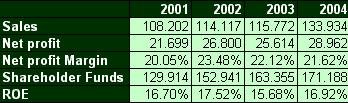
The above table represents what Yilai has achieved since listing. As can seen from the above table, it would appear that fy 2004 was a peak for Yilai and the decline in earnings margins clearly indicates the current extreme competitive market for the tiles industry.

Last month, YiLai announced its 07 Q2 earnings.
Quarterly rpt on consolidated results for the financial period ended 30/6/2007.

The following table shows YiLai's most recent quarterly earnings.


Couple of points to note.

1. First half 2 quarters earnings totals only 9.602 million, which is significantly lower than its previous year, fy 2006 first half earnings total of 11.311 million.

2. Inventory level is up a lot for the current quarter.

Dividends. Yilai just announced another interim dividend.

Here is Yilai's dividend track record.


Yes, YiLai pays fantastic dividend yearly and based at current traded market price of 1.20, the dividend yield for Yilai is certainly interesting.

However, let's be honest with ourselves, have a look at the above table. As can be clearly seen, the total dividend received shows a decline and the decline in dividend clearly corresponds with the decline in yearly earnings. So the current risk is such. Although Yilai dividend yield is fantastic now but if the earnings continues to slump, the investor should be realize that future dividends to decline as per the decline in earnings.

Now since I had made several blog postings on YiLai before, I would like to review past blog postings.

1.
ROI on Yi-Lai - posted on March 13th 2006.

Review of Earnings.

The decline of earnings was noted back then!


  • How do you rate such performance? Yes, total ytd net profit dropped from 29 mil to 27.8 mil. Is there a concern?

    Its profit margins. Did it deliver or not?

    Or are you worried about the slump in earnings?

2. ROI on Yi-Lai: Part II

Review of Balance Sheet.

The issue of inventory again.

  • While I was told that the tiles do not deteriorate over time, however, the design of tiles is important. A good fashionable tile helps boost sales, while poorly designed tiles could get outdated and turn into dead stock. So when a tile manufacturer reports a rising inventory, the concern is that the inventory could consist of out-dated tiles. So when you consider that yi-Lai's inventory increased from 22.023 million a year ago to 32.690 million, how concerned would one be? The concern is that although the tiles have a long life-span since it does not deteriorate, an out-dated, out-fashioned tile is a dead stock which could not be sold. Is this a non-issue?

And the depleting cash issue or rather YiLai's aggressive capital expansion.

  • Back in Nov 2005, RHB had a report which stated the following:

    Yi-Lai’s new line that boasts a production capacity of 5,500-6,500 sq m/day is now ready for commercial production but practically left idle due to the weak demand condition. The line may be activated over the next six months. Originally designed to produce multi-effect tiles that yield higher margins, the line may be switched to produce glazed tiles or other tiles that are in demand. Given that we expect the weak demand condition to persist over the longer term, it make sense for Yi-Lai to switch its existing production from some of the smaller, older and less cost effective lines to the new line


    Although the funding of this capex was done without any bank borrowings, a whole new production left practically idle does not bode well. All dressed-up but no where to go! How? What if the production continues to be left idle? Who is paying for the bills?

3. ROI on Yi-Lai: Part III

Outlook.

  • I reckon that there are three issues to consider.
    (1) Economic impact on the building materials market.
    (2) Massive capacity expansion by tiles manufacturers.
    (3) Competition from importation of cheap ceramic tiles.

    For the investor, would one be comfortable holding a stock in a sluggish industry?
    Is the company's product really durable and competitive enough to sustain a sluggish industry?
    And what if the sluggishness continues for a prolong period?

4. ROI on Yi-Lai: Part IV

The dividend issue.

5. ROI on Yi-Lai: Part V

Reviewing the whole Review Of Investment on Yilai.

  • How? Are the reasons still valid to justify one to stay invested in the stock?

    Oh.. and some invested in the stock because of the dividend issue. And how would one evaluate their reasoning to stay invested in Yi-Lai since Yi-Lai has decreased their dividend payout this year?

Other postings made: ROI on Yi-Lai: Part VI and ROI on YiLai: Part VII

For the record, Yilai price at 31st March 2006 was 1.32 and currently Yilai is traded at 1.20.

So despite the fantastic dividend yield, the lack of earnings growth or rather the slump in Yilai's earnings has probably been the main factor for the current lackluster performance of YiLai's stock price.

Friday, November 17, 2006

ROI on YiLai: Part VII

Yi-Lai just announced its 2006 Q3 earnings. (past blog postings on it can be found here: Part I , Part II , Part III , Part IV , Part V , Part VI)

The following is a snapshot of how Yi-Lai has fared for its most recent 4 quarters.

And this was what the company management had to say in their earning notes.

  • For the current quarter under review, the Group recorded a higher turnover of RM34.9 million compared to RM30.8 million for the corresponding quarter in 2005 whilst profit before tax was RM8.9 million compared to RM8.7 million for the corresponding quarter in 2005. The improvement in results was attributable to higher sales volume achieved in the current quarter.
    On a cumulative basis for the first nine months of 2006, the turnover increased by 14.8% to RM100.6 million (2005 – RM87.7 million). However, profit before tax was lower by 5.0% to RM24.7 million (2005 – RM26.1 million) as a result of higher cost of production and stiff price competition.

For me the two issues I mentioned in Part VI still remains. Here is what I wrote back then. (in blue italics)

  • So two clear and present issues.

    Remember the issue of it's the business that counts?

    Well, Yi-Lai's business is struggling in the current tough business environment. The tough business environment is hurting Yi-Lai's profits. Make no doubt about it.

    How concern would you be on this issue? How worried are you that Yi-Lai's earnings is hurting?

    However, the balance sheet is top draw. Another rarity since we are witnessing an extremely healthy growth in the cash flow despite the tough business environment. It's highly commendable what the management is achieving during current times..

    How brown cow?

Same issue for me.

Yes, I think Yilai is still managed brilliantly...

BUT....

I really believe the current ballgame has changed. It's a tough current ball game. The current YiLai ain't as good as the YiLai of the yester-years!

When will it change? How long will it last? And worse still, will the situation worsen?

How?

Here are some commentary from a RHB writeup this morning:

  • X 9MFY12/06 net profit came in at 78-84% of our full-year forecast and the full-year market consensus. However, we consider the results within expectations as we expect weak performance in 4Q as operating conditions continue to deteriorate.

    X Competition in the domestic ceramic tiles industry continues to intensify against a backdrop of massive excess capacity and softening demand on the back of a weak property market. The rising production costs coupled with local players’ inability to penetrate the export market in a major way do not help either. Yi-Lai is not spared.

    X However, the weak prospects will not impair Yi-Lai’s ability to pay out a generous gross dividend of 12sen/share per annum, translating into a gross dividend yield of 9.9%. This is because of its net cash of RM58.5m or 37sen/share as at 30 September 2006 coupled with minimal capex projected at only RM4m per annum going forward. Indicative fair value is RM1.16 based on 8x FY12/07 EPS, in line with its 1-year forward historical average PER. Maintain Market Perform.


Thursday, May 18, 2006

ROI on Yi-Lai: Part VI

Yi-Lai just announced its 2006 Q1 earnings. (past blog postings on it can be found here: Part I , Part II , Part III , Part IV , Part V )


Yes, the net earnings were pretty low. And some would deem this as a huge disappointment. But then given the business economics of the industry during this earnings period, wasn't it expected? Two issues mentioned before (see : part-iii ), stiffer competition and higher cost of production stood out and it kept Yi-Lai's profits down. Oh yeah, I have to note that its sales revenue did increase.

And this was what the company management had to say in their earning notes.

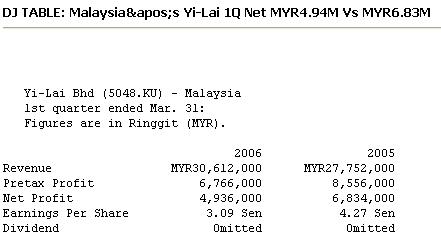
  • For the current quarter under review, the Group recorded a higher turnover of RM30.6 million compared to RM27.8 million for the corresponding quarter in 2005 whilst profit before tax was RM6.8 million compared to RM8.6 million for the corresponding quarter in 2005. The lower profit before tax for the current quarter despite higher sales was due mainly to lower selling price as a result of stiffer competition and higher cost of production

Now on the positive note, Yi-Lai's cash flow was extremely healthy. Cash grew by 5.415 million for the quarter, which is something like DIGI, after the adjustment for non-cash item, such as depreciation charges, the piggy bank cash grew more than the reported earnings. And in Yi-Lai's case, the positive cash flow was a huge relief because Yi-Lai's recent capital expansion saw drastic cash depletion in its piggy bank ( the depletion of piggy bank cash was mentioned in part-ii. )

Piggy bank cash is back up to 53.613 million (no debts) versus 48.198 million a quarter ago. ( Ze piggy bank cash grew 5.415 million - yeah some folks just loved to see ze piggy bank cash grow and grow and grow.).

So two clear and present issues.

Remember the issue of it's the business that counts?

Well, Yi-Lai's business is struggling in the current tough business environment. The tough business environment is hurting Yi-Lai's profits. Make no doubt about it.

How concern would you be on this issue? How worried are you that Yi-Lai's earnings is hurting?

However, the balance sheet is top draw. Another rarity since we are witnessing an extremely healthy growth in the cash flow despite the tough business environment. It's highly commendable what the management is achieving during current times..

How brown cow?

Oh, Yi-Lai's final dividend goes ex on 1st June 2006.

Wednesday, April 12, 2006

It's the calculations that counts.. !!

Hmmm ... remember this blog posting: It's the business.. Part IV

Let me show something really interesting...

  • Remember I mentioned that if an investor made an investment into Yi-Lai at a cost of 1050 back in 2003, the investor would have received 450.00 in dividends and I went on to calculate in the following manner.

    So from an investment outlay of 1050, the investor would have gotten a 450.00 in dividends or 43% back of their investment outlay. Which means that the investor current holding cost of Yi-Lai is 600.00.

    Currently Yi-Lai last traded at a share price of 1.30. Which means the investor is holding on to an investment gain of 117%!!!

    Which works to an annual compounded return of 29.4% for holding this investment for 3 years!!!

Did everyone realise that I am really cheating here?!

LOL!!!!!

Ah... let me show why. The invested capital is 1050. The return in dividends is 450.

Current market price = 1.30.

Current market price + dividends received = 1300 + 450 = 1750. Or a 'current' gain of 67%. (and not 117%!!!)

Which works out to a mere 18.56% compounded annual return for holding the stock for 3 years.. and not 29.4%.

See how I managed to glorified everything when I deducted the dividend received from my investment cost?

Ahh.... do you notice that Insider Asia write-ups... and do you notice how they deduct the dividends received from their investment cost?

The below is the snapshot of their portfolio published...

See how they have their 5,000 shares of Yi-Lai 'purchased' in 2003 has an average cost of a mere 61.5 sen?

And by doing so.... lol.... it just makes everything look so much nicer.... :p

Ahem.... it'sthe calculations that counts.. !!!

Tuesday, April 11, 2006

It's the business.. Part IV

In the previous post, Its the business.. Part III the example discussed was based on a stock which contniued to pay great dividends despite its slumping business. And if one had purchased the stock in 2002 for the sake of the dividends despite the fact the business was slumping, the end result was pretty poor.

Now let's look at another stock which pays good dividends. Click on the
Map of Mumblings and look at the series of blog postings on Yi-Lai , Yi-Lai: ROI Part II , Yi-Lai: ROI Part III , Yi-Lai: ROI Part IV and
Yi-Lai: ROI Part V

Firstly how is Yi-lai's business?

From the first post
Yi-Lai ,

Earnings since fy 2001: 21.7 mil -> 26.8 mil -> 25.6 mil -> 29 mil -> 27.8 mil

Ahh... Yi-lai's business wasn't too happening for its latest fiscal year. Latest fiscal year showed that earnings dropped from 29 mil to 27.8 mil.

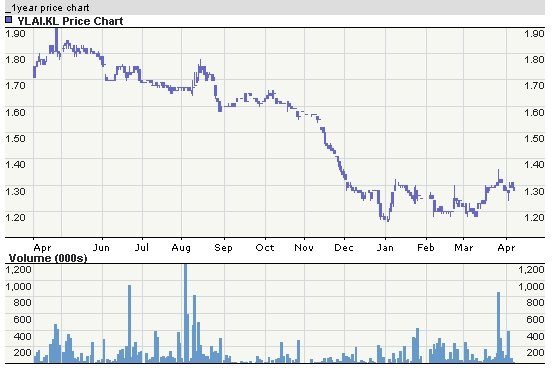
Not too happening right? And doesn't it reflect in the charts?


If one had purchased this stock last year at around 1.80, one would have been left holding some paper losses..

however...

there would be some who would argue that the correction in the stock price is not justifiable given the fact that Yi-Lai's business earnings performance wasn't really all that bad... since one is talking about a 4% slump in yearly earnings...

anyway... let's look at the end-result if one had purchased Yilai way back in 2003 at a price of around 1.05.


Not too shabby isn't it?

Let's ass-u-me that one had invested in 1000 shares of Yi-Lai at a cost of 1.05. Cost of investment 1050.

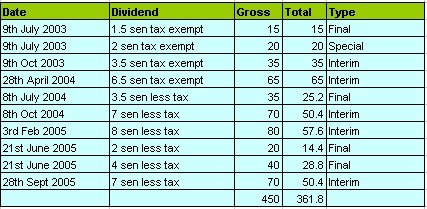
Now let's look at the dividends received by the investor. Here's a snapshot of the dividends paid by Yi-Lai since 2003.


The investor would have received a total gross dividend of 450 or an after tax dividend of 361.80. (but since one can claim these taxes back, I would use 450.00 as reference for the total dividends paid)

So from an investment outlay of 1050, the investor would have gotten a 450.00 in dividends or 43% back of their investment outlay. Which means that the investor current holding cost of Yi-Lai is 600.00.

Currently Yi-Lai last traded at a share price of 1.30. Which means the investor is holding on to an investment gain of 117%!!!

Which works to an annual compounded return of 29.4% for holding this investment for 3 years!!!

Fantastic?

Yup... now compare it with Multicode.

Why the huge disparity?

Ah.. all I can say is compare Multicode's fy 2001 results with current. Back in fy 2001, Multicode earned some 10.122 million and was operating with a net profit margin of 15.43%. Now? Multicode latest net earnings is only some 4.137 million. See the huge slump in business earnings?

Do you believe that ultimately it's the business that counts?

Wednesday, March 15, 2006

ROI on Yi-Lai: Part V

They say that there is a reason for everything. And when one purchases a stock for an investment purpose, shouldn't there be a valid reason to justify the investment? For some, as long as their reasons to invest in the stock are still valid and justifiable, they would consider this as a valid reason to stay invested in the stock. Fair reasoning?

Let's try it out and review the reasons to invest in this stock. For simplicity sake, I would ass-u-me that perhaps one made the investment in ... say... May 2005. (Why May 2005? LOL! I had discussed this stock with some friends in a private site before, hence all my old notes are still around)
(the ROI will be made in red font)


The above table represents the available financial track record for Yi-Lai back in May 2005.

This is Yi-Lai's track record since listing.

  • net profit margin since listing: 20%, 23%, 22%, 21.6%
    ROE since listing: 16.7%, 17.52%, 15.68%, 16.9%
How would I define such a financial performance? (Current net profit is 23%, while current ROE is 15%)

Well.... as it is... Yi-Lai had a slightly disappointing fy 2003... it was really lacklustre in which its net profit dropping slightly. But overall if one compare from 2001 to 2004 numbers, Yi-Lai's performance has been fairly good, hasn't it?

So what would be the fair assessment of Yilai's financial performance? Has it been consistently good?
since Yilai has only 4 years financial record since listing, there is no point running any CAGR computations.... (err... if one uses 2001 as its starting base, Yilai's cagr since 2001 is around 9.6% )
(Yi-Lai's current net earnings dropped by 4% compared to its previous fiscal year)

Does Yi-Lai pass the initial test?
(how? net earnings margin improved.. roe dropped slightly, while total net earnings dropped by 4%)

From a business perspective....

Yilai has been performing steadily since listing in 2001. The steady performance is even more impressive because Yilai's products not only survived but even manage to improve despite the initial Afta concerns of cheaper Chinese tiles. Much of this could be contributed to the robust housing growth since 2002.

What about Yilai's product?

Does it have a brand-name? (A good exercise to do is to visit some tile shops and check on the Alpha tiles, ask about their price and the comparisons with other tiles)

http://ir.wallstraits.net/yilai/page.php?id=corporate_info
http://www.alpha-tiles.org/company.html

You probably could get tons of info from those two links... and from Alpha-tiles website, there is a page on Alpha tiles projects. From here, u get an indication that Alpha tiles could be strong in housing projects (which can be found
here ) and check the type of projects Yilai had achieved...

another strength is that one could argue that tiles have a slight advantage and one could argue that it could survive tough economic environment cos home renovations always exist.... and when folks renovate... there is a chance that tiles are needed.... (however... this one is pretty subjective hor.... so u might wanna consider this issue first)

Weakness

I believe Yilai cannot compete with Whitehorse on the higher-end quality tiles. This is where Yilai loses out...
(is this point still valid? has Yi-Lai's product improved? or perhaps there is new competitors?)

And of course.... the economy.... the economy..... !!!

When the economy hurts.... sooner or later..... the housing/property market will hurt too.... and when the slowdowns happen..... sales would slow down!
(how? property market has been sluggish wor!)

Opportunities
Ahh... this one... u have to understand Balance Sheets issue... Now Yilai has been a strong debt free company throughout its history. Hence the opportunity for future growth is there cos Yilai could easily embark on a capex to challenge for the higher-end quality tiles.... but.... one shud realise that such opportunities itself is speculative..... and as it is.... i believe there is no evidence of Yilai doing so.

And then perhaps u cud throw in the export opportunity (ahh... due to its location, Yilai does supply to certain Spore projects).
(how would you evaluate the capex now? Would you consider as an opportunity? or would you consider it as a burden?)

So how is your assessment of Yilai's business? Would it be hurting if there is a slow in housing/development projects? Do you think it has a strong consistent business? Is this what u are looking for in a business?

what about the company's outlook?

let's take a step back... the following comments was made by Wallstraits following a company visit.

  • Yi-Lai’s ceramic tiles manufacturing operations commenced in 1990 with its first production line generating an annual output of 1.4 million sq meters of tiles. The production line remains at the present factory in Kulai, Johor. The Group has since added 5 more lines to boost the annual capacity to 8.9 million sq meter on a twenty-acre land to manufacture a wider range of tiles. It is understood that Yi-Lai is one of the three factories in Malaysia that have installed the production line with advanced technology. (Slowdown is happening isn't it? Earnings dropped by some 4%)
  • The six production lines currently manufacture ceramic and homogenous tiles for the Malaysian and overseas markets. The main export market is , which contributed about 10 percent of the Group’s sales. Yi-Lai has been marketing its tiles locally and internationally under the brand name of ‘ALPHA Tiles’ since 1991.
    To further add to its product range, Yi-Lai has started manufacturing and marketing full-bodied homogenous tiles (multi-effect homogenous tiles) last year with the purchase of new machinery. Full-bodied homogenous tiles are the higher end products that have the natural stone effect on the surface finishing. Part of the IPO proceeds was used to finance the two machines, Dry Powder Mixer and Spot-Feeder, to manufacture this new variety of tiles.

Point to note... since listing..... Yilai has not purchased any more machinery... hence we have a company that had performed pretty well since listing. (this issue NOT valid anymore!)
Now the following were some comments from RHB (back in 2005)...

  • OUTLOOK
    1QFY12/05 outlook remains positive. 1QFY12/05 demand outlook for ceramic tiles remains bright, supported by renovation activities and on-going property constructions. In the medium term, Yi Lai’s efforts to expand its product range and to beef up its marketing strength will continue to enhance its market position. Essentially, the company’s strong production efficiency places it on a strong foothold to defend its market position.
    The undergoing expansion programme will be funded by internal funds. Total capex budgeted under the expansion programme is estimated at RM25m, which includes the spending of RM18m for a new line and another RM7.0m for the acquisition of a show house cum warehouse in PJ. The capex will be financed by its internal funds, which include its operating cash flow of RM37.7m p.a. in FY12/04-05 and its cash reserve of around RM60m after the latest interim dividend payment in Feb 04 and the pending total dividend payment of RM6.9m (final plus special).
    Capacity expansion is to raise production mix of high-end tiles and to improve efficiency. Management plans to add another new line to cater to demand growth and to further expand its capacity for the high-end products (homogeneous tiles and multi-effect tiles). The new line is able to produce up to 6,500 square meters (sq m) of tiles per day or 2.3m sq m yearly and is projected to raise its total capacity by 26%. The benefits of the new line are 1) to raise the generation mix of the high-end products (homogeneous and multi-effect tiles) from 40% currently to 52%; and 2) to improve production efficiency.
    Installation works for the new line is expected in June 2005 and commercial operation to commence in July 2005.

==>>
Soo.... what's your view on Yilai's outlook? Promising?

(How? What's your outlook on Yi-Lai now? So Yi-Lai has made their expansion program. New line, new warehouse cum showroom in PJ (hmm.. it can still be argued that Yi-Lai which is stronger in the Johor/Spore region is trying to expand its reach, rite?) but as mentioned earlier the new line has been left idle)

Now the ownership/trust issue...

now let me say one thing... except for some minor shareholder changes... I rate highly of Yilai.
There has been absolutely no hanky panky stuff!!!!!!!!!!! (is this issue still valid?)

no rights issue... no bonus issue... no placement.... no funky corporate exercises and most important no ESOS!

Clean!!! Fantastico!!!!!!

These are the type of companies whose owners are very much focused on the company's business and not on the company's share price!!

So how? Do you want to own such a business?? Do you want to be part owner of such business? Do you think the management has been competent or not?
(How valid are these points now?)

That's the most important question. Do you want to own such business? Cos if the business ain't good, no point talking no more!!! (How? From a business perspective, does Yi-Lai still looks like a good business to own?)

In Yi-Lai's wallstraits site, there is a news archieve page and this article in the Smart Investor magazine is worth a read. Compare the points then and now.

Logically we want to invest in companies at a cheap price but more logically we only want to invest in good companies, rite?

There is absolutely no point in talking price when the quality of the business is in doubt. Don't you see that happening so often? Folks talk about investing in this and that company just because the price is cheap. But if the company is poor, in a tough industry, has a very poor financial history (most of da time losing money), then there is no point talking price, is there?

Yup... b4 we talk how much... we better talk quality first, rite? (is the quality still there?)

In real life... if a company has a poor habit of losing money, owing lots of money, why on earth, and if one is given an opportunity to be part owner of such business at a supposedly cheap price? Should we? well some of the commonsense things to ask are like.... Are we in a management position to turn it around? Or are we just a part owner with no say in the management? So is it a wise decision to invest in such company?

Now if in real life we say no.... how can one say yes in the stock market?

think about it hor....

So.... how? What would you evaluate YiLai as a business?
What's your evaluation? (how's your evaluation now? Is Yi-Lai still a good business?)

Is it a good business with clear sustainable earnings? Or is it an average company? Or is it a poor business?

How? Are the reasons still valid to justify one to stay invested in the stock?

Oh.. and some invested in the stock because of the dividend issue. And how would one evaluate their reasoning to stay invested in Yi-Lai since Yi-Lai has decreased their dividend payout this year?

Tuesday, March 14, 2006

ROI on Yi-Lai: Part IV

How now for Yi-Lai?

Do you reckon that there is enough justifications for one to continue to hold on to Yi-Lai?

Oh, before you answer that, I am afraid that there is perhaps another issue that needs to be considered.

The dividend issue. ( Click
here for Yi-Lai historical dividends. )

From that site, Yi-Lai paid a gross dividend of 6 sen for its fy 2002, 13.5 sen sen for fy 2003 and 21 sen for its fy 2004.

What a cash cow! Awesome isn't it?

Now there's a problem.. a concern... so far fy 2005, Yi-Lai has only paid 7 sen. Another 8 sen dividend was announced and is pending... which means for fy 2005, Yi-Lai would only pay a gross dividend of 15 sen.

A gross dividend of 15 sen per share for Yi-Lai is still pretty impressive but it pales in comparison to what Yi-Lai paid last year.

How?

Drop in dividends wor!

How?

Is this acceptable or not?

What say you?

Do you reckon that there is enough justifications for one to continue to hold on to Yi-Lai?

~~~~~~~~~~~~~~~~~~~~~~~~~~~~~~~~

Btw... for those interested... hhc had drawn up a pretty good pro and cons comparison for Yi-Lai...

But i think it will make more sense if we make apple to apple comparison. If u see what the other tile makers are doing, u will agree that Yilai is the best company to invest in.

Some Pro for Yilai:

  1. High N. profit margin ~24~20% (Wthorse from 21% drops to 7& last Q)
  2. Revenue is still consistent.
  3. Trailing PE is still 7X compared to Wthorse 8X (it suffered huge drop in earning in LASt Q)
  4. Cash hoard around 48M (30 sen per share)
  5. No ESOS
  6. Management is still honest and no funny expansion or diversification.
  7. High ROE (~15%)
  8. High profit yield ~15%. Meaning that if u buy the company at RM1.2, theoritically it is making around RM0.17 per share in a year. Much better than building your own factory, i think,

Bad things

  1. Lembaga tabung haji is selling its share
  2. Major shareholder (taiwainese) is selling.
  3. COnstruction and property section is not in good shape. (yilai does export to Spore HDB, so not that bad).
  4. Cash hoarding is depleting so that cannot expected bumper dividen like last year (~0.21 per share).
  5. Not v liquid
  6. Low market cap which bar certain fund from investing in it (RM192 M only).

ROI on Yi-Lai: Part III

Review of Yi-Lai's outlook.

I reckon that there are three issues to consider.

(1) Economic impact on the building materials market.
(2) Massive capacity expansion by tiles manufacturers.
(3) Competition from importation of cheap ceramic tiles.

(1) The economic impact on the building material market. What is the likely impact of the higher oil prices, higher inflation and more important, what is the impact of higher interest rates on the property market?

As can be seen in their historical performance, Yi-Lai's performance has been pretty decent since 2002. The good fortunes happened as the property market enjoyed good fortune since 2002. But lately as the property market softened, sales and performance of most tiles makers had been sluggish. Yes, people do use tiles for renovation but the main meat is in the new property projects and once these projects slows down, the tiles markers would feel the impact of the slowdown.

For the investor, would one be comfortable holding a stock in a sluggish industry?
Is the company's product really durable and competitive enough to sustain a sluggish industry?
And what if the sluggishness continues for a prolong period?

(2) Massive capex by both Whitehorse and Yi-Lai. Taken from RHB notes in Feb 2006.

  • Looking beyond 2005, we believe the domestic ceramic tiles industry is bracing for tougher operating conditions on the back of: (1) The commissioning of new capacities in 4QCY2005, i.e. +28% to 63,000 sq meters/day by White Horse and +26% to 31,600 sq meters/day by Yi-Lai, that will further intensify competition.
Whitehorse increased its capacity by 28% while Yi-Lai increased by some 26%.

Would this be an issue for the tile makers?
Would this spell intense competition?
And what would happen if the property market continues to be sluggish!

How?

(3) Cheaper imports.

Ok, so far, the China tiles have not been an issue, however what about tiles from Thailand?

Some players mentioned were Dynasty Ceramic, Union Mosaic Industry and Royal Ceramic. Do you see them competing with Yi-Lai?

How? How do you rate the outlook for Yi-Lai?

ROI on Yi-Lai: Part II

2. The review of Balance Sheet.

I would take a good look at the issue of inventory. Click here or open the pdf file 4QFY2005Financial Results

What caught my eye was the inventory.

At end of fy 2005, Yi-Lai's inventory now stood at 33.743 million. While last fiscal year fy 2004, Yi-Lai's inventory total was 22.023.

Question: Is Yi-Lai's inventory build-up a concern?

How?

Let's compile some quarterly inventory numbers. Quarterly Inventory since fy 2004 Q4..

22.023 mil (04 Q4), 25.234 mil (05 Q1), 29.973 mil (05 Q2) , 33.743 (05 Q3), 32.690 mil (05 Q4)

Firstly, why is the inventory issue important? And why is more important in the tile industry?

While I was told that the tiles do not deteriorate over time, however, the design of tiles is important. A good fashionable tile helps boost sales, while poorly designed tiles could get outdated and turn into dead stock. So when a tile manufacturer reports a rising inventory, the concern is that the inventory could consist of out-dated tiles. So when you consider that yi-Lai's inventory increased from 22.023 million a year ago to 32.690 million, how concerned would one be?

The concern is that although the tiles have a long life-span since it does not deteriorate, an out-dated, out-fashioned tile is a dead stock which could not be sold. Is this a non-issue?

On the other-hand, some could argue that since Yi-Lai has its own direct customers, (it is mentioned that 50% of its tile sales goes directly to project developers (one can verify this fact by checking out Yi-Lai's list of projects
here )) pushing out these 'dead stocks' should not be too much of an issue.

How?

The other issue is the cash issue. Open the
4QFY2005Financial Results pdf file again.

A year ago, Yi-Lai was a company in a nett cash position with over 76.230 million in its piggy bank, no debts. The most recent report showed that Yi-Lai still had zero debts but the piggy bank cash has depleted to just 48.198 million. For a company that reported a net profit of over 27 million, would one consider this as a concern?

Well, the company paid over
21 sen per share dividends for its previous fiscal year. And recently Yi-Lai has built a new plant.

And this would account for Yi-Lai's depleting cash issue.

However, that new plant itself is an issue.

Back in Nov 2005, RHB had a report which stated the following:

  • Yi-Lai’s new line that boasts a production capacity of 5,500-6,500 sq m/day is now ready for commercial production but practically left idle due to the weak demand condition. The line may be activated over the next six months. Originally designed to produce multi-effect tiles that yield higher margins, the line may be switched to produce glazed tiles or other tiles that are in demand. Given that we expect the weak demand condition to persist over the longer term, it make sense for Yi-Lai to switch its existing production from some of the smaller, older and less cost effective lines to the new line

Ah.. two issues for me.

1. Although the funding of this capex was done without any bank borrowings, a whole new production left practically idle does not bode well. All dressed-up but no where to go! How? What if the production continues to be left idle? Who is paying for the bills?

2. Back to inventory issue... can't help wondering if this new plant issue had any doing with the inventory issue....

Things worth considering or do you reckon these are simple non-issues?

~~~~~~~~~~~~~~~~~~~~~~

hhc has posted some good comments for all regarding these issues.. I have added his comments into this posting...

Now the question in my head, is value starts to surface in Yilai? COmparing to Wthorse, every concern you had mentioned is a night mare in Wthorse or other tile marker.

MOst of them are in net debt. higher inventoriesWthorse 2005 161.8M 2004 126.8M while revenue for 2005 383.9M 2004 408M. Percentage of Inven to sales

__________2005 2004

Yilai..........27% 16%

Wthorse... 42% 31%

I would said that Yilai inven is a worry but not as bad as in Wthorse problem.One more things to ponder, yilai is mainly producing low value tile which can be used by any developer. So when the property sector recovers, yilai should have no problem in pushing their stock since they are generic and common tiles unlike those homogeneous or designer tile.

2) Factory expansion.I dont blame them on this as at year 2004, everyone is expanding (Wthorse esp). AS a competitor , u cant wait and die so some kind of expansion is desirable to maintain the status quo. Luckily, the expansion is internally funded and Yilai is still debt free. This increase its chance to survive downturn. I think u wont doubt yilai will survive.

How?

If you have any comments and opinions on these issue, please we would like to hear your feedback!

Monday, March 13, 2006

ROI on Yi-Lai

Firstly... do remember the things not to ass-u-me issue! Ass-u-ming is not only an issue of making the big ass out of u and me but it is simply hazardous to health of your piggy bank!

The majority of earnings has been reported for most stocks. Do you folks take the opportunity to review your investment (ROI)? What are the critical points that you folks are looking for? And if the company fails to meet your minimum set of requirements, what are you going to do? Are you going to forgive and forget?

Let me run the ROI on this stock called, Yi-Lai.

(LOL!...see in the stock market... it's so hard to say 'Never Say I Ass-u-me' ... for I am going to make another huge assumption here! :D )

Anyway the assumption here is one had made an investment in this tile manufacturer. (Yilai has an investment relation website
here )

1. First, we need to review Yi-Lai's financial track record. (click
here )

Earnings since fy 2001: 21.7 mil -> 26.8 mil -> 25.6 mil -> 29 mil

Net profit margin since fy 2001: 20%, 23%, 22%, 22%

Yi-Lai announced its 2005 Q4 earnings recently. It's unaudited net earnings showed a total fiscal 2005 net profit of 27.706 mil, with a sales revenue of 119.733 mil (click
here for Yi-Lai's quarterly earnings tables from Wallstraits) giving it an unaudited net profit margin of over 23% for fiscal year 2005.

How do you rate such performance? Yes, total ytd net profit dropped from 29 mil to 27.8 mil. Is there a concern?

Its profit margins. Did it deliver or not?

Or are you worried about the slump in earnings?

How? Are we satisfied? Or am i singing Mick Jagger's classic, I can't get no Satisfaction, already?

Remember in ROI, there is no point in cheating. If we cheat, we only cheat ourselves. By giving ourselves lame, flimsy excuses to justify our own reasonings to stay invested in the stock, we are simply cheating ourselves and we are only helping the share market make a fool out of our beloved money!

( The full unaudited 4QFY2005 financial results with explanatory notes is available in .pdf file -
4QFY2005Financial Results )

ps.. me stop here first cos I had some comments that I post too much and too fast that they found it difficult to follow.. so... me stop here first... continue tomorrow.. ok
?