Showing posts with label Bob Pisani. Show all posts

Thursday, October 07, 2010

Shh.. Market's Going Higher, Let's Not Mention The Fund Flows Or Better Still Let's .....

Shh.. market's going higher, let's not mention the fund flows or better still let's ..... ask CNBC to talk about the current fund flows.


WOW!

Did Bob Pisani said that there was inflows into stock mutual funds in September???

Tide is turning?!!

Uh ah!


With that data from ICI, it would mean that we have seen 22 consecutive weeks of fund OUTflows!!!

And CNBC is telling America and the rest of the world that there's INFLOWS!

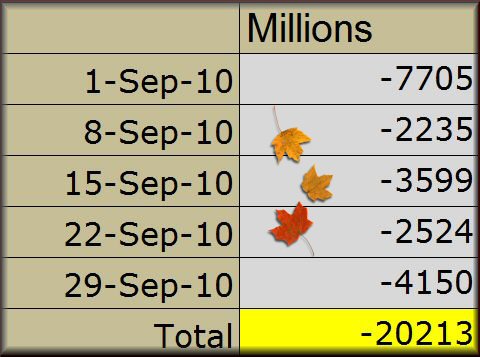
Here's the data. 22 consecutive weeks of outflows and 78 Billion withdrawn from stock equity mutual funds!


Monthly breakdowns.
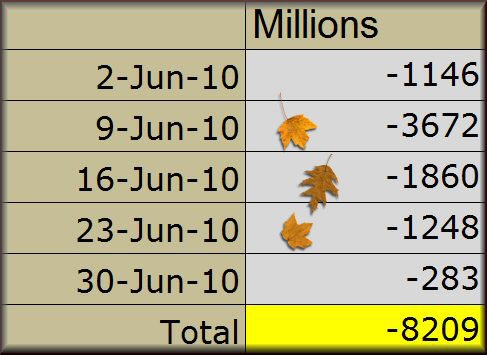


5 consecutive MONTHS of outflows! Wall Street With Funds With Lesser Funds? No wonder Meredith Whitney predicts that there could be 80,000 layoffs in Wall Street!

Yeah I was expecting that data would be bad again this week but the CNBC clip certainly put everything in a nice perspective, yes?

Equity mutual fund investors are PULLING money out of their equity funds but Bob Pisani and CNBC reckons it's best to tell America and the rest of the world that investors are PUTTING money into their equity funds instead!

Irony. From a CNBC article in September 2010, 'Flash Crash' Effect: Investors Don't Trust Wall Street

  • Nearly five months after the May 6 Flash Crash, many individual investors see the stock market as rigged, and they have little confidence in regulators to fix it.

    Most of the poll's 1,035 respondents view the market as unfair to small investors.
    In a new CNBC/Associated Press poll, 86 percent of the 1,035 respondents view the market as unfair to small investors..... ( more here )

Perhaps CNBC should ask investors if they trust CNBC!!!

Here's two nice posting to read again, Why Small Investors Have No Interest In Equities and They Just Don't Trust Wall Street

How?

What do we have?

Markets is going UP.
And Gold is going UP.
And long term treasuries is soaring!
And world markets is going UP!
And USD is falling! LOL!
And Japan is now on ZERO percent rates!
LOL!
Stock mutual fund is UP too!
Insiders selling is also UP too!
Bura Malaysia is also UP too!
LOL!


Past postings tracking the fund outflows.

Friday, May 07, 2010

8 Points And More On Yesterday Plunge

Taken from the http://www.thereformedbroker.com/ : There Had to be a Second Trader…On the Grassy Knoll, Perhaps?


  1. For starters, let's all keep in mind that these things don't happen in a healthy tape. The jitters from Greek rioting and possible contagion were the necessary preconditions for a crash like that.
  2. The "Fat Finger" thing is nonsense. Maybe someone made a sizable error, but one cannot deny the fact that the algo-driven tradebots poured gasoline on the fire. The machines were triggering stops and wrecking everything in sight before human beings with qualitative senses could get a handle on what was happening. Congress is planning the hearings as we speak.
  3. For me to enter a sell order for a retail brokerage client of 500 shares of Microsoft ($MSFT), I need to go through 3 screens of verification and order confirmation. How is it possible that someone with the clearance to sell 16 billion shares of the S&P Spider could even have a typo? If I have 3 screens to confirm a trade, how much order verification does he have?
  4. Look at your keyboard...the "M" for million is not even next to the "B" for billion. There's an "N" in between the two keys. Dude, how fat is your finger?
  5. If you were intentionally trying to chase the last of the individual investors from this market you couldn't have written a better script than "accidental trade vaporizes trillions in value from US stocks". People are just disgusted already.
  6. Cramer was so money today. Whatever you think about him in general, he's the guy that came on CNBC down 1000 and told you that these were fake quotes, to go buy Proctor & Gamble ($PG) down 20 points. He was cool, calm and perfect in that slot.
  7. We still don't know whether or not any of the trades from that session will be unwound by broker/dealers. There were a ton of stop loss orders hit and people missed fills entirely in many cases. We should hear about that soon. Let the bickering begin!
  8. Anyone who told you he bought down 1000 is lying to you. Bids were raised off those levels in seconds.

Another article from TraderMike: May 6, 2010 Recap: The Day the Market Broke

  • There’s a lot of talk about some fat-fingered trades and technical issues causing that steep drop but I think that’s masking deeper, fundamental issues. Currencies were trading wildly all day, well before the 2:30 debacle in the stock market. Even Dennis Gartman said he’d seen nothing like those currency moves in his 30+ years of trading. I watched a lot of CNBC tonight and most of the talk is about what can be done regulation-wise to prevent the kind of slide we saw today. It made me flash back to October 2008.
  • So back to the more fundamental stuff… The focus really needs to be on what’s going on in Europe and the possibility of global contagion. This afternoon CNBC had live coverage of a stand-off between Greek police and protesters of Greece’s newly passed austerity package. It seemed to me that as soon as the police surged to disperse that particular crowd is when the selling really got going. That’s what got the Dow from down 150 to down 300 or so. It’s anybody’s guess as to what caused the rest of that 10% slide. But let’s not celebrate because we ended down *only* 3%. Serious technical damage was done today. There’s also some talk that the market will *have to* test today’s lows based on what’s happened in the past. So this is certainly a time to stay on your toes — long or short. Fast market situations like today can be quite treacherous.
  • Worden was in rare form in tonight’s report, so I thought I’d share what he had to say. (Emphasis is mine):
    The Computers Did It!?!?
    I suggest you forget all this nonsense about the glitches in computers and software being the true culprits behind today’s near collapse. Today’s mentality would lead to charging the NYSE with fraud.
    The market has been waiting for something like this to happen since the bottom in March of 2009 occurred, over a year ago. Why? Because this is the way primary bear markets end. The market has to prove itself before a bear can advance into a bull market once again. It can only prove itself by going up and down a number of times until it becomes clear that it has the strength to go on to better things. It does this by providing comparisons with preceding trends in the opposite direction.
  • I should point out that the capitulation we saw today could be followed by repeated shakeouts of the same type. The first shakeout is almost invariably followed by at least one more shakeout. A series of shakeouts eventually form themselves into any one of many possible bottom formations, and the breakout above that designates that the bear is dead.

Here's an article by Bob Pisani arguing Why the Trades Were Clearly Erroneous

Monday, October 26, 2009

Some market comments

Not that it mattered but mentioned on Bob Pisani's posting: A Real Work of 'Art' — Cashin And Me

  • On the uncertainty of new cash entering the markets:

    "The amount of cash in the mutual funds is going down. So they're driving the car and the gas gauge is going down. Nobody's adding gas to them. Nobody's coming up and saying, here— here's new cash. So you're absolutely right. And that raises the question, how much more gas do they have to give to this rally."


Tuesday, February 03, 2009

8.7 Billion Inflow Into Mutual Funds In Hope Of Obama Rally

From Bob Pisani's trader talk: Meet Wall Street's Public Enemy #1

  • The market has a major enemy: utter indifference. Professionals do not seem interested, and the average person still has a lot of hope—hope that the inauguration of Obama means some kind of bottom.

    Charles Biderman at TrimTabs tells me that from Wednesday the 21st to Wednesday the 28th (when the market rallied 8 percent), there was 8.7 billion in inflows into mutual funds; the best we have seen in months.

    That 8 percent rally has now dissipated.

    What has to happen? From bears, I keep hearing about the need to break through the November lows, about more capitulation needed. From bulls, I keep hearing about more clarity on the stimulus, TARP, TALF, and Treasury purchases of everything.


Saturday, January 17, 2009

Banking Loans Is Not Increasing, It Is Decreasing!

I like Bob Pisani short notes from the markets. On today's he notes on the banking sector. Pain For Banks On Both Sides Of The Pond

  • I've been asked repeatedly what is going on in U.K. banks, with double digit declines in Royal Bank of Scotland, Barclays, and single digit declines in Lloyds.

    The answer is, shareholders in those companies have
    the same fears that shareholders of large banks here do: massive dilution and further significant write-downs.

    The UK Prime Minister has indicated the government would be announcing new measures to "resume the normal function of lending" to the private sector.

    Read: More capital injections are coming into U.K. banks, in the hope they will use the money to do more lending.

    Why? The U.K. government, like the U.S. government, is worried that without more intervention bank lending will continue to shrink.

    But here in the U.S., there is growing debate about the limits of government intervention. The reason banks are not lending is not because they don't want to, it's because:

    1) Deteriorating credit quality is a strong motivation to limit new lending growth, and

    2) Banks need more deposits so they can lend more (i.e. people need to save more)


    And that's just the supply side.
    On the demand side, loan demand is not INCREASING, it is DECREASING, both here and in the U.K.

    That is not a bad thing. Corporations and households have too much debt already and need to deleverage.

    The bottom line: government is not going to create an artificial demand by creating a false supply. Let us start by building up capital and increasing savings.

    And to everyone--Sheila Bair on down--who angrily say to the banks, "What did you do with all the TARP money?," the correct answer is, "We used it to survive."

Friday, October 10, 2008

Where Is The Moola?

And here is the issue. Where is the Moola? LOL! Excuse the pun but the according to Bob Pisani's street talk, the focus now is Where is the Earnings?!!

  • The markets are extremely oversold, but it can't muster a rally. Why not? The Fed is doing everything it can; it will undoubtedly soon start taking direction positions in financial companies, and may even guarantee loans between banks.

    While many are expecting a rally, and some are in fact buying modestly right now,
    there are other problems.

    1) Financials have been hurt by concerns about wider losses (credit card, commercial real estate), and capital raising issues.

    Look what happened to BofA[nd Morgan Stanley after they announced capital raises; look what is happening to Wells Fargoand Prudential and Protective Life now that many believe they will have to raise capital.

    2) But there's a bigger problem: there is no "E" in the P/E.
    In English, there is no Earnings in the Price/Earnings Ratio.

    Look at the estimates now: S&P 500 price is 975; many estimates of earnings for the S&P 500 for 2009 are around $75 for the index.

    Do the math: 975/$75 = 13 x earnings. Now, this is modestly cheap. The historic average is 15 x earnings, so 13 x is a little cheap, but not much.

    Here's the problem: that $75 estimate is baloney. No one has a CLUE what earnings will be. All we know is they keep dropping.

    So the Street is re-jiggering the numbers. Instead of $75 earnings, let's assume, say, $60 earnings. In order to get to a level where the S&P is cheap (13 x earnings), we have to go to 800 on the S&P: 800/$60 = 13.3 x earnings. 800 on the S&P??? Gads, it's at 975 or so now, that's a drop of...another 175 points....1,700 points on the Dow! Sobs and wails.

    See why the Street is in despair? With no visibility on earnings, we can't play the game.


    That's why the banks have to start lending, in order to get a clear indication of what it costs to borrow money. Getting a grip on a company's lending costs are key.

Source: http://www.cnbc.com/id/27103775

Tuesday, September 23, 2008

Some Interesting Comments

Bob Pisani had some interesting stuff to say regarding yesterday's markets.

  • The despair of Wall Street, redux. Volatility with no volume. That's what we got today. The Dow swung in a 400 POINT RANGE, but volume was about half what it was at the end of last week.

    Why? Some said too much uncertainty over the Treasury bill, some said with no short sellers adding liquidity, what do you expect? Others said the reflation trade has added another level of confusion.

    The markets may have acted negatively over concern about all the strings Democrats are attaching to the Treasury Department rescue plan, but don't kid yourself: a deal will get done.

    Still, don't underestimate what this bill is doing to the psychology on the Street. Most stock traders would be willing to accept more help for homeowners facing foreclosure as part of the bill.

    What's left? Some Dems want a stake (warrants) in any company that sells assets to the program. That's a problem. We're selling you the assets, below market price probably, and you still want warrants?

    Also an issue: drastically limiting pay for executives. We are probably not just talking about CEOs. We're probably talking about anyone in management. And--as we all know--commercial bank management makes A LOT less than investment bank management. ( my comments: yes about time, yes? Those buggers were paid insanely. It's totally obscene that anyone could be paid so much! )

    Bottom line: less business, less pay, less reward. That's what Wall Street management is facing today.

    Little wonder some guys are thinking of getting out altogether
    .


Source: http://www.cnbc.com/id/26841732