Showing posts with label Multico. Show all posts

Wednesday, July 02, 2008

If the stock pays good dividends, is it justifiable to buy and hold forever?

Here's a common question asked, "If a company pays good dividends, will it be a good reason to buy and hold long term to the stock?"

Take this real example of a stock, who is in a net cash position and pays about yearly dividend of 10 sen (tax exempt) per share. And with the stock trading at 1.52, would it be a good reason to buy and hold long term to the stock?

Let's have a look at what happened.
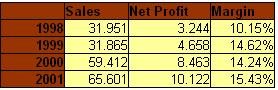


In which, one can easily argue that justification to invest in the stock is there...

1. company's net profits are growing yearly...
2. margins are decent
3. there is a 10% tax exempt dividend yearly.
4. net cash also.

When this stock announced its 2001 Q4 earnings back in
Sept 2001. The traded prices then was 1.52. Based on a price of 1.52, the stock was trading on a trailing earnings multiple of 5.8x and with a dividend of 10 sen tax exempt, and giving a dividend yield of 6.6%.

Low PE and a good dividend yield.

This makes an investment case, right? Isn't this what one is taught to invest in?


Yes but sadly this is investing based on yardsticks and numbers.

What about the business?

Well, if one had bought the stock at 1.52, based on low PE and good dividend yields, without considering the business factors in the stock, the stock is now trading at 40 sen!

Yes 40 sen!

So what happened here? The stock in question is Multico.

If one got in Sept 2001, one would have done really well, considering that Multico did manage to edge past 3.00, one would have gained close to a 100% gain within the next six months. Yes, one could have bought the stock and came out smelling like roses.

But what if one decided to hold long term. Surely the thinking rational is if the stock could produce such fantastic gains in such a short period of time, the temptation, the greed to hold the stock for a longer period is there. This is just plain human nature.

However, from a business perspective, let's look at the chain of events and examine if one could have exited this investment in a much better manner.

Take a look at the quarterly earnings table below. Look at the 02 Q4 numbers and look at the one highlighted in lime-green. Could one see the drastic change in its quarterly earnings shown in 02 q4 earnings?
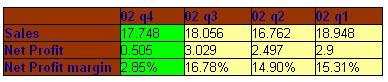
On a quarterly comparison, net profit margins slumped from 16.78% to 2.85. And net profits plunged to a mere 505 thousand.

Wasn't this the right time to get out?

Just from the quarterly earnings, we could sense that there was something drastic happened within Multico business.

Compare those earnings with the past historical earnings.
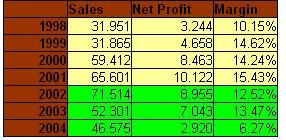


Wasn't it the right decision to make? To EXIT AFTER fy 2002?

And then early this year, there was 2 blog postings on this stock. Special audit on Multico accounts! and Multi-Code files suits..

Based on all logical reasoning, shouldn't one really exit the stock? Forget about the dividends it pays, the dividend yields, the stock fundamentals had deteriorated and the issue of trust and integrity within the company stood out like sore thumb!( See also Police report lodged by the Company )

Let's look at the end result of an investor who chooses not to accept reality and chooses to ignore all these issues and insist on holding on to the belief that one should buy and hold long term!

William O'Neil author of the best seller ' How To Make Money In Stocks ' wrote the following comments.

  • One of my goals is to get you to question and change many of the faulty investment ideas, beliefs, and methods you have heard about or used in the past.

    One of these is the very notion of what it means to invest. It's unbelievable how much erroneous information is out there about the stock market, how it works, and how to succeed at it. Learn to objectively analyze all the relevant facts about a stock and how the market is behaving. Stop listening to and being influenced by friends, associates and the continuos array of experts' personal opinions on daily TV shows.

    It's also risky and possibly foolish to say to yourself, "I'm not worried about my stocks being down because they are good stocks, and I'm still getting my dividends." Good stocks bought at the wrong price can go down as much as poor stocks, and it's possible they might not be such good stocks in the first place. It may just be your personal opinion that they're good.

    Furthermore, if a stock is down 35% in value, isn't it rather absurd to say you're all right because you are getting a 4% dividend yield? A 35% loss plus a 45 income gains equals a whopping 31% net loss.

    To be a successful investor, you must face facts and stop rationalizing and hoping. No one emotionally wants to take losses, but to increase your chances of success in the stock market, you have to do many things you don't want to do. Develop precise rules and hard-nosed selling disciplines, and you'll gain a major advantage.

Let's do another exercise.

Consider one made an investment of 10,000 shares at 1.52 way back on Sept 2001 and yes, Multico had one Bonus Issue after the bonus issue, one would be left holding some 11,000 shares. Cost of investment would be around 15,200.

Now let's count the dividends received...

2001
10 sen (10 x 100 = 1000)

2002
10 sen (11 x 10 = 1100) (num shares increased due to bonus issue)

2003
10 sen (11 x 10 = 1100)

2004
7 sen ( 11 x 70 = 770)

2005 8 sen (11 x 80 = 880)

2006 7 sen (11 x 70 = 770)

2007 None! (No dividends! Why not sell? Another baffling reason not to sell, yes?)

So total dividends received after holding a stock for 6 years = 5620 but the current share price is now 0.40! So the current market value of the shares based at a price of 0.40 is 4,400.

And if you add up the current market value of the share with the dividend received, one's current value in this investment is: 4,400 + 5620 = 10,020!

Which means, from their original outlay of 15200, the investor is now holding to an investment worth 10,020!!!!

So holding a stock for so many years and after witnessing a grand bull run recently, how does this investment look? Is good or is it bad?

How?

Wasn't it better for the investor to acknowledge long ago that this stock is clearly good no more? Shouldn't one have sold much, much earlier? See how it's the business that counts.. ?

Anyway let's look back at what O'Neil wrote:

  • It's also risky and possibly foolish to say to yourself, "I'm not worried about my stocks being down because they are good stocks, and I'm still getting my dividends." Good stocks bought at the wrong price can go down as much as poor stocks, and it's possible they might not be such good stocks in the first place. It may just be your personal opinion that they're good.

I do strongly believes that O'Neil is teaching something good here. Do not hold onto a stock just because of its dividends.

If the business performs poorly (Multico is in the dreaded automotive parts sector), the stock will STILL get hit.

Which means our investment in the stock will most likely perform rather poorly over the years as shown in this Multico example.

Now of course, do not misunderstand what I am saying here...

Dividends is indeed great, but for my personal choice, I want that something extra. I would want to see the business of the stocks doing great as well.

And the great business will most likely be the catalyst to drive the stock much higher.

Thursday, January 31, 2008

Multi-Code files suits..

Previously blogged: Special audit on Multico accounts! and also see It's the business.. Part II (Muticode was a stock that paid great dividends but the business was in a slump!)

Today, Business Time published that
Multi-Code files police report on former MD!!!


  • The company's chairman has lodged a formal complaint against Gordon Toh Chun Toh over an alleged RM36 million misappropriation

    A POLICE report has been lodged against the former managing director of Multi-Code Electronics Industries (M) Bhd over an alleged RM36 million misappropriation in the second board-listed company.

    In a filing to Bursa Malaysia yesterday, the company said the formal complaint was lodged by its current chairman Datuk Mohd Nadzir Mahmud against Gordon Toh Chun Toh.

    "The board had resolved that Toh was unable to account to the board and the company's auditors RM35 million to RM36 million of the company's funds had been properly invested in foreign financial institutions," the company said.

    Toh, a Singaporean, was appointed managing director of Multi-Code on March 23 2007.

    Toh, 56, was described as a Colombo Plan scholar, having served in the Singapore civil service and later, several banks. He was managing director of Elliott Gordon Singapore .

One comment - I am known not to like to see the listed company investing the excess money. So many things can go wrong. I would prefer to see the listed company to return excess company back to its shareholders!

Wednesday, January 02, 2008

Special audit on Multico accounts!

What a start to the new year.

Published on the Star Business:
Special audit on Multico accounts

  • Wednesday January 2, 2008

    Special audit on Multico accounts

    By C. S. TAN

    PETALING JAYA: Multi-Code Electronics Industries Bhd (Multico), a second board company with RM37mil in unascertained deposits and investments, will appoint Azman, Wong, Salleh & Co to carry out a special audit on its accounts.

    The company told Bursa Malaysia on Monday the special audit would cover matters highlighted by the external auditors and “the failure to detect the error in FRS (financial reporting standards) recommendations by the external auditors.” The company’s external auditors are Ernst & Young.

    Multico has yet to announce its audited accounts for its financial year ended July 31 (FY07) even after three extensions. It announced in September an unaudited net profit of RM1.3mil for that year, and was required to disclose its audited results by Nov 30 under Bursa’s Listing Requirements.

    After three extensions, the latest of which was till Dec 19, the company had yet to present its audited results, according to Bursa’s website.

    On Monday, in announcing its results for its first quarter ended Oct 31, Multico said that in the course of audit for FY07, auditors were not able to obtain documentary evidence and satisfactory explanation from management so as to verify the existence or recoverability of sums totalling over RM37mil. These involve:

    1) Deposits with a foreign financial institution of RM28.6mil, and accrued interest income of RM960,000;

    2) Investment in a foreign investment fund amounting to RM3.5mil; and

    3) Deposit of RM4.2mil with a foreign company for registration of the company in the American Depository Receipt programme.


    Multico said these sums arose from transactions involving parties connected to a director of the company.

    Meanwhile, Multico, which makes electronics components like remote control auto alarm, central locks, power windows and reverse sensors, reported an unaudited net profit of RM1.1mil for the first quarter of FY08.

    The company saw a change of major shareholder and managing director early last year.

    Goh Tong Huat, who was managing director, resigned on March 23, 2007. He was disclosed in the company’s 2006 annual report as having a direct interest in 12.1 million shares, or 27.3% of the company’s equity, and deemed interest in 502,000 shares, or 1.1% of the company’s equity.

    It was announced on the same date Goh resigned that he sold 10.8 million shares at RM1.60 each and ceased to be a substantial shareholder, while his wife Lee Siew Kiat sold 500,000 shares at the same price. Goh was deemed interested in the shares that Lee sold.

    Most of these shares were apparently sold to Ace Prelude Sdn Bhd as it was later announced that this company bought 11.1 million shares representing a stake of 24.9% in Multico at RM1.60 a share on March 23.

    Gordon Toh Chun Toh, a Singaporean who was appointed managing director of Multico the same date that Goh resigned, was disclosed as having deemed interest in Ace Prelude.

    Toh, who was 55 last year, was described as a Colombo Plan Scholar, having served in the Singapore civil service and later, several banks. He was managing director of Elliott Gordon Singapore.

    Multico shares closed at 84 sen on Monday, down 1.5 sen, and just a shade above its low of 83.5 sen for 2007.

This is utterly terrible!

Another huge cavaet for those who relies on the cash per share yardstick.

Sunday, April 09, 2006

It's the business.. Part II

It's the business that counts.. says Teh Hooi Ling and according to her, ultimately it is the business that drives the share price.

Ok, Teh Hooi Ling demonstrated why investing because of the cash per share is not a 100% fool-proof method of investing. What about dividends? If a company pays good dividends, will it be a good reason to buy and hold long term to the stock?

Take these comments from William O'Neil, author of ' How To Make Money In Stocks '

  • One of my goals is to get you to question and change many of the faulty investment ideas, beliefs, and methods you have heard about or used in the past.

    One of these is the very notion of what it means to invest. It's unbelievable how much erroneous information is out there about the stock market, how it works, and how to succeed at it. Learn to objectively analyze all the relevant facts about a stock and how the market is behaving. Stop listening to and being influenced by friends, associates and the continuos array of experts' personal opinions on daily TV shows.

    It's also risky and possibly foolish to say to yourself, "I'm not worried about my stocks being down because they are good stocks, and I'm still getting my dividends." Good stocks bought at the wrong price can go down as much as poor stocks, and it's possible they might not be such good stocks in the first place.
    It may just be your personal opinion that they're good.

    Furthermore, if a stock is down 35% in value, isn't it rather absurd to say you're all right because you are getting a 4% dividend yield? A 35% loss plus a 45 income gains equals a whopping 31% net loss.

    To be a successful investor, you must face facts and stop rationalizing and hoping. No one emotionally wants to take losses, but to increase your chances of success in the stock market, you have to do many things you don't want to do. Develop precise rules and hard-nosed selling disciplines, and you'll gain a major advantage.
Let's look at a real example..


in which... one can easily say that justification to invest in the stock is there...

1. company's net profits are growing yearly...
2. margins are decent
3. there is a 10% tax exempt dividend yearly.
4. net cash also.

now the company mentioned is MULTI-Code.

It announced its
2001 Q4 quarterly earnings on 20th Sept 2001. The traded prices at that time was 1.52. At that time Multi-co had around 39 million shares. So for fy 2001, Multi-code had an eps of 26 sen.

Based on a price of say 1.52, this meant that Mutli-code had an PER of 5.8x and with a dividend of 10 sen tax exempt, Multicode had a dividend yield of 6.6%.

This makes an investment case, right? The reason to invest in Multi-code was there.... rite?

Justifiable? Let's ass-u-me that one does make such an investment.

so what happen to such an investment?

If one got in Sept 2001.... one would have done really wll.... consiering that Multi-code did manage to edge past 3, for close to a 100% gain, within the next six months...

Brilliant!!! Fantastic!!

but.... imagine if one had used ze "I'm not worried about my stocks being down because they are good stocks, and I'm still getting my dividends."

look at how this investment would have fared.... !!!!!


See how the stock dived after hitting the rm3.00 peak in 2002?

So what happened?

What about looking at the it's the business that counts.. issue?

From a business perspective, could one have knew when was the time to exit?

Take a look at the quarterly earnings table below.. read from left to right.. look at the 02 Q4 numbers .. the one highlighted in lime-green. Could one see the drastic change in its quarterly earnings shown in 02 q4 earnings?


Was this the right time to get out? Just from the quarterly earnings, we could sense that there was something drastic happened with Multi-code's business. Its quarterly net profit margins slumped from the 14-16% to a mere 2.85%!

look at the yearly earnings achieved by Multicode after fy 2002.


Wasn't it the right decision to make? To EXIT AFTER fy 2002?

Here's something more intersting..

Multicode announced their Q4 2002 earnings on 24th Sep 2002.

If an investor takes this key to exit, the investor could have had exited at between 1.90-2.00++. (Please verify from these data)

So the investment return was not too bad... entry at 1.52, one could have exited a year later at least 1.90, plus a dividend of 10 sen.... not too shabby at all... :D (and there was a 1 for 10 bonus issue in early 2002)

but.... butt.... buttttt....

if one held on... and applied what William ONeil is suggesting... ie I'm not worried about my stocks being down because they are good stocks, and I'm still getting my dividends ...... let's examine how one is doing.

let's consider one making an investment of 10,000 shares at 1.52 on Sept 2001, after the
Bonus Issue , one would have 11,000 shares. Cost of investment at around 15,200. Multicode last traded at 1.10

let's count the dividends received...

2001
10 sen (10 x 100 = 1000)

2002
10 sen (11 x 10 = 1100) (num shares increased due to bonus issue)

2003
10 sen (11 x 10 = 1100)

2004
7 sen ( 11 x 70 = 770)

2005 8 sen (11 x 80 = 880)

So total dividends received after holding a stock for 5 years = 4850. And based on an investment outlay of 15200, this means that the investor has recieved back a whopping 31% of their invested money.

Fantastic!!!

But... the current share price is 1.10. And since one now have 11,000 shares, the current market value of the shares based at a price of 1.10 is 12,100.

And if you add up the dividend received.. 12,100 + 4850 = 16,950.

Which means, the investor is up some 1750 from their original outlay of 15200. A return of 11.5%.

(ps... this works out to an annual compounded return of only 2.14%!!)

So holding a stock for 5 years.... do you reckon that this is good or is it bad?

How?

Does this sound like a super duper investment idea now?

Or do you agree that it's the business that counts.. ?

And to make it more complicating.. Multi-code reported its 2005 Q4 earnings last Sept.

Net earnings was 4.137 million versus fy 2004 earnings of just 2.889 million. Just imagine what if Multicode did not show such a business recovery.. I am saying this because Multicode last year's low was a mere 1.01. And if I had used 1.01 as the gauge, the five year result would have been more gloom.

It's the business that counts .. right?

Hmmm... anyway let's look back at what O'Neil wrote:

  • It's also risky and possibly foolish to say to yourself, "I'm not worried about my stocks being down because they are good stocks, and I'm still getting my dividends." Good stocks bought at the wrong price can go down as much as poor stocks, and it's possible they might not be such good stocks in the first place. It may just be your personal opinion that they're good.

I think O'Neil teaches us something good here. Do not hold onto a stock just because of its dividends. If the stock earnings performs poorly, the stock will STILL get hit. Which means our investment in the stock will most likely perform rather poorly over the years as shown in this Multicode example.

Now of course, do not misunderstand what I am saying here...

Dividends is indeed great, but for my personal choice, I want that something extra. I would want to see the business of the stocks doing great as well. And the great business will most likely be the catalyst to drive the stock higher.