Showing posts with label Malaysia Economy. Show all posts

Saturday, August 25, 2012

Featured Article: Malaysia Flush With Middle East Cash

From CNN Money: http://business.blogs.cnn.com/2012/08/23/malaysia-flush-with-middle-east-cash/?iid=HP_LN

  • Kuala Lumpur, Malaysia (CNN) – When Facebook went public in May it became the biggest stock launch of the year, but the two next biggest initial public offerings had something in common - they were both Malaysian companies.

    In June, Felda Global Ventures Holdings raised $3.1 billion in shares, and a month later IHH Healthcare raised $2.1billion. Both are Malaysian and for both, key investors came from the Middle East.

    “Middle East investment is highly important,” Fung Siu, Asia editor for the Economist Intelligence Unit, told CNN’s Ayesha Durgahee.

    Siu added: “There are synergies to be had between the two countries - not least because they are Muslim-dominated countries, they have that in common. Sharia law is common to both countries and they try to leverage that in the Islamic finance sector - particularly Malaysia which is at the vanguard of Islamic finance.

    “So the Middle East could actually use and tap Malaysia as its financial center and hub, and source of finance as well.

    “Foreign direct investment is crucial to Malaysia's transformation into a high-income economy by 2020."

    Malaysia's economy is growing rapidly, with the country's GDP rising by 5.4% over the past three months.

    A report by HSBC in January predicted that Malaysia will be the world's 21st-largest economy by 2050, with income per capita jumping from $5,224 to $29, 249.

    “It’s still an export-led economy, buoyed by palm oil, the oil and gas sector, the manufacturing sector is also very strong ,” said Ahmad Jauhari Yahya, CEO of Malaysia Airlines. “You can only export to a certain extent. What the government is trying to do is to encourage more the consumer economy.”

    Boosting visitor numbers could be part of the formula. Tourism currently accounts for 8% of the country's GDP. A change in foreign-ownership rules could increase it to 13%, which could generate a total of $54 billion in revenue by 2020.

    “We have nine airlines flying from the Middle Eastern region,” said Chong Yoke Har, director of Tourism Malaysia. “Malaysia is very strategically located in the middle of Southeast Asia, and therefore foreigner investors look at this as a very attractive area to invest in.”

    And they've already started to bite. Qatar Holding, owner of Harrods department store, announced in July that its first Harrods hotel will be built and launched in Kuala Lumpur.

    A launchpad for hotels and a potential springboard for investment, Malaysia's multicultural roots are helping to change the economic landscape of the country, whilst moving the Middle East closer to Asia.

Tuesday, January 04, 2011

A Quick Look At Malaysia's 2010 Nov Exports

On Business Times:

  • Malaysia's total trade back to pre-crisis levels

    Published: 2011/01/04

    MALAYSIA'S total trade has returned to pre-crisis levels, led by increased demand from regional markets like China.

    The International Trade and Industry Ministry said total trade during the period of January to November 2010 has surpassed the RM1 trillion mark with a value of RM1.064 trillion, increasing by 19.4 per cent from the same period in 2009.

    Exports in November expanded by 5.3 per cent to RM52.70 billion compared to a year ago while imports grew by 6.1 per cent to RM43.79 billion.

    Malaysia had enjoyed trillion ringgit trade for three consecutive years (2006-2008) before the recent crisis.

    According to Miti, the increase in exports was largely due to higher exports of palm oil, liquefied natural gas (LNG), refined petroleum products, chemicals and chemical products, manufactures of metal, crude rubber as well as optical and scientific equipment.

    Kenanga Investment Bank economist Wan Suhaimie Wan Saidi said November's trade performance was an indication of growth prospects for the first half of the year.

    Exports in the fourth quarter of 2010 would be slower than the third quarter, leading to a slower GDP growth.

    "At best, real GDP growth for the fourth quarter 2010 would be slightly higher than 4.0 per cent but we have estimated a growth of 3.6 per cent," he said, adding that GDP growth for the whole of 2010 is estimated at 6.8 per cent.

    Exports would also face some strong headwinds going forward as it would be subjected to the slower external demand especially from Europe and the US, he added.

    "The higher base effect may exacerbate the slower growth trend. However, exports of commodity namely crude oil and gas as well as palm oil and rubber may help to mitigate the slowdown of exports going forward."

    Miti said exports to China increased by 14.2 per cent to RM7.19 billion from a year ago, on higher exports of palm oil, crude rubber, refined petroleum products, chemicals and chemical products, LNG and rubber products.

    Exports to Japan surged by 17.3 per cent while exports to the European Union (EU) registered an increase of 2.0 per cent due to higher exports of palm oil, crude rubber as well as chemicals and chemical products.

    Exports to the US saw a decline of 16.9 per cent from a year ago, mainly due to lower exports of E&E products while exports to Hong Kong also saw a decline of 7.1 per cent from November 2009 due mainly to lower exports of E&E products.

Sounds good eh?

Now compare to this : Pre_External_Trade_NovBI.pdf

Yes... Malaysia’s exports expanded by 5.3% to RM52.70 billion compared with November 2009 but what about that one very important statement underlined?

  • Compared with October 2010, exports in November 2010 decreased by 4.1% while imports contracted by 9.2% and total trade declined by 6.5%.

See below.


Is that statement not important to even mention?

This is Star Biz version: Moderate growth in Malaysia’s November exports
  • According to the Department of Statistics, November exports expanded 5.3% year-on-year (y-o-y) to RM52.7bil, meeting the general market consensus. But the numbers when compared with the preceding month was a decline of 4.1% due to comparatively lower demand from key developed markets, particularly for electrical and electronic products.

At least Star Biz takes the effort to highlight this point. Why did Business Times not highlight the fact that exports showed a decline when compared with the preceding month? Is that issue not important?

I dunno ... but here's the export data so far.


Thursday, November 04, 2010

Malaysia Exports Slows Sharply In Sep

Update of our external trade numbers:


2 consecutive months of decline! A worry?

Report: posted on MITI.

Business times: Malaysia export growth slows sharply in Sept

  • Malaysia export growth slows sharply in Sept

    By Rupa Damodaran Published: 2010/11/04

    MALAYSIAN exports slowed sharply in September to single-digit growth after enjoying eight months of double-digit expansion.

    The International Trade and Industry Ministry said yesterday that exports grew by 6.9 per cent compared with September last year, while imports grew by 14.6 per cent, recording a trade surplus of RM7.01 billion.

    Compared with August, exports slipped by 4.5 per cent while imports slowed by 2.4 per cent.

    Miti attributed September’s exports to higher sales of liquefied natural gas (LNG), crude petroleum, palm oil, crude rubber, chemicals and chemical products, optical and scientific equipment as well as rubber products.

    Standard Chartered Bank economist Alvin Liew expressed concern with the magnitude of easing in September.

    It reinforced the view that the pace of Malaysia’s GDP growth was moderating in the second half of this year.

    “More importantly, exports to key export markets like the US and China contracted by 4.4 per cent year-on-year and 3.8 per cent year-on-year respectively, raising concerns that key markets are seeing demand turning more sluggish as global economic activity and consumer sentiment weakens,” he said.

    However, with China’s latest PMI (Purchasing Managers’ Index) reading that turned out to be stronger than expected, the appetite for Malaysian exports could improve in the coming months.

    According to Miti, lower exports to China was mainly due to lower exports of crude petroleum, palm oil and electrical and electronic products.

    Exports to the European Union (EU), however, expanded by 2.5 per cent to RM5.46 billion compared with the corresponding month in 2009, on stronger demand for palm oil, crude rubber as well as chemicals and chemical products.

    Exports to Japan rose 30 per cent, due mainly to higher exports of LNG, E&E products and crude petroleum.

    Azrul Azwar Ahmad Tajudin, chief economist with Bank Islam, said the worse-than-expected slowdown in export growth in September could be a harbinger of further softening in overseas demand for made-in-Malaysia goods in the next few quarters as the global recovery cools.

    “A strengthening ringgit will not work in our favour neither although on a net basis, given the simultaneous appreciation of other Asian currencies, Malaysian exporters should not lose out that much vis-à-vis their regional competitors,” he said.

Here's the 'shocking' version from Star Business: Trade surplus hits RM7b in September

  • PETALING JAYA: Malaysia’s total exports increased 6.9% to RM50.47bil in September from a year earlier, while imports grew 14.6% to RM43.47bil during the same period.

    Total trade rose 10.4% to RM93.94bil.

    A trade surplus of RM7.01bil was recorded in September, making it the 155th consecutive month of trade surplus since November 1997, the International Trade and Industry Ministry (Miti) said in a statement yesterday.

    The increase in exports in September was largely due to higher exports of liquefied natural gas, crude petroleum, palm oil, crude rubber, chemicals and chemical products, optical and scientific equipment as well as rubber products.

    Higher imports were mainly due to higher imports of intermediate and capital goods. Compared with August, exports in September declined 4.5% and imports contracted by 2.4%, while total trade decreased by 3.5%, it said.

    Exports to Asean were valued at RM12.4bil, accounting for 24.6% of Malaysia’s total exports in September.

    Higher exports of crude petroleum, refined petroleum products and palm oil resulted in an increase of 5.4% in total exports to this region.

    Month-on-month, exports to this region decreased 4.5%. Total imports from Asean amounted to RM12.5bil, or 28.7%, of Malaysia’s total imports in September.

    For the nine-month period ended September, total trade increased 23% to RM864.48bil with exports expanding 20.4% to RM474.59bil while imports rose 26.4% to RM389.89bil, resulting in trade surplus of RM84.7bil.

    Total exports to Asean increased by 19.1% to RM120.36bil, or 25.4%, of Malaysia’s total exports from January to September.

    Singapore was Malaysia’s biggest export destination during the period, totalling RM62.53bil.

    Exports to China, Malaysia’s second highest destination, increased 28.5% to RM60.17bil, or 12.7%, of total exports during the nine-month period. The major contributor to the increase was electrical and electronic products, which accounted for 51.4% of total exports to China, Miti said.

    Total imports from Asean during the nine-month period increased 38.1% to RM106.84bil, accounting for 27.4% of Malaysia’s total imports.

    China was Malaysia’s largest import source during the period, accounting for RM49.60mil, followed by Japan at RM48.47mil

Saturday, October 09, 2010

Weak Malaysian Export Numbers

On Business Times:

  • Malaysia Aug export pace slows

    By Rupa Damodaran Published: 2010/10/09

    EXPORTS grew at a slower pace than market expectations, confirming views that export growth had peaked in the early part of the year
    .

    The Ministry of International Trade and Industry (Miti) yesterday said exports had expanded 10.6 per cent to RM52.85 billion while imports had risen 16.5 per cent to RM44.53 billion.

    This resulted in a total trade of RM97.38 billion, 13.2 per cent higher from a year ago.

    Compared with July, exports in August declined 4.6 per cent while imports contracted 8.0 per cent and total trade decreased by 6.2 per cent.

    Miti said the August growth was largely due to higher exports of liquefied natural gas (LNG), electrical and electronic products, refined petroleum products, chemicals and chemical products.

    Alvin Liew of Standard Chartered Bank said the bulk of exports remain to be electronics, accounting for 40 per cent of total exports although its pace eased to 3.7 per cent in August.

    "Key commodity exports (such as refined petroleum, crude oil and palm) remain supportive of headline exports in August, although crude oil exports grew by a slower 2.7 per cent year-on-year in August, way off the near 18 per cent year-on-year pace set in both June and July," he said.

    The bright spots for Malaysia, he added, turned out to be exports to the European Union (EU) and Japan which have been recording double-digit growth since December 2009 and March 2010 respectively.

    Exports to China rose 2.4 per cent compared to a year ago. Exports to the EU grew 12.6 per cent.

    Exports to Japan edged up 28.4 per cent on higher exports of LNG, refined petroleum products and E&E products but exports to the US saw a marginal increase of 0.5 per cent compared with a year ago.

    Liew added that the decelerating export picture corroborated with StanChart's weaker manufacturing outlook for Malaysia in the second half on the back of sluggish external demand and lingering uncertainties in the external environment.

    Miti said import growth was mainly due to intermediate goods which took up 70.2 per cent of the total.

    "Resilient domestic demand and higher capital investment by companies likely drove import demand, although concerns about the external economy may have dampened import appetite for the rest of the second half," Liew said.


    Read more: Malaysia Aug export pace slows here

52.85 Billion?


And since 2009 was a washout year, I don't thi nk it's meaningful to compare to those numbers. Instead I would compare to the export numbers in 2008. How? Current numbers are rather weak, yes?

From Matrade website: http://www.matrade.gov.my/cms/content.jsp?id=com.tms.cms.section.Section_727adcb2-7f000010-562d562d-9ea58874

Friday, September 03, 2010

How Good Is Malaysia's Current Total Exports

The Business Times article..

  • THE country's exports rose higher than expected in July, led by an improvement in external demand for electrical and electronic (E&E) products.

    The International Trade and Industry Ministry (Miti) said yesterday the exports, amounted at RM55.43 billion, were the second highest monthly value recorded so far this year.....

    Read more: Malaysia July exports higher on better E&E demand here

Huhu!

Exports flying... stock markets flying!!!

Good times are back yo!

Second highest monthly value recorded so far this year!

I updated my 'exports' table and this is what I have to show...


Err.... yes, July's exports of 55.426 Billion is the second highest monthly value but... but... are you impressed?

Doesn't the numbers look a bit lacklustre?

But when compare with 2009.... the numbers looked super good!


But for some... the comparison above is rather pointless because in 2009... everything pretty much was terrible. So any comparison made against 2009 numbers sure would look super good.

So the 2008 numbers is added into the comparison...


How?

Looks like 2008 numbers are much better except for March.

Here's Star Biz article: Exports data show more sustainable growth rate

Wednesday, August 04, 2010

Malaysia's Exports Climb 17.2% In July

On MSN news.


  • By Agence France-Presse, Updated: 8/3/2010

    Malaysia exports climb 17.2 percent in June

    Malaysia said Tuesday its exports, the mainstay of the economy, had risen 17.2 percent year-on-year in June due to stronger demand for electronic goods and liquefied natural gas.

    Export-dependent Malaysia, Southeast Asia's third-largest economy, was hit hard by the global slowdown and its economy shrank 1.7 percent last year.

    The trade ministry said in a statement that shipments had risen to 52.83 billion ringgit (16.7 billion dollars), while imports were up 30.1 percent at 46.79 billion ringgit, producing a surplus of 6.04 billion ringgit.

    The increase was due to greater exports of electrical and electronic goods, liquefied natural gas, chemicals and chemical products, palm oil and rubber products, among others.

    Electrical and electronic items account for 40.2 percent of Malaysia's total exports to markets such as Singapore, China, the United States and Japan.

    The economy is forecast to grow 5.5 percent this year, but Prime Minister Najib Razak recently said he was aiming for 6.0 percent this year, as he unveiled a 69-billion-dollar development plan aimed at spurring growth.

    Malaysia expects exports to grow between six and seven percent this year as demand improves. Exports dipped 16.6 percent in 2009. ( Source:
    http://news.malaysia.msn.com/regional/article.aspx?cp-documentid=4253975 )

Hmm... it's a comparison made versus last June, June 2009.

Hmmm... I rather use BNM website.

http://www.bnm.gov.my/files/publication/msb/2010/6/pdf/7.4.pdf

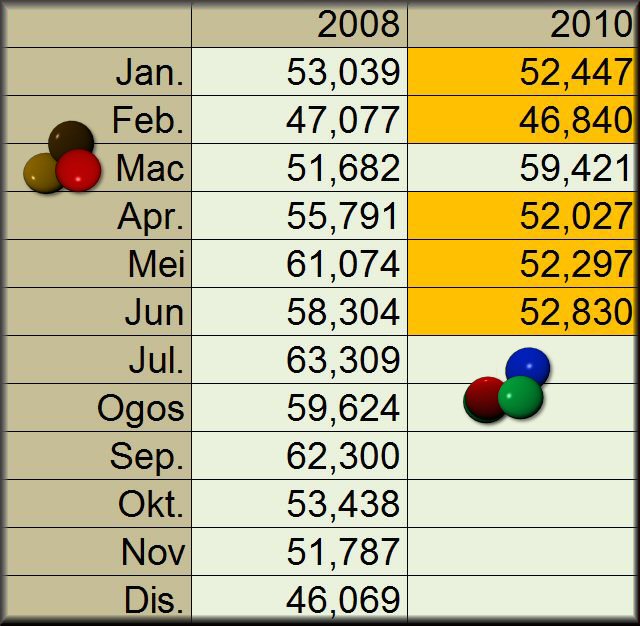
Now if I compile the numbers into a more simplified table and include a June export number of 52.830 billion, this would how our exports would look like..


Yes, compare to 2009, our current figures looks superb!

But...but... butttt.... if I HIDE the 2009 column... (why because 2009 was a terrible trading year for most countries globally and any comparison made versus 2009 would be rather meaningless!).. this is what I see. The dark yellow colored boxes indicates where 2010 fared worse than 2008.

How?

Here's the preliminary report from the our statistics department.

http://www.statistics.gov.my/portal/index.php?option=com_content&view=article&id=538&Itemid=61&lang=en

Here's Business Times article: Slower Malaysia export growth in June

  • MALAYSIAN exports in June 2010 grew slower than market expectations, in tandem with the performance of regional peers.

    The Ministry of International Trade and Industry (Miti) said exports rose by 17.2 per cent year-on-year in June, while imports grew by 30.1 per cent year-on-year. Trade surplus stood at RM6.04 billion.

    Miti said the rise in exports was broad-based, namely electrical and electronic products, liquefied natural gas, chemicals and chemical products, optical & scientific equipment, palm oil, manufactures of metal, crude petroleum, crude rubber and rubber products.

    Commenting on the latest trade data, HSBC Bank Asian economist Wellian Wiranto said it points towards slower exports momentum going forward alongside its regional peers.

    The latest reading is the slowest since November last year due largely to the petering out of base effects.

    "All in all, the picture for Malaysia's exports is roughly the same as the picture we see for the region in general going forward: a less enthusiastic pace of expansion, but no double-dip," he said.

    Wiranto said given the relative slowdown in trading activities around the region, it may get comparatively harder for the exports of electronics, although he expects receipts from the segment to be within the RM19 billion to RM21 billion range.

Here's Star Business version: Malaysia’s exports advance 17.2% in June


Tuesday, June 29, 2010

Our Exports To China Surging?

On today's Business Times:


  • Malaysia's exports to China surge to US$19.1b

    Published: 2010/06/29

    MALAYSIA'S exports to China in the first five months of this year rose by 82.2 per cent to US$19.1 billion (RM61.69 billion) compared with the same period last year.

    Malaysia External Trade Development Corp's Sabah director Syed Zahirulldin Syed Ali said with the implementation of the Association of South-East Asian Nations (Asean)-China Free Trade Area (ACFTA), where tariffs of over 90 per cent of the products were cut to zero, Malaysia's trade with China was expected to continue to grow.

    "Malaysia's economic relations with China have shown remarkable growth in trade and investment over the past 10 years, and we hope this trend will continue for mutual benefits," he said at the 7th China-Asean Expo (CAEXPO) promotional conference in Kota Kinabalu yesterday.

    Also present was CAEXPO secretariat vice director-general Gong Qijun.

    The CAEXPO will be held from October 20-24 in Nanning, China.

    Syed Zahirulldin said China was Malaysia's largest trading partner last year with total trade amounting to US$36.3 billion (RM117.24 billion).

    He said the CAEXPO has positioned itself as the symbol of cooperation between Asean and China not only in trade and investment but also in tourism.

    Syed Zahirulldin said last year, 100 Malaysian firms participated in the expo under five industry clusters - food, beverages, general products by small- and medium-sized industries, Malaysia brands and government agencies.

    He said last year, Malaysian exhibitors secured deals worth RM204.5 million. - Bernama


Now I had always reminded myself of this posting: Do Not Be Fooled By Headline Numbers

As stated in the posting, Pankaj Kumar reminded the following..

  • Moving towards the current economic indicators, it is also interesting to note how one economic figure can be misconstrued as good by some and bad by others when in reality it may well be saying something else.

    The issue here is that as most fund managers are busy keeping track of economic data out of the US, Europe and Asia practically on a daily basis
    , are we seeing the trees from the forest or mainly just looking at headline numbers?

    Most economic data are measured either on a month-on-month or year-on-year basis. There are two ways to measure the data points; either by absolute difference (for example consumer confidence data), which to me is more reflective of the real situation, or by percentage change, which can sometimes be misconstrued by investors...

Misconstrued by investors.

For example, yes comparison to last year numbers, this year numbers simply looked great. But what about last year numbers itself?

The first five months of last year... what period did it represent? What did the first five months of last year represent? Wasn't that almost the peak of the crisis, where almost everything in the world, declined? And if so, won't the comparison by misconstrued?

And also, earlier this month, I posted Malaysia's Exports To China Shows Big Decline

  • Exports to the PRC increased by 28.0% from April 2009 to RM6.53 billion. This was mainly contributed by higher exports of E&E products, palm oil, chemicals and chemical products, rubber products and LNG. Compared with March 2010, exports to the PRC contracted by 18.1%.

Yes, y-y comparison, April 2010 export numbers of rm 6.53 billion showed an increase of 28%.

However on a m-m comparison, our exports to China in March 2010 was RM7.98 billion. April numbers fell 18.1% to 6.53 billion.

How?

Declining exports or surging exports?

Me? I can't wait to see our May export numbers.

Monday, June 07, 2010

Malaysia's Exports To China Shows Big Decline

From Malaysia Department of Statistics: Preliminary Release of Malaysia External Trade Statistics April 2010 (Updated:04/06/2010)

The following caught my attention...

  • Exports to the PRC increased by 28.0% from April 2009 to RM6.53 billion. This was mainly contributed by higher exports of E&E products, palm oil, chemicals and chemical products, rubber products and LNG. Compared with March 2010, exports to the PRC contracted by 18.1%.

On a y-y our exports to PRC did increase by 28% but that comparison to 2009 is a waste of time because 2009 was a period where everything collapsed. (ps: do see this posting: Do Not Be Fooled By Headline Numbers )

So in my flawed opinion the biggest concern is...

  • exports to the PRC contracted by 18.1%.

See posting last month: Regarding Malaysia Booming Trade

  • Exports to the PRC rose to a new monthly high of RM7.98 billion

Our Aprils exports to the PRC is now only RM6.53 billion.

Is the contraction a worry?


Thursday, May 06, 2010

Regarding Malaysia Booming Trade

Firstly, I need to declare to you that I did not study economics at all and whatever comments and views you read from me could certainly be flawed. Ok? :D

The said article..

  • Malaysia’s trade booms as it rides Asian economic recovery
    May 4, 2010 3:23pm
    by Kevin Brown

    Malaysia is roaring out of recession even faster than expected, with March trade figures published today beating forecasts by a wide margin. The numbers suggest east Asia’s post-crisis recovery is moving ahead even faster than expected. According to the government’s announcement, exports rose 36.4 per cent year-on-year(compared with forecasts of around 20 per cent), and imports by 45.3 per cent (forecasts of around 30 per cent).

    Given Malaysia’s high exposure to trade, the numbers bode well for first quarter gross domestic product growth, which economists now see reaching up to 10 per cent and more, compared with a 6.2 per cent decline in the first three months of last year, at the height of the global crisis.The government said in March that the economy had grown 4.5 per cent in the fourth quarter compared with a year earlier.....

Well let me attempt to understand what it says..

The exports rose 36.4% is on a year-year comparison.

It's impressive but I would personally note that this is a year-to-year comparison and that the 2009 numbers were a total-washout numbers - ie. those numbers were recession numbers.

Well it certainly looks like Malaysia is out of recession.

  • Robert Prior-Wandesforde, senior Asian economist at HSBC, told Reuters:

    It looks to us as though exports in Q1 as a whole was up strongly probably by 6.5 per cent on a seasonally-adjusted basis, which in turn bodes well for GDP. GDP will be something close to 11 per cent in Q1 and for the year as a whole it would be 7.3 per cent. The picture is one of rampant trade growth. A lot of it was intra Asia exports but exports to the US have picked up very strongly too. This is a V-shaped recovery, which in our view is sustainable and will lead to significant further upside in terms of GDP growth.

Alright.

Now since it's on a year-to-year comparison, I would guess the numbers might not be accurate or rather the numbers comparisons might not be really that conclusive because the risk is that it could be a low base comparison.

So I would ask myself, what are the Feb export numbers? what are the Jan export numbers? What are the export numbers before 2009.

The best website to use is BNM website.

And here is the link to the export numbers: http://www.bnm.gov.my/files/publication/msb/2010/3/pdf/7.4.pdf

And if I would compile the numbers into a very simple table, this is what I am looking at.


Malaysia recorded total exports of rm 59.44 Billion for the month of March 2010.

How?

How would you want to interpret those numbers?

Sorry I do not wish to do so since I am not qualified.. :D

On our department of statistics website, the following article is published.

Preliminary Release of Malaysia External Trade Statistics March 2010 (Updated: 04/05/2010)

  • The Minister of International Trade and Industry (MITI), YB Dato’ Sri Mustapa Mohamed announced that total exports recorded a new high for the month of March, amounting to RM59.44 billion, a surge of 36.4% compared with the corresponding month in 2009. This is also the highest post crisis monthly exports recorded since September 2008. Imports rose 45.3% to RM45.09 billion.

Yes highest since Sep 2008. On Sep 2008, Malaysia export numbers were rm 62.3 Billion.

  • Total trade in March 2010 expanded by 40.1% to RM104.54 billion compared with March 2009. Trade surplus was valued at RM14.35 billion, making it the 149th consecutive month of trade surplus since November 1997.

    Compared with February 2010, exports increased by 26.9% while imports rose 28.2%. Consequently, total trade rose 27.5%.

Yes compared with Feb 2010, the increase in exports were impressive.

However, as you can see from BNM stats, Feb is usually our weakest month.

  • During the first quarter of 2010, total exports registered a marginal decrease of 0.2% to RM158.73 billion compared with the fourth quarter of last year. Imports contracted 5.4% to RM119.78 billion. Total trade decreased by 2.5% to RM278.51 billion while trade surplus increased by 20.1% to RM38.95 billion.....

Marginal decrease when compared to 4th quarter the previos year.

  • Major export products:
    Electrical and electronic products valued at RM22.31 billion or 37.5% of total exports;
    Palm oil (RM4.42 billion or 7.4% of total exports);
    Liquefied natural gas (RM3.99 billion or 6.7% of total exports);
    Chemicals and chemical products (RM3.91 billion or 6.6% of total exports);
    Crude petroleum (RM3.02 billion or 5.1% of total exports);
    Refined petroleum products (RM2.16 billion or 3.6% of total exports);
    Transport equipment (RM2.14 billion or 3.6% of total exports);
    Machinery, appliances and parts (RM2.12 billion or 3.6% of total exports);
    Optical and scientific equipment (RM1.60 billion or 2.7% of total exports); and
    Manufactures of metal (RM1.59 billion or 2.7% of total exports).

    The People’s Republic of China (PRC), Singapore, Japan, the United States of America (USA) and Thailand were the top five export destinations, accounting for 51.8% of Malaysia’s total exports.

Electrical and electronic products.. that's our bread and butter. :D

Our top five export destination.. China, Spore, Japan, USA and Thailand and they account for 51.8% of our total exports.


  • Exports to the PRC rose to a new monthly high of RM7.98 billion, an increase of 51.2% from March 2009. This was mainly contributed by higher exports of E&E products, palm oil, chemicals and chemical products, crude and rubber products, crude petroleum as well as optical and scientific equipment. Exports to the PRC in March 2010 rose 40.3% compared with February 2010.

Ah.. China a key country!

But what about EU? With all the issue over there, I am sure many are worried.

  • Exports to the European Union (EU) increased by 31.5% to RM6.09 billion from March 2009. This was mainly due to higher exports of E&E products, crude and rubber products as well as chemicals and chemical products. Compared with February 2010, exports to the EU rose 18.7%.

Here is the table.

And last but not least..

  • Exports to the USA amounted to RM5.77 billion, an increase of 26.5% from March 2009. This was mainly attributed to higher exports of E&E products, machinery, appliances and parts, palm oil and crude petroleum. Compared with February 2010, exports to the USA expanded by 35.7%.

And here is the article on our front page Star: More than 10% economic expansion in first quarter for the first time in 10 years

  • KUALA LUMPUR: The country’s economy is likely to register growth of more than 10% in the first three months of the year – an achievement not seen in the last 10 years.

    The latest economic indicators show a positive trend. Exports in March grew by 36.4% beating the market forecast of 22.4%. Imports rose by 45.3% (forecasts were around 30%).

    The London-based Financial Times says: “Given Malaysia’s high exposure to trade, the numbers bode well for first quarter gross domestic product growth”.

    Analysts from major banks, local and international, put the first three months’ growth at between 9.8% and 12% and they expect the trend to continue for the second quarter making it a “very good first half of the year for Malaysia.”

    As a result, the analysts are also revising upwards their estimates for Malaysia’s GDP growth forecast for the year. Banks are now forecasting the annual GDP to grow by between 8% and 11% as compared to Bank Negara’s earlier estimate of between 4.5% and 5%.

    “Given the recent developments in both domestic and external conditions, we are confident our 2010 forecast of 8% should be achievable,” said Ambank group chief economist Manokaran Mottain in his Economic update released here yesterday.

    He also noted that besides the surge in exports, there was a marked improvement in private sector spending, especially by households. Big ticket items such as cars have seen increased sales.

    According to the Malaysian Automotive Association, auto sales surged 25% year-on-year in March to 56,139 units, up from 44,896 in the same month last year.

    HSBC Global Research economist Robert Prior-Wandesforde in his report entitled “From bust to boom - double-digit GDP growth in Singapore and Malaysia?” noted that the recovery of the economy came three months faster than expected.

    While the Financial Times said, “Malaysia is roaring out of recession even faster than expected”.

    The country’s key economic indicators including the export figures were released on Tuesday.

    Malaysia’s exports recorded a new high for the month of March, amounting to RM59.44bil, registering a significant growth of 36.4% year-on-year. This was also the highest post-crisis monthly exports recorded since September 2008. Imports rose 45.3% to RM45.09bil.

    The increase in exports was largely contributed by increases in exports of electrical and electronic (E&E) products, which surged 31.8%; chemicals and chemical products, (+60.8%); palm oil, (+49.3%); transport equipment, (+188.4%); as well as crude petroleum (+55.8%).


Tuesday, September 08, 2009

Malaysian Exports Fell 22.8% Compared To A Year Ago But It's Better Than Expected.

Malaysian exports fell a whopping 22.8% compared to a year ago.

But hey, that's not a worry!

It's better than expected and when compared to last month's figures, export grew 8.4%!

Ah... I shouldn't blame our press media for such bullish statements!

We are not the only ones making such statements.

Anyway.. for what's it's worth, let's have some fun with numbers. Let's assume we were at 100 a year ago.

A 22.8% fall means we are now at 77.2.

And since this is an improvement (lol.. or should I use the word 'growth' :p) of 8.4%, this means last month, we were at 70.7.

So we used to be 100. Last month we were at 70.7. Now we are 77.2. Hey things are looking up yo!

Time to celebrate by having a bull run on the markets.

What say you?

Here's the Business Times article.

  • Malaysia July exports down 22.8pc year-on-year
    By Rupa DamodaranPublished: 2009/09/08

    MALAYSIAN exports in July fell a better-than-expected 22.8 per cent from a year ago as major economies continued to reel from the global recession and the decline was made worse by the fact that 2008 was a good year for trade.

    However, July exports grew 8.4 per cent from June and this is the fifth straight monthly gains this year, on the back of an increase in exports of electrical and electronic products.

    According the Ministry of International Trade and Industry (Miti), July's exports of RM48.87 billion was the highest monthly export value so far this year.

    "The fifth consecutive monthly gain is one of the positive indicators that the industry is returning to normal levels, as manufacturers were replenishing inventories in anticipation of stronger sales in the second half-year," said AmResearch senior economist Manokaran Mottain.

    Compared to a year ago, however, exports declined 22.8 per cent in July while imports were lower by 16 per cent.

    A Business Times poll expected exports to fall 24 per cent and imports by -21.79 per cent.

    Manufactured exports in July increased by 11 per cent compared with June, due mainly to higher exports of E&E products (42.2 per cent), chemicals and chemical products (6.1 per cent), iron and steel products as well as optical and scientific equipment.

    Singapore, China, the US, Japan and Hong Kong were the top five export destinations of the month.

    Compared to June, exports to Asean also increased in July by 6 per cent, mainly due to higher E&E and petroleum products.

    Exports to China increased by 14 per cent while exports to the US saw a 10.6 per cent increase due to higher shipments of E&E products.

    Exports to the European Union rose 10.5 per cent from June although exports to Japan declined on lower exports of liquefied natural gas and E&E products.

    Miti said imports rose 14.2 per cent from June.

    Mottain said global semiconductor sales rose 5.3 per cent in July from June, reflecting a pick up in demand for products such as netbooks and cell phones, according to the Semiconductor Industry Association (SIA).

Here's Star Business article. It's simply better!

July export value highest in first seven months this year


Thursday, August 06, 2009

What Are Out Export Numbers Telling You?

On Business Times: E&E, gas sales help cushion decline in June exports

Now that would seem a rather tame headline and more so the decline in June exports were considered to be BETTER than what the pros had forecasted.

Yeah.. we talking about recovery NOW or what! :D

The words that matter for me.

  • Exports in June fell 22.6 per cent year-on-year....

22.6 percent!

Well that's how bad things are still in the exports sector.

Hey, exports does matter for our country, yes?

Here's the rest of the media report.

  • E&E, gas sales help cushion decline in June exports

    By Hamisah HamidPublished: 2009/08/06

    MALAYSIA'S exports fell at a slower rate in June, helped by a slower deceleration in the exports of electronic and electrical (E&E) products and a rise in liquefied natural gas (LNG) exports.


    Exports in June fell 22.6 per cent year-on-year, beating a 25.47 per cent contraction forecast in the Business Times poll.

    Together, E&E and LNG accounted for 46.2 per cent of the overall exports.

    Imports also dropped 20.8 per cent from the same month a year ago, while total trade shrank by 21.8 per cent to RM81.09 billion.

    The International Trade and Industry Ministry (Miti) said month-on-month, exports rose 5.1 per cent in June to RM45.1 billion from May, while imports rose 9.4 per cent to RM35.99 billion.

    Economists said the decline in the country's exports is easing, but improvement is likely to be gradual because exports still register a sharp drop year-on-year.

    "The month-on-month trend shows that the contraction in global demand is stabilising, but we are not expecting a V-shape recovery in exports because major developed economies are still in recession in the first half of the year," RAM chief economist Dr Yeah Kim Leng told Business Times yesterday.

    "Some are projecting a recovery or slight growth in the US economy in the third quarter, but not a robust recovery," he added.

    Yeah said at a 20 per cent contraction, Malaysia's exports are still better than other Asian countries such as Singapore, Japan and China, whose exports have shrunk between 30 per cent and 40 per cent since the onset of the global financial crisis.

    MIDF Research head Zulkifli Hamzah said the month-on-month recovery in exports was in line with regional trend, driven by intra-Asian trade.

    "The Western economies of US and Europe are still weighed down by weak demand and overcapacity. As Malaysia is an open economy, a meaningful recovery needs to have the participation of the US and Europe," he said.

    Zulkifli said while Asia has the capacity to drive demand, probably until the end of the year, the momentum must be supported by the Western economies. Otherwise, the recovery would not be sustainable.

For sure things are not at the doomsday level but things really aren't rosy at all.

Yes, one can bet on the recovery. For sure it's one logical bet. Worth the justification.

But... but.... butttt..... look at them stocks now.

Ask yourself the logical question........ :D


Friday, July 10, 2009

Worst May Be Over For Malaysia...

On the Edge Financial Daily. Worst may be over for Malaysia, May's IPI slowest decline since November

  • Worst may be over for Malaysia, May's IPI slowest decline since November
    Written by Joy Lee
    Thursday, 09 July 2009 23:43

    KUALA LUMPUR: Another sign has emerged that the worst may be over for the Malaysian economy with May's industrial output declining at the slowest pace since November last year and was gaining month-on-month (m-o-m) for three consecutive months to May.

    Although the industrial production index (IPI) in May had fallen 11.1% year-on-year (y-o-y), it had gained 1.6% from April.

    "We are quite optimistic about the IPI figures. It is in-line with our expectations and has been gaining for the third consecutive month now. The gain month-on-month shows that recovery is on-track and it has strengthened our assumptions that the worst is over," senior economist at AmResearch Manokaran Mottain told The Edge Financial Daily.

    According to the Statistics Department, the cumulative IPI for the period of January-May 2009 had declined 13.2% against the same period in 2008.

    The y-o-y drop in May's IPI was due to decreases in broad sectors such as manufacturing (15.2%), mining (3%) and electricity (2.1%).

    The Statistics Department said the 15.2% y-o-y decline in manufacturing output contracted due to decreases in the electrical and electronics products segment (down 31.9%); non-metallic mineral products, basic metal and fabricated metal products (down 17.3%); and petroleum, chemical, rubber and plastic products (down 4.2%).

    The 3% y-o-y decline in the mining sector was due to a decline in the index of crude oil (down 3.2%) and natural gas index (down 2.5%) while electricity output rose 3.9% from the previous month. Nonetheless, the mining sector had gained 2.4% from the previous month.

    Manokaran said the contraction in manufacturing was expected to further narrow moving forward as global chip sales, which mirror the performance of the overall economy, have rebounded for the third consecutive month towards May.

    In a recent report, the Semiconductor Industry Association said worldwide sales of semiconductors rose to US$16.5 billion (RM58.74 billion) in May, an increase of 5.4% from April when sales were US$15.6 billion.

    "Other than that, labour deterioration worldwide has stabilised and global PMI (purchasing managers index) and consumer confidence have returned. Major economies have rebounded in their PMIs," Manokaran said.

    Other countries in the region have also shown a rebound in industrial outputs in recent months.

    China's industrial output rose 8.9% y-o-y in May, rebounding from April's lacklustre 7.3% and exceeding March's 8.3%. Japan, the world's second-biggest economy, saw its industrial output rose for the third straight month. It increased 5.9% y-o-y in May, matching a rise in April. As for India, its industrial output in May is likely to increase 1.3% y-o-y, according to estimates.

    Closer to home, Singapore's industrial production rose 2% year-on-year in May but fell a seasonally adjusted 1.6% from April.

    The smaller contraction in IPI spells good news for the Malaysian economy and Manokaran expected better gross domestic product (GDP) figures for the second half (2H) of the year.

    "The first quarter GDP declined 6.2%, which was a ten-year low. We are expecting about -4% for 2Q or maybe even better. There would be further improvement in the third quarter and subsequently a positive fourth quarter," he said.

    However, Azrul Azwar Ahmad Tajudin, senior economist at Bank Islam Malaysia, said it was not time to celebrate as the IPI has seen a double-digit plunge for six months in a row now.

    "It has eased somewhat. But combined with the sharp dip in exports, the magnitude of GDP contraction in 2Q may cast doubt over the timing and strength of the recovery which is widely expected to resume by year-end or the beginning of 2010," Azrul said.

    He said the worst may be over but there could be many pitfalls ahead for recovery to take place, adding that optimism over "green shoots" a few months back may have been tampered with recent dismal data.

    "What we are seeing now is the impact of the financial crisis on the economy. But the full impact of the mounting job losses on the economy has yet to be seen.

    "If job losses remain, we may see another round of negative impact on the economy. We may only see earnest recovery in the middle of next year," he said.

    Azrul said other indicators to look out for were the global job indicators and production figures in industrialised economies as these are the key export markets for Malaysia.


Hmmm..... let me borrow Warren Buffett's phrase "We are not in a freefall, but we are not in a recovery either."

That would be rather accurate, no?

But then what about the continued weakneess in the Ringgit?

And what about the weakening commodity prices?

Thursday, July 02, 2009

Confusing Headlines On Malaysian Export Numbers

On Business Times: 'Malaysian exports inching towards recovery'


  • By Rupa Damodaran Published: 2009/07/02

    MALAYSIAN exports are taking small steps towards recovery as manufacturers take advantage of inventory replacement activities worldwide, economists said.

    Malaysian manufacturers mainly produce electronic and electrical items that are used to make computers, among others.

    They have been hit hard by weak demand due to the global recession.

    Although there seems to be some improvement in the month-on-month E&E orders and industrial output, economists were still concerned whether the data was sustainable.

    They forecast May exports to contract further by 28.83 per cent, with imports also down by 23.91 per cent. Trade balance may average RM8.68 billion.

    The contraction in May, from a minus 26.3 per cent in April, will be made worse by high numbers last year as commodity prices were strong then.

    The International Trade and Industry Ministry will release the data tomorrow.

    Irvin Seah from DBS said the worst quarter of the recession was behind and an impending recovery for Malaysia would be visible in the months ahead.

    "As far as we're concerned, the trough of the export cycle (in absolute level) was back in January."

    "Improvement in the global economic environment, led by restocking by producers as well as the recent increase in oil prices probably will contribute to the headline export figure in May."

    The oil prices also rose to US$65 (RM228.80) per barrel from US$39 (RM137) per barrel between April and May.

    "That's a 32 per cent increase, which will certainly inject some 'price effects' to the export number."

    Standard Chartered Bank economist Alvin Liew expects a sharper contraction in exports in May,
    driven by the plunge in export value of key commodities like crude palm oil and crude oil.

    This would translate into a trade surplus of RM7 billion, which could be the narrowest monthly surplus since April 2007.

    TA Research economist Patricia Oh said faltering trade activities are likely to persist considering the rise in unemployment, dampened consumer sentiment and reduced demand for goods and services.

Hmm... I wonder why Business Times decided to name that headline ''Malaysian exports inching towards recovery' when two of the three economists mentioned inside the article itself weren't optimistic at all.

Strange eh? :p2

On Star Business, the headline was Economists see further fall in Malaysia’s exports

  • By FINTAN NG

    PETALING JAYA: Malaysia’s exports continued to contract year-on-year in May as the bottoming-out process worked its way through the global economy.

    A Bloomberg poll of 12 economists saw exports contracting 28.2% year-on-year in May (April: minus 26.3%), imports falling 23.2% (April: minus 22.4%) and the trade balance rising to RM8.8bil (April: RM7.4bil).

    The Statistics Department is expected to release the external trade figures tomorrow.

    Economists are still cautious of the landscape although there are signs that things are looking better ahead with China’s purchasing managers’ index expanding for a fourth month in June and consumer confidence in Britain and the euro-zone rising.

    However, a gauge of US consumer confidence dropped in May while Japan’s Tankan business survey showed confidence among the country’s manufacturers was still down in June as factories remained under-utilised.

    The economists said the key driver remained government stimulus measures to boost domestic demand as there was no recovery in exernal demand.

    Oversea-Chinese Banking Corp Ltd treasury research and strategy head Selena Ling said global demand, especially from the G3 countries (the United States, Japan and the 25 members of the European Union) remained “very weak”.

    In Malaysia’s case, we see continued weakness in the electrical and electronics (E&E) segment of manufacturing, with revenue contribution to exports versus commodities continue falling,” she told StarBiz yesterday.

    Ling said the conflicting data coming from various parts of the world was quite common at the inflection point.

    “It’s a bottoming-out process, there will be stabilisation but there will not be real growth as most of it is coming through stimulus measures,” she said.

    Forecast Pte Ltd economist Joanna Tan said there were still no blatant signs of demand recovery, with the global E&E sector still in contractionary mode although it was off its lows from the start of the year.

    “Right now, it’s good to be cautious as there are no compelling signs the recovery is gaining momentum,” she said.


    Standard Chartered Bank economist Alvin Liew said even if China were to recover, final demand still hinged on the G3 nations.

    “However, countries such as Australia and Malaysia, with strong base in commodities, will benefit from China’s relatively stronger performance,” he said.

    Liew said the liberalisation measures taken by Malaysia would help but benefits should be seen only in the long term.

    On Tuesday, Prime Minister Datuk Seri Najib Razak announced measures aimed at liberalising the capital markets, of which the dismantling of the 30% bumiputra equity policy was an important part.

    United Overseas Bank Ltd economist Ho Woei Chen said the bullish stock markets and upturn in consumer sentiment signalled that the worst was over but a firm recovery in external demand had yet to happen.

    “Most trade statistics in Asia remain weak and will likely be the case for the coming months until we see US consumers spending again,” she said.

    HSBC Holdings plc senior Asia economist Robert Prior-Wandesforde said the data in recent months were not quite as bad.

    “The Tankan survey showed a drop in business confidence but capital investment has improved quite a lot,” he said.

    Prior-Wandesforde added that China was clearly at the forefront of the global recovery. Although its exports had fallen, fixed investment was up more than 40% year-on-year while industrial output had also improved, he said.

    He said the leading indicators had shown for some time that things were starting to improve. “We believe the worst is over, with industrial output in Taiwan, South Korea and Singapore rising more than 20% from the lows.”


Friday, June 19, 2009

Yet Another Depressing Economic Data Seen For Malaysia

Yet another depressing article. On Stare Business Malaysia's manufacturing sales down 26.2% in April

  • KUALA LUMPUR: Malaysia’s manufacturing sales notched six consecutive months of decline in April, dropping 26.2% from a year earlier, the Statistics Department said yesterday.

    The April sales amounted to RM35.9bil and was 1.6% lower from March on a seasonally unadjusted basis. March sales fell to a revised 25.6% to RM36.5bil from a year earlier.

    According to the department, the decline was attributable to the drop in sales value of 79 industries (68.1%) out of 116 covered in the survey.

    The five major industries where sales value decreased significantly were the manufacture of refined petroleum products (36.9%), computer and computer peripherals (47.8%), basic iron and steel products (51.7%), electronic valves and tubes as well as printed circuit boards (34.3%), and the manufacture of other basic industrial chemicals, except fertilisers and nitrogen compounds (38%).

    Total employees engaged in the manufacturing sector in April was 944,058, down by 78,353 or 7.7% from a year earlier, the department said.

    Month-on-month, the number of workers employed decreased by 10,368, or 1.1%, from 954,426 in March, it said.

    The department said salaries and wages paid in April fell 9.4%, or RM191.2mil, year-on-year to RM1.84bil.

    Productivity or average sales value per employee for the month under review dropped by 20.1% year-on-year to RM38,024, it said.

    Productivity also declined 0.5% compared with the preceeding month, it added. — Agencies

Let's see what we have...

6 consecutive months of decline.

A decline of 26.2% compared on a year-year basis.

Last month decline was 25.6% on a year-year basis.

Less workers hired in the manufacturing sector.

Less wages paid.

Productivity dropped by 20.1% on a year-year basis.

How now my dearest brown cow?

Time to be super bullish on equities that had already surged substantially since March?


Thursday, March 26, 2009

V-Shape Economic Rebound For Malaysia

Erhm... published on Business Times: 'Economic rebound will be V-shaped'

  • 'Economic rebound will be V-shaped'

    Published: 2009/03/26

    ECONOMISTS are optimistic that Malaysia's economy will quickly rebound this year after it shrinks, or an event commonly known as a V-shaped recovery.

    Bank Negara Malaysia's newly-appointed assistant governor
    Dr Sukhdave Singh said at worst, Malaysia's economy will contract by 1 per cent when it feels the full brunt of a global recession.

    HSBC economist Robert Prior-Wandesforde expects Malaysia's economy to shrink 3.5 per cent this year.

    "It will be a difficult first half but we should see recovery as soon as in the second half of this year."

    They were speaking to reporters after participating in a seminar organised by the Malaysian Economic Association and Universiti Malaya's Economics Faculty in Kuala Lumpur last night.

    Prior-Wandesforde said Asian banks were better off than their peers in developed nations.

    "The US banks had cunningly sold toxic assets to many other banks in Europe. Asian banks, however, had wisely avoided buying these toxic assets in the form of sub-prime property loans," he said.

    Also, in the last decade, Malaysia has shifted more exports to China, India and Southeast Asia.

    "V-shaped recovery is normal in Asia," he added.

    The HSBC economist said Malaysia should start seeing growth in the first quarter of 2010 because interest rate cuts by central banks across the region will promote trade and growth.

V-shaped recovery is normal in Asia??

Sure?

How IS Japan doing all these years?

And how same is this time compared to last time?

Tuesday, March 10, 2009

Highlights Of Malaysia's RM60 Billion Stimulus Plan!

Highlights of RM60b stimulus plan

Published: 2009/03/10

Measures to boost economy:

# RM15 billion fiscal injection;

# RM25 billion guarantee funds;

# RM10 billion equity investments;

# RM7 billion private finance initiative and off-budget projects;

# RM3 billion tax incentives;

# unemployment rate in 2009 to jump to 4.5 per cent from 3.7 per cent in 2008;

# RM700 million allocated to create 163,000 new jobs;

# Housebuyers given tax relief on interest paid on housing loans up to RM10,000 a year for three years;

# Additional RM200 million for public low-cost housing scheme for low-income earners;

# RM1.6 billion fund to promote investments;

# RM200 million to repair and maintain roads and drains;

# RM150 million for renovation, maintenance and repairs to welfare homes, fire and rescue stations, firemen living quarters and public toilets in mosques,suraus and tourist spots;

# Government to issue syariah-compliant Savings Bonds amounting to RM5 billion this year;

# RM1.95 billion to build and upgrade facilities in 752 schools, particularly in rural areas, Sabah and Sarawak of which RM300 million will be used to improve facilities in government-aided religious schools, Chinese and Tamil schools and mission schools;

# RM230 million allocated to increase electricity supply coverage and water supply in rural areas particularly in Sabah and Sarawak.

# RM350 million allocated for rural road construction

Friday, March 06, 2009

Malaysia January Exports Slide 27.8%

Posted on The Edge.

  • January exports slide 27.8% to RM38b
    Written by Joe Chin
    Friday, 06 March 2009 12:38

    KUALA LUMPUR: Malaysia's exports slid 27.8% in January to RM38.3 billion from RM53.04 billion a year ago as electrical and electronic (E&E) and crude petroleum exports fell.

    The Department of Statistics said on March 6 that total imports fell by 32% to RM29.47 billion from RM43.31 billion a year ago.

    "Month-on-month, exports decreased by 16.9% from December 2008, while imports were lower by 14.7%. The performance in January was in tandem with countries that had announced their January trade figures," the department said.

    According to its data, E&E exports fell sharply to RM13.59 billion from RM20.98 billion while crude petroleum exports fell to RM1.81 billion from RM3.47 billion and petroleum products to RM959 million from RM2.37 billion.

    The 27.8% decline in January exports, when compared with a year ago, was worse than expected as a Bloomberg news survey of 16 economists was a 22.4% decline.

    Exports to Asean, valued at RM9.18 billion or 24% of Malaysia's total exports in January fell by 38.1% on-year.

    The decline was due to lower exports of E&E products, refined petroleum products, chemicals and chemical products, machinery appliances and parts, manufactures of metal, crude petroleum as well as iron and steel products.

    Economists believe the country cannot avoid a recession due to shrinking exports as major markets were also facing a contraction in their economies. In the fourth quarter of last year, Malaysia's GDP grew at only 0.1% while manufacturing shrank for the first time in 28 quarters.

Tuesday, February 24, 2009

Malaysia Economy Prospects

Published on Business Times: Malaysia exports may fall 4pc as electronic demand dips


  • MALAYSIA's exports may fall as much as 4 per cent this year as demand for the Southeast Asian nation's electronics slumps amid the global recession, the government said.

    Overseas sales of made-in-Malaysia products - mostly electrical components, palm oil and crude oil - may increase 0.5 per cent at best in 2009,
    Minister of International Trade and Industry Tan Sri Muhyiddin Yassin said. Exports rose 9.6 per cent in 2008.

    "The economic situation on the global front is very bad," Muhyiddin said yesterday in Kuala Lumpur. Malaysia's trade performance is "very difficult" to predict this year, he said.

    Demand for electrical and electronics goods, which account for about 38 per cent of Malaysia's exports, is drying up as consumers worldwide spend less. The government is due to propose a second stimulus plan to Parliament on March 10 in a bid to avoid entering a recession.

    The government has said the second plan will be larger than a package unveiled in November worth RM7 billion, joining countries from China to Thailand in expanding budgets to counter the global economic slowdown.

    Muhyiddin said he has asked the Finance Ministry to include in the package grants for small businesses, cuts in sales and corporate taxes, and a reduction in contributions by employers to the country's biggest pension fund.

    The government may announce a stimulus of between RM10 billion and RM15 billion that gives tax breaks to small-and medium-sized businesses, RHB Research Institute Sdn Bhd said yesterday. - Bloomberg
Last week Challenging year ahead for Malaysia
  • Trade figures showing sharp downtrend

    THE country’s latest trade figures announced last week have brought closer to home the reality that the current economic downturn could be more severe than anticipated.

    December exports fell 14.9% year-on-year, the biggest slide since September 2001, while imports fell 23.1%, the biggest since August 2001.

    This has raised concerns that the decline in global demand in the coming months may be more severe and will weigh on the country’s gross domestic product (GDP) growth.

Let's note some 'expectations', views and opinions made in that article.

  • Kenanga Research, in a recent note, has revised its GDP forecast to 0.6% for 2009 from 3.3% while the average GDP growth for 2008 may edge closer to 5%.
  • AmResearch estimates GDP growth of 4.9% in 2008 and a contraction of around 0.5% in 2009.
  • RAM Holdings Bhd group chief economist Dr Yeah Kim Leng sees a very challenging first half as industries and companies seek to weather the export slump and knock-on effects of cutback in consumer spending and business investment. “It will also be smaller than that of our last recession in 1998 as most large firms are generally healthy going into this economic slowdown,” he told StarBiz. His initial growth forecast of 3.6% this year will be more than halved due to the deepening global downturn. ( forecast of 3.6% halved? LOL! Why can't Star Biz states just the number? :P )
  • Malaysian-American Electronics Industry chairman Datuk Wong Siew “If the downturn is stronger than expected, I foresee more retrenchment in the second half of the year as companies have already cut costs and will have to adjust their human resource capacity to meet demand,”
  • Retail Group Malaysia managing director Tan Hai Hsin sees bad times for retailers, at least until the second quarter of the year with the end of the annual festivities and lower consumer spending due to more retrenchments and reduced take-home pay.
  • This year’s forecast car sales have been revised downward by the Malaysian Automotive Association (MAA) to 480,000 units, a 12.4% drop versus last year.

Now in today's papers , Malaysia economic growth target realistic: PM

  • THE Malaysian economy can still grow this year and the government's expectation is realistic, says Prime Minister Datuk Seri Abdullah Ahmad Badawi.

    He did not say what would be the revised economic expansion target that would be announced on March 10.

    "We are still realistic (about positive economic growth) depending on how we apply ourselves to this task," Abdullah told industry captains at a dialogue session organised by the KL Business Club in Kuala Lumpur yesterday.

    The government had targeted to grow the economy by 3.5 per cent this year. However, Deputy Prime Minister Datuk Seri Najib Razak is set to announce a revised figure on March 10, the same day he will announce the second stimulus package.

    Abdullah was also asked about the trend of protectionism where countries impose measures to protect local businesses, often at the expense of other nations.

    "This is a symptom of failure of World Trade Organisation (WTO) talks. That is why countries want to go on their own," he said.

    As countries cannot rely on the WTO, smaller groups of nations like Asean, for example, will be more important. Groupings like Asean will then engage with similar groupings like the European Union to boost trade.

How?

Thursday, February 12, 2009

Plunging Export Numbers!

Caught this on Dow Jones.

Malaysia December Exports Plunge The Most In 7 Years

  • KUALA LUMPUR (Dow Jones)--Malaysia's exports slumped the most in seven years in December, as the global economic downturn curbed demand for the country's key products.

    Economists say exports will likely continue to fall in the first quarter of this year, hurting the trade-driven economy.

    "The numbers just went off the cliff," said David Cohen, director of Action Economics in Singapore.

    Malaysia's exports fell 14.9% to MYR46.09 billion ($12.79 billion) in December from a year earlier, worse than market expectations, due to lower shipments of electrical and electronics products and chemical products, data released Thursday showed.

    The contraction was the most severe since September 2001, when exports plunged 21%.

    Imports fell 23.1% on year to MYR34.42 billion, sharply weaker than MYR40.28 billion in November, the Ministry of Trade & Industry said in a statement.

    The trade surplus in December, however, rose to MYR11.67 billion from MYR11.49 billion the month before.

    The median forecasts of 12 economists polled by Dow Jones Newswires had called for a 9.0% contraction in December exports, a 11.9% fall in imports and a trade surplus of MYR9.6 billion.

    Cohen said the sharp slowdown wasn't a complete surprise. "The pattern in Malaysia follows that in the rest of the region and reflects the collapse in global demand," he said.

    He said demand and trade will not likely recover in the near term and this will affect the country's growth rate.

    "The economy will do well if it manages between 0% and 1% growth this year," he said.

    Standard Chartered economist Alvin Liew said exports from Malaysia would likely "suffer" this year from declining demand for manufactured goods such as electronics and falling commodities such as crude petroleum and palm oil.

    "We project Malaysia exports will likely contract by 11.9% in 2009," Liew said, noting that the last time exports contracted by such a magnitude was in 2001, by 10.4%.

    On month, exports declined 11% in December while imports were lower by 14.5%.

    Shipments of electrical and electronics goods, the country's biggest export, fell 25.6% on year to MYR17.0 billion.

    Chemical and chemical products exports dropped 28% to MYR2.40 billion while palm oil exports eased 6.1% to MYR3.55 billion.

    For the full year, Malaysia' exports rose 9.6% to MYR663.51 billion, while imports grew 3.3% to MYR521.5 billion.

    Liew said Malaysia's exports fared better than regional counterparts like Singapore largely thanks to the huge commodities boom in the first half of last year.


Wednesday, February 11, 2009

Not A Good Indicator As Malaysia IPI Falls

As expected...

  • 11-02-2009: December industrial output falls 15.6%

    KUALA LUMPUR: Malaysia’s industrial output contracted sharply in December, with the industrial production index (IPI) falling 15.6% on-year, with the manufacturing sector the worst affected.

    The Department of Statistics said on Wednesday the IPI down 15.6% on-year after contracting 8.2% (revised) in November.

    “The contraction in December 2008 was due to the decreases in the three indices: manufacturing (18.4%), mining (8.3%) and electricity (6.2%),” it said.

    Month-on-month, the IPI was also down by 5.2%. The IPI for the fourth quarter of 2008 declined 9.0% as compared with the same period of 2007. The index for the year of 2008 edged up 0.2% as against 2007.

    The department said manufacturing output fell 7.2% as against November 2008. As against the same quarter of 2007, manufacturing output for the fourth quarter of fell 10.4%. The annual output for the entire year of 2008 increased by a marginal 0.2% from a year ago.

    “The contraction of the manufacturing output was due to decreases in the groups, office and accounting machinery (40.4%), electronic valves and tubes and other electronic components (35.3%) and television and radio transmitters and apparatus for line telephony and line telegraphy (33.4%),” it said.

Source: http://www.theedgedaily.com/cms/content.jsp?id=com.tms.cms.article.Article_6393a3fd-cb73c03a-1c6866d0-ad93b530