Showing posts with label US Dollar. Show all posts

Tuesday, October 27, 2009

Marc Faber: US Dollar Worth Less Or Worthless?!

Marc Faber sees US dollar becoming worthless on fiscal policy 'disaster'

  • INTERNATIONAL. Marc Faber the Swiss fund manager and Gloom Boom & Doom editor said the US dollar will become worthless when people eventually realise the fiscal situation in the US is a "disaster".

    Speaking today in an interview on Bloomberg TV, Faber said:
    "It will go to a value of zero eventually, but not right now".

    "I think it will take about 10 years until people realise that the fiscal situation of the US is a complete disaster," Faber added.

    The famed investor reiterated his long-held views that the Federal Reserve’s expansionist monetary policies are the causes of the financial crisis by creating a large amount of leverage in the system and creating a credit-addicted economy.

    "In my opinion, about 50% of tax revenues will be used just to cover the interest payments on the government debt. That is unsustainable. Then you'll really be forced to print money."

    The best investments right now are foreign currencies, commodities and equities, Faber said. Stocks will continue to benefit from the actions of Federal Reserve Chairman Ben Bernanke, he said.

    "As soon as the S&P drops to 900 or 800, he will print money again," Faber said.

    Referring to the Fed Chairman, Faber said: "He's a money printer. He's nothing else."

    While the dollar may rebound in the short term because it's been oversold, a rally won't last because the US will be forced to print more money to pay its debt, he said.

    Faber blames previous Fed Chairman Greenspan’s decision to hold interest rates at artificially low levels for precipitating the housing bubble and sees current Fed Chief Ben Bernanke repeating the mistake in the current crisis.

    "The Fed seems to ignore the fact that one of the causes of this crisis was the amount of leverage in the system. This is a credit-addicted economy," Faber told the European Investment Conference in Frankfurt on Thursday.

    He sees central bankers as having become hostage to inflated asset markets and questions how sustainable the next boom would be given that it was simply storing up more debt.

    Total US debt to GDP is now at 375%, without including the contingent liabilities from Medicare and Medicaid, he said.

    Faber sees this having serious implications for inflation.

    In his September issue of The The Gloom, Boom & Doom Report Faber wrote: "The future will be a total disaster, with a collapse of our capitalistic system as we know it today, wars, massive government debt defaults and the impoverishment of large segments of Western society."

    The years 2006 and 2007 were "the peak of prosperity" and the world economy is not likely to return soon to that level, he recently said.

    Unless the system is cleaned out of losses, "the way communism collapsed, capitalism will collapse".

    "The best way to deal with any economic problem is to let the market work it through."


Wednesday, August 19, 2009

Warren Buffet On The US Dollar Effect

On NYTimes: The Greenback Effect

  • IN nature, every action has consequences, a phenomenon called the butterfly effect. These consequences, moreover, are not necessarily proportional. For example, doubling the carbon dioxide we belch into the atmosphere may far more than double the subsequent problems for society. Realizing this, the world properly worries about greenhouse emissions.

    The butterfly effect reaches into the financial world as well. Here, the United States is spewing a potentially damaging substance into our economy — greenback emissions.

    To be sure, we’ve been doing this for a reason I resoundingly applaud. Last fall, our financial system stood on the brink of a collapse that threatened a depression. The crisis required our government to display wisdom, courage and decisiveness. Fortunately, the Federal Reserve and key economic officials in both the Bush and Obama administrations responded more than ably to the need.

    They made mistakes, of course. How could it have been otherwise when supposedly indestructible pillars of our economic structure were tumbling all around them? A meltdown, though, was avoided, with a gusher of federal money playing an essential role in the rescue.

    The United States economy is now out of the emergency room and appears to be on a slow path to recovery. But enormous dosages of monetary medicine continue to be administered and, before long, we will need to deal with their side effects. For now, most of those effects are invisible and could indeed remain latent for a long time. Still, their threat may be as ominous as that posed by the financial crisis itself.

    To understand this threat, we need to look at where we stand historically. If we leave aside the war-impacted years of 1942 to 1946, the largest annual deficit the United States has incurred since 1920 was 6 percent of gross domestic product. This fiscal year, though, the deficit will rise to about 13 percent of G.D.P., more than twice the non-wartime record. In dollars, that equates to a staggering $1.8 trillion. Fiscally, we are in uncharted territory.

    Because of this gigantic deficit, our country’s “net debt” (that is, the amount held publicly) is mushrooming. During this fiscal year, it will increase more than one percentage point per month, climbing to about 56 percent of G.D.P. from 41 percent. Admittedly, other countries, like Japan and Italy, have far higher ratios and no one can know the precise level of net debt to G.D.P. at which the United States will lose its reputation for financial integrity. But a few more years like this one and we will find out.

    An increase in federal debt can be financed in three ways: borrowing from foreigners, borrowing from our own citizens or, through a roundabout process, printing money. Let’s look at the prospects for each individually — and in combination.

    The current account deficit — dollars that we force-feed to the rest of the world and that must then be invested — will be $400 billion or so this year. Assume, in a relatively benign scenario, that all of this is directed by the recipients — China leads the list — to purchases of United States debt. Never mind that this all-Treasuries allocation is no sure thing: some countries may decide that purchasing American stocks, real estate or entire companies makes more sense than soaking up dollar-denominated bonds. Rumblings to that effect have recently increased.

    Then take the second element of the scenario — borrowing from our own citizens. Assume that Americans save $500 billion, far above what they’ve saved recently but perhaps consistent with the changing national mood. Finally, assume that these citizens opt to put all their savings into United States Treasuries (partly through intermediaries like banks).

    Even with these heroic assumptions, the Treasury will be obliged to find another $900 billion to finance the remainder of the $1.8 trillion of debt it is issuing. Washington’s printing presses will need to work overtime.

    Slowing them down will require extraordinary political will. With government expenditures now running 185 percent of receipts, truly major changes in both taxes and outlays will be required. A revived economy can’t come close to bridging that sort of gap.

    Legislators will correctly perceive that either raising taxes or cutting expenditures will threaten their re-election. To avoid this fate, they can opt for high rates of inflation, which never require a recorded vote and cannot be attributed to a specific action that any elected official takes. In fact, John Maynard Keynes long ago laid out a road map for political survival amid an economic disaster of just this sort: “By a continuing process of inflation, governments can confiscate, secretly and unobserved, an important part of the wealth of their citizens.... The process engages all the hidden forces of economic law on the side of destruction, and does it in a manner which not one man in a million is able to diagnose.”

    I want to emphasize that there is nothing evil or destructive in an increase in debt that is proportional to an increase in income or assets. As the resources of individuals, corporations and countries grow, each can handle more debt. The United States remains by far the most prosperous country on earth, and its debt-carrying capacity will grow in the future just as it has in the past.

    But it was a wise man who said, “All I want to know is where I’m going to die so I’ll never go there.” We don’t want our country to evolve into the banana-republic economy described by Keynes.

    Our immediate problem is to get our country back on its feet and flourishing — “whatever it takes” still makes sense. Once recovery is gained, however, Congress must end the rise in the debt-to-G.D.P. ratio and keep our growth in obligations in line with our growth in resources.

    Unchecked carbon emissions will likely cause icebergs to melt. Unchecked greenback emissions will certainly cause the purchasing power of currency to melt. The dollar’s destiny lies with Congress.


    Warren E. Buffett is the chief executive of Berkshire Hathaway, a diversified holding company.

Thursday, August 13, 2009

Dr.Marc Faber: The US Dollar Will Rise And Punish Assets

On CNBC.

  • A period of weak stock markets and strong dollar is likely to come after the strong rally in developed and emerging markets alike, Marc Faber, the author of "The Gloom, Doom and Boom Report," told CNBC.

    Between 2002 and 2007 we had a bull market in assets and stocks and a weak dollar, while in 2008 the opposite was true, Faber said Wednesday.
    This year, we bottomed out on the S&P 500 index but the dollar was weak.

    Emerging markets have seen even stronger moves since the lows hit last year and in the spring of this year, Faber said.

    China's stock market bottomed out in October last year and has recently shown signs of weakness, while Russia is down 20 percent from the peak, he added.

    "I expect now for the next couple of months a period of a recovering dollar and weak assets," Faber said.
    "A strong dollar means global liquidity tightening."

    The dollar will strengthen because the US economy is the least cyclical, but developing countries are more exposed.

    "In a scenario where growth will be disappointing, I think emerging markets are vulnerable. I think we had huge increases in stock prices, a lot of markets have doubled in price," he said. ( source:
    http://www.cnbc.com/id/32384159 )

ps: Don't shoot the messenger. LOL!

ps/ps: Heard from a grabbing forex trading pro yesterday to long the USD?

ps/ps/ps: Is it me or has the ringgit moved the opposite direction again?

Friday, June 05, 2009

Jim Rogers: Beware Of Dollar Crisis - Do NOT Short The Market

On CNBC. Dollar Crisis Looming — Don't Short the Market: Jim Rogers

  • By: Krystina Gustafson
    A currency crisis is imminent, so investors should avoid shorting the market, said Jim Rogers, chairman of Rogers Holdings.

    "I’m afraid they're printing so much money that stocks could go to 20,000 or 30,000," Rogers said.
    "Of course it would be in worthless money, but it could happen and you could lose a lot of money being short."

    Rogers typically holds both long and short positions, but his perception of global currencies' instability has led him to pull out all his shorts, he said.
    The last time he can remember doing so was before the market fiasco in 1987.

    Rogers called the US dollar a "terribly flawed currency," adding that it could be the starting point for the next currency crisis.

    "I would suspect that somewhere along the line...someone's going to say, 'I'm going to start selling mine before everybody else does,'" Rogers said. "That's when you have a currency crisis."

    But instead of pouring money into stocks, Rogers said investors should turn toward commodities. This sector will lead the recovery if the global economy improves, and if it doesn't, they'll still be the best place because of inflation, he said.

Yeah.. good old Jim Rogers still insisting that one should follow his vested positions. Long commodities.

Hmm.... but then most commodities have soared already, no?


Tuesday, May 12, 2009

Jim Rogers Warns On Stocks And Calls End To USD Rally

On Bloomberg: Dollar Rally Will End, Rogers Says; May Short Stocks

  • By Chen Shiyin and Haslinda Amin

    May 12 (Bloomberg) -- The dollar’s rally is set to end in a “currency crisis,” investor Jim Rogers said, adding that he may bet on a slide in equities after they jumped 34 percent in the U.S. in nine weeks.

    The rally in the dollar has been driven by investors covering their short sales, Rogers, 66, said in an interview with Bloomberg Television in Singapore. He may consider adding to his holdings of the yen and prefers the euro to the dollar or the pound, the investor added.

    “We’re going to have a currency crisis, probably this fall or the fall of 2010,” Rogers. “It’s been building up for a long time. We’ve had a huge rally in the dollar, an artificial rally in the dollar, so it’s time for a currency crisis.”

    The dollar has rallied against all of the so-called Group of 10 currencies except the yen over the past 12 months, according to data compiled by Bloomberg. The U.S. currency was at $1.3576 per euro today from $1.3582.

    So-called short sellers borrow securities and sell them on hopes of capturing a profit by replacing them after prices fall.

    The rally in U.S. stocks also signals a “correction,” Rogers said. He’s avoiding equities for the next two to three years because prospects haven’t changed, he added.

    The Standard & Poor’s 500 Index has jumped 34 percent from its March 9 low, erasing its losses for the year. The gauge plunged 38 percent in 2008, its worst year since the Great Depression.

    ‘Time for a Correction’

    “The market in the U.S. went up very powerfully for nine weeks in a row so of course it’s time for a correction,” Rogers said. “Fundamentals haven’t changed if you ask me. I don’t see the stock market as a great place to be in the next two to three years.”

    Equity markets may dip below recent lows as more troubles lay ahead in the financial market, Rogers said in an April 13 interview with Bloomberg TV. Rogers is the author of “A Bull in China: Investing Profitably in the World’s Greatest Market.”

    Rogers owns some Chinese and Japanese stocks, and also continues to hold some shares of airlines, he said without naming any companies. Stocks in emerging nations that supply natural resources may also perform better than U.S. shares, Rogers added.

    Commodities are still among the best bets for investors because of constrained capacity, the investor said. He has been buying agriculture-related commodities and prefers silver to gold, palladium and platinum, Rogers added

Wednesday, March 11, 2009

Short Them Stocks, Buy Them Dollars!!

So said Hugh Hendry.

I'm Short Stocks, Buying Dollars: Hugh Hendry

  • The stock market is still an unsafe place for investors as quantitative easing, by which central banks boost the supply of money attempting to kick-start economies, is unlikely to work, Hugh Hendry, Chief Investment Officer at Eclectica, told CNBC.

    Hendry also disagreed with Warren Buffett's view, recently expressed to CNBC, that inflation is likely to be as bad if not worse than in the 1970s.

    "I've honestly never known a time of near-universal conviction that we have to worry about inflation today," Hendry told "Squawk Box Europe."

    "For quantitative easing there's no successful precedent. It has never, ever succeeded," he added.

    He is buying government bonds, shorting stocks and "can't buy enough dollars." Taking the contrarian view to the majority of speculators creates opportunities, Hendry added.
    "Gold, silver, I'm shorting them right now."

    Inflation will become a reason to worry for authorities again at some point, but they should think about combating deflation right now, Hendry said.

    "It is coming back in the future. All I'm saying it is just an unprofitable proposition at the time," he said. Betting on inflation is as if "we got a new book and we've read the last page. But if you read the entire novel, it's a different journey."

    Despite Tuesday's strong rally in the stock markets, shares are not a good investment, said Hendry, who continues to bet on government bonds.

    "I dare you to touch an equity today. Tell me you're making money on equities," he said.

    The unravelling of the crisis is likely to continue as world economies re-adjust after the cheap credit bubble has burst.

    "We were deluded by easy finance and as that easy finance is being removed, we're shocked," Hendry, who said his investment fund made a 32 percent return last year and is up 10 percent this year, said.

    The market has grown for about 30 years and for a long period, it will be "going nowhere," Hendry said, likening this period with the one after the crash of 1929 and with the crisis in Japan at the beginning of the 1990s, despite claims that this time it is different because the world has evolved.

    "I am saying that we are no different. Here we are, surrounded by technology and computers, and we are no different."


Tuesday, March 03, 2009

US Dollar Stronger Against Asian Currencies So Far This Year

Just a note to myself. On Star Business Asian currencies fall against US$ this year

  • Tuesday March 3, 2009
    Asian currencies fall against US$ this year
    By YEOW POOI LING

    PETALING JAYA: Asian currencies continued to weakened further against the US dollar this year, fuelled recently by poor economic data in most Asian economies.

    In the past two weeks, the Korean won fell 10%, the baht dropped 3%, the Singapore dollar declined by 2.6%, the Indian rupee decreased by 6%, the rupiah slipped 1.8% and the ringgit lost 3% against the US dollar.

    Thailand and Singapore had reported contractions in their gross domestic product (GDP) growth of 4.3% and 4.2% respectively for the fourth quarter. The Singaporean government indicated further downward revision to GDP forecasts.

    Japan and South Korea, which are major exporters in this region, saw exports plummeting by 45.8% and 32.8% respectively in January from a year ago.

    According to UOB Singapore economist Ho Woei Chen, the weak economic data from Asia reinforced belief that the region would take a longer time to recover from the present crisis due to the doldrums in the exports segment.

    “In the near term, we are likely to experience further weakness in currencies. The US dollar is still the trading currency and for risk-averse investors, the US dollar is a safer shore relative to Asian currencies,” she said.

    CIMB-GK economist Song Seng Wun told StarBiz that while weaker currencies should bode well for exporters, “we can’t export our way out of trouble because external demand is so weak.”

    Although Asian governments had been proactively rolling out stimulus packages to cushion the impact, the effect of external demand was greater as “it’s a big component of aggregate demand,” he said.

    Economic data for Asian countries is expected to be poorer in the first quarter judging by the figures released so far.

    Japan, for example, saw January car sales tumbling more than 32% year-on-year. Technology manufacturing-based companies are downsizing, either reducing the number of shifts or overall headcounts.

    “Export orders are slumping across the region,” Song said, adding that there was little that Asian countries could fall back on given that the US, the world’s biggest economy, was still struggling.

    “The signs (so far) are not good. We’re in our worst recession ever,” he added.

I can still remember those shouting out loud that one should short the USD. How?

See also: Charts Of USD Vs Other Currencies On a One Year Time Frame

Friday, February 20, 2009

Charts Of USD Vs Other Currencies On a One Year Time Frame

Here are a bunch of currency pair charts taken on a one year time frame. Charts are done on Yahoo! Finance ( I do like their interactive charts!)

USD vs Malaysian Ringgit


USD vs Indian Rupees


USD vs Euro


USD vs Great Britain Pound


USD vs Sing Dollars


USD vs Australian Dollars


USD vs South African Rand (ZAR)


USD vs Russian Ruble


Put them ALL together and this is what you get.


How?

I did not include the Japanese Yen.

Here is the USD versus the JPY on a one year time frame. A total different picture, yes?


However the recent one month chart does indicate something!


Holy cow?

Thursday, December 04, 2008

And The Ringgit Goes Slip Sliding Away Against The US Dollar

Published on Business Times:

  • Ringgit may hit 3-year low: StanChart

    Published: 2008/12/04

    MALAYSIA's ringgit may decline to a three-year low against the dollar should it fall below so-called support at 3.6410, said Standard Chartered Plc, citing technical charts that predict price movements.

    The support level at 3.6410 is a 76.4 per cent retracement of the ringgit’s advance from a low of 3.80 in July 2005 to a high of 3.127 in April 2008, said Thomas Harr, a senior currency strategist at Standard Chartered, referring to a series of numbers known as the Fibonacci sequence. Support refers to an area where buy orders may be clustered.

    “If you see a break of this last Fibonacci level, then there basically are no levels before 3.80,” Singapore-based Harr said in a Bloomberg News interview. “The ringgit will continue to be under pressure.”

    The ringgit traded at 3.6395 per dollar as of 3:39 pm in Kuala Lumpur, compared with 3.6400 yesterday, according to data compiled by Bloomberg. The currency has weakened 9 per cent this year, headed for its first annual loss since 1999.

    Malaysia’s government scrapped the ringgit’s peg of 3.80 to the dollar in July 2005, allowing it to trade freely in a managed float against a basket of currencies of the nation’s major trading partners.

    Fibonacci analysis is a mathematical formula based on the theory that prices rise or fall by certain percentages after reaching a high or low. A break of one indicates a currency may move to the next. A failure suggests a trend may stall. Other Fibonacci points include 50 per cent and 61.8 per cent.

    In technical analysis, investors and analysts study charts of trading patterns and prices to forecast changes in a security, commodity, currency or index. Resistance is where sell orders may be clustered, while support is where there may be buy orders. - Bloomberg ( Source:
    here )

And here is the market closing notes on the ringgit.

  • FOREX: Ringgit Closes At 3.63 Against US Dollar

    KUALA LUMPUR, Dec 4 (Bernama) -- The ringgit closed flat today against the US dollar on thin commercial demand from foreign and local traders, dealers said.

    At close, the local currency was quoted at 3.6380/6410 with very little difference from yesterday's closing of 3.6380/6420.

    The dealer said players took a cautious stance over the speculation of the European Central Bank's decision to cut interest rate by half a percentage point today.

    "If they cut interest rate, it will help the dollar to go higher," he said.

    The local unit was mixed against other major currencies.

    It was lower against the Singapore dollar at 2.3784/3813 from 2.3779/3826 yesterday but higher against the yen at 3.9144/9188 from 3.9156/9212 previously.

    The ringgit rose against the British pound to 5.2849/2904 from 5.3708/3785 yesterday and also against the euro to 4.5795/5844 from 4.5966/6020. (Source:
    http://bernama.com.my/bernama/v5/newsmarket.php?id=376432 )

Will the ringgit be an issue?

For me it will be a massive issue!

Far too many local corporates had taken far too huge loans denominated in the USD!

Wednesday, December 03, 2008

Warnings Made on The US Dollar

Published on FT.Com: UN team warns of hard landing for dollar

  1. UN team warns of hard landing for dollar
    By Harvey Morris in New York
    December 1 2008 08:48

    The current strength of the dollar is temporary and the US currency risks a hard landing in 2009, according to a team of United Nations economists who foresaw a year ago that a US downturn would bring the global economy to a near standstill.

    In their annual report on the world economy published on Monday, the economists said the dollar’s sharp rebound this autumn had been driven mainly by a flight to the safety of the international reserve currency as the financial crisis spread beyond the US.

    The overall trend remained a downward one, however, reflecting perceptions that the US debt position was approaching unsustainable levels. An accelerated fall of the dollar could bring new turmoil to financial markets.

    “Investors might renew their flight to safety, though this time away from dollar-denominated assets, thereby forcing the US economy into a hard landing and pulling the global economy into a deeper recession,” the report said.

    Publication of the annual survey by the UN’s Department of Economic and Social Affairs, its trade organisation Unctad and UN regional bodies, was brought forward by a month in the light of the financial crisis. It was launched in Doha to coincide with the UN-sponsored development financing conference in the Qatari capital.

    The UN team said that, as the financial crisis spread beyond the US, there had been a massive shift of global financial assets into US Treasury bills, driving their yields almost to zero and pushing the dollar sharply higher. At the same time, however, the US’s external debt had risen to new heights that could provoke a dollar collapse.


    The report recommends reform of the international reserve system away from almost exclusive reliance on the dollar and towards a globally backed multi-currency system.

    Rob Vos, a Dutch economist who heads the UN’s policy and analysis division and who is responsible for the annual economic review, said the global economic pain could be eased if governments co-ordinated a spate of stimulus packages that were already under way.

    “There has been a sea change in attitudes in favour of intervention and concerted action,” he told the Financial Times. He welcomed statements from US president-elect Barack Obama’s transition team in support of spending on infrastructure.

Tuesday, November 25, 2008

Jim Rogers Expects US Dollar To Fall And Remains Bullish On Commodities

Posted on Bloomberg.

  • Nov. 25 (Bloomberg) -- The U.S. dollar will be “devalued” as policy makers seek to weaken it, undermining the greenback’s role as an international reserve currency, said Jim Rogers, chairman of Rogers Holdings in Singapore.

    “They think that if you drive down the value of your money, it makes you more competitive, now that has never worked in history in the long term,” said Rogers. The ICE’s Dollar Index has gained 18 percent since Rogers said in an interview on April 27 he expected a dollar rally “about now.”

    The U.S. dollar gained since June 30 against all the 16 most-traded currencies except for the yen as investors fled for the perceived safety of Treasuries after the global financial crisis struck, tipping the world into recession. U.S. politicians are seeking to reverse those gains to revive growth, Rogers said.

    The dollar is “going to lose its status as the world’s reserve currency,” Rogers said yesterday in an interview with Bloomberg Television. “It will be devalued and it will go down a lot. These guys in Washington, they want to debase the currency.”

    Rogers said that he is buying the Japanese yen. All of the 16 most-active currencies have weakened against the yen this year, with South Korea’s won falling 45 percent as the worst performer.

    The ICE’s Dollar Index, which tracks the greenback against the currencies of six major trading partners, fell to 86.028 as of 11:55 a.m. in Tokyo from 86.081 late in New York yesterday. It reached 88.463 on Nov. 21, the highest level since April 2006.

    Plan to Exit Dollars

    The U.S. currency’s rally has “already lasted several months” and “will probably go into next year,” Rogers said.
    “What I plan to do sometime during this rally is to get out of the rest of my U.S. dollars.”

    “If I were doing it today and what I have done today is buy the yen,” Rogers said. “But, it is also an artificial move that’s going on. It’s a difficult problem to find out what is a sound currency.”

    Democratic lawmakers including Senator Charles Schumer of New York said this weekend they plan to design a package as large as $700 billion and deliver it to President-elect Barack Obama on his first day in office. Obama has called for a large economic-stimulus package, saying the U.S. faces the loss of “millions of jobs” unless immediate steps are taken to stimulate growth and rescue the nation’s automakers.

    Buying Commodities

    Rogers also is buying commodities, saying their “fundamentals have not been impaired and, in fact, are improved.”

    “In mid-October, I started buying commodities, I started buying China and I started buying Taiwan,” he said. “I bought them all, but I’ve been focusing more on agriculture. I mean sugar is 80 percent below its all-time high. It’s astonishing how low some of these prices are.”

    Sugar surged the most in two weeks yesterday amid speculation that higher crude-oil prices will boost demand for alternative fuels, including ethanol made from cane.

    Raw-sugar futures for March delivery rose 0.44 cent, or 3.9 percent, to 11.72 cents a pound on ICE Futures U.S. in New York yesterday. The gain was the biggest for a most-active contract since Nov. 4. Sugar has declined in each of the past three weeks.

Source: http://www.bloomberg.com/apps/news?pid=newsarchive&sid=axUDVSTZ1k3g

Thursday, November 13, 2008

Market Is Still In A Limbo As Libor For Dollars Climb!

On Bloomberg news..

  • Libor for Dollars Climbs; Three-Month Rate Snaps 23-Day Decline

    By Anchalee Worrachate

    Nov. 13 (Bloomberg) -- The cost of borrowing dollars for three months in London rose, snapping a 23-day decline, signaling policy makers have yet to succeed in thawing the global credit freeze.

    The London interbank offered rate, or Libor, that banks say they charge each other for such loans increased almost 2 basis points to 2.15 percent today, according to British Bankers' Association data. The last time the rate climbed was Oct. 10. The overnight rate also rose 2 basis points, to 0.40 percent, or 60 basis points below the Federal Reserve's target rate.

    Declines in money-market rates may be petering out amid signs the financial crisis will persist and is spreading to the global economy. U.S. Treasury Secretary Henry Paulson said yesterday he plans to use the second half of the $700 billion financial-rescue program to help relieve pressures on consumer credit, scrapping an effort to buy devalued mortgage assets.

    ``The market is still in a limbo, and Paulson's statement yesterday doesn't help,'' said Robin Marshall, head of international fixed income in London at NCL Smith & Williamson, which oversees about $20 billion in assets. ``It's true U.S. policy makers have done a lot to address important issues, but given the magnitude of the problem, the $700 billion package is looking too small rather than too big.''

read rest of the news article here: http://www.bloomberg.com/apps/news?pid=20601087&sid=aK7aQmjuKGKs&refer=worldwide

Monday, October 22, 2007

Buffett Interview: PetroChina, Bear Stearns and USD.

Published on Bloomberg ( here )

On PetroChina


  • PetroChina Stake

    Buffett's decision to sell PetroChina was ``100 percent'' based on the share price, he told anchor Liz Claman. Human rights groups have been calling on him to sell the stake.

On Bear Sterns

  • ``That was an incorrect story,'' he said. ``We were not taking a stake. That one had no basis.''

On USD and Brazilian Real

  • Buffett identified the Brazilian real as the unnamed currency he said in May that he owned, noting it has doubled against the U.S. dollar in the past five years.
    ``During much of that time, the Brazilian government has in effect been supporting the U.S. dollar,'' Buffett said. ``They have been buying dollars in the market, they have been building up their own reserves. Their current account has turned into a good surplus,'' while the U.S. is behaving like ``the Brazilians or the Argentinians 10 or 20 years ago.''
    Buffett said he wasn't suggesting anyone buy reais. ``We may be cashing out. This is not a huge position. We'll make $100 million,'' he said.

This other fox link includes the video.

Enjoy!

Saturday, December 09, 2006

Friends and Foes of the US Dollar

Monty Guild from Guild Investment Management Inc has written a very interesting piece of editorial, called View from the Sandbox, in which Guild speculates on what the allies and the enemies of the US Dollar would do.

Here is a snippet from his editorial.

5 YEAR CHART OF THE U.S. DOLLAR


THE MARKETS ARE REALIZING THAT THE US BUDGET DEFICITS
ARE HERE TO STAY

This means more bond sales by the U.S., more interest expense and bigger deficits. It also requires finding someone to buy the bonds.

Many friendly countries have been going through the following process for the last few months, and realizing that a balanced U.S. budget is far in the future.

  • Realizing that President Bush is militarily and economically overextended.
  • Realizing that the U.S. is in a very weak negotiating position, many countries are using the current opportunity to protect their big asset in U.S. dollar debt.

How will the friends of the U.S. do this?

  • By shifting their assets from the U.S. dollar to the Euro or some other currency.
  • By buying more gold to hold as an asset in their treasury instead of IOU’s from a free spending, heavy bond issuing country.
  • By stockpiling more base metals and oil.

They want to diversify out of the dollar, but want to do so without setting off a major rout of the dollar. It is a delicate balance, especially for the friends of the U.S.

The enemies of the U.S. have an even bigger goal. It is to destroy the U.S. as an international power. In this effort, they are being aided unwittingly by those who will spend public funds to a level beyond the means of the U.S. economy to support the expenditures.

>>>

Interesting eh?

But...

What if you are just in it for the money?

What's the logical thing to do? And looking ahead, what lies ahead for the US Dollar.

Here's some suggestion and more commentary from Guild:

>>>>>>>>>>>>>>>>>>>>>>>>>


The dollar is falling because of the problems outlined in above.

What we see ahead is more of the same. But why?

How can the U.S. quickly correct the problem? I cannot think of a quick fix for this problem. All the solutions, even the most radical, will take at a minimum of several years. Many will take much longer.

A recent study by State Street Research points out that U.S. consumption of goods and services exceeds domestic income by 7 %. In recent years, people have borrowed against their assets to finance this spending. The study shows that asset values (mainly real estate) and household debt would have to rise forever in relation to incomes to keep the current U.S. growth rate trending at the same level.

I would now like to quote John Plender of the Financial Times who said in an article entitled, “The Waning Dollar and the Brave new World” published Dec 4 2006:

  • “Markets are adjustment mechanisms. When liberalized, as the capital markets have been on a global basis, they tolerate extremes for longer while retaining the potential to revert more brutally to the mean when policy fails to address economic problems.”

Most obviously, U.S. economic policy has failed to address the problem of our triple deficits. In my opinion, a REVERSION TO THE MEAN would send the dollar to much lower levels versus other major currencies. Part of the adjustment process could easily be the U.S. standard of living falling for an extended period of time. Not a pretty picture.


1 YEAR CHART OF THE U.S. DOLLAR


SUMMARY

PROTECT YOURSELF

Live within your means, and vote for people who will have the U.S. live within its means. Own foreign currencies, precious metals and foreign stocks, which may hold their value much better than the U.S. dollar over the long run.

These are themes we have supported for a long time. The recent and continuing decline in the U.S. dollar brings them more into focus and should cause more investors to get serious about protecting themselves and beginning to act to solve the problem.

Thursday, November 30, 2006

The US Dollar again

Well the Fortune has an article on it posted on the CNN website: The dollar's slide: How far, how hard

  • The dollar has tumbled about 2.5 percent against the euro in the five sessions through Tuesday. Although the greenback came back a bit Wednesday, the dollar's near its weakest against the euro since March 2005. The dollar also fared badly against the British pound, though it's done slightly better against the lowly Japanese yen
And the most interesting comments were the last two paragraphs.

  • "What we really should focus on is that fact that the Americans were on holiday and foreigners decided to sell," said Axel Merk, manager of the Merk Hard Currency Fund, which has $47 million under management, referring to the dollar's recent drop. "Given the extent to which we're dependent on foreigners to prop up the dollar because of our current account deficit, that's worrisome."
    "A dollar decline is in nobody's interest, but it's highly overdue and will happen at some point," Merk said.
And did you read Gary Dorsch editorial, Will China lead a stempede out of the US Dollar?

Tuesday, November 28, 2006

US Dollar, Housing & Stock Market

Saw a report stating that one should not to sweat about the US Housing Market ( here ). Wow. No worries? Just be happy?

The US Market slumped to their biggest one-drop since July 2006. ( CNN report: here )

Most interesting note is:

  • Having rallied since the summer, stocks were probably vulnerable for a bit of a pullback Monday, analysts said. That was exacerbated by some negative news Monday, including a slide in the U.S. dollar to a 20-month low versus the euro, a nearly 2 percent jump in the price of oil, and a big run up in gold prices.

Rob Kirby has an interesting editorial called It's All About the Dollar .

  • IT'S ALL ABOUT THE DOLLAR

    While America celebrated Thanksgiving, foreign exchange markets behaved in an unruly fashion with the U.S. Dollar Index precipitously dropping to 83.60 – falling out of a range between 85.10 and 85.71 which had held for some four weeks between October 26 and November 21.


    The following is a synopsis of the Dollar’s predicament - derived largely from the Privateer's most recent weekly newsletter.


    This precipitous drop in the Dollar was conveniently attributed, by the mainstream financial press, as reaction to yet another Chinese monetary official making the case for diversification of sovereign Chinese forex reserves – which had ballooned to $U.S. 1 Trillion on November 6.


    "Firstly, long-term interest rates are falling (meaning lower returns on bond investments). Secondly, the exchange rate of the US dollar, which is the major reserve currency, is going lower, increasing the depreciation risk for east Asian reserve assets," Wu said.


    Sounds like a credible explanation, doesn’t it?


    Other media outlets tried to explain the Dollar’s drop to the “anticipated narrowing” of interest rates between the U.S. and Euroland – with the European Central Bank [ECB] widely expected to raise their benchmark lending rate 3.50% on December 7 when they meet with the Fed, whose FOMC meets one week later, is widely expected to leave rates unchanged.


    Still other reasons proffered run the gamut from the cessation of the Yen Carry Trade to thin markets resulting from North American traders being on vacation.


    Who’s to argue with any of these reasons – here’s what happened:


    Now For The Real Reason


    As the Privateer’s editor - Bill Bucker - so eruditely points out,


    “The [real] reason why the US Dollar is weak is that it is a fiat currency backed by nothing. True, so is every other currency in the world. But the US, along with having a fiat currency, also has a level of debt - “public” and private - unapproached by any other nation.”


    The chart of the 35 year history of the U.S. dollar since President Nixon closed the Gold Window in August of 1971 tells the story:


    And Here’s Why It’s Different This Time:


    Once again, I’ll defer to the words of Bill Bucker:


    The US has had a fiat currency for thirty-five years - since August 1971 when federal government debt was $US 400 Billion. It has been a net international debtor for more than twenty-one years - since March 1985 when federal government debt was just under $US 2 TRILLION. The present Bush Administration, now halfway through its second term, has already amassed nearly HALF of all Federal Government debt borrowed since 1787. But the Bush Administration (and the US Congress) have done more than that. They have also destroyed the reputation of the United States of America in the eyes of the world.


    And HERE lies the REAL danger to the US Dollar.


    As analysed in this issue and the previous issue of The Privateer (Numbers 565 and 566), US foreign policy is in tatters. The downward spiral of US global influence and clout in the less than three weeks since the mid-term elections on November 7 has been awesome to behold.


    It is inevitable that this loss of “clout” and this examination of the ever widening gulf between the words and DEEDS of the US federal government will spill over into the financial system in general and into US markets in particular. We have now seen the start - with the sudden dive of the USDX this week.


    In a nutshell folks, for all of the reasons above – this is why Jim Puplava and Financial Sense crew are such ardent advocates of proper asset diversification among ALL asset categories – including foreign currencies, precious metals and resources.

Saturday, November 25, 2006

Update on the Whacking of the US Dollar.

Here is an update to previous day post topic US Dollar Getting Whalloped.

Update:

November 24 2006: 2:56 PM EST
NEW YORK (CNNMoney.com) -- The dollar took a plunge Friday as there were signs that the European Central Bank would likely continue to raise interest rates next year, sending American markets tumbling and giving a boost to Treasury bonds.

The euro rose to $1.3105 against the dollar, reaching a one-and-a-half-year high, up from $1.2940 Wednesday. The dollar bought ¥115.78, down from ¥116.74 in the previous session.

source:
http://money.cnn.com/2006/11/24/markets/bondcenter/bonds/index.htm?postversion=2006112414


other Links (AP):
Dollar Falls Against Major Currencies

other link (CBS):
http://www.marketwatch.com/news/story/dollar-slumps-19-month-euro-low/story.aspx?guid=%7BB1219ADF%2DA78D%2D47C8%2DB692%2D8DE0FB576697%7D&siteId=


Some charts posted by Gary Tanashian: http://www.financialsense.com/fsu/editorials/tanashian/2006/1124.html


USD is breaking down from a bearish flag and a test of the major lows around 80 looks likely.


Euro breaking out of bullish flag on the way to a possible test of major highs.


Swissy is even more bullish then the Euro. See our short-term
chart from 2 days ago.


Aussie dollar sporting something of a rising wedge up to a double top?


Now here is a large and bearish rising wedge on the Canadian Dollar in the process of breaking down.


Finally we find our favorite basket case, the Yen, actually looking bullish in the bigger picture

And some comments posted by Ashraf Laidi of CMC Markets NA.

===========================

The US Dollar drops to:

- 19-month lows against the euro at 1.31, down 2.5% on the month and 10.6% on the year

- 3 month lows against the yen at 115.62, down 1.1% on the month and 2.0% on the year.

- 23-month lows against sterling at 1.9348, down 1.4% on the month and 12.4% on the - year.

- 5-month lows against the Swiss franc at 1.2072, down 2.6% on the month and 8% on the year.

The dollar damage deteriorates in thin trading activity on a combination of the following:


  1. Escalating optimism in Europe and inflation vigilance by the European Central Bank officials, particularly following Thursday's unexpectedly strong German IFO business climate survey matched a 15-year high in November at 106.8 from 105.3, overshooting expectations of a 105.2 reading. The survey not only increased speculation of further ECB rate hikes, but also dispelled speculation that the region's largest economy will be unfazed by next year's 3-point increase in the VAT tax. 5-month highs in French consumer confidence have also helped boost the euro.

  2. Heavy unwinding of yen carry trade positions against the higher yielding currencies of the USD and AUD. As we have repeatedly warned before, the unwinding of USD/JPY carry trade positions particularly ensues as the Japanese yen -- largest currency provider of global capital reduces USD positions in anticipation of slower growth in the US, reduced risk appetite and anticipated reduction in stock market complacency seen through sub-10 levels in the VIX.

  3. Comments from People's Bank of China warning about the risk to Asian currency reserves from further dollar slide, suggests that shifts from USD is already underway. The rise in the yen is also boosted by increased expectations that China will make more concrete decisions in its currency on reports that Fed Chairman Bernanke will join Treasury Secretary Paulson in a trip to China next month.

  4. Talk of sovereign Mideast accounts buying euros is also accelerating the EURUSD rise, after the central bank of the United Arab Emirates and Qatar have long stated their intentions to shift towards EUR and gold in their currency reserves.

  5. Increased expectations that the ensuing slowdown in the US will produce earlier than expected interest rate cuts in the US, with market odds of a March easing as high as 42%. Next week's array of US data increases the probability of not only increased evidence of slowing housing market but also dissipating inflationary pressures signaled through the October core PCE price index (expected down to 2.2% from 2.4%).

  6. Gold prices have hit a fresh 21/2 month highs at 638.80 per ounce, breaching the 50% retracement of the major move from the May 2006 high of $730 per ounce to the June 2006 low of $549 per ounce.


The pace of the dollar downfall is highlighted by current losses in US stock futures, reflecting worries about foreign financing of the US trade deficit instead of producing the usual optimism fed on US exports. Japanese officials are unlikely to intervene today as the momentum in dollar selling has not yet receded.

The current euro rally/dollar sell-off may stabilize before end of the day but is unlikely to end in the short term as the fundamentals and market flows are increasingly stacked up against the US currency as clarified by the aforementioned factors -- which are seen long term in nature. Unlike in the EURUSD rallies of January 2004 and January 2005 when the ECB was NOT in a tightening cycle, today's euro rally is vitalized by current rate increases as well expectations of 50-bps of tightening in the next 4 months.

=============================

And Peter Schiff is saying that The U.S. Dollar is the Week's Biggest Turkey

Thursday, November 23, 2006

US Dollar Getting Whalloped!

In today's market wrap, Michael Hartman talks about Economic Reports and White House Say Economy Will Slow .

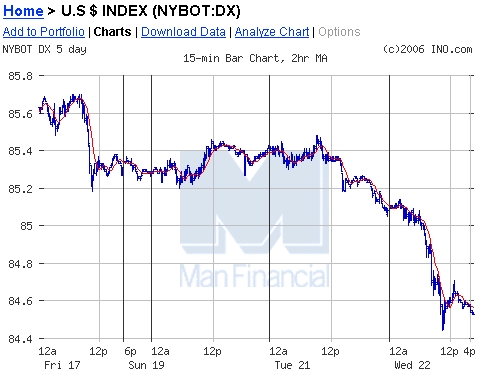
  • Investors are jamming the exit doors for the U.S. dollar this morning as three economic reports came out with a negative bias, with the only positive report coming from the Energy Department. Stock prices are struggling to move higher from yesterday’s close and bond prices are catching a modest bid to push yields lower with the economic slowdown moving into the spotlight. Most investors, including myself, expected lower volatility today going into the holiday weekend, but this development in the foreign exchange market is quite significant. The dollar is really getting whacked! Yesterday the U.S. dollar index closed at 85.12, but this morning it gapped-down to open at 84.77 and is still getting pounded lower to 84.32, touching a six-month low versus the euro.

    The first surprise that seemed to have the biggest impact on the dollar was the increase in unemployment claims from 309,000 to 321,000. Analysts’ consensuses were looking for a number closer to 310,000. To add fuel to the fire, Alcoa announced they would be sending another 13,000 workers to the unemployment lines with a reduction of workforce. The unemployment numbers hit the dollar, but stock futures were not affected much.

    Thirty minutes before the bell rang on the floor of the NYSE the University of Michigan released their index of consumer sentiment. Last month the index had a reading of 93.6 and analysts were expecting 93.3 for November, but the number came in lower than expected at 92.1. The slumping consumer confidence numbers aided the dollar decline, but this time around stock futures also moved lower.

    The third report adding fuel to the dollar decline came from the Mortgage Bankers Association saying their application index was 3.7% lower last week even though the 30-year fixed rate dropped to 6.13%. This is the lowest rate since January and below the rate from a year ago at 6.26%, but mortgage applications are declining nonetheless.

    The only report that would have offered some support for the dollar came from the Energy Department with an unexpected build in crude oil and unleaded gasoline inventories. Analysts expected a build of approximately 500,000 barrels in crude, but the number came in much higher than expected at 5.1 million barrels. Prior to the report, some analysts were expecting energy prices to rise as traders cover their short positions to square-up prior to the long weekend. Just the opposite is actually occurring. As I write, crude is down $1.42 to $58.75. I expect these low prices to last for another month, and then we move higher into the first quarter around the $60 to $65 a barrel range, but no blow-out back to $80 until later next year.

So how weak is the USD.

Have a look...