Showing posts with label EcoFirst (Kumpulan Emas). Show all posts

Saturday, March 12, 2011

Update On Ecofirst

Here's an update to an old series of posting on . The old postings:


  1. Sep 28, 2007: EcoFirst (Kumpulan Emas)
  2. Dec 21, 2007: Update on EcoFirst
  3. July 30, 2007: Update On EcoFirst
  4. Nov 25, 2008 New Update On Ecofirst
  5. July14, 2010: And What About EcoFirst (Kumpulan Emas)?

Since I wrote that July 14 2010 posting, Ecofirst announced another 3 quarterly earnings:

1. July 2010: Quarterly rpt on consolidated results for the financial period ended 31/5/2010 - loss 21.8 million.

2. Oct 2010: Quarterly rpt on consolidated results for the financial period ended 31/8/2010 - loss 2.1 million.

3. Jan 2010: Quarterly rpt on consolidated results for the financial period ended 30/11/2010 - loss 3.42 million.

Which meant that since Kumpulan Emas changed its name to Ecofirst back in Jan 2006, Ecofirst had recorded losses all the way!

And what's more embarrassing was how they disposed their shares in SEGi last year.

Here's an article on the Edge back on Aug 2010:

  • Education rally: A case of two contrasting fortunes
    Written by The Edge Financial Daily
    Monday, 09 August 2010 17:49

    IN the recent rally among education stocks, there was one clear winner and one big loser among the publicly listed companies. Selangor Properties Bhd, the major shareholder of HELP International Corp Bhd, was a clear winner, as the value of its 51% stake in HELP appreciated. EcoFirst Consolidated Bhd was the big loser, having divested its stake in SEG International Bhd just before the stock started its big rally, and rose over four times from its selling price

    SelProp, the big winner in HELP
    Selangor Properties Bhd (Selprop) is arguably the biggest winner in the education stock rally, as it is the largest shareholder in HELP International Corporation Bhd.

    According to HELP's director of corporate planning Adam Chan Eu-Khin, Selprop had been supportive of HELP from the beginning.

    "It has stuck by us through thick and thin since the beginning. That is why we are proposing a bonus issue for the first time since IPO as a reward," he told The Edge Financial Daily.

    HELP had recently proposed a three-for-five bonus issue of 53.26 million shares, upon the completion of which its share base would increase from 88.8 million to 142 million shares.

    Selprop, one of Malaysia's oldest and most conservative listed property companies, has a 51% stake, or 45.27 million shares in HELP.

    Selprop is the largest landowner in the prime Damansara Heights suburb of Kuala Lumpur, where it owns 33 acres (13.2ha) as well as several commercial buildings, including Menara Milenium, Wisma Damansara, Kompleks Pejabat Damansara and 16 shops along Jalan Batai.

    It also has a 50% stake in Claremont Shopping Centre project in Perth, and sizeable cash reserves.

    Interestingly, Selprop's stake in HELP is carried at very low costs as Selprop invested in the company during the early stages.

    According to Selprop's annual report for the financial year ended Oct 31, 2009, the cost of its investments in subsidiaries quoted and which refers to its stake in HELP, stood at only RM2.62 million. That is equivalent to a book cost of just 5.8 sen per HELP share.

    The market value of these shares then, according to the annual report, was RM70.63 million, which is equivalent to RM1.56 per share. Based on HELP's closing price of RM3.80 last Friday, Selprop's stake would now be valued at RM172 million.

    Compared with its book cost of just RM2.62 million, Selprop is sitting on unrealised gain of RM169.4 million, which is equivalent to 49 sen per Selprop share. The property company has 343.617 million shares issued. Selprop's net assets per share stood at RM4.95 as at April 30, 2010.

    Adding the "unrealised gain" of 49 sen per share will imply a revised net asset value of RM5.43, some 43% above the last traded share price of RM3.80. And this does not yet include the revaluation of its own property assets.

    While analysts note Selprop's shares are undervalued, the stock has been trading below its NTA due to the company's conservative stance compared to other developers.

    The company derives most of its income from the rental of its properties, although the upcoming launch of the Jalan Batai condominiums in Damansara Heights will lift future earnings.

    Ecofirst, a case of bad timing?
    Ecofirst Consolidated Bhd (ECB) turned out to be the biggest loser in the education stock rally when it disposed its entire 19.87% stake in SEG International Bhd (SEGi) from March to April 2010, just before the counter surged in the following months.

    Ecofirst, formerly known as Kumpulan Emas Bhd, pocketed about RM30.6 million, but could have gained at least four times more if it had held on to SEGi's shares when it rallied.

    Ecofirst had sold its stake, representing 17.69 million SEGi shares, of which 1.7 million shares were held by its wholly owned subsidiary Sawitani Sdn Bhd (SSB). It was sold to Rexter Capital Sdn Bhd for RM30.6 million or RM1.73 per share.

    The original cost of investment of Ecofirst and SSB in SEGi was RM36.1 million, made since 2001. In its Bursa filing, Ecofirst said the proceeds would be used to repay its RM7 million borrowings and for working capital purposes.

    In April, just after Ecofirst sold its shares, SEGi announced a one-into-two share split, and a one-for-two five-year warrant issue at five sen per warrant, with an exercise price of RM1.

    A month later in May, SEGi added an additional two-for-five bonus issue to the proposals, which took effect after the stock split. The share split and bonus issue was completed on July 15. Prior to the share split, SEGi had surged to a 52-week high of RM4.75 on June 24
    .

    If Ecofirst had held on to the SEGi shares, its original stake of 17.69 million shares today would become about 49.53 million shares, after the stock split and bonus issues, according to calculations by The Edge Financial Daily. In addition, it will be entitled to subscribe for 24.77 million warrants.

    Given SEGi's closing price of RM2.22 last Friday, Ecofirst's stake would have been worth RM109.96 million. In addition, the warrants would be worth RM27 million, based on the last traded entitlement rights price of RM1.09, before they ceased trading.

    This suggests Ecofirst's stake, which was sold for RM30.6 million in March-April, would have been worth RM136.96 million — or 4.5 times more, just five months later.

    SEGi had also declared a final dividend of 3.5 sen per share less tax for the year ended Dec 31, 2009 that was paid on July 28, 2010.

    Ecofirst now only holds a small 2.24% stake in SEGi. However, financial woes continue to besiege Ecofirst after the disposal.

    For the financial year ended May 31, 2010, it posted a net loss of RM41.38 million, or 6.36 sen per share, on the back of RM21 million revenue, due to an impairment loss of RM26 million on the uncompleted development in Seri Kembangan, Selangor.

    Its borrowings stood at RM130.5 million, while its cash and cash equivalents stood at RM26.17 million. Its net debt of RM104.33 million translated into net gearing of 99%.

    Had it held on to the SEGi shares a little longer, EcoFirst ironically would have been able to pare down all its debts. While Ecofirst's sale of its stake in SEGi appears to have a case of bad timing, it was not the case for Rexter Capital, which acquired its shares.

    It is unclear who is behind the privately held company. Rexter first emerged as a substantial shareholder of SEGi on March 12, 2010, when it acquired an initial 8.29% stake. Its stake as at mid-July stood at 25.4%.

I was more interested to look at Ecofirst's balance sheet from their Jan 2010 earnings. For example, I would like to compare their cash/debt versus what was published on the Edge report to see if there was any progress made. From the payment of their sold SEGi investment, surely Ecofirst's balance sheet should see some sort of improvement.

Here's my answer:

Total cash balance is only 10.55 million.

Its borrowings stood at 130.89 million.


So despite all the selling, Ecofirst's balance sheet did not improve at all.

And their quoted share 'investment'?


And what's interesting is that say in June 2007, if one had looked at Ecofirst, it was trading around 14.5 sen and Ecofirst's NTA was around 41 sen. (you can refer to their Q earnings Quarterly rpt on consolidated results for the financial period ended 30/4/2007 ).

Now if you compare to Jan 2010's Q earnings, the NTA's is only around 16 sen.

Wednesday, July 14, 2010

And What About EcoFirst (Kumpulan Emas)?

Names, names, names... you know, many do believe that names are a very, very important issue and some names just brings bad luck.

LOL! That's what they say.

Me? I hear only.

:P

Anyway, I wasn't going to write about EcoFirst. Seriously. I kid you not.

What happened was I was writing on EcoFuture ( just posted
What Lies In The Future For EcoFuture? ) , I wrote a bunch on it and yes, it really looked terrible and then I realised 'oh hell, this is EcoFirst and not EcoFuture!'

LOL!

Now since I had all the data... heck.. I might as well make this posting!

And where were we initially? Oh names. Talking about name changes, EcoFirst used to be THAT Kumpulan Emas or translated as the golden company (Apparently there was no gold, I guess )

My old posting on Ecofirst...


  1. EcoFirst (Kumpulan Emas)
  2. Update on EcoFirst
  3. Update On EcoFirst
  4. New Update On Ecofirst

From the last blog posting on EcoFirst on Nov 2008: New Update On Ecofirst

  • Which means that since Kumpulan Emas changed its name to Ecofirst back in Jan 2006, Ecofirst had recorded losses all the way!

Let's continue from Nov 2008.

Jan 2009: Quarterly rpt on consolidated results for the financial period ended 30/11/2008 - Loss 3.533 million.

April 2009: Quarterly rpt on consolidated results for the financial period ended 28/2/2009 - Loss 4.454 million.

July 2009: Quarterly rpt on consolidated results for the financial period ended 31/5/2009 - Loss 78.229 million. (yeah.. 78 million! )

Oct 2009: Quarterly rpt on consolidated results for the financial period ended 31/8/2009 - Loss 4.027 million.

Jan 2010: Quarterly rpt on consolidated results for the financial period ended 30/11/2009 - Loss 3.163 million.

April 2010: Quarterly rpt on consolidated results for the financial period ended 28/2/2010 - Loss 12.320 million.

Well, apparently changing the name from Kumpulan Emas to EcoFirst did not change the company's fortunes at all. (EcoFirst and EcoFuture.. I wonder... who jinxed who! :P )

Here's a couple of snips from EcoFirst's balance sheet taken from its earnings notes in April 2010.

Cash balances is around 700k. (yeah.. k and not m. :P)


Tons of borrowings.

Ahh... some would point out that EcoFirst owns quite a nice chunk of shares in SEGi.

And SEGi the stock had been on a fine run lately.

Apparently... this would not be doing EcoFirst much good because EcoFirst has dumped all its shares of SEGi!


Ouch! EcoFirst sold SEGi and then the stock flew!


Ok.. that was so nasty...... and mean too. Sorry! :P

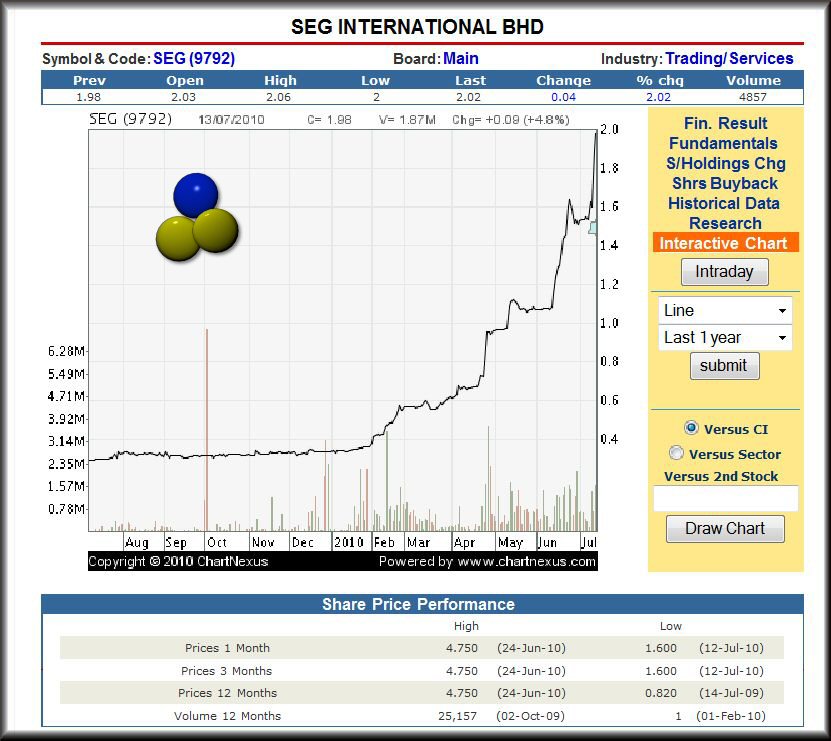
(ps: SEGi did have a rights issue and as you can see from the SEGi chart above, last month, SEGi hit a high of 4.75 on 24th June 2010! ps: EcoFirst dumped all their SEGi shares at 1.73!!!!!!!!!!!!!!!!!!!!!!!!!!!!!!!! Ouch!!!!! )

Now EcoFirst share disposed was announced on Bursa website on March 2010: Proposed Disposal - final.pdf

  • The Board of Directors of ECB wishes to announce that EcoFirst Consolidated Bhd (“ECB” or “the Company”), had on 16 March 2010 entered into a Share Purchase Agreement (“SPA”) with Sawitani Sdn Berhad (Company No. 22804-D) (“SSB”), the wholly-owned subsidiary of the Company, and Rexter Capital Sdn. Bhd. (Company No. 645612-K) (“RCSB” or “the Purchaser”) in relation to the disposal of all its shareholding of 17,690,525 ordinary shares of RM1.00 each in SEGi, representing 19.87% of the issued and paid-up share capital of SEGi (“the Sale Shares”), of which 1,709,000 ordinary shares of RM1.00 each were held through SSB in SEGi, for a total consideration of RM30,604,608.25 or RM1.73 only for each Sale Share (“the Proposed Disposal”).

Sold for 30.604 million. (hmm.. this should help EcoFirst's lack of cash in its balance sheet)

  • The original cost of investment of ECB and SSB in SEGi is RM36.1 million. The investment was made since 2001.

Since 2001? So much for long term investing.... for EcoFirst (ECB). :P

And talking about investments in quoted shares... in EcoFirst quarterly earnings notes, page 8...

How? Not doing too good eh? Looks like EcoFirst's dabbling in quoted shares is not bringing much fortunes for the company.

Tuesday, November 25, 2008

New Update On Ecofirst

I just saw an article on EcoFirst on theEdgedaily.com.

I chuckled.

I remember this one since I had blogged on it back on Sep 2007:
EcoFirst (Kumpulan Emas) I was rather amazed because this company had 7 consecutive quarters of losses since changing its name from Kumpulan Emas!!!! And that was during the good times too! I guess change of name did not bring a change in fortunes!

And the quarterly earnings after that.

Quarterly rpt on consolidated results for the financial period ended 31/10/2007

That would make it 9 quarters in a row! The next quarter, Ecofirst showed some profit!

Quarterly rpt on consolidated results for the financial period ended 31/1/2008

However the gain was rather subjective because as the company own self stated:

  • The improvement is due to recognition of gain on disposal of subsidiaries amounting to RM18.1 million

And since Ecofirst had earnings of only around 11 mil and if you minus out this disposal, Ecofirst would have showed a loss too.

And as expected, the next three quarters, Ecofirst continued to record losses!

Quarterly rpt on consolidated results for the financial period ended 29/2/2008

Quarterly rpt on consolidated results for the financial period ended 31/5/2008

Quarterly rpt on consolidated results for the financial period ended 31/8/2008

Which means that since Kumpulan Emas changed its name to Ecofirst back in Jan 2006, Ecofirst had recorded losses all the way!

Truly amazing.

Anyway, back to the article on theEdgeDaily.com. It announced it had a new Executive Director and the Executive Director has came out with a rather BOLD announcement!

  • 25-11-2008: Ecofirst sets 3-year target for rebound
    by Pauline Puah

    SUBANG JAYA: Ecofirst Consolidated Bhd will return to the black within several years if its turnaround strategy goes according to plan,
    said its newly-appointed executive director Tiong Kwing Hee.

    “With all these things (turnaround measures) in place, I would say in about two to three years’ time we should be in the black,” he told The Edge Financial Daily after the company’s AGM yesterday.

    Key to Tiong’s strategy is the restructuring of the group’s liabilities. Tiong said he planned to talk to financial institutions on the possibility of restructuring the group’s borrowings to a “slightly longer term”, possibly through their convertion into preference shares.

    As at May 31, 2008, the group’s long-term borrowings stood at RM102.2 million, while short-term borrowings amounted to RM29 million.

    The group changed its financial year-end to May 31 from July 31 for fiscal 2008, in which it posted a net loss of RM32.4 million in the 10 months.

    “(Another option) may be some form of loan stocks and a minimum coupon rate, may be a few percent to match our cash flow,” said Tiong who joined the group in September.

    Ecofirst’s diversified business interests include property, construction, food services and network marketing businesses. The group has been posting net losses for the past three years.

    As part of its turnaround strategy, the group planned to turn its South City Plaza into an “educational mall” for higher learning institutions to cater for 6,000 to 7,000 students, Tiong said.

    He also said the group expected to secure some projects from its ongoing negotiations with several government agencies.

    “We expect to get about few hundred million (government) worth of works for next year. (The amount will be) around RM300 million to RM400 million,” he said.

    Tiong said the group’s network marketing division had set up offices in Indonesia and the Philippines and planned to set up more offices in the region.

    “Hopefully by middle of next year, we will be in Vietnam and Thailand.”

    In near future, our turnover will be RM25 million,” he said, adding it was currently in talks with several manufacturers with “very good growth potential”.

    Tiong said the group would be going through operational cost cutting but denied there would be lay-offs.

Wednesday, July 30, 2008

Update On EcoFirst

Blogged last year: EcoFirst (Kumpulan Emas) and Update on EcoFirst.

Ecofirst announced its earnings tonight. It wasn't nice at all. It lost some 24 million for the current quarter. Total fiscal year loss totals more than 35 million!


And the balance sheet was extremely weak!


Friday, December 21, 2007

Update on EcoFirst

Here is an update to the blog posting, EcoFirst (Kumpulan Emas). Ecofirst announced its earnings on Wednesday. Quarterly rpt on consolidated results for the financial period ended 31/10/2007

It posted a lost of 2.4 million for the quarter.

Now if you refer to the posting
EcoFirst (Kumpulan Emas), this means that this is the 8th consecutive quarterly earnings of losses posted by EcoFirst!

Now I noted that the Edge had an article on EcoFirst.

  • 21-12-2007: Ecofirst expects more aggressive construction unit

    PETALING JAYA: Ecofirst Consolidated Bhd is expecting its construction division to move forward more aggressively next year, said its group managing director Datuk Clement Hii Chii Kok.

    He said the company was in the final stage of negotiations for a few key projects locally amounting to about RM250 million.

    “We are now focused on turning our new and existing businesses into profit generating divisions,” he said, adding that it had been less than two years since a change in the management of the company.

    It is currently constructing the Casa Subang Service Apartments in Subang Jaya comprising two blocks of 25-storey apartments.

    Speaking to The Edge Financial Daily last Wednesday, Hii said its key asset was the South City Plaza in Seri Kembangan and was looking to revamp the tenant mix and giving the property a facelift by next month.

    Its other main activities are in property development, food services and multi-level marketing. The property and construction division currently contributes 60% to the group’s turnover.

    Its subsidiary EcoFirst Hartz Sdn Bhd has a flagship Hartz restaurant in Subang Jaya, Selangor. It has a 15-year area trademark licence agreement (West Malaysia) signed in Sept 2006 with Hartz Chicken (Malaysia) Sdn Bhd, the licensee of all Malaysia and Brunei rights to the marks of “Hartz Chicken Buffet.”

    Hii said EcoFirst, as the area sub-licensee, was looking at opening four new restaurants within a year. The ultimate licensor is Texas-based Hartz Chicken Inc. EcoFirst can sub-license Hartz Chicken Buffet restaurants to other third party.

    Ecofirst has also entered into a joint venture with the Johor state government to develop a 1,000-acre biotechnology driven agricultural farm in Desaru, Johor, to set up and run greenhouses and open crop farms. It is currently in the first of three phases.

    The JV is part of the group’s expansion into more areas of agro-biotechnology, specifically organic farming using high end and environmentally friendly technology.

Friday, September 28, 2007

EcoFirst (Kumpulan Emas)

EcoFirst Consolidated used to be known as Kumpulan Emas until the name change back in Jan 2006.

Here's a long article posted on Star Biz back in 2006.


  • Saturday February 25, 2006

    What’s in store for EcoFirst with new MD

    BY ERROL OH

    FOR a company whose market capitalisation has been more than halved since the start of last year, any major change usually brings hope to its minority shareholders. So it was for EcoFirst Consolidated Bhd when Datuk Clement Hii had recently bought a substantial stake and later became its group managing director.

    Hii's appointment on Jan 27 was part of a boardroom revamp that also included former academician Tan Sri Dr Syed Jalaludin Syed Salim taking over from Datuk Patrick Teoh Seng Foo as chairman. The latter is now the deputy chairman but retains his executive directorate.

    Before that, there was a name switch. This explains why, for some people, EcoFirst does not ring a bell. The stock had been trading as Kumpulan Emas Bhd until Jan 20.

    However, the bigger changes at EcoFirst are still ahead. For one thing, the diversified group – it has interests in oil palm plantations, property, education and manufacturing – intends to venture into new fields. Biotechnology is one area.

    The idea is to ride the government's push to build up the industry via the National Biotechnology Policy, which was unveiled last April. EcoFirst's immediate plan is to tie up with some Indian companies to produce herbal products for the domestic and foreign markets.
    Says Hii, “The main thing is to focus on core businesses that will bring in money. The problem with EcoFirst is that it doesn't have a core business that generates a steady stream of income.”

    This absence of sturdy anchor activities has led to losses in financial years 2004 and 2005. To make things worse, EcoFirst had to part with some valuable assets last year to lighten its debt burden.

    The disposals were done at depressed prices and resulted in EcoFirst relinquishing control of two listed companies, water engineering specialist Salcon Bhd and furniture manufacturer SYF Resources Bhd. It also reduced its stake in property player Meda Inc Bhd.

    (Another listed company in the EcoFirst stable is education provider SEG International Bhd, or SEGi. EcoFirst has almost 26% equity interest in SEGi. Hii is also the chief executive officer of SEGi.)

    At the start of 2005, EcoFirst (then still known as Kumpulan Emas) was trading at 27 sen. The shares are now just a little above the 10-sen mark.

    It's the kind of performance that frustrates shareholders, and there are many EcoFirst minority shareholders out there. It is a counter that has always had a strong retail following. As at Dec 31, 86% of its share capital was in the hands of almost 36,000 shareholders. Its 30 largest shareholders accounted for only 34%.

    Apart from Hii, the only substantial shareholders are Patrick and his brothers, Seng Kian and Seng Aun. The brothers' combined stake is about 12%.

    New directions for EcoFirst

    Since Hii only bought his 5% stake in November, the minority shareholders' displeasure was mainly aimed at the Teoh brothers. It is understood that this dissatisfaction bubbled to the surface at the company's annual general meeting on Dec 30, with shareholders demanding answers as to why the company has fared poorly.

    Such sentiments have also sparked speculation that the Teoh brothers are ready to leave the company. Says a corporate observer, I think they're just tired of it all – the huge effort required to try to turn things around, and the growing criticism.”

    Naturally, Hii's emergence as a substantial shareholder has stoked the rumour mill. He says he invested in EcoFirst because he believes that its diversified business base offers a lot of room for growth. He hints that he will increase his stake, either through acquisitions in the open market or via option agreements with the existing shareholders.

    In any case, EcoFirst has an attractive valuation, at the current market price. So, there is great upside potential. It's a matter of doing a few right things and putting a few things right,” he adds.

    “There'll be a major revamp of our management systems and style, and we will pursue greater operational efficiency for our existing businesses. And we will aggressively pursue business developments in new fields.”

    He points out that there are many avenues to maximise the potential of the company's existing businesses. For example, the plantation division can be a major money-spinner because palm oil prices in India are higher due to the tariffs that shield the local industry.

    Subsidiary PalmTech India Ltd has a concession for contract farming with local landowners, who collectively own more than 280,000 hectares (ha). However, only 10,000 ha have been planted over the last five years. “To me, that shows not enough emphasis has been given to oil palm,” says Hii.

    He adds that EcoFirst is talking to provincial governments in India to get new additional concession areas, not just for oil palm, but also to cultivate other cash crops and herbal plants (such as vanilla, aloe vera and jatropha, whose oil can be used to make biodiesel) for the export market.

    In addition, there are plans to transfer to Malaysia the expertise of the Indian biotechnology partners. EcoFirst has initiated discussions with Malaysian landowners on possible joint ventures for large-scale farming and processing of herbal products.

    Are the Teoh brothers in or out?

    Such plans may well be a reason for optimism, but some observers say investors are equally interested to know if the Teoh brothers will continue to be involved in EcoFirst.

    When asked about the talk that they are exiting the company, Patrick says, “Who told you that? We are still substantial shareholders. We'll each have our role. Datuk Clement will run the company, while my role is more at the board level.

    “It's just like how it was at SEGi. We don't want to meddle in the operations of the company. It's a move towards separating the ownership from the management of the company. That's the way it should be. Look at Salcon, although there has been an ownership change, the management is still in place.”

    Hii recognises that the negative perception about EcoFirst is linked to how people feel about the Teoh brothers' handling of the listed companies in the group. He, however, insists that in the four and a half years that he has run SEGi, the brothers have seldom interfered in management and operational matters.

    The question of whether the Teoh brothers will stay on at EcoFirst may become irrelevant if Hii stamps his mark at the company.

    Those who know him from when he was appointed as SEGi CEO say he is decisive and hands-on. A former senior journalist, Hii had ventured into the education business and became the SEGi boss in 2001 after it had acquired his Kuching-based institute.

    “He is a fast learner, and at SEGi, he has picked up a lot about the corporate world. He's a good choice for EcoFirst,” says a CEO of a listed company who is familiar with the EcoFirst group.

    There is the worry that Hii may be spreading himself thin by leading both EcoFirst and SEGi. He maintains that he can do well at both jobs, with the support of the management teams of both companies.

    “I continue to be involved in SEGi because education is a personal passion as well as a professional pursuit. Over the past few years, my team and I have embarked on various ambitious projects to move SEGi forward. We are moving into new market segments and we are beginning to show results despite some initial setbacks.

    “I am determined to ensure that these projects are realised and that they bear fruit in due course.”

    Another challenge is that Hii has to demonstrate that his strength is not just in education, and that he can run a diversified company.

    He says, “I have been in business for over 20 years. I hope people see me as an entrepreneur, an enterprise builder. I believe that whatever business we're in, innovation is the key to success.”

    In any case, it may not be a long wait to see if Hii has what it takes to restore confidence in EcoFirst. “I don't expect a long honeymoon for my management team and me. We have to add value to our current businesses and bring in new core businesses to generate a steady stream of revenue,” he adds.

    “We have to move fast. We give ourselves a maximum of two years to show some positive tangible results. But we should within a few months, and not a few years, make significant progress in developing new businesses.”

I would like to comment on them bold purple fonts.

Firstly on the issue of the growing criticism. Let's face it, Kumpulan Emas performed terribly as a company. Surely the criticism is justifiable! And when the performance is so utterly poor, certainly this would frustate the minority shareholders. Question that begs to be asked is why are these minority shareholders still a shareholder? Surely this is one huge investment gone wrong. Yes?

  • “In any case, EcoFirst has an attractive valuation, at the current market price. So, there is great upside potential. It's a matter of doing a few right things and putting a few things right,”

Attractive valuation? And doing a few right things and putting things a few things right. Sounds so easy.

So EcoFirst parted with some valuable assets to lighten its debt burden.

But let's see how has Kumpulan Emas performed as a company under a brand new company name, EcoFirst.

Quarterly rpt on consolidated results for the financial period ended 31/1/2006

Revenue 8.30 million. Loss 2.4 million. ( Total Cash - 2.729 mil, total debts - 143.872 million, Net debts of 141.143 million)

Quarterly rpt on consolidated results for the financial period ended 30/4/2006

Revenue 6.465 million. Loss 1.178 million.

Quarterly rpt on consolidated results for the financial period ended 31/7/2006

Revenue 28.981 million. Loss 10.564 million.

Quarterly rpt on consolidated results for the financial period ended 31/10/2006

Revenue 24.235 million. Loss 3.547 million.

Quarterly rpt on consolidated results for the financial period ended 31/1/2007

Revenue 18.752 million. Loss 5.898 million.

Quarterly rpt on consolidated results for the financial period ended 30/4/2007

Revenue 21.584 million. Loss 2.663 million.

Last night it reported its 2007 Q4 earnings.

Quarterly rpt on consolidated results for the financial period ended 31/7/2007

Revenue 28.224 million. Loss 24.944 million. (Total cash of 3.9 mil vs total loans of over 150 million! Any improvement of its debts burden?)

So let's be frank here. If someone critics the poor earnings performance of EcoFirst, do you reckon that there is justification?

7 consecutive quarters of losses!!!!

Improving debt burden? Is there any?

And what was said back in 2006?


  • “In any case, EcoFirst has an attractive valuation, at the current market price. So, there is great upside potential. It's a matter of doing a few right things and putting a few things right,”

Doing a few right things and putting things a few things right. Yeah man, it just sounds so easy!