Thursday, December 07, 2006

There's a more serious bubble today than there was then

Remember Julian Robertson? Well he's one of them legendary hedge fund manager.

There is a nice commentary posted on Morningstar.com where Julian fired a strong warning about today's market: here

  • Legend vs. legend

    Hedge fund manager, investment conference impresario and newsletter publisher Whitney Tilson has a terrific piece in the latest edition of his Value Investor Insight in which he does a mea culpa to legendary hedge fund manager Julian Robertson, who quit the business in 2000 at the height of the last round of stock-market insanity.

    The mea culpa deals with comments Tilson, a big fan of Warren Buffett, wrote when Robertson threw in the towel. He noted that Robertson and Buffett have different styles, reflected in their portfolios at the time: Buffett likes high- growth companies with high margins, great balance sheets and returns on equity that exceed their cost of capital. Robertson opted for the ultimate value stocks with high debt, low margins, poor returns on equity and erratic growth. "This is a lame collection of companies...which deserve to trade at a low average multiple," Tilson wrote.

    Fast-forward to today and, as it turns out, Robertson's 2000 portfolio shows why he, too, is considered a legend: In a period when the S&P 500 slipped 7%, his portfolio boomed by 120% compared with a 38% rise for Buffett's Berkshire Hathaway. Both, Tilson points out, handily beat the market.

    Speaking of the markets: Robertson quit because he felt it was too irrational. What does he think now? "Surely you don't see the same degree of irrationality today that existed then?" Tilson asked. "Oh yes sir, I do," Robertson shot back.
    "There's a more serious bubble today than there was then."

Think about it for a moment...

How Brown Cow?

Hot Markets

Aren't we all having a time of our lives?

There is one article posted on Safehaven:
Warning Shots and Spin. It's written by Steve Saville from www.speculative-investor.com.

Highly interesting piece and the point in which he mentions the sharp correction Saudi Arabia's Tadawul Index is really as a good warning as any. Look at his posted chart. See how it has broken sharply to the downside over the past several weeks?

And I do agree very much with his comments on how the US Fed is trying to put the spin on the collapsing US Housing Market:

  • Spinning the housing downturn as a stock market positive

    The downturn in the US housing market is being spun as a stock market positive on the basis that it will force the Fed to begin a rate-cutting program and, as everyone knows, Fed rate cuts are bullish for the stock market. Well, it's often the case that what everyone knows is not worth knowing and that certainly applies here because Fed rate cuts are often NOT bullish for the stock market.

    When it comes to the setting of the Fed Funds Rate target the Fed will usually just follow the market in that some time after the market begins to lower short-term interest rates the Fed will start doing the same. However, lower short-term interest rates definitely wouldn't be a significant positive for a stock market priced in anticipation of strong earnings growth if the downward move in interest rates was a response to a sharp deterioration in the economic outlook.

    In any case, the whole idea that the Fed's next move will be to lower the official interest rate deserves to be seriously questioned because it is based on the assumption that inflation expectations will remain low. There are, however, conditions that have a reasonable chance of arising over the coming months that would invalidate this assumption. Before we mention what these conditions are it's important to understand the Fed's greatest fear.

    It is often said that the Fed fears deflation. This is true, but the Fed's fear of deflation can be likened to your editor's fear of swimming with Great White sharks. Your editor would be very fearful of jumping into the water if he suspected that a Great White was lurking below, but sharing a patch of water with a Great White is not something he spends any time worrying about because it is something he can easily avoid. It's the same story with the Fed and deflation. Deflation would be a nightmare for the Fed, but Ben Bernanke will never spend much time worrying about it because he knows he can easily avoid it.

    What the Fed regularly does have to worry about is an out-of-control surge in inflation expectations. The Fed can create money in unlimited quantities at practically zero cost, but today's money continues to have value because most people TRUST that it is going to do no worse than lose its purchasing power at the rate of a few percent per year. Or, to put it another way, the money is essentially worthless but as long as most people BELIEVE that the money will decline toward ultimate worthlessness at a slow pace it can continue to be a useful medium of exchange.

    The Fed and all other central banks would face a problem, though, if a critical mass of people began to anticipate a rapid acceleration along the road toward eventual worthlessness. If this happened then the Fed would be at risk of losing its ability to keep the world's greatest confidence game going, and it is this risk, not the risk of deflation, that has the potential to keep a central banker awake at night.

    We'll now return to our original discussion. There is a significant chance that additional weakness in the housing market WILL prompt the Fed to begin reducing the official short-term interest rate target within the next few months, BUT ONLY IF inflation expectations remain under control. On the other hand, if it looks like the gold price is about to breakout to new multi-year highs then cutting interest rates will probably be the last thing on the collective mind of the Fed, regardless of how weak the housing market happens to be.

Dr. Marc Faber's Interview with Jim Puplava

Dr.Marc Faber appeared as a guest on Jim Puplava's Financial Sense Newshour.

It's extremely interesting.

Give it a click. You might pick-up an extremely good tip in there!

http://www.financialsense.com/Experts/roundtable/2006/1202.html

Monday, December 04, 2006

Zero Integrity from Our Financial Press!!

Blogged on the issue of Where is the Integrity of Our Financial Press?

In that blog posting, I questioned the integrity of the journalist who had a history of quoting 'according to sources' throughout his editorials.

This is what I wrote:

Today, 2nd Dec 2006, the same reporter has another article.

TM eyes Time dotCom

THE board of Telekom Malaysia Bhd (TM) is expected to deliberate on a proposal this week, one that it has been mulling for some time now. Sources say the state controlled elecommunication giant is considering a plan to acquire a 42.7% stake in Time dotCom Bhd from its parent
Time Engineering Bhd.

Incredible a lot of folks knew that this article was going to be published today!!!! (look at the nice run Time dotCom had on yesterday!)

Same style, same shenanigans from the journalist.

THE board of Telekom Malaysia Bhd (TM) is expected to deliberate on a proposal this week, one that it has been mulling for some time now. Sources say the state controlled telecommunication giant is considering a plan to acquire a 42.7% stake in Time dotCom Bhd from its parent Time Engineering Bhd.

Expected? Sources say?

These aren't factual reporting is it?

Again where is the integrity of OUR financial presss?

BizWeek understands that the offer price for some 1.1 billion Time dotCom shares, although yet to be finalised, may be in the region of RM1 and RM1.20 per share. A decision is expected to be made soon.

Woah!!!!

BizWeek understands?

>>>

Hmm... I wonder where is the Editorial team when yet again the party mentioned in the FINANCIAL NEWS denied the write-up today!!

Article in the Star entitled "TM eyes Time dotcom" and the Article in The Edge Malaysia, entitled "Now it's TM to buy Time"

Quote:

  • We wish to inform the Exchange that the above statements are inaccurate and misleading and they were not attributed to any sources from Telekom Malaysia Berhad (TM). We further wish to state that TM has no plan currently to acquire a stake in Time dotCom nor Time Engineering Berhad and that there is no Board of Directors meeting scheduled this week as erroneously reported.

    For the record,
    TM Group owns the largest network of fibre optic cables in Malaysia totaling more than 220,000 core kilometers.

So come on Jose, Show ME your SOURCE!!!

And did you watch that movie on Astro called SHATTERED GLASS?

You really should!

Look at the drastic U-TURN Timedotcom did today!


See the unreal danger when OUR financial press writes 'according to un-named sources'?

Are the sources even REAL?

I wonder!!

btw... i saw this other announcement.

TIME ENGINEERING BERHAD ("TIME" OR "THE COMPANY") DISPOSAL OF 54,126,800 ORDINARY SHARES OF RM1.00 EACH IN TIME DOTCOM BERHAD

We wish to announce that TIME has further disposed a total of 54,126,800 ordinary shares of RM1.00 each in TIME dotCom Berhad ("TdC") in the open market from 27 October 2006 to 4 December 2006 for a total net consideration of RM 44.5 million ("the Disposal").


Woahhhhh!!!!!

A party disposing shares of Timedotcom like crazy!!!

I wonder!

I really wonder!


Mulpha

Ah Kor-Kor,

S&P on its write-up on Nov had judged Mulpha based on its earnings performance. And this is what it had mentioned:

Mulpha’s 3Q06 earnings were below our expectations. The company reported 3Q revenue of MYR185.3 mln, which was largely in line with our forecast. However, its net loss of MYR10.5 mln was unexpected.


Operationally, the performance of Mulpha’s property development arm was surprisingly weak, reporting an operating loss of MYR13.6 mln compared with an EBIT of MYR11.9 mln in 3Q05. Management attributed the weak results to the absence of contributions from Mulpha FKP Pty Limited, which is undergoing a restructuring exercise and the soft property market in Australia from rising interest rates.


Which technically, S&P was correct...

but...

Mulpha business is complex. A different kind of animal in all honesty.

The following was its previous year, fy 2005 Q4 earnings.

Quarterly rpt on consolidated results for the financial period ended 31/12/2005

And if you look at the earnings notes, you would note the exceptional items noting gains of 298.747 million.

And the following is Mulpha's previous year, fy 2004 Q4 earnings.

Quarterly rpt on consolidated results for the financial period ended 31/12/2004

And if you look at it again, there was yet exception items in which Mulpha recorded gains totalling some 30.9 million.

And the previous year, fy 2003, same thing yet again.

Quarterly rpt on consolidated results for the financial period ended 31/12/2003

For fy 2003, Mulpha recorded exceptional gains of 31.380 million.

Do note, these exceptional items are rather tricky in nature. Some involved sale of land, some involved disposal of investments and some gains recorded from the gorup's restructuring of its businesses. Hence, Mulpha is not a straightforward business in one could value by just looking at earnings.

Now let's have a look at its fy 2002 Q4 earnings.

Quarterly rpt on consolidated results for the financial period ended 31/12/2002

Same thing. But back then it had exception losses which cause a lost of 11.149 million. Anyway, i do believe you get my drift.

So perhaps earnings is not how you would want to gauge this group by and perhaps a more interesting way is to gauge is by the doing the quick asset gauge. What one could do is perhaps gauge the fy 2004 Q4 earnings NTA verus its current Q earnings nta. Do note this asset comparison is fallable and many would argue against its usage - however as a quick and fast indicator to see if this company is worth our time in exploring in more detailed, I would perhaps use it as a starter.

So far.. right now.. the simple Question would be, do you like what you see? Do you see value being created in the group? Do you reckon that perhaps there is more value to Mulpha than just to gauge it by its earnings?

And as usual.. just my second opinon.

rgds


Compilation of Warren Buffett articles

Found an site which compiled a comprehensive imformation on Warren Buffett. Great work done by Toughiee.

http://webcompilation.googlepages.com/webcompilation.htm

Enjoy!

Thursday, November 30, 2006

Maxtral's Earnings and its possible ICP dilution effect

Unker Anon,

Sorry was in a rush this morning. :D

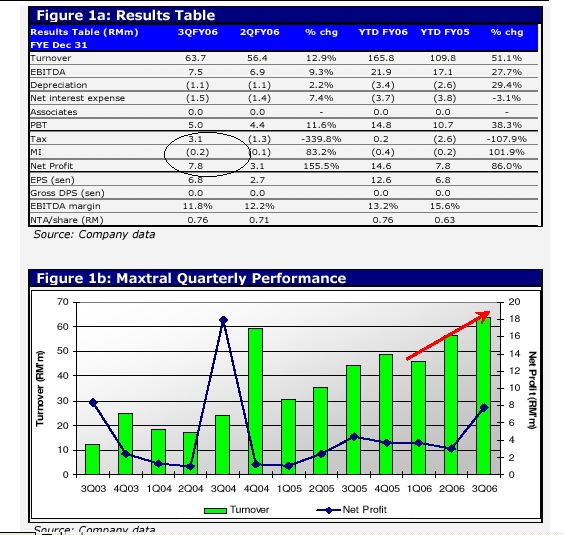
Firstly, its earnings.

I'm kinda confused cos i had a glance at OSK write-up.

So I decided to look back at Bursa website.

This is Maxtral's Q1 earnings.

Quarterly rpt on consolidated results for the financial period ended 31/3/2006

net profit reported: 3.707 million

This is Maxtral's Q2 earnings.

Quarterly rpt on consolidated results for the financial period ended 30/6/2006

net profit reported: 3.053 million.

This is Maxtral's Q3 earnings.

Quarterly rpt on consolidated results for the financial period ended 30/9/2006

net profit reported: 3.470.

If you add up the numbers, its net profits shows 10.230 million only. But if you look at what Maxtral is saying, its ytd 3 quarter net profit is at 14.559 million.

How?

I think the later is correct because the cash flow is much, much stronger than Maxtral's earnings of 10.230 million. So what i am saying is i believe Maxtral's Q3 net earnings is much more than stated. I believe it's a typo, perhaps.

I took a screen-shot of Maxtral's earnings (look at the circle). OSK is saying that according to Maxtral data, its Q3 net earings is 7.8 million. (which kinda tally with Maxtral's cash flow, cos this quarter, Maxtral's cash flow increased by some 14+ million!)


Now regarding them dilution effects again.

Remember i wrote the following....

>>>>

1. Them preference shares issue. See Maxtral posting.

  • At the moment of writing, Maxtral has some 210.099 million shares and it has some 84.415 million shares of ICUL outstanding. (ICP can converted on 1-1 basis)

Which means that if one ass-u-me full conversion of these ICP shares, then Maxtral should have 294.514 million shares. That should the share base you probably should work upon to avoid any shocks from discovering that your earnings per share has been diluted by these ICP shares. Ass-u-me the worse case scenerio. That's what I would have done. Remember this is just a mere second opinion. Some would probably have a different approach depending on one's investing style. For example, some would dare just the current share base (210.099 mil shares) cos they do not reckon that they would be such a long term investor. Which is right or wrong, it depends on your own interpretation.

>>>

So if you have a look at Max's earnings, its Q3 earnings states that its net earnings came in at 14.979 million.

Now assuming this figure is correct.. then this company is churning out some 4.993 million per quarter or as they say, if u annualise on a yearly basis, that's close to 20 million in earnings.

Using the fully-diluted number of shares - ie assuming full conversion of ICP, then the earnings per share is 20 million divided by 294 which gives you roughly an earnings per share of 6.8 sen.

So if you use this diluted earnings per share number, i think you should be ok lah.

PS..

regarding the mp player. BUY the IPOD nano unker. Your kids been good and they deserve a grand christmas present!

:D


The US Dollar again

Well the Fortune has an article on it posted on the CNN website: The dollar's slide: How far, how hard

  • The dollar has tumbled about 2.5 percent against the euro in the five sessions through Tuesday. Although the greenback came back a bit Wednesday, the dollar's near its weakest against the euro since March 2005. The dollar also fared badly against the British pound, though it's done slightly better against the lowly Japanese yen
And the most interesting comments were the last two paragraphs.

  • "What we really should focus on is that fact that the Americans were on holiday and foreigners decided to sell," said Axel Merk, manager of the Merk Hard Currency Fund, which has $47 million under management, referring to the dollar's recent drop. "Given the extent to which we're dependent on foreigners to prop up the dollar because of our current account deficit, that's worrisome."
    "A dollar decline is in nobody's interest, but it's highly overdue and will happen at some point," Merk said.
And did you read Gary Dorsch editorial, Will China lead a stempede out of the US Dollar?