Web Hosting

Your Ad Here


Mr. Soros: I'm only rich because I know when I'm wrong.

Wednesday, February 28, 2007

Is this the Perfect Storm?

Markets around the world took a hefty beating yesterday. And the US Market was hit pretty hard.


http://money.cnn.com/2007/02/27/markets/markets_0530/index.htm?postversion=2007022718

  • Brutal day on Wall Street
    Dow tumbles 416, biggest one-day point loss since 2001, as investors eye China, drop in durable orders.
    By Alexandra Twin, CNNMoney.com senior writer
    February 27 2007: 6:22 PM EST

    NEW YORK (CNNMoney.com) -- The stock market tumbled Tuesday in a selloff sparked by worries about economic growth at home and abroad, sending the Dow industrials to their biggest point drop since the day the market reopened after the Sept. 11 attacks.

    A big decline in Chinese stocks, weakness in some key readings on the U.S. economy and news that Vice President Dick Cheney was the apparent
    target in a Taliban suicide bombing attack in Afghanistan all fueled the selling on Wall Street.

    The Dow Jones industrial average (down 416.02 to 12,216.24,
    Charts) tumbled 416.02 points, the biggest point loss since Sept. 17, 2001, when the 30-share tumbled nearly 685 points.

    It was the seventh biggest one-day point ever for the Dow. On a percentage basis, the Dow lost about 3.3 percent.

    The broader S&P 500 (down 50.33 to 1,399.04,
    Charts) index fell about 3.5 percent - its worst one-day percentage loss since March 2003.

    The Nasdaq (down 96.66 to 2,407.86,
    Charts) composite tumbled 3.9 percent in its biggest percentage drop since early December 2002.

On Valentine's day, I posted the following posting: US Market Soars ... but....

Which highlights the issue about the insane going on in China. Now this blog posting is not too boost my ego and neither is a I-told-you-so posting but for those interested, I thought it would be good if I brought up the points mentioned again.

I am and has been extremely wearly about the extremely stong turbulance beneath it all. Can a strong market simply mask all the woes underneath?

Today's FSO write-up, Frank Barbera has another wonderful piece: Oh, What a Tangled Web We Weave

...
And Mr.Barbera then highlights China and Mexico.

  • In addition to the investment banks, change always tends to develop on the outer periphery, in the credit markets, at the lowest quality of debt, the most marginal borrower. Where the “sea of liquidity” is concerned, the Emerging Markets, ripe with high-beta, represent the equity front where nervous capital is most likely to begin an organized retreat. In the current instance, these markets are also of paramount concern, as the chart configurations also herald what could be a very major peak. Of course, no economy has been hotter in recent years than China, And in the final closing moments of 2006, we saw Chinese share prices move almost ‘straight up.’ Looking back, this kind of near vertical movement over an extended period of months (as was seen in the second half of 2006), strongly suggests a ‘blow-off’ top, an argument which gained more traction with the nearly 10% decline in the opening sessions of 2007.


  • Above: the Chinese stock market over the last several years, traced out a potential blow off top amid rampant speculation in the final days of 2006. On the bottom chart, we see that Wave V equaled the net gain of Waves One thru Three, at the peak seen earlier this year.


  • In addition to the highly volatile and unstable trading pattern seen in China, markets like Brazil and Mexico appear over-extended and toppy. In the case of Brazil’s Bovespa Index, we saw momentum register an important peak back on February 6th of 2006 with the Bovespa at 32,847.61. Since then, prices succumbed to 21.75% decline which bottomed last June, with the second half rally in global equity markets lifting the Bovespa to new all time highs in early December. However, even as the Bovespa attempted to breakout to new highs in December, MACD was making lower highs then had previously been seen at the February 2006 peak. Over the last few weeks, the Bovespa has pushed to new highs once again, this time with a momentum profile that is threatening to go negative. This kind of extreme bearish divergence is often a signal that prices are topping out.


  • In the case of the Mexican IPC, the market has gained 69.32% SINCE LAST JUNE, annualized; that’s a rate of appreciation north of 138%. In addition, the Mexican Bolsa is also more than 25% above its 200 day average, another “red flag” indicating an overheated market likely to reverse lower. Finally, I also maintain an indicator known as the “Days Up per 50” which in the case of the Mexican Bolsa tells us that the market has now been up 38 of the last 50 days, and it has been holding that level for the better part of two weeks. How much risk does this represent? In my view, it strongly suggests that the capital markets are now living on borrowed time, and that the Emerging Markets are ready to begin rolling over in earnest in the days just ahead. For an over-leveraged financial speculator community including untold hedge funds, this chart should spell ‘trouble ahead’ for anyone who has been in the markets any length of time.
Btw... on Sahamas there was couple of postings mentioning this isssue: White Hot Chinese Markets and here's another good posting on the issue of global liquidity Merrill sounds alarm...... and in today's FSO commentary, Mr.Barbera made the following posting: Tracking the Perfect Storm.

  • There is a blip on the long-range radar, something out there -- out there at extreme range -- yet now steadily closing the distance. Unable to be seen over the expanse of a long horizon, the object draws relentlessly closer bearing down on our position. As it approaches, we begin to feel the lashing winds and violent seas of a still developing ‘perfect storm.’ In advance of its approach, the palpable change is impossible not to notice with the complexion of a sunny day evaporating into a miasma of increasing winds and darkening skies. Like the approaching storm -- a weather system of immense size and power -- today’s violent decline in global financial markets is the signature of steadily darkening storm clouds and a BEAR MARKET in its early stages. Whoa, to the investor that ignores the message of such an unmistakable and powerful force. Bear markets take no prisoners cutting a path through investor portfolios strewn with wreckage and debris.
  • Over the last few weeks, all of our indicators have pointed to burgeoning trouble spots -- China, Mexico, Brazil, the Investment Banks, Homebuilders, the S&P itself and of course, the Sub-Prime Lenders. They are all actors in ACT I of a still unfolding 7 ACT play. The pain threshold and turbulence is only now just starting to increase, so for those with weak stomachs, now would be a good time to reach for the Dramamine and buckle in. In last week's report, I noted the S&P appeared to be in the final stages of completing a five-wave advancing wedge. In today’s action, that wedge formation broke down violently with prices moving down to test the 1380 to 1390 support zone near the lows of the day.


Above: an update of last weeks hourly S&P chart showing the five wave “Rising Wedge” now breaking down.


  • For those wondering what a breakdown from a wedge formation implies, it means that prices have left behind what in all likelihood will be THE highs for this cycle. Wedges are ending patterns, and this one has packed the classic wallop. For a “would be” developing bear market, today’s decline is just another straw in the wind, letting us know that the storm is drawing ever closer. Over the next few weeks, the broad market will very likely make a short term low over the next day or two in the 1380 to 1390 zone and then begin a slow, “failing” recovery rally. Odds are high that within two weeks, today’s sell-off will be dismissed by the Wall Street “Buy Side” pundits as nothing but a healthy correction with happier and sunnier days dead ahead. Their bullish prattle will likely be wrong, and likely wrong in a financially costly manner, as was the case in 2000-2002 as it has taken the S&P nearly seven years to recover what was lost in just two. In bear markets, “Down is faster,” a rule many all too quickly forget. No, the clouds are definitely darkening, and this storm has the earmarks of something much deadlier, packing far more firepower than anything seen in a very long time.

  • At landfall, it will literally unfold all around us with a Housing Crisis – Check!, a Banking Crisis – Check!, and ultimately, a Currency Crisis – Check!. Check, Check, Check! On all three centers of gravity, the vortex will spin faster and faster, becoming ever more self-reinforcing like a maze of tumbling dominos. Only gold, and perhaps oil are likely to withstand, and indeed, thrive within this particular burgeoning onslaught. With today’s decline, the S&P is now down 1.34% for the year, with the NASDAQ down 4 points for the year and the DJIA down 1.98% for the year. So much for the barrage of daily new records repeated and repeated ad nauseam by the squawking parrots on cable TV. We will now undoubtedly be told that the market is “oversold” and sure, the market is becoming oversold on a “short-term” basis. Yet a quick glance at the Medium Term ARMS Index below, shows that even with today’s violent market decline, it is still a long, long way to Tipperary as the ARMS Index ended at a very neutral value of .95.


  • Historically, the Medium Term ARMS Index would not even begin to signal the presence of an important stock market bottom until readings above 1.30 or higher are seen. The index is plotted on an inverted scale, where “high” readings above 1.30 signal a significant oversold condition, with readings below .85 signaling an overbought condition. As recently as last Wednesday, February 21st, the Medium Term ARMS was heavily overbought at values in the low .70 range with a close of .739 last week. This implies that over the period of let’s say, the next six months, there can be much room for great pain and damage in the stock market indices -- starting with the complete retracement of the market rally of the last six months. From here on, until we see serious oversold values, it will be best to assume that where market rallies are concerned, they should be viewed as opportunities to sell non-gold, and non-oil related stocks.

  • Of course, the upcoming downturn will likely be global in nature. Two weeks ago, I featured the over-extended charts for Shanghai, Mexico and Brazil, warning of an imminent reversal. Last night, Shanghai registered a nearly 10% decline, one of its largest single day declines in history and a large single day decline even by US historical standards. In Mexico, the IPC Index plunged 4.79% while in Brazil, the Bovespa fell nearly 6.13%. These are not “incidental” declines, nor do they leave a price structure devoid of technical damage. Quite the contrary, within these markets, we have seen the construction of the classic parabolic edifice with these declines puncturing the larger bubble. And yet, the equity bubble was a mere trifle when compared to the much larger credit bubble, the true power plant that will drive the Perfect Storm. Note this morning’s announcement for the venerable Freddie Mac stating that,

Freddie Mac Plans to Stop Buying Some High-Risk Mortgages in Roiled Subprime Market

WASHINGTON (AP) -- Mortgage giant Freddie Mac said Tuesday it will no longer buy high-risk home mortgages that it deems to be highly vulnerable to foreclosure. The surprise move came amid a deteriorating market for subprime loans affected by slumping home prices and rising interest rates. The government-sponsored company, which is the second-biggest financer of home loans in the United States, said it will begin using stricter standards for mortgages that it buys -- including limiting the use of loans requiring less documentation of the borrower's status than conventional mortgages. The goal is "to help ensure that future borrowers have the income necessary to afford their homes," McLean, Va.-based Freddie Mac said.

"The steps we are taking today will provide more protection to consumers and enhance the level of underwriting standards in the market," Richard Syron, the company's chairman and CEO, said in a statement. The changes will take effect Sept. 1, the company said, to avoid disrupting the mortgage market. Roughly half the subprime mortgage-backed securities that Freddie Mac now owns would likely fall short of the new standards, the company estimates. The company's new standards cover certain types of hybrid adjustable-rate mortgages that comprise about three-quarters of the subprime market. An adjustable-rate mortgage is considered a higher-risk loan because it typically draws borrowers in with an initial low, or "teaser" rate, which can rise substantially over time. In a bid to promote a change in the home-loan market, Freddie Mac also said it will "strongly recommend" that banks and other mortgage lenders hold money from borrowers in escrow for paying taxes and insurance.

  • Like a plate of Rice Krispies, the theme of the day is Snap, Crackle, Pop, as in “Snap” goes China, “Crackle” goes Freddie Mac, and “Pop” goes the Sub-Prime Market. The end result will be a messy brew of another breakfast cereal, this one a soggy bowl of Captain “Credit” Crunch. Within the Credit Markets, we see a contagion well underway. Just look at the destruction on New Century and Novastar Financial. Piloted straight into an asteroid belt, in both cases, we see the proverbial “wrecked” ship with a dead crew. Yet, the ripple affects reverberate up the quality chain, as Wall Street is loathe to mount a brave front in the face of invading hordes.


  • Above: Moving up the quality chain, we see a long erosive decline underway for months at Novastar Financial, greeted by jeers and laughter from investors in “favorite” IndyMac. Virtually within days of Novastar’s spectacular collapse, IndyMac flirts with 52 week New Highs. The ensuing collapse of Novastar then sends a cold chill through the mortgage industry, with Wall Street quickly reversing gears on even the diversified “darlings” on IndyMac and Countrywide


  • In the chart abov), we plot the price of New Century Financial against “bluechip” Countrywide. Notice that between September 2004 and October 2005, New Century plunged 52% from $66 to $30 while over the same time, Countrywide corrected by a milder 20%. Thereafter, between October 2005 and April 2006, New Century recovered half its loss, with “high quality” favorite Countrywide moving up to new all time highs at $45. “They are more immune to the pitfalls of a down cycle,” we were told by many and now “are well diversified to stand up to a down-cycle with more “fee” related income.” And so we see still more new highs in Countrywide right up to the very moment of the exploding crisis -- Countrywide hitting still higher highs right into early February 2007, only days before New Century collapsed. Now, in light of the clear and wide-spread admissions from HSBC, Freddie Mac and others that things are not right in Sub-Prime Land, we see the Countrywide stock price starting to sag. Rats just beginning to jump the proverbial ship? Time will tell.

  • Yet there are many dangers in the current turbulent storm driven seas. The debt bomb is ticking, and like Marisa Tomei’s character in the movie, “My Cousin Vinnie,” is “ticking, ticking, ticking!!!” louder by the day. Case in point, the pending disaster that is Ford Motor (F), often overlooked as a floundering auto-company, Ford is none other that the US chief creator of junk credit market debt. Within the yield curve society of the US Government, US Municipalities, US Agencies, and US Corporation, the big addition in recent years has been Ford Motor, which has so much paper outstanding all by itself, it now owns its own yield curve. Quite an accomplishment in debit proliferation from a company that also mastered the creation of large gas guzzling low mileage trucks. Of course we know they are built Ford Tough, yet one wonders if the same can be said for the Ford Bonds. Here again, the truth will lie ahead in the price action of the months to come.


  • Unfortunately for Ford, whose current product line does not include much in the way of “economy” oriented transportation, the pattern on the weekly RSI shows a technical failure wherein RSI became fully oversold on the weekly basis with a print of +16.43 on April 15th, 2005 and then fully overbought at a reading of +66.47 the week of September 15th, 2006. What makes the pattern technically weak is the fact that during the entire “oversold” rally from +16 to +66, the stock failed to gain any ground, and in fact, was at $9.49 at the bottom of the fully oversold cycle and ended at $9.48, a penny lower at the peak of the fully overbought cycle. While not quite as dramatic a “failure” as Enron, which started its oversold cycle at $64.50 and peaked its pre-collapse overbought cycle at $37.50, in the process losing a great deal of value, the technical similarities are present with both stocks residing below massive Head and Shoulder distribution patterns, and below long term severely down-trending moving averages.


  • In addition, both companies showed highly leveraged financial profiles making them extremely vulnerable to the predatory hedge community. Nowhere, if not in the hedge community, does the Theory of Efficient Markets take on a greater conceptual meaning, with Enron’s critical default covenants lining up early in the cross-hairs of the big gun sights for many important funds. We also saw this action in Tyco a few years later, and I marveled at the time how during the assault on conglomerate type companies that followed in the wake of Tyco, even mighty GE was made to flounder. Against this type of deep-pocketed adversary, with cash flow ailing, Ford could be in for a rough ride indeed. Is Ford the next leg in the building Great Credit Crunch of 2007, the next victim of the approaching Perfect Storm? Who knows, but there is an old saying on Wall Street about not trying to catch falling daggers. Today, Ford was down 5.47% leaving a third lower high evident in the $8.50 to $9.00 range.

Tuesday, February 27, 2007

Titan's Dividend.

Just saw this news clip posted on Business Times:

  • Payout cheer for Titan investors
    Pending shareholders approval in May, Titan Chemicals is proposing a full-year dividend payout ratio of 7.5 sen per share

  • Payout cheer for Titan investors
    By Ooi Tee Ching
    bt@nstp.com.my

    February 27 2007

    TITAN Chemicals Corp Bhd, South-East Asia's largest polyolefins producer, expects to give higher dividends to shareholders this year, its chief said.

    The company, whose products are used to make plastic products, wants to increase its payout to shareholders on higher profits.

    In 2006, Titan's net profit more than doubled to RM773.2 million, thanks to contribution from Chemical Brothers Ltd, a newly acquired unit. Revenue went up by 21 per cent to RM5.45 billion from RM4.50 billion.

    Managing director Thomas Patrick Grehl said, pending shareholders approval in May, Titan is proposing a full-year dividend payout ratio of 7.5 sen per share.

    In 2005, Titan paid out 20 per cent of its net profits as dividends and that worked out to be 6 sen per share.

    "We had a good year in 2006. We plan to give back 30 per cent of net profit, or 7.5 sen per share, to investors," he told a media briefing held in Kuala Lumpur yesterday.

    Titan plans to de-bottleneck its crackers to produce more olefins.

    "We are goint to de-bottleneck the polypropolene plant so that it can churn out to 480,000 tonnes per year from the current capacity of 380,000 tonnes," Grehl said.

    In the last six months, the trading gap between the price of raw material naphtha and end-product polyolefins had resulted in healthy profit margins for Titan.

    Grehl is optimistic of Titan's outlook as forward orders of polyolefins are exceeding regional supply.

    "The stable regional outlook for polyolefins, amid a slower supply growth and steady demand, will continue to boost Titan's revenue growth," he added.

    In meeting robust polyethlene demand in Indonesia, PT Titan, formerly known as PT Petrokimia Nusantara Interindo (PT PENI), is increasing output.

    Last year, Titan's Indonesia operation churned out 100,000 tonnes of polyethlene and sold them at between US$1,300 (RM4,550) and US$1,400 (RM4,900) per tonne.

    Despite such high prices, it captured 22 per cent of the Indonesian polyethlene market.

    "Basically, whatever we produce in Indonesia, we can sell. To meet growing demand, we're ramping up production to 300,000 tonnes," Grehl said.
I find it great to read such stuff where the listed companies reward their shareholders.

However, in Titan case, I am left wondering because as it is, the cash balance sheet is not looking that great to support the size of a 7.5 sen cash dividend.

Have a look at the pdf file link attached in Titan's earnings.

http://announcements.bursamalaysia.com/EDMS/edmsweb.nsf/ba387758ae37412b482568a300466fb6/48256e5d00102df3482572810031f62d/$FILE/Qtr%204Announcement1206.pdf

The following is the snapshot of their cash balance sheet.


Cash balances of some 25.748 million.

Consider this... Titan has some 1,752,700,000 shares. A dividend of 7.5 sen will work to..... ?

Update on Scomi Group

Last May 2006, I wrote the following posting: Regarding Scomi

  • So let's look at how did Scomi do since its listing...

    For its fiscal year 2003, Scomi Group announced an earnings of 14 million.
    For its fiscal year 2004, Scomi Group announced an earnings of 61.4 million.
    For its fiscal year 2005, Scomi Group announced an earnings of 151.692 million.

    And there you have it mate, yes it is true that Scomi has an astonishing growth rate!

    But how about them points again? Well, as at its last reported earnings...

    Cash is at 87.595 million.
    Trade receivables has increased to 438.430 million.
    Group's borrowings is not at 918.363 million.

    And yes, I do understand your issue that leverage can be used to generate a much higher revenue but on the other hand, I do hope you realise that this leverage issue is a matter of personal views and opinions. Me, for one, believe that too much leverage can turn deadly if one is not prudent enough.

Scomi group announced its earnings last night. Now I will add in Scomi latest earnings to my comments in bold blue.

For its fiscal year 2003, Scomi Group announced an earnings of 14 million.
For its fiscal year 2004, Scomi Group announced an earnings of 61.4 million.
For its fiscal year 2005, Scomi Group announced an earnings of 151.692 million.
For its fiscal year 2006, Scomi Group announced an earnings of 84.545 million.

( And its fiscal year 2006 earnings is achieved on the back of its sales revenue increasing from 1.067 BILLION to 1.575 BILLION. WOW! Incredible. Despite an increase of its sales revenue by as much as 500 million, its earnings fell from 151 million to 84.545 million!!)

Let's compare some key balance sheet items mentioned before. New comments in bold blue.

Cash is at 87.595 million. (Cash now is at 301.518 million.)
Trade receivables has increased to 438.430 million.
(Trade receivable is now at 497.968 million.)
Group's borrowings is not at 918.363 million. (Group borrowings is now at 1.330 BILLION!!)

WOW!!!

Incredible isn't it.

Last fiscal year, Scomi Group was at a net debt position of 830.768 million. A year later, Scomi Group is now at a ned debt position of 1.028 BILLION.

WOW!


The Source Strikes Once More

Saw this news clip posted on Dow Jones Newswire:

  • 0007 GMT [Dow Jones] Asiatic Development (2291.KU) may shed gains, having ended +3.8% at MYR5.45 yesterday, possibly fall to MYR5.20 (roughly 5-day moving average); this after parent Genting (3182.KU) says it "has no plans to dispose of its interest in (Asiatic)" in brief response to Bursa query. Rise yesterday propelled by BT unnamed industry source story Feb. 23, saying Genting keen to sell its 54.5% stake in Asiatic. "Asiatic is Genting's cash cow, but its revenue contribution is small compared to the entire group's earnings and the parent sees Asiatic as just another management unit," source was quoted as saying. (ELL)
The unreal power by UNNAMED INDUSTRY SOURCE.

Monday, February 26, 2007

Chat on Titan

  • ywt06 said...
    hi,it's me again.i didn't blame for the shortfall of actual net profit vs forecast in IPO.who would know the sudden increase of oil price in second half of 2005?the ability of the management team is impressive under new MD.the stock is getting better and better ....


Hi ywt06,

I fully agree with you very much about the extremely diffiuclty in forecasting profits in an IPO.

I really do.

However, there are instances where companies take advantage of this situation and project an earnings number which are totally overly optimistic.

Take a look again at the following points mentioned. Please do note, I am merely sharing my opinions and this is not an issue of right and wrong. Ok?

Anyway, in my first Titan posting:
Titan

If you look at the attached snapshot of Titan earnings posted on OSK report, you would note that the company boldy projected a net earnings of 604 million for fy 2005.

Now, what's so wrong with that earnings projection?

Simple. Titan only earned some 262 million for their last reported earnings. And to project and then SELL their IPO to the investing public based on this earnings of 604 million or a growth of 130% was totally incredible and way overly optimistic in my opinion.

By the way, if you look at the blog posting, observe the dates and see how the company management continued to maintain their optimistic views on their earnings in May and Aug. Let me repaste here again:

  • Friday August 26, 12:38 PM
    Malaysia Titan sees strong profit margin until 2009

    KUALA LUMPUR, Aug 26 (Reuters) - Malaysia's Titan Chemicals Corp said on Friday it expects its strong profit margin to continue until 2009.Managing director Donald M. Condon Jr says Titan Chemicals has been largely unaffected by the surge in oil prices because it is able to pass growing costs to customers

How?

Crude oil was supposed to be a non-factor! (Another incredible statement in my opinion.)

Anyway, just sharing my views.

rgds


Thursday, February 22, 2007

Bad Moon Rising?

Chris Puplava, Financial Sense market commentator has another brilliant write-up today: Bad Moon Rising?

The following part is worth noting:


------------------------
What I want to comment on is that of the cumulative -$4.2 trillion trade deficit since 2000, $1.2 trillion of that deficit has come from oil imports. Oil imports represent 29% of the cumulative trade deficit since 2000!

Addicted to oil, you better believe it! We have shipped $1.2 trillion dollars to Mexico, Canada, the Middle East, and Venezuela to purchase a product that doesn’t last, that returns no dividends, no income, no return on investment -- it’s completely consumed! In contrast to our country exporting our dollars overseas for a consumable product, the nations receiving our dollars invest them into their economies to improve productivity, quality of life, or they recycle them back into our country buy buying our treasuries where they receive interest on their investment.

We ship our dollars (wealth) overseas for oil and then to compound the wealth transfer, our government pays interest to foreigners on this exported wealth when they buy our treasuries, shipping even more of our wealth overseas. Who do you think is the loser and winner in this trade?


We have nothing to show for the money we ship overseas as our wealth is transferred to oil exporting nations and what we buy is consumed. These nations are building wealth while we consume it! By improving our alternative technology industries here in the United Sates and reducing our dependency on foreign nations exporting oil to us, we will be able to keep more and more of our dollars within our borders and recirculating within our economy instead of making other nations wealthy at the expense of our dependency.

Tuesday, February 20, 2007

Regarding Titan

  • ywt06 said...
    I have no idea why you dislike Titan. Lower cash flow is mainly due to the purchase of PPE for their new plant. In mid ot long term, you will know how great is this stock ...

Yes, you are absoultely correct on why the cash flow decreased.

Here is my archives of postings made on Titan. Perhaps you could understand why I am not impressed at all with Titan. (ps. this is just my personal opinion on Titan. And this is not an attempt to persuade others to follow my reasonings/opinions)

  1. Titan
  2. Titan: Part II
  3. Titan: Part III
  4. Titan: Part IV
  5. Titan: Part V
  6. Titan: Part VI
  7. Titan: Part VII
  8. Titan VIII
Just prior to their listing, during their ipo period, these companies would promise their prospective investors heaven and earth. Bright future prospects with optimistic earnings growth.

In
Titan: Part III

Record earnings? Excuse me, Titan was SOLD to the investing public in a titanic IPO worth some rm950 million. And the whole valuation was based on the fact that Titan itself gave a promise that it would deliver some rm604 million in net earnings. And how much did Titan deliver? rm361 million!

Here is some titanic stuff from that article..

  • Speaking at a media briefing in Kuala Lumpur on Feb 22, Titan managing director Donald M. Condon Jr attributed the impressive results to the strong first-half performance.

Well I am impressed, aren't you?

  • On the performance of Titan’s share price: “We do think our share is undervalued. That’s why we’ve put together a share buyback plan. The plan will be put in place depending upon how the share continues to do in the market.”

Undervalue? Did he say undervalue?
Titan clsoed the day trading at rm1.35.
What was Titan IPO price? rm2.17!

That was one of my main issues against Titan.

Anyway, as it is, total loans is at 1,544,626. Cash balances is only 25.748 million. From an investing point of view, this company is really overly geared isn't it?

ps. the market is kinda optmistic right now. As it is, all stocks stands a chance to be great, no?

Anyway, just a mere second opinion as usual.

Cheers

More on PECD

Previously blogged: How about PECD?

On Star Bizweek, a new twist was published: ( source )

  • Saturday February 17, 2007

    New shareholder for PECD?

    Ahmad Zaki may emerge as substantial shareholder

    OVER the week, generally low-key PECD Bhd has been in the spotlight. There has been much talk of a new shareholder emerging, and several prominent names have been linked to the company, with a view to adding strength to PECD’s ailing fortunes.

    One name that has cropped up is that of construction company Ahmad Zaki Resources Bhd (AZRB). BizWeek understands that AZRB has conducted base-level negotiations with the shareholders of PECD, and may acquire as much as 29.6% in PECD, currently held by Peremba (Malaysia) Sdn Bhd.

    According to PECD’s latest annual report, the shareholders of Peremba are Tan Sri Mohd Razali Abdul Rahman who has 50% equity, Datuk Hassan Abas holding a 40% stake and Abu Bakar Mohd Nor with 10%.

    The price being bandied about is still unclear. PECD’s net asset per share as at end-September last year was about 55 sen, while its stock ended trading on Thursday at 55.5 sen.

    At its close on Thursday, the 29.6% or 88.8 million shares in PECD has a market value of about RM49.3mil. However, the acquisition price will also have to factor in PECD’s current losses and the fact that it is a controlling block of shares.

    It is also possible that AZRB may inject its wholly-owned oil and gas outfit Inter-Century Sdn Bhd, which has an agreement with Petronas Dagangan Bhd till the middle of next year to provide bunkering facilities in Kemaman Port in Terenggannu, into PECD for equity and conclude the deal via a cash and equity deal which is unlikely to tax AZRB. As at end-September last year AZRB had cash and deposits of almost RM140mil.

    Much of PECD’s appeal to AZRB could be from the former’s US$230mil contract in Sudan to build an export marine terminal for the Melut Basin Oil Development Project, which was given by among others, state-controlled oil major Petroliam Nasional Bhd (Petronas) which has 40% equity in PetroDar Operating Co, the concern which has the rights to explore for oil in south-east Sudan.

    This project has been a bane to PECD and the cost overruns, for which PECD is claiming some US$200mil (RM700mil), have dampened interest in PECD considerably.


    PECD’s dilemma

    When its shares were first traded on Bursa Malaysia, there was much expectation from PECD by the investing fraternity.

    It’s relatively long history as a construction player under the Peremba banner, and the many jobs abroad created quite a buzz among market players and the analysts’ fraternity alike.

    However from the first quarter of 2005, things took a turn for the worse. After a bad stint in Sudan, when the company inked a contract to build an export marine terminal which was plagued with issues and incurred heavy cost overruns and led to PECD’s fortunes taking a turn for the worse.

    This foray in Sudan has led to the company losing much of its appeal and leading it to bleed. For the nine months ended September last year, PECD suffered a net loss of almost RM38mil from RM675.2mil in revenue. For the corresponding period a year earlier, PECD raked in as much as RM16.6mil on the back of RM761.6mil in sales.

    According to the company’s notes, which accompany its financial results, the non-recognition of profits from the Sudan Marine Terminal project was among the reasons for the losses incurred.

    Despite the losses, PECD has a relatively strong order book of about RM1.4bil which should keep it busy till the end of this year.

    Two of the jobs recently inked include the RM500mil Dubai Al-Fattan Towers project and an engineering, procurement, construction and commission contract won with MMC Corp Bhd for RM133mil to build crude storage tanks at the Petronas refinery in Malacca.


    AZRB

    AZRB’s bunkering arm, Inter-Century, has been producing relatively good results. For the nine months ended September last year, AZRB posted a net profit of RM15.8mil on the back of RM322.8mil sales.

    According to the company’s notes which accompany its financial results, the oil and gas division contributed as much as 29% and 11% of pre-tax profits and revenue respectively.

    It is not clear if AZRB will be looking to rope all the oil and gas units under PECD while taking over the construction business of PECD.

    AZRB, as at end-September last year, had a construction order book of about RM1.3bil, largely made up of locally awarded projects. The significant project abroad is the company’s RM400mil contract to build the Alfaisal University in Saudi Arabia of which about a third has been completed, and the RM106mil IT Expressway deal in Chennai, India.

    For quite sometime now AZRB has been looking at penetrating the Middle East in a big way, but has yet to make much impact.

    Perhaps this tie-up with PECD would settle this issue. PECD, in contrast, has significant exposure to the Middle East market and has offices in various parts.

    To add to its muscle in securing jobs in the Middle East is PECD’s third largest shareholder (holding 6.1% equity) Investment Office LLC, which is a state-controlled entity and based in Dubai.

    But the main draw could be the size of the merged entity, which would have a consolidated order book of about RM2.7bil, and thus give the merged entity more clout in securing larger jobs locally and abroad.

    “It’s quite a clear-cut deal, PECD is in need of financial assistance, but is a (politically) well connected entity, and has the clout to ink jobs abroad. AZRB, on the other hand, is making great progress at home especially in home state Terenggannu, but does not have a significant presence overseas. So, it’s a marriage of convenience actually,” a source familiar with the deal says.


Friday, February 16, 2007

Nasioncom Caught Inflating Sales Revenue

Posted on Business Times.


SC raps NasionCom for inflating revenue figures

The telecommunications service provider has to rectify and re-issue its financial statements for the year ended December 31 2005 within a month

“NasionCom’s revenue of RM194.98 million as reflected in its 2005 financial statements contained RM143.11 million sales that were not transacted,” the SC said in a press release late yesterday.

Thursday, February 15, 2007

The Source and Wimax

Posted on Star Biz:

http://biz.thestar.com.my/news/story.asp?file=/2007/2/15/business/16888018&sec=business

  • Thursday February 15, 2007

    YTL-e, Green Packet emerge as WiMAX frontrunners

    By C.S.TAN

    PETALING JAYA: YTL e-Solutions Bhd (YTL-e) and Green Packet Bhd are the frontrunners to secure WiMAX licences,
    according to sources yesterday.

    WiMAX is a new standard for wireless broadband that covers long distances. Securing that spectrum would enable the companies to become full-fledged cellular companies (celcos) that can offer voice, data and video services on mobile phone networks.

    Energy, Water and Communications Minister Datuk Seri Dr Lim Keng Yaik told the media last month he would announce the winners of the WiMAX spectrum not later than the end of this month.

    However, he also indicated that while up to four WiMAX licences may be available, he might announce two winners this month and another two later.

    YTL-e and Green Packet groups are believed to be successful in their applications for WiMAX but it is not clear if both are among the two winners to be announced this month.

    It is also not clear if DiGi.Com Bhd would be one of the winners. One of the issues it faces is that Telenor of Norway owns 61% of DiGi although foreign companies are currently allowed to own up to only 49% of local telecoms firms.

    Under Telenor, DiGi has been competitive and its network is hugely popular, as seen from its high subscriber growth.

    Speculation was rife in the stock market yesterday that YTL-e and Green Packet would win the WiMAX spectrum. YTL-e shares surged 12 sen to 57 sen on volume of 86.1 million shares while Green Packet jumped 15 sen to RM5.25 on a volume of 1.6 million shares.

    Both groups submitted their applications through their member companies that are licensed service providers, which qualify them to bid for WiMAX spectrum.

    YTL-e announced in late December it would subscribe to new shares in Bizsurf (M) Sdn Bhd, giving it a 50% stake in the company.

    Bizsurf is one of 17 licensed service providers that have applied for and are being considered for the 2.3GHz spectrum for WiMAX deployment.

    YTL-e would pay RM1.3mil cash for the 50% interest in Bizsurf. This is a small sum for YTL-e, which reported in its last financial results that it held RM167.8mil cash.

    A member of the YTL group, the Mesdaq-listed YTL-e is mainly engaged in developing technology companies and services.

    Green Packet's bid for WiMAX is through MIB Comm Sdn Bhd, which is 55% owned by Packet One International Sdn Bhd, a subsidiary of Green Packet.

    Packet One bought the MIB Comm stake in December for RM6mil cash, on condition that an additional RM3mil would be paid to the vendors if the company secured the 2.3GHz spectrum.

    MIB Comm holds several licences from the Malaysian Communications and Multimedia Commission (MCMC) that would enable Green Packet to deploy its SONmetro wireless broadband infrastructure in the country.

    Green Packet is currently installing its SONmetro infrastructure in the Klang Valley that can deploy broadband services using fourth-generation (4G) technology and long-range WiFi coverage. The group's infrastructure would be enhanced if it secures a WiMAX licence.

    The company is also cash-rich, reporting it had RM125mil in cash at end-September last year. That would have been boosted by a private placement in November of new Green Packet shares issued at RM4.50 each, which raised RM182mil cash.

    It would thus have over RM300mil in cash.

    “It would be a red packet for Green Packet for the Chinese New Year if they get the WiMAX licence,” said a fund manager.

    Green Packet, with a market value of over RM2bil, is the largest company on the Mesdaq Market. The company is led by chief executive officer Puan Chan Cheong.

    The issue of WiMAX licences to corporates that have the resources and technology would be a step towards achieving the Government's objective of raising the penetration rate of broadband subscription and usage.

How?

View On US Consumer

Chris Puplave has a very interesting commentary on the US Consumer: A Bird's Eye View of the U.S. Consumer: 7th Inning Stretch or 9th Inning?

The point that very much worth highlighting is the following issue:

  • Seventh Inning Stretch or Ninth Inning?

    The importance of the growth in debt can not be overstated as the fuel for our service and financial economy that supports the U.S. consumption appetite that has grown to 70% of GDP as shown by Figure 1 shown again.


    Figure 1


    Source: Moody’s Economy.com/BEA, Federal Reserve Board (FRB)


    When consumer and corporate appetite for more debt contracts a retrenchment in consumer spending and capital investment ensues that leads to a recession. Since1950 there has only been one period when there was a sharp contraction in household debt growth that didn’t lead a recession, and also only one period of a contraction both corporate and consumer debt growth that didn’t lead to a recession -- only one exception in over a half century.


    The exception with household debt growth without a resulting recession occurred in the middle 1960s. What helped prevent a recession was the corporate sector picking up the slack as corporate debt growth remained in the high single to low double digit rates. When the corporate debt growth rate began to slow, a rebound in consumer debt growth was already underway preventing a recession.


    In the 84/85 mid-cycle slow down, both consumer and corporate debt growth contracted significantly at the same time without a resulting recession. The likely reason for a recession not resulting was due to the levels from which both dropped and fell. Both fell from the high teens to high single digit rates, still strong growth rates. It was only when rates fell sharply to low digits, or even negative rates in the case of corporate debt growth, when a recession resulted in 1990. When both have contracted to low single digit rates we have had a recession, no exception.


    As is shown below, household debt growth has contracted sharply, principally due to a drop in mortgage debt as seen in Figure 19. This is likely sending us a recessionary warning as there has only been one exception to contracting household debt growth without a recession as mentioned above (mid 1960s). What is alarming is corporate debt growth looks like it is rolling over and if corporate debt growth and subsequent spending contracts, the alarm bells will be loudly ringing as there has been no exception of the absence of a recession when both fall to low single rates.


    Figure 21


    Source: Moody’s Economy.com/FRB


    The YOY rate of change is a relative number expressed in percentage terms. The relative trends in consumer and corporate debt growth is alarming, but the absolute debt growth in corporate and consumer debt growth is downright frightening. Take a look.


    Figure 22


    Source: Moody’s Economy.com/FRB


Claire Barnes of Apollo Management carried the following note on her website.

  • 12 Feb 07:The US 'housing finance breakdown: a saga of corruption, stupidity, and government complicity' is now being tracked by The Mortgage Lender Implode-o-Meter. The Apollo Asia Fund owns no HSBC shares.

And oh, the US Market had another record shattering day again.


http://money.cnn.com/2007/02/14/markets/markets_0530/index.htm?postversion=2007021418

  • Record-shattering day on Wall Street
    Dow industrials close at highest point ever as do utilities and transportation averages; S&P 500 hits 6-1/2-year high.
    By Jessica Dickler and Alexandra Twin, CNNMoney.com staff writers
    February 14 2007: 6:16 PM EST
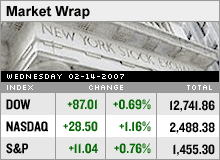
    NEW YORK (CNNMoney.com) -- Stocks rallied across the board Wednesday, pushing the Dow Jones industrial average to a new all-time record, after investors cheered comments from Federal Reserve Chairman Ben Bernanke.

    The Dow (up 87.01 to 12,741.86,
    Charts) jumped 0.7 percent to close at a record high, taking out its previous record from two weeks ago. The blue-chip barometer also hit a record trading high during the session.

Wednesday, February 14, 2007

How about PECD?

The Business Times Article published the following article today:

  • Umno set to surface in PECD
    Umno will buy 25 per cent of PECD, which has a RM1.4 billion order book, a move that could help the company settle its disputes with government-related bodies
The article stated the following:

  • Umno set to surface in PECD
    By Shahriman Johari
    ashahriman@nstp.com.my

    February 14 2007

    THE United Malays National Organisation (Umno) is set to emerge as a substantial shareholder in construction firm PECD Bhd, a source said.

    Umno will buy 25 per cent of PECD, a loss-making firm with a RM1.4 billion order book, a move that could help the company settle its disputes with government-related bodies.

    "Umno will buy the shares from existing shareholders, and an announcement could be made as early as today," said the source.

    The existing major shareholders of PECD include Tan Sri Mohd Razali Abdul Rahman, Nik Sufian Mohd Zain and Datuk Othman Hashim with a collective 32.18 per cent, its 2005 annual report showed.

    Peremba PJ Holdings Sdn Bhd also holds another 26.11 per cent.

    PECD shares closed 3 per cent down to 32.5 sen yesterday. A quarter of the company would cost some RM24.4 million based on the closing price.

    PECD swung to a third-quarter net loss of RM34.4 million as at September 30 2006 versus a net profit of RM6.3 million in the same period a year earlier.

    The loss was due mainly to slow progress of works from ongoing projects, reversal of profits recognised from certain completed projects and non-recognition of profits from its Sudan marine terminal project.
    Umno is likely to lend support to PECD's effort to resolve differences with state oil and gas firm Petroliam Nasional Bhd (Petronas) and state-owned property developer Putrajaya Holdings (PJH).

    PECD is claiming some US$200 million (RM700 million) in cost overruns for a project to build a marine terminal in Sudan. The project, to build oil storage tanks and fuel tanks among others, was awarded by a group of oil companies led by Petronas.

    PECD is also claiming RM178 million from PJH after the latter issued a termination notice for PECD to stop work on a government quarters project in Putrajaya.

PECD was performing extremely poorly. This is is the link to their last reported quarterly earnings:

Quarterly rpt on consolidated results for the financial period ended 30/9/2006

Year to date total net losses totalled 37.9 million. Bad shape.

And it was a no-brainer why the stock fared rather poorly.


Now watch the miracle of that one source and that one news report did to the stock.


Amazing!!!

PECD closed the day up by 36 sen or 110.77%!!!!

So much Dow Jones newswire carried this news brief:

  1. 0807 GMT [Dow Jones] Loss-making PECD (5093.KU) +133.9% at 76 sen in heavy volume of 68.2 million shares, surging in heavy volume of 68.9 million shares following BT report ruling political party UMNO set to emerge as substantial shareholder in construction play via purchase of 25% stake. Dealer cautions retail investors from chasing stock any higher; notes Unusual Market Activity query issued by exchange requesting explanation for surge in share price and volume. "There's every reason to be believe that this stock's share price is at unreasonable levels and is likely to retreat sharply as fundamentals do not support this kind of valuation," broker says. Resistance at 81 sen (November 04 peak); support at 68 sen (October 05 peak). (VGB)

And in the evening PECD issued this statement: Article Entitled: "UMNO Set To Surface In PECD".

  • We refer to the letter of query from Bursa Malaysia Securities Berhad ("Bursa Malaysia") dated 14 February 2007 (Ref No. IJ-070214-39714) in connection with the above titled article appearing in the New Straits Times, Business Times Section, page 39 on Wednesday, 14 February 2007 which among others contained the following statement:-

    "UMNO will buy 25 percent of PECD".

    After due and diligent inquiry with all directors, major shareholders and all such other persons reasonably familiar with the matters and based on our record available to us at the close of business on 14 February 2007, we confirm that the Company has no information on "UMNO will buy 25 percent of PECD".

    This announcement is dated 14 February 2007.

How?


Titan VIII

Saw this article posted on Business Times:

  • Titan Q4 net profit surges 20-fold

    February 14 2007

    TITAN Chemicals Corp Bhd's fourth quarter net profit grew a whopping 20 times compared to a year ago, driven by improved average selling price and sales volume.
    Titan registered a net profit of RM241.1 million for the quarter to December 31 2006 compared with the same quarter in 2005's figure of RM12 million.

    Average selling price grew by 14 per cent, while sales volume grew by 17 per cent.

    Revenue also grew by 33 per cent to RM1.5 billion compared with RM1.1 billion a year ago.

    Titan said business and consumer confidence strengthened during the period and that improved its operating profit even amid the high global crude oil prices.

    Net profit for the full year ended December 31 2006 grew two folds to RM773.2 million compared to RM319.4 million in year 2005.

    The sharp rise was mostly due to contribution of RM340.9 million from Chemical Brothers Ltd, a newly acquired unit.

    Revenue for the full year was also higher at RM5.4 billion, up 21 per cent from before.

    Meanwhile, OSK Research yesterday upgraded its recommendation on the stock, to a buy, on strong improvement in yields due to falling crude oil prices and its capacity expansion kicking in, in 2008.

    OSK Research analyst Chris Eng said Titan is expected to report three quarters of good results with oil prices going down, major shareholder Perbadanan Nasional Bhd to stop paring down its stake and foreign interest in the Malaysian market to pare down the regional discount.

    He said Titan will report bottom line growth in 2008 due to its capacity expansion.

    Titan is adding new capacity to its polypropylene plant and also debottlenecking its crackers to produce more olefins.

    A new butadiene plant will also be in place to allow Titan to capture higher margins for its C4 products.

    Titan is expected to see strong growth in the financial year 2007's net profits as margins recover this year as compared to 2006.

    Titan beat the research company's net profit and revenue forecasts of RM246.2 million net profit against RM5.2 billion in revenue for the financial year ended December 31 2006.

Nice way to highlight Titan earnings.

20-fold increase in earnings.

I wonder if the stock would increase 20-fold too?

Blogged on this stock last night: Oh Titan

US Market Soars ... but....

The following was CNN Money headline for its market wrap.

  • Stocks ride blue-chip wave
    Dow, S&P 500 rise on strength in 3M, Alcoa, GM and commodity stocks; investors await Fed chief's testimony
    Wednesday.By Alexandra Twin, CNNMoney.com senior writer
    February 13 2007: 6:08 PM EST
    NEW YORK (CNNMoney.com) -- Blue chips led a broad stock market rally Tuesday, as investors welcomed takeover talk about Alcoa, a rebound in commodity shares and an upgrade of GM. Wednesday brings reports on retail sales and business inventories but also the start of Federal Reserve Chairman Ben Bernanke's two-day semi-annual monetary policy report to Congress.


  • http://money.cnn.com/2007/02/13/markets/markets_0540/index.htm?postversion=2007021318

I am and has been extremely wearly about the extremely stong turbulance beneath it all. Can a strong market simply mask all the woes underneath?

Today's FSO write-up, Frank Barbera has another wonderful piece: Oh, What a Tangled Web We Weave

Some of the issues mentioned were certainly worth highlighting once again:

  • In our view, it is this disproportionate dependence on Construction and Real Estate activity that now threatens the broader economy as interest rates have increased dramatically in recent years. Within the Real Estate industry, it is the ultra-sensitive “Option ARMS,” and “Interest Only Loans,” “No Credit Check Loans,” and “Piggy Back” loans that have been a recent product of “Creative Finance,” i.e., The Great Credit Bubble, that are now starting to go sour. These loans, made to clients that in many cases did not have the necessary credit, are known as Sub-Prime Loans, wherein the delinquency rates are now climbing at an alarming pace. Just last week, HSBC Corp, one of the world's largest banks announced that it was raising its provision for bad loans 20% higher than the market was expecting due to “Foreclosures that have shown a higher severity" than expected at the banks Household Finance unit. In a conference call, Chief Executive Michael Geoghegan said, "The major impact was taking into account adjustable mortgage resets," and “The impact of slowing house price growth is being reflected in accelerated delinquency trends across the U.S. sub-prime mortgage market, particularly in the more recent loans." Back in December HSBC noted that the main risk in the near term was in personal lending in the United States, where increases in short-term interest rates are hitting people with adjustable-rate mortgages with the bank also noting that its underlying revenue growth had slowed despite an improvement in third-quarter profit. The slowdown was largely attributable to a weaker performance in HSBC's investment banking arm.

And Mr.Barbera continues by mentioning the following issue.

  • More bad news also came from Irvine (Calif.)-based lender New Century Financial (NEW). New Century, the second-largest subprime mortgage originator in the U.S., announced it would restate results for the first three quarters of 2006 to correct for “accounting errors” related to loan repurchase losses, sending the stock down 30% on Feb. 8. Even more recently, we have seen the following from Reuters just yesterday, suggesting that even non-sub prime delinquencies may be on the rise.


NEW YORK, Feb 12 (Reuters) - Countrywide Financial Corp. <CFC.N> and New Century Financial Corp. <NEW.N> led shares of U.S. mortgage lenders down for a third trading day as a new report suggested that even U.S. homeowners with good credit may be defaulting more often. The report by Moody's Investors Service about "prime" loans came amid mounting concern about "subprime" borrowers, who have weaker credit histories. Investors worry that as home price appreciation slows, people will have more difficulty refinancing adjustable-rate loans as rates reset higher. Shares of Countrywide, the largest U.S. mortgage lender, fell 3.4 percent, while New Century, the No. 2 subprime lender, dropped 5.5 percent. Also declining was Accredited Home Lenders Holding Co. <LEND.O>, a subprime lender whose shares declined 5.1 percent.

Most of the focus has been on subprime loans, and analysts said the risks of holding subprime-related debt are rising. Early this month, Friedman Billings Ramsey & Co. said the default rate on sub-prime loans that were packaged into bonds reached their highest level this decade. Last Wednesday, in a report titled "Inferno," Credit Suisse analysts said the 60-day delinquency rate for second-quarter loans that were six months old had doubled from a year earlier to 5.7 percent.

In my article entitled, The Great Credit Bubble: What Could Go Wrong? dated January 30th, I specifically highlighted Accredited Home Lenders, New Century Financial and Fremont General as these three stocks appeared to be in big technical trouble. On the next page, I show the chart of New Century “before” and “after,” with the decline actually unfolding faster than I expected. Ugly! – what more can you say?


And Mr.Barbera then highlights China and Mexico.


  • In addition to the investment banks, change always tends to develop on the outer periphery, in the credit markets, at the lowest quality of debt, the most marginal borrower. Where the “sea of liquidity” is concerned, the Emerging Markets, ripe with high-beta, represent the equity front where nervous capital is most likely to begin an organized retreat. In the current instance, these markets are also of paramount concern, as the chart configurations also herald what could be a very major peak. Of course, no economy has been hotter in recent years than China, And in the final closing moments of 2006, we saw Chinese share prices move almost ‘straight up.’ Looking back, this kind of near vertical movement over an extended period of months (as was seen in the second half of 2006), strongly suggests a ‘blow-off’ top, an argument which gained more traction with the nearly 10% decline in the opening sessions of 2007.


  • Above: the Chinese stock market over the last several years, traced out a potential blow off top amid rampant speculation in the final days of 2006. On the bottom chart, we see that Wave V equaled the net gain of Waves One thru Three, at the peak seen earlier this year.


  • In addition to the highly volatile and unstable trading pattern seen in China, markets like Brazil and Mexico appear over-extended and toppy. In the case of Brazil’s Bovespa Index, we saw momentum register an important peak back on February 6th of 2006 with the Bovespa at 32,847.61. Since then, prices succumbed to 21.75% decline which bottomed last June, with the second half rally in global equity markets lifting the Bovespa to new all time highs in early December. However, even as the Bovespa attempted to breakout to new highs in December, MACD was making lower highs then had previously been seen at the February 2006 peak. Over the last few weeks, the Bovespa has pushed to new highs once again, this time with a momentum profile that is threatening to go negative. This kind of extreme bearish divergence is often a signal that prices are topping out.


  • In the case of the Mexican IPC, the market has gained 69.32% SINCE LAST JUNE, annualized; that’s a rate of appreciation north of 138%. In addition, the Mexican Bolsa is also more than 25% above its 200 day average, another “red flag” indicating an overheated market likely to reverse lower. Finally, I also maintain an indicator known as the “Days Up per 50” which in the case of the Mexican Bolsa tells us that the market has now been up 38 of the last 50 days, and it has been holding that level for the better part of two weeks. How much risk does this represent? In my view, it strongly suggests that the capital markets are now living on borrowed time, and that the Emerging Markets are ready to begin rolling over in earnest in the days just ahead. For an over-leveraged financial speculator community including untold hedge funds, this chart should spell ‘trouble ahead’ for anyone who has been in the markets any length of time.


  • Above: the Mexican IPC Index - sporting a potential fifth wave advance in its terminal stages with prices moving up at a near vertical rate of ascent. Anyone feeling really lucky?


  • Above: the Percent above the 200 day average for the IPC Bolsa Index. When the indicator is above 25% the market has been seriously over-extended and in relative proximity to major shake outs. Below: we see the IPC Index and the “Days Up Per 50” indicator, telling us that again we have seen a one sided directional market moving straight up. Over the last 50 days, the Mexican Bolsa has been up 38 out of 50 days. Can you say “accident waiting to happen?” Nothing can maintain this rate of ascent indefinitely, leading us to wonder what lies on the other side of this parabolic curve?


How?

I am not calling for an immediate doomsday. At this very moment of time, Mr.Market simply wants to move higher and higher and markets simply do not collapse overnight.

However, this issue currently cannot be denied. I for one, would note for the serious turbulance underneath it all.

Acknowledge and do not discount this issue at all would be my advice.

Put it this way, if the markets were to collapse, are you ready?


Tuesday, February 13, 2007

Oh Titan

Titan just released its quarterly earnings. Here's a news report posted on Titan's earnings:


  • Titan's net profit up 142% to RM773m
    By Joyce Goh

    Titan Chemicals Corp Bhd's net profit rose 142% to RM773.18 million for the year ended Dec 31, 2006 from RM319.4 million a year earlier, on improvement of naptha and polymer margins.

    In addition,
    the excess of the group’s interest in the net fair value of acquired company Chemical Brothers Ltd was also recognised, raising after-tax profit by RM340.9 million, the company said on Feb 13.

    Revenue for the year just ended was RM5.45 billion, up 21.11% from the RM4.5 billion achieved in 2005.

    Titan noted that the rise in the average selling price and sales volume by 14% and 17% respectively had contributed to the growth in sales revenue, driven by continued strong market fundamentals.

    For the fourth quarter ended Dec 31, 2006, Titan's net profit soared to RM241.12 million from RM12.01 million during the same period last year. Revenue was RM1.53 billion from RM1.15 billion.

    Titan expects its performance for the first quarter of 2007 to be satisfactory with the demand for polymer products continuing to be strong and the margin for the business expected to remain stable.

    Titan has recommended a final tax-exempt dividend of 4.5 sen per share for the year ended Dec 31, 2006.

So good?


  • Titan Chemicals Corp Bhd's net profit rose 142% to RM773.18 million for the year ended Dec 31, 2006

Quarterly rpt on consolidated results for the financial period ended 31/12/2006


Ok, what does the investor get from a company that just made RM773 million?


Well, the loans decreased.


Total loans is at 1,544,626 versus 1,643,010.


Bravo!


Much improvement.


But take a look at the cash flow... look at the very end balance...


Cash and cash equivalent at end of the period is only 16.925 million?

So much did Titan made?

Past postings:

  1. Titan
  2. Titan: Part II
  3. Titan: Part III
  4. Titan: Part IV
  5. Titan: Part V
  6. Titan: Part VI

Khazanah-led SPV, UEM in talks on Johor land deal

In today's Business Times, it carried the following article: Khazanah-led SPV, UEM in talks on Johor land deal

  • Khazanah-led SPV, UEM in talks on Johor land deal
    By Francis Fernandez
    bt@nstp.com.my

    February 13 2007

    A FOUR-member special purpose vehicle (SPV) concern led by Khazanah Nasional Bhd is in an advanced stage of negotiations with UEM World Bhd to acquire some 2,000ha in Johor.

    It is understood that the SPV will sign an agreement soon, and that the acquisition will land UEM World an exceptional item gain of about RM500 million.

    UEM Land Bhd, a unit of UEM World, is developing a 9,669ha city at its Bandar Nusajaya project in Johor where it plans to build homes, waterfront property, offices, hotels, factories, hospitals and campuses for overseas universities, making it Malaysia's biggest real estate development.

    The township includes a new state administrative centre and theme parks, which were previously linked to Japan's Oriental Land - the Japanese partner for Tokyo Disneyland.

    Khazanah officials said they will not comment on market speculation.

    Khazanah has previously acquired land from UEM World specifically to build a destination resort, which includes a theme park.

    "The evaluation process for the destination resort is now being undertaken by Khazanah Nasional," UEM World said in a statement to the stock exchange.

    The state-controlled property developer further said that it is in talks with several bankers to raise financing for its projects in Nusajaya.

    Senior government officials confirmed UEM World is planning a major relaunch of the Nusajaya project on February 23, but said they were unaware of further acquisitions by the state-owned fund.

    UEM World will reveal plans for the Nusajaya project at the relaunch, several people who have been invited to attend the function said on condition of anonymity.

    Meanwhile, bankers familiar with the deal said that apart from Khazanah, the other members of the SPV include companies linked to billionaire Robert Kuok Hock Nien, Ekovest Bhd and a United Arab Emirates-owned investment fund.

    The 84-year-old Kuok, often billed at the Sugar King of Malaysia, controls a slew of public-listed companies across Malaysia, Singapore and Hong Kong.

    Kuok, estimated to have a wealth of RM21.5 billion in 2006, has plantation-related interests in Indonesia and China.

    He also controls PBB Group Bhd, Hong Kong's Kerry Properties Ltd and the Shangri-la hotel chain in Asia.

    It was reported late last week that Khazanah via a SPV is looking to buy a third of Danga Bay Sdn Bhd, which is controlled by Datuk Lim Kang Hoo, Ekovest's dominant stakeholder.

    Ekovest itself has an option to buy as much as 30 per cent of the enlarged paid-up of Danga Bay, the company said in a statement to Bursa Malaysia last year.

    The call and put option allows Ekovest to buy into Danga Bay at the net tangible asset (NTA) level. Danga Bay's total NTA is around the RM3.80 per share level.

    Under the call and put agreement, Ekovest has untill March to decide if it wants to enforce its option.

    The RM4 billion Danga Bay project involves a 15-year development of 559ha of waterfront land in Johor, located between central Johor Baru and new developments such as Bandar Nusajaya and the second crossing to Singapore in the western part of the city.


Jobstreet

Interested in this stock? The following stock was discussed on Sahamas.

Here is some of the main issues about the stock.

Plus.

  1. potential for the company to grow is there
  2. profitable business
  3. healthy balance sheet
Minus.
  1. cash management should and could be better. In that sense, for such a profitable business, the company could perhaps attempt to give a more rewarding return of equity to its shareholders. If you look into its cash flow, cash flow as actually around 16 mil. But cash flow although increased by a healthy some 2.615 million, in my opinion, they could have done better because in their investing activities, the company invested some 10 million into unit trusts. This is a personal issue. For me, it's a no-no. Remember these are young chaps running the company, perhaps they should have done the right thing by increasing the excess capital back to their shareholders. 30% of their profits back to the shareholders is simply not enuf when you consider they have excess money to invest into unit trusts. Again, i stress, this is a rather personal choice or view of mine. For some, it's OK but for some like me, it's a no-no.
  2. Not comfortable with the e-business because the biggest asset is them brain cells. Which means competition could easily emerge.

How?

Read more here

Crude Revelations


Here's an editorial from Rob Kirby on crude oil. Give it a good read: Crude Revelations

Sunday, February 11, 2007

Warren Buffett Articles: X

Learn To Think Like Warren Buffett ( source )

Learn To Think Like Warren Buffett
The structure of the P&G-Gillette deal could well become a Wall Street model

One way Warren E. Buffett became the world's most successful investor was by understanding how putting off tax payments can build wealth. Every year in the "owner's manual" he includes with Berkshire Hathaway Inc. (BRKB ) annual reports, he spells out the advantages of deferred tax liabilities over ordinary debt. His essays show how Berkshire boosts returns by keeping cash invested as long as practical until sending it to the U.S. Treasury.

Now, with his Jan. 28 backing of Procter & Gamble Co's (PG ) novel two-step, tax-free deal for Gillette Co. (G ), Buffett is again seizing an opportunity to exit a position without triggering a giant tax bill. Berkshire's gain on the 96 million Gillette shares it has held since 1989: $4.3 billion. Yet because it is plowing all of that gain into shares of the new company, Uncle Sam will have to wait for his piece of the profits.

Exactly who suggested the deal structure is not clear. Neither Buffett, Gillette's largest shareholder, nor the investment bankers involved would comment. Given Buffett's well-known aversion to taxes, though, bankers most likely devised the structure to satisfy him while also preventing an all-stock deal from drastically watering down P&G's earnings. Just as important, the ingenious structure could become a Wall Street model for future mergers and acquisitions. At the same time it comes with a lesson about what investors can and can't learn from watching Buffett.

Think of the deal as a two-step jig: The first movement makes Buffett happy, while the unusual second step pleases P&G. First, P&G will pay for Gillette with nothing but stock, issuing 0.975 shares of its common stock for each Gillette share. Gillette investors will owe no tax since they're exchanging one stock for another. If, instead, P&G had paid for Gillette with cash, Berkshire alone would have faced a whopping $1.5 billion tax bill thanks to the 35% corporate rate it pays.

Problem is, all that new stock will dilute the value of the shares P&G's current investors hold and slash its earnings per share. So as part of the deal P&G announced that it will spend $18 billion to $22 billion over the next 12 to 18 months buying back some of the stock it just issued for Gillette. The result, says P&G, is the same as if it had paid for Gillette with a package of 60% stock and 40% cash.

Why not just structure a 60-40 deal in the first place? Because that could leave many Gillette shareholders with an unwanted tax bill, as happened to Buffett in 1996. Then, Capital Cities/ABC Inc., in which Buffett held a $2.2 billion unrealized profit, sold out to Walt Disney Co. (
DIS ). Disney agreed to pay partially in stock, but when the Disney shares were divided among all Cap Cities shareholders who wanted them, Buffett ended up with half his money in cash -- and a tax bill of some $400 million.

P&G's two-step gets around that. Gillette shareholders can keep as much stock as they want, controlling when their taxes come due. Tax-exempt pension funds or others who want to cash out can sell in the open market whenever they choose. And because P&G will be spending billions on the buyback, there's less risk that a wave of investors selling out will send the shares tumbling. "It is very democratic," says Lawrence A. Cunningham, professor of law and business at Boston College and the editor of a book of Buffett's essays.

Of course, tax concerns are not all that drives Buffett's decisions. He has proven that by selling winning positions for cash, such as stakes in Disney and Freddie Mac (
FRE ). Still, given the huge capital gains -- and deferred taxes -- Berkshire has racked up on key holdings such as American Express (AXP ) and Coca-Cola, they are clearly important. And taxes should be a bigger concern to Buffett than to many others: Berkshire's 35% corporate rate is more than twice the 15% individuals pay on capital gains.

Therein lies a lesson for investors trying to piggyback on Buffett's picks. Many assume that if he owns a stock, it's worth buying. But because Berkshire's tax rate is so high, Buffett bears less risk holding overpriced stocks. After tax, he would give up only 65% of profits foregone by not selling at a high, while an individual would forfeit 85%. By the same token, on those occasions when he does sell and offer Uncle Sam his 35% cut, he's sending a loud signal that the outlook is bleak. But since Buffett never reveals what he's selling until he's done, it's hard to play copycat. Investors are better off trying to learn how Buffett thinks.

Thursday, February 08, 2007

REXIT

If you have any interest in this stock, I have posted a posting on it on Sahamas.

Link to posting thread:
here

Cheers!

Update on EonCapital

On Tuesday, I blogged the following : EonCap Merger?

And I made the following remarks:

And guess what today, Business Times continued with the story yet again. (Why?)

  • EON Capital enters the fray for RHB CapThe Utama Banking Group board is due to meet by as early as today to consider the EON Capital bid said to be in concert with the Employees Provident Fund, sources say

The mighty sources strikes again! Crikey!

  • EON Capital enters the fray for RHB Cap
    By Francis Fernandezbt@nstp.com.my
    February 6 2007
    EVEN as suitor Kuwait Finance House (KFH) unravelled its bid yesterday for RHB Capital Bhd, the country's fourth largest financial group, a new party, EON Capital Bhd, was said by some sources to be preparing to join in the fray.

Last night, EonCapital comfirmed this story and that they have made a bid for RHB Capital.

Ah, finally for once, the source of the story became story.

But...

How and who leaked the story to the press?

Is this what they call Insider Info?

Hmmm....

Wednesday, February 07, 2007

Update on LKT

Here's an update to a previous blog posting: LKT Industrial

Here are some key points mentioned by Kenanga in its research article posted today. My comments in green:

Key Points


l M1 (92,500 sf) is fully operational. The visit confirms that M1 ( the first of the two new plants) is fully operational with the buzz of activities both in the sheet metal machine shop as well as assembly plant for the OEM machines. The sheet metal machine shop being the largest in the northern region has freed up bottlenecks in its production process for its own brand name and OEM machines.

l M2 (134,000 sf) is on schedule for completion in March 07. All of the OEM equipment will be built in M1 and M2. We had earlier underestimated the strictness of its OEM customers as we did not anticipate that they will be undertaking a plant qualification process before the load LKT with large orders. This has in turn delay ed the sharp pick up in earnings which we had anticipated in FY07 to FY08.

l The thoroughness of OEM customers reinforces high barrier of entry. On the flip side of the extenuating qualifications of the new plants, we are positive that the barriers to entry for being an OEM supplier to tier one semiconductor equipment manufacturers remain an exclusive club which is highly coveted and difficult to attain.

l We expect RM6m net loss in 4Q06 due to one-off forex losses and write down in inventory. The sharp appreciation in the Ringgit has resulted in some of its earlier contracts priced at lower exchange rate to result in a loss compared with the sharp appreciation at end of 2006. Some write down in value of inventory which could have been obsolete was also undertaken, we estimate the total one of net loss to be RM6m for 4Q06. This would result in FY06 net profit to be within RM33m to RM35m ie at around FY05 levels. (rm6m in losses... ahh... finally some light on what's happening. Kinda disgusting cos the market action recently which saw the saw tumble from rm4.00 indicated that them insiders knew something the minority investors did not know. And rm6m in losses is huge!!)

l Not too concern about one-off losses, business as usual. As we have indicated earlier in our strategy report 2007 that small–mid cap stock are likely to have volatile QOQ net earnings while the whole business model and direction remains intact and in fact poised for strong growth in FY08.

l Industry remains bullish. Largely front -end capital expenditure investment in 2007 in wafer fabrication would result in higher demand in back end equipment with a time large of 12 to 18 months. SEMI has forecasted global semiconductor equipment sale of USD42.1b for 2007 up 3.7% yoy. The growth for 2008 and 2009 is even more bullish with 13.3% and 5.4% yoy growth. ( err... industry remains bullish? Some had voiced concerns, no?)

l OEM business diversifies and grow LKT’s offering from back end to front end of the semiconductor equipment segment. With the OEM business, LKT’s equipment revenue mix is now 60% back-end and 40% front-end which is encouraging seeing that about 70% of the total global semiconductor equipment sales is in the front end.

l The departure of the previous president, Mr Lim Wei Yee will not affect the business. Dato’ Vincent Loh, the executive chairman has stepped up his involvement in the daily operations of the company and remains very hand-on, essentially taking over the duties of Mr Lim. (WOW!!! Departue of previous president... hmmm... did the investing public know about this? (i for one did not know cos i had not followed the stock closely)

l The customers remain confident of the continuation of business as usual. The institutionalisation of the management team with professionals rather than family members of controlling shareholders ensure that there is leadership succession and that no one person is indispensable. LKT has in place a board of management committee which oversees the strategic as well as day to day decision making of the company.

l OEM business has already obtained pioneer status. Meerkat Technologies and Meerkat Integrator have obtained poineer status with 100% tax exemption for 10 years and 5 years respectively. LKT has applied to MITI to activate the status retrospectively to 1 Jan 06 which could result in higher contribution from the OEM division. This could result in lower overall taxes for FY06 and boost its net profit when the approval to activated the status on 1 January 2006 is obtained.

l EPS revised downwards. Given the delay in OEM customer loading LKT with we are lowering FY06, FY07 and FY08 EPS to 39 sen, 51 sen and 65 sen from my earlier forecast of 70 sen, 87 sen and 89 sen respectively assuming lower growth in revenue and also higher overall operating costs. (huge downwards revision in eps!!!! )

l Reiterate BUY recommendation with revised price target of RM4.20 from RM5.60 previously. The target price is derived using a 6.5x PER multiple on FY08 EPS of 65 sen. The selldown in the stock represents good opportunity to purchase LKT at extremely attractive PER multiples 5x and 4x respectively (remember this cheap PE multiples is based on fy 2008 earnings. as it is. fy 2006 estimates is at 26.991 million. fy 2008 estimates is at 44.736 mil. And because the estimates is so much higher than fy 2006 earnings... LKT is surely looking mighty attractive and cheap)

Tuesday, February 06, 2007

Update on EON Capital Merger

This morning I wrote about this : EonCap Merger?

Well, here is the first denial.

Article Entitled " EPF eyeing DRB-HICOM's stake in EON Capital"

  • Subject : Article Entitled " EPF eyeing DRB-HICOM's stake in EON Capital"

    Contents :

    We refer to the query from Bursa Malaysia Securities Berhad dated 5 February 2007 on the above article published in the New Straits Times, Business Times section on 3 February 2007.

    We wish to inform that DRB-HICOM Berhad has announced on 6 February 2007 that the company is not in negotiation with EPF as stated in the above article.

Again?

Are you shocked that the article has been denied?

Let me ask you the productivity issue. Them folks at EON Capital nothing else to do than to reply to all these queries based on sources.

Btw Singapore Business Times carried the following article: source to article

  • EON Capital poised to join race for RHB
    Two proposals from foreign suitors already under consideration

    By S JAYASANKARAN
    IN KUALA LUMPUR

    THE race to grab control of RHB Capital, Malaysia's fourth largest lender, may get even more crowded with the entry of yet another suitor.

    Mr Daim: He's advising international investment agency Primus Pacific Partners, one of the bidders
    Bankers familiar with the matter said EON Capital, the country's seventh largest bank, is poised to enter the fray.

    It isn't clear if EON has received permission from the central bank to commence negotiations with any of RHB Capital's shareholders - a requirement of Malaysian law - but that may not be difficult.

    Late last year, the central bank relaxed rules on bank takeovers allowing owners to negotiate simultaneously with multiple would-be partners.

    The multiplicity of suitors for RHB's banking services underscores the new, market driven approach preferred by the central bank to consolidate Malaysia's banking sector. And it means that RHB's shareholders could exit with the best possible price.

    The RHB group is now considering two separate proposals from foreign suitors.

    The two: Kuwait Finance House's proposal to buy Utama Banking Group's 32 per cent in RHB and a slightly more complicated offer by international investment agency Primus Pacific Partners to buy into RHB.

    Primus shareholders Qatar Investment Agency and the Tsai family of Taiwan are being advised in Malaysia by former finance minister Daim Zainuddin.

    All this is complicated by the indebtedness of the group. RHB, a financial services company, holds 65 per cent in listed RHB Capital which, in turn, holds 70 per cent of RHB Bank. But RHB itself is indebted to the tune of RM3.5 billion (S$1.6 billion), with close to RM1 billion of that due this June.

    The debt has to be resolved, which was why RHB's board announced a plan last week to sell its stake in RHB Capital back to shareholders in proportion to their holdings in RHB. If implemented, the plan would have raised RM3.6 billion, which could have ended the firm's debt while allowing RHB's shareholders direct exposure to the actual cash-generating unit in the group.

    RHB's shareholders include the Sarawak-based Utama Banking Group (32 per cent), the EPF or the Employees Provident Fund (30 per cent) and a government pension fund (10 per cent). Of the three shareholders, only Utama is talking to the foreign bidders, while the state agencies want to go ahead with the sale of RHB's stake in RHB Capital.

    Enter EON Capital. The bank has a clean balance sheet but is itself a takeover target because of its relatively small size. That is why EON has tried taking over other mid-size banks; its previous attempt to takeover AMMB Holdings in 2004 failed over price.

    The bankers said that in September last year, EON Capital proposed to take over RHB Capital through a voluntary general offer. According to them, the finance ministry was keen on the idea but the EPF balked and the proposal went nowhere. But with two foreign parties bidding for RHB, the bankers said that the EPF may have now warmed up to EON Capital's proposal. One reason is the state-owned nexus running between both the banks.

    RHB Bank, the group's unlisted bank, is 30 per cent owned by state investment agency Khazanah Nasional, which also has a near 20 per cent interest in EON Capital. The commonality of state interests in both banks could prompt the government to lean towards EON Capital.

    Meanwhile, although EON Capital is smaller than RHB Capital, its clean, almost debt free balance sheet allows it to gear up to make a takeover possible, the bankers said.

    They added that the EON Capital bid could also be preferred because it avoids the complications of the Kuwait Finance House offer, which is said to be more generous than the bid by Primus.

    The Kuwaiti bid is only for the Islamic banking portions of RHB, which means its conventional banking parts would have to be hived off. This, the bankers said, could be potentially embarrassing for the Muslim-dominated Malaysian government as it could see the EPF, say, buying back RHB's conventional banking processes while selling its Islamic banking business.


APB Resources

This stock, APB Resources, is famously named as Baby KNM by RHB Research.

Well, this is one stock whose stock price has appreciated tremendously in recent months due to fact that it was in JV with PSCI. For me, this was the catalyst for its strong share price appreciation in recent months.

RHB today has another report on it today and one of the points worth noting is the fact that this JV has not been concluded YET.

Ah.. a risk? Maybe? For me, I think it would be rather foolish to discount this risk. No?

Anyway, here is what RHB is saying on this stock.


♦ PSCI jv discussions may be shaky. The company is currently still in negotiations with Boustead on the terms and conditions for the 50-50 joint venture to fabricate process equipment on 10 acres of sea-frontage land within PSCI’s 43-acre shipyard in Penang. Although management had previously expected to sign the agreement in 2QFY07 and commence operation towards the end of FY07, we believe discussions have been moving too slowly and may now be shaky. Management has set a deadline for middle of March to conclude the agreement or negotiations will likely be called off.

♦ Alternative plans. The company is currently evaluating two other proposals.

Firstly, management is looking at a piece of land of more than 10 acres with workable access to the sea to allow fabrication of more bulky process equipment.

Sea frontage would also allow loading and unloading of raw materials and products, which would improve the overall efficiency of the operation. Currently neither of APB’s yards (in Subang and Kuantan) have direct access to the sea, and all materials have to be transported by road. The second alternative would be to buy 18 acres of land near its existing Kuantan yard. The land may cost some RM5-6m and equipment and building would require capex of around RM20-25m over two years.

♦ Opportunity cost. Management readily admitted that the delay in the PSCI jv has resulted in lost opportunities. However, the company does not plan to rush into alternatives. Growth in FY07 will likely come from higher-margin product mix and recovery from the FY06 cost overruns.

♦ Normal capex of RM10m p.a. Management guided that the company will spend around RM10m p.a. in normal capex which can be easily funded internally from operating cashflow of RM19-23m p.a. in FY07-09. However, management is prepared to borrow to expand its capacity if the company opts to buy the land in Kuantan. Our sensitivity analysis suggests net debt/equity would still remain manageable at around 25%, vs 2% currently estimated for FY07.

♦ Good visibility. Management believes the earnings visibility is good for the next three years given confirmed major oil & gas, power and oleochemical projects, especially in Indonesia. Currently 90% of its sales are derived from overseas contracts, of which 50% are from the Middle East, 35% from Asia and 15% from Europe, US and Africa.

♦ New risk-management policies. The company has introduced new policies for dealing with contracts that require more exotic steel alloys to mitigate the risk of future cost overruns, including: 1) completion period increased from nine months to 15 months; 2) contract period to start only when the raw material is delivered; and 3) the client supplies the raw material. Management stated that the company is prepared to walk away from contracts where the client is not agreeable to these terms to prevent the recurrence of major cost overruns.

♦ Maintain Outperform. Although the failure to conclude the PSCI jv would be a disappointment and cause a further delay in APB’s capacity expansion plans, we note that our forecasts have not factored in the jv. We highlight that although we only expect 6% growth in turnover in FY07, we have forecast 18% growth in fully-diluted EPS, due to recovery from FY06 cost overruns and slight improvement in gross margins to 19%, from 18% in FY06 (adjusted for costoverruns).

The sector weighted average PER for CY07 has risen from 15x to 17x over the last three months. Maintaining a 25% discount to peers, to factor in APB’s relatively small market cap and tight liquidity, we have used a CY07 PER of 12.8x to derive our fair value of RM1.89/share. This implies a further 17% upside in the share price. Given the sustained momentum in the industry, good visibility ahead, and potential upside from future capacity expansion (via PSCI or otherwise), we thus maintain our Outperform call on the stock.

AsiaEP

KenangaResearch just posted a nice rosy write-up on AsiaEP.

Really.

And I made a posting on Sahamas on this stock
here. Give it a read.

EonCap Merger?

Them sources will never die will they? Not especially in a hot market.

This was reported on Business Times on 3rd Feb 2007.


  • EPF eyeing DRB-HICOM's stake in EON Capital
    By Francis Fernandez
    bt@nstp.com.my
    February 3 2007

    THE Employees Provident Fund (EPF) is considering making a formal proposal to acquire DRB-HICOM Bhd's stake in EON Capital Bhd for about RM9.50 a share, executives familiar with the matter said yesterday.

    Business Times was told the provident fund had in the past two months held informal talks with DRB's dominant shareholder, Tan Sri Syed Mokhtar Al-Bukhary, at the shareholder level to facilitate the sale. DRB is the single largest shareholder in EON Capital with a 20.2 per cent stake in the lender.

Yesterday, OSK had a report based on the article. LOL!! Don't you wonder why the need for them to do so? Well, you do have consider the issue of the countless times when all these news based on sources were denied by all parties concerned!

Have a look at the following snippet of what OSK wrote.

  • Merger Of The Two “Caps”?
    It was speculated in an article over the weekend that EPF could be the latest suitor for DRBHCOM’s 20%-stake in EONCAP with a higher offer price of RM9.50/share. According to the report, EPF could then merge both EONCAP and RHBCAP. Pending any further details, we are maintaining our BUY call and target price of RM7.90 on EONCAP. Meanwhile, we are of the opinion that the recent reported
    offer prices of between RM9.00 and RM9.50/share are not impossible and would revise our target price should the M&A news flow become more tangible.

Ironic cause OSK themselves acknowledged it's mere speculation!!

And guess what today, Business Times continued with the story yet again. (Why?)

  • EON Capital enters the fray for RHB Cap
    The Utama Banking Group board is due to meet by as early as today to consider the EON Capital bid said to be in concert with the Employees Provident Fund, sources say

The mighty sources strikes again! Crikey!

  • EON Capital enters the fray for RHB Cap
    By Francis Fernandez
    bt@nstp.com.my

    February 6 2007

    EVEN as suitor Kuwait Finance House (KFH) unravelled its bid yesterday for RHB Capital Bhd, the country's fourth largest financial group, a new party, EON Capital Bhd, was said by some sources to be preparing to join in the fray.

And to refresh everyone's memory, I had just blogged on EonCapital recently. See As Expected: EON Capital!

How?

You buy these sources stories?

Do you?

Really?

Warren Buffett Articles IX

Saw this article written by Mr. Robert Miles on Warren Buffett. Mr. Miles, a long term shareholder of Berkshire Hathaway, had penned the folloing books, Warren Buffett Wealth: Principles and Practical Methods Used by the World's GreatestInvestor, The Warren Buffett CEO: Secrets from the Berkshire Hathaway Managers and 101 Reasons to Own the World's Greatest Investment: Warren Buffett's Berkshire Hathaway. It's a great article, worth a good read. ( Article Source : 10 Secrets Hidden in Warren Buffett's Wallet )

Here is a snippet from it - the 10 secret!

>>>>

SECRET NUMBER 1:
Invest in an old economy company that's a leader in an industry you understand.

Banking may not be the world's oldest profession, but it's one of the oldest, so a bank is clearly an "old economy" company. The Illinois National Bank [INB] was established in 1931 — right in the middle of the Depression — by Eugene Abegg, with a beginning net worth of $250,000 and $400,000 in deposits. By the time Abegg's bank became part of Berkshire, it wasn't only the largest in Rockford, it was also one of the most profitable in the country. And since banking is a business that Warren understands, it was a perfect match for his emerging conglomerate.


SECRET NUMBER 2:
Invest in companies with consistent earnings.

In the 38 years before INB became a part of Berkshire, it had registered an 11.7 percent annual growth in book value and a 15.6 percent annual growth in time deposits. In its very first year, the bank earned $8,782, which set the benchmark for the company. Under Abegg's management, for nearly 50 years, the bank consistently returned two percent annually on assets. That's three times better than the average large bank, so it's not surprising that Buffett considered Abegg's management to be extraordinary.


SECRET NUMBER 3:
Pay only a reasonable price even for an outstanding business.

When Buffett bought Illinois National Bank, he paid $15.5 million for 98 percent of the business, not an insignificant amount of money. At the time, though, the bank was earning some $2 million on $100 million in deposits, and had a book value of $17 million. So Buffett bought it at 7 times earnings and less than its book value. But Warren knew exactly what he was doing. Within five and a half years Berkshire was repaid for its investment, and within eight years the bank had paid its parent company $20 million in dividends. Within a decade the bank was worth four times its original purchase price.<>


Buffett learned a long time ago from his mentor, Ben Graham, that "Price is what you pay, value is what you get," and he's never deviated from this investment approach. Warren paid a reasonable amount for Illinois National Bank, and value — in fact, excellent value — is what his Berkshire shareholders got.

SECRET NUMBER 4:
Buy a lot of the company, and keep it.


Contrary to popular opinion, Warren believes in concentration over diversification. Whenever he can, and if he has the money, he will buy all of a company rather than buy pieces of it through the stock market. Another one of the important lessons he learned from Ben Graham is that, whether in whole or in part, his valuation of a business and its stock are one in the same.

Warren typically purchases at least 80 percent of a wholly owned company and encourages the founder to keep a small interest in it. By retaining some ownership, the founder will be compensated based entirely on how well his particular company is doing, which will encourage him or her to focus on earnings and net worth rather than on stock prices or stock options or other businesses within the enterprise.


True to this principle, in the case of the Illinois National Bank, Buffett purchased almost all of the company. And he probably would have kept it if it hadn't been for the Federal Bank Holding Act of 1969, which was passed soon after the acquisition. As a result, in 1980, after 11 years of ownership, and as required by law, he spun off the wholly owned bank to his shareholders. Interestingly, given Buffett's philosophy, had the act not forced the liquidation of this investment, Berkshire Hathaway might have evolved quite differently and become an insurance and a banking empire.

SECRET NUMBER 5:
Invest in businesses with experienced managers in place.

When Warren Buffett bought Illinois National Bank, Eugene Abegg had been running the business for almost 40 year and was already 71 years old. Even so, Abegg had every intention of staying on to manage it, and Buffett wouldn't have had it any other way.


In fact, this is one of the most important elements in the development and success of Buffett's empire. Buffett buys companies with successful managers in place, and keeps them in place so they can continue running the businesses as they always have. Also, unlike other conglomerates, at Berkshire no attempt is ever made to "synergize" the acquired company into other subsidiaries and drive the founding entrepreneur out of the business.

SECRET NUMBER 6:
Leave talented managers alone to do their jobs and compliment them from a distance.


Just as one might manage a small portfolio of stocks, Buffett manages his wholly owned businesses from afar. He never takes the keys, and he never suggests how the companies should be managed. He doesn't schedule any meetings with his managers, and he doesn't expect them to submit budgets. He just leaves them alone and lets them do what they do best.

He does, however, compliment them on the job they're doing, and he does it through an annual letter to Berkshire's 300,000 shareholders. In fact, it was in his first letter to shareholders, in 1970, that he praised Eugene Abegg for the job he was doing. "Eugene Abegg," Buffett wrote, "had the problem in 1970 of topping a banner year in 1969 — and in the face of an unchanged level of deposits, managed to do it. While maintaining a position of above average liquidity, net-operating earnings before security gains came to well over two percent of average deposits. This record reflects an exceptionally well-managed banking business."


Buffett's annual letters, which are also available at his website www.berkshirehathaway.com, have become one of his primary methods of recognizing, motivating, managing, leading, and retaining talented and independently wealthy managers. And it works. Having completed over 100 acquisitions over the past 37 years, Buffett has never lost a CEO to a competing enterprise.

SECRET NUMBER 7:
Buy companies from owners who care more about who's buying the business than how much they'll get for it.


Berkshire doesn't have managers in place to run acquired businesses, so it's imperative that the founders and managers of the companies it buys stay on after the acquisition. Buffett knows that if the manager cares more about a high sale price and less about the management philosophy of the organization that's acquiring his or her creation, chances are the merger won't work. And that's because the more a manager is concerned about the purchase price, the less he or she is likely to be concerned about the company's employees. This is one of the reasons that Warren will rarely, if ever, engage in an auction for a business.

SECRET NUMBER 8:
Invest in companies whose managers are frugal and care about costs.


Warren knows that the best way to make more money is to spend less. "Our experience," he wrote in his 1978 letter to shareholders, "has been that the manager of an already high cost operation frequently is uncommonly resourceful in finding new ways to add to overhead, while the manager of a tightly-run operation usually continues to find additional methods to curtail costs, even when his costs are already well below those of his competitors. No one," he added, "has demonstrated this latter ability better than Gene Abegg."<>

SECRET NUMBER 9:
Don't force experienced managers to retire.

Because he knows the value of experience, Buffett has never established a mandatory retirement age at Berkshire. In fact, the opposite policy is in effect — founders and managers are encouraged to continue painting their business masterpiece for as long as they have a passion for it. While corporate America retires its leaders at 65, Berkshire often buys companies whose managers are already over that age. Even so, while the average CEO is on the job for six years before retiring, the typical Buffett CEO has an average tenure of 23 years. Eugene Abegg was six years past typical retirement age when Illinois National Bank became part of Berkshire, and he continued to build his business for another 11 years before he passed away at the age of 82.


SECRET NUMBER 10:
Above all else, know the character of the manager.

As Warren says, he acquires managers, like Eugene Abegg, who have "every bit of the care and drive that they would have exhibited had they personally owned 100 percent of the business. No rules are necessary to enforce or even encourage this attitude; it is imbedded in the character of these managers long before selling to Berkshire. Their good character has become Berkshire's good fortune."


Like an astute banker, Buffett's genius lies in his ability to read a business owner and manager, often from the comfort of his small office in Omaha, Nebraska and determine his or her character and motivation. And the Oracle of Omaha has rarely, if ever, misjudged any of those managers. In fact, Buffett's decision to purchase the Illinois National Bank, and to bring Eugene Abegg into his company, set the standard by which to judge all of his wholly owned businesses and their CEOs. And even though it is a high standard, Warren has clearly never regretted setting it. In 1980, when Abegg died, he memorialized him in his annual letter saying, "As a friend, banker and citizen, he was unsurpassed." And that's exactly the kind of thing he would no doubt say about all the managers he's welcomed into the Berkshire Hathaway family.

Saturday, February 03, 2007

LKT Industrial

I have made a posting on Sahamas forum on LKT Industrial.

Click here for the posting: http://sahamas.net/forum5/2446.html