Web Hosting

Your Ad Here


Mr. Soros: I'm only rich because I know when I'm wrong.

Monday, June 30, 2008

In Investing, ultimately the good business would drive up the share price

One of the most quoted investment advice from Warren Buffett is

“Investment is most intelligent when it is most businesslike.”

"We select our marketable equity securities in much the way we would evaluate a business for acquisition in its entirety. We want the business to be one

  1. 1. that we can understand;
  2. 2. with favorable long-term prospects;
  3. 3. operated by honest and competent people;
  4. 4. and available at a very attractive price."

Do note that all 4 must exist and that there are simply no exemptions.

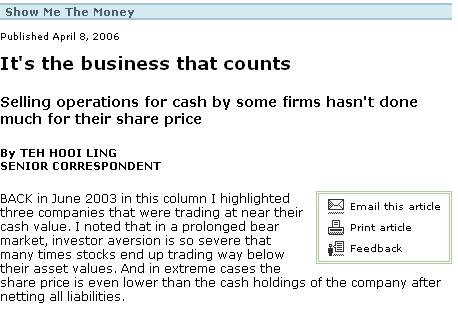
A couple of years ago, there was very interesting article, it's the business that counts , posted on the Singapore Business Times. It's written by Teh Hooi Ling. Her column's name is very special for me for it's called Show Me The Money. Here is a snapshot of the column.

In that article, there are many valuable advice given for the investor.

Regarding cash per share.

  • 'Of course, if the company has no intention to return the cash to shareholders and its operations are bleeding cash, then the share price may well have reason to be trading below the cash net of liabilities per share,' I wrote. 'Unless there is a turnaround in the business, the cash will eventually be depleted.
Hmm.. the intention to return the cash!

Very important issue, eh?

What can the minority shareholder or speculator do if the management has NO INTENTION to return cash or unlock its assets?

Think about it. I have seen it way too often that the cash per share is rather meaningless if the management has no itention to share their wealth with the minority shareholders.

There is this one lesson from legendary investor, Philip Fisher.
  • The management of a company is always for closer to its assets than its shareholders. And without even breaking any laws, there are number of ways that the management can benefit themselves and their families at the expense of the minority shareholders, for example employing their relatives, buy-and-selling of properties between relatives at above market rates or the issuing common stock options.

Look at the issue with Lion Diversified Acquisition of Subsidiary at RM61.55 million!

This company BOLDY announced their acquisition of their subsidiary at a whopper rm61.55 million without even attempting to provide their minority shareholders without any detailed information on why should their subsidiary is worth so much.

Continuing on the article.

  • 'But if a company's share price is significantly lower than its cash net of liabilities, and there is no shareholder with a more than 50 per cent stake, then there is a possibility that a corporate raider may come in to scoop up the bulk of the shares, gain control, strip the assets and take hold of the cash.

    'Yet another possibility is for the controlling shareholder to take the company private, paying a premium to the market price.

    'Even if none of these corporate manoeuvres takes place, a company flush with cash and with operations that are profitable and generating cash will have no reason to trade below its net cash value per share for long. Thus a look at a company's cash position, coupled with an analysis of its operations, is a rather clear-cut way to ascertain the extent of under-valuation of a stock.'
A corporate takeover or the company being taken private. Interesting. For me,
I would add two more issues for consideration.

  1. 1. The time-frame - how long does one have to wait before an offer materialise?
  2. 2/ Will the offer price being a fair and just offer to the minority investor/speculator?
She also mentions the issue of management trust and integrity. (see past blog posting on Philip Fisher On Management Integrity )

  • 'So if you decide to buy into its shares now, you are, in fact, putting your trust in the management to invest the money wisely and in projects that will yield attractive returns.
  • But again, it boils down to one's assessment of the management, whether one believes it will make a wise choice of business to buy into, and at a reasonable price, and subsequently how it can add value to the business.
    At the moment, all of this is unknown. And it seems the market currently prefers the certainty of an existing thriving business to the uncertainty of an unknown one.

She then elaborates on what happened to the three Singapore stock examples she gave back in 2003 and she concludes from her examples by saying...

  • The above examples underscore the fact that ultimately it is the business that drives the share price. That conclusion is further reinforced by the price movements of a few companies that have sold their operations for cash.

Friday, June 27, 2008

Key West Global Proposal to list on Toronto Stock Exchange (TSX)

The following news article caught my attention: h7-06-2008: Key West to list subsidiary in Canada

  • 27-06-2008: Key West to list subsidiary in Canada

    PETALING JAYA: Mesdaq-listed Key West Global Telecommunications Bhd has proposed to list its wholly owned subsidiary, Times Telecom Inc (TTI), on the Toronto Stock Exchange (TSX) Venture Exchange, a public venture-capital market tailored for emerging companies.

    The listing will be done via the demerger of the Times Telecom Group, whose principal activity is the retailing of long-distance telecommunications services in Canada. The Edge weekly had reported a few weeks ago on the listing of a subsidiary of Key West Global.

    Under the exercise, TTI shares will be distributed to existing Key West shareholders. The allotment of a total of 90 million TTI shares will be on a basis of two TTI shares for every five Key West shares held. Pursuant to the capital distribution exercise, 90 million shares in Key West will be cancelled, ultimately resulting in existing shareholders of Key West who hold five shares ending up with two TTI shares and three Key West shares.

    Under the listing exercise, there will not be any issuance of new shares nor offer for sale of existing shares. All TTI shares will be granted listing and quotation on the TSX Venture Exchange. The exercise is expected to be completed by the fourth quarter of this year.

Now Key West Global was listed only in 2005.

This was the Q4 earnings reported on March 2006. Quarterly rpt on consolidated results for the financial period ended 31/1/2006

It made 980 thousand for the year.

A year later, Quarterly rpt on consolidated results for the financial period ended 31/1/2007, it reported losses of 664 thousand.

Couple of months later, I made a posting on this stock. Key West's ESOS issue

I gave a strange feeling. It was one of the first local companies to start expensing their ESOS. Which was good. However, the expenses of the ESOS caused Key West to lose money! Yes it did. Which made me baffled.

Should a company reward their employees with so much money that it causes the company to lose money?

And what about the minority shareholders?

Shouldn't the company justify themselves and its employees to their minority shareholders?

This is my simple issue.

If they want ESOS, fine.

Expense it and most important, they have got to JUSTIFY it.

On March 2008, their fiscal earnings was much better. Quarterly rpt on consolidated results for the financial period ended 31/1/2008. It earned some 1.8 million for the fiscal year.

This got me thinking about today's news article. Key West Global wants to list its subsidiary. I am baffled. As it is, Key West Global isn't making a lot of money. It only made 1.8 million and now it wants to list its subsidiary.

I am just so curious about the potential of this subsidiary that Key West Global wants to list it in Canada.

And accordingly, The Edge weekly had reported a few weeks ago on the listing of a subsidiary of Key West Global.

Here is that article: 27-06-2008: Key West to list subsidiary in Canada

  • 26 May 2008: Corporate: Key West likely to spin off unit in Canada
    By Joyce Goh

    Telecommunication services provider Key West Global Telecommunications Bhd is mulling the idea of splitting its businesses to list one of them in the Canadian stock exchange, say sources. (Damn! The sources strikes again! Look just about anyone can be a source! The coffee Auntie can even be considered the source, yes? So if you don't state who the source is, where is the credibility of such financial news?)

    "The company is looking at splitting its retail and wholesale businesses and listing its retail business on the Canadian TSX venture exchange," says a source.

    It is unclear how much the company is planning to raise from its Canadian listing and how the structure of the group will look like post-corporate exercise. But this exercise could pave the way for Key West's shareholders to have direct exposure in the company that is to be listed on the Canadian stock exchange. (Huh? It is unclear... ?)

    "The company is looking to take out the retail business of the group to list on the stock exchange in Canada. The details have yet to be finalised," points out the source. (Why don't you point out who is the source?)

    But, why list in Canada? (Yeah, why Canada?)

    It is believed that the nature of Key West retail business will receive better valuations in Canada. "The business is better understood in Canada and the listed company will be able to command a price earnings (PE) ratio of as high as nearly 20 times," says the source.

    According to the data in Bloomberg, Key West's PE as at Jan 31, 2008, stood at 10.5 times. (Hello, why didn't the article states clearly how much Key West actually earned?? Talking PE without stating the actual earnings is so outright fuzzy! It just doesn't make any sense!)

    Key West through its subsidiaries provides wholesale network products and services to telecommunications companies (telcos) and caters to retail clients comprising corporations and individuals. The company offers a host of telecommunications services such as Internet Protocol voice, data and network services for carriers.

    Key West has subsidiaries operating in Malaysia, British Virgin Islands, Canada, US, Hong Kong, Australia and Brunei. Based on its FY2007 annual report, the bulk of its retail business is in its wholly-owned subsidiary Times Telecom Inc Canada. Although it is unclear how the structure would look like post-corporate exercise, this could mean that Times Telecom might be demerged from the group.

    Since being listed on the Mesdaq in 2005, the company has not seen heavy activity with a market capitalisation of RM19.13 million. The stock hit its 52-week high of 18.5 sen on Oct 30 last year but dropped its 52-week low of seven sen at end of April. The stock closed at 8.5 sen last Friday. (Perhaps if one had look at Key West Global earnings track record, then one could understand why no one was interested in such a stock in the first place!)

    The telecommunication services industry is indeed a competitive one. However Key West's vast network gives it strong global exposure and it has good ties with global telcos in major markets.

    For its FY2008 ended Jan 31, Key West returned to the black, registering a RM1.8 million net profit compared to a RM643,000 net loss for the year before. This turnaround was achieved despite its revenue dropping 20% to RM175.9 million compared to its revenue in FY2007 of RM219.6 million. The group had slipped into the red in FY2007. (Nice to see the article stating some actual facts here)

    Out of the RM175.9 million revenue achieved in its FY2008 (unaudited), about 72% of it was derived from the wholesale telco sector while 28% was from the retail sector. With the retail sector still contributing to the top line, will spinning it off significantly affect Key West's fundamentals?

    According to an industry observer, it should not be a problem for the listed Key West component in Malaysia to maintain its business and achieve further growth.

    "Quite a large part of Key West's wholesale business is in VoIP business and that segment of the business is one of the key drivers of growth for the industry. Also, the listed company in Canada would probably be related to the Key West group here in Malaysia so an arrangement between the two is likely," points out the industry observer.

    Additionally, according to Key West's announcement to Bursa Malaysia, its wholesale business has new services to offer such as iCall shop and Prepaid PC-to-Phone which it plans to launch this year.

    For its FY2008 (unaudited), Key West's cash increased 20% to RM10 million while its borrowings stood at RM4.4 million as at Jan 31, 2008.

    Moving forward, Key West expects better days ahead. According to the company's recent research report on Bursa, it expects the telecommunications industry to improve this year. "From the vantage point of 2008, the global telecommunications industry appears to have returned to a firmer footing and looks set to experience better times," notes the research report.

    "According to a December 2007 report by Telegeography on the international voice market outlook, international traffic growth slowed sharply in 2006 to 10%, the lowest level in more than 20 years. However, the market outlook appears to be improving, and worldwide revenues are predicted to grow from under US$1.7 trillion (about RM5.4 trillion) in 2008 to over US$2.7 trillion in 2013," it adds.

    No doubt the competition in the telecommunications industry is stiff. But given Key West's vast network and an impending corporate exercise, it should give reason enough for a second look at the Mesdaq stock.

*** Edit: Just realised that Key West Global just announced its Q1 Earnings. It made 10 thousand only! ***


Key West Global Telecommunications Bhd (0095.KU) - Malaysia
1st quarter ended April 30:
Figures are in Ringgit (MYR).

2008 2007
Revenue 35,033,000 52,718,000
Pretax Profit (8,000) 1,138,000
Net Profit 10,000 720,000
Earnings Per Share Omitted 0.32 Sen
Dividend Omitted Omitted

Thursday, June 26, 2008

Yet Another Reason Why Many Don't Like Jim Cramer


ps.

His Buy, Buy, Buy thingee... who does it reminds us of?

Lion Diversified Acquisition of Subsidiary at RM61.55 million!

Lion Diversified announced last night it was acquiring a subsidiary. In local lingo, it's a Kaki-Lang type of corporate exercise. Here is the temporary link to the announcement. ACQUISITION OF A SUBSIDIARY

  • The Board of Directors of Lion Diversified Holdings Berhad ("LDHB" or the "Company") wishes to announce that LDH Trading Sdn Bhd, a wholly-owned subsidiary of the Company, had on 25 June 2008 completed the acquisition of the entire issued and paid-up capital comprising 3,000,000 ordinary shares of RM1.00 each in Banting Resources Sdn Bhd ("Banting Resources"), a company incorporated in Malaysia, for a total consideration of RM61.55 million ("Acquisition of Subsidiary"). Hence, Banting Resources became a wholly-owned subsidiary of the Company.

    Banting Resources, a company incorporated under the Companies Act, 1965 on 26 September 2006, is a property investment company with an authorised capital of RM10,000,000.00 comprising 10,000,000 ordinary shares of RM1.00 each and an issued and paid-up capital of RM3,000,000.00 comprising 3,000,000 ordinary shares of RM1.00 each.

    The Acquisition of Subsidiary is not expected to have a material impact on the earnings of the LDHB Group for the financial year ending 30 June 2008 and, on a proforma basis, is not expected to have a material impact on the audited consolidated balance sheet of LDHB as at 30 June 2007.

Here are some of my comments.

1. This is an acquisition which has been completed. It's not a proposal.

2. It's wholly owned subsidiary, LDH Trading Sdn Bhd bought the entire stake in, Banting Resources Sdn Bhd for a total consideration of RM61.55 million.

3. Rm61.55 million and this company doesn't even have the decency to show detailed information of this acquisition. Questions that I can think of.

  • a. Is the purchase price fair or is it the purchase price exorbitantly high?
  • b. What it the track record of Banting Resources?
  • c. What kind of Balance Sheet does Banting Resources have? Is it highly in debt?
  • d. What does Banting Resources do?
  • e. Who are the exact shareholders in Banting Resources?

4. If you look at Lion Diversified historical announcements, why are they constant acquisition of subsidiary? I mean seriously, is Lion Diversified in the business of buying its own companies?

5. Here is the link to Lion Diversified last reported quarterly earnings. Quarterly rpt on consolidated results for the financial period ended 31/3/2008 (You will note some drastic increase in trade receivables - and did you see that LionD has investment in quoted securities totalling a massive 237 million?? Wonder what securities man!). In the Balance Sheet, Lion Diversified is noted to have 199.547 million in its piggy bank and with debts totalling 480.681 million. As it is, based on this purchase would cause Lion Diversified to be even more in debt.

Ah, but that's not all.

Let me highlight just a couple the many, many proposals that I saw in its historical announcements. Well there is one proposal where Lion Diversified is purchasing land in China for some 151 million.

And then there is their massive BLAST FURNACE IRON-MAKING FACILITY which is valued at 1.62 Billion!

Wasn't Lion Group a group of company which almost sank a decade ago due to overly aggressive expansion and massive borrowings?

5. Try google the exact phrase "Banting Resources" and see if you can get more info on this company.

How now brown cow?

Do you like what you see or are you simply disgusted?

Warren Buffett Says Growth Is Slowing And Inflation Is Really Heating Up!

Did you catch the clip on Warren Buffett on CNBC's lunchtime? I found it to be extremely interesting and I have marked down the interesting points from that interview transcript from CNBC below.

-----------

This is a transcript of Warren Buffett's live interview with Becky Quick on CNBC's Power Lunch, Wednesday, June 25, 2008 at 12p ET. Buffett tells Becky U.S. inflation is "exploding" and warns that the Federal Reserve must signal controlling prices is not a secondary concern.

Becky Quick: We are standing by at Smith and Wollensky in New York City for an annual gathering, something that's been happening for years now. This is to benefit the Glide Foundation. That's an organization Warren Buffett has been very closely allied with. And Mr Buffett, we want to thank you very much for joining us today.

Warren Buffett: Thank you.

Becky: The first question, we just want to talk about why we're here today. The Glide Foundation is an organization you've been workign with for many years at this point. For people who aren't familiar with it, why Glide and why this lunch where you're going to be meeting with people today who have paid over 600-thousand dollars for this chance to break bread with you?

Buffett: Well, Glide is an organization in San Francisco. It's run by a remarkable man named Cecil Williams, who, more than 40 years ago, went out there as a young black pastor to a dying inner-city church. And they turned it into a marvelous, marvelous, really social organization. he takes people that the world has given up on, and sometimes have given up on themselves, and he brings them back.. He gives them hope. They feed 750-thousand meals a year. They train people. They have child care. They have health clinics. They have 52 rooms where people who don't have shelter can come... As the years have gone by, the people in San Francisco have come to appreciate it and I learned about them some years ago and I just decided that money couldn't go to a better cause.

Becky: Well today, over 600-thousand dollars will be going for this lunch. Let's talk a little bit more about the poeple who are going to be eating lunch with today, but while we have you here, let's cover some of the news of the day, because people have been waiting to hear about some of those things. The Fed is going to be coming out with it's announcement (on interest rates) in little over two hours time. And there's been a huge debate about whether the Fed should be more concerned about higher inflation or slowing growth. In your mind, what's the most important factor?

Buffett: Well, they should be concerned about both, because both are going on. Growth is slowing, in fact, I'm not even sure it's growth anymore. And inflation is really heating up. So, it's not an easy job to have, serving two masters in effect. That's why I'm glad that Ben Bernanke has the job and I don't. (Laughs.)

Becky: Pretend you are in his shoes for the moment. What would you do?

Buffett: I'd probably offer my resignation. (Laughts.)

Becky: Would you keep rates steady, though, if it was your job to decide this right now, you're faced with both those headlines?

Buffett: I think inflation is really picking up, so I think the Fed has to be very careful to do anything that signals that they consider inflation to be a secondary goal and something that they'll worry about later. Because it's huge right now. I mean, whether it's steel or it's oil, you name it. The pressure, you've seen it in chemical prices recently. Dow has announced. We see it everyplace. It's exploding.

Becky: That's almost an argument for raising rates today, but there's still an awful lot of weakness with consumers, with the house prices they've been watching. Would that be too much of a shock, if the Fed came out with a surprise interest rate increase today?

Buffett: I think it probably would be, but the economy is weakening. All the data I see, and I see a fair amount on a real-time basis, indicates that the weakening, if anything, is getting worse.

Becky: You mean from the consumer's perspective?

Buffett: Right, from the consumer's perspective. But the things that fall out from the weaker consumer buying, and the credit card losses and that sort of thing.

Becky: Where do you see that weakness, because you have such a broad array of businesses, everything from the bricks business to the insurance business to actual retail businesses. Where do you see the biggest weakness?

Buffett: Everything connected with construction and with consumer, I see weakness. And if anything, it's accentuating a little bit.

Becky: Along with the concerns about inflation, a lot of people have been screaming the Fed has to do something to save the dollar. It's seen so much weakness recently. Do you have any currency bets right now?

Buffett: Just, I've got the tail end of the Brazilian real. But, over time, if we keep doing what we're doing, and it isn't the Fed, it starts with policy makers in Congress. If we keep doing what we're doing, we're going to keep getting the same result, which is a weakening dollar.

Becky: What do you mean, keep doing what we're doing? In terms of running a budget deficit?

Buffett: In terms of running huge current account deficits. And part of that stems from oil. I mean, there are a lot of things that go into that. But the truth is we can't send two billion dollars a day out to the rest of the world and not expect the dollar to get weaker over time. That's not a short-term forecast, but that's going to happen over time.

Becky: You mentioned oil prices, and there's been a huge debate we've been having on our show, and throughout the day, where people are trying to figure out, is this supply and demand picture or to the idea that there's speculation going on in these markets. That there's a lot more money in these markets than there used to be, say three years ago.

Buffett: It's supply and demand. I mean, if somebody buys a thousand forward oil contracts and somebody sells a thousand forward oil contracts, somebody's speculating on the downside and somebody's speculating on the upside. The only way you could have speculators having a big impact is if you had a huge amount of storage where they started actually withdrawing actual, physical oil from the system. But it's not speculation, it's supply and demand and the situation is that in my adult lifetime, up until the last year or two, there's always been a huge amount of excess supply available. There's been reserve capacity. And that goes back 30 years ago, in this country we produced way more oil than we needed here and we had something called the Texas Railroad Commission that shut down wells. And a matter of fact, we got down to where they would only let wells operate in Texas for eight days, we had so much extra capacity. We don't have excess capacity in the world anymore, and that's what you're seeing in oil prices.

Becky: Except we had a series of people who came to Capitol Hill, to Congress on Monday, who said, the analysts, if you tamp down on speculation, you could cut 50 percent, as much as 50 percent, out of oil prices immediately. Do you think that's just hogwash?

Buffett: (Laughs.) I think if they closed the oil futures trading, I don't think it would make much difference. Incidentally, the five-year oil price, you can buy oil for delivery in 2012 now, or 2013, that price is very close to this price. Now if anyone thinks that short-term speculation is entering into oil prices, where are they paying 130 dollars a barrel for delivery in 2013.

Becky: Mr. Buffett, you are the (second) largest shareholder in Anheuser-Busch. InBev has made a bid for Budweiser, for Anheuser-Busch, for Bud, and there are a lot of people trying to figure out if you think that's a good offer. What do you think about it?

Buffett: (Laughs.) When we get through with this interview, there will still be a lot of people wondering what I think about it. I haven't talked about it to anybody. I've been reported, all these things have been reported, I have not talked to anybody about it. I've been reported to have been seen in St. Louis. There's obviously some double of me that's running around out there. (Laughs). I can't imagine any guy wanting to look like me, but if he's out there, he's apparently in St. Louis and he's apparently over talking to InBev and all these people.

Becky: So you haven't talked to Anheuser-Bush management? You haven't talked to InBev?

Buffett: I have not talked to anybody.

Becky: What do you think about the deal?

Buffett: (Laughs.) I think it's an interesting spectator sport at the moment.

Becky: So you're not going to weigh in on either side of this?

Buffett: (Laughs.) I certainly haven't so far.

Becky: And you don't want to right now?

Buffett: (Laughs.) If we didn't have all these people around I could tell you about it.

Becky: If we didn't have all these people around. Let's talk a little bit about politics, too.

Buffett: Sure.

Becky: Barack Obama has been the person that you're supporting. This is the first time you've really had a chance to talk since Hillary Clinton dropped out of the campaign, but you're holding a fund-raiser for him next week.

Buffett: July second.

Becky: July second. We watched some of the numbers coming in in May and Barack Obama's fund-raising ability slowed down significantly in May. McCain has picked up. Do you think that's a temporary, one-time blip, or are these two candiadtes going to be running neck-and-neck when it comes to fund-raising.

Buffett: Well, I think Barack is going to have plenty of money. I mean, he gave up on federal financing. So I don't think money is going to be a problem for either candidate. The American public, when they go to the voting booth in November is going to have a very good fix on both candidates and the shortage of money will not impair them having that fix. So I think money is going to be a non-issue in the campaign.

Becky: Barack Obama did give up on public financing after saying he would accept it. What did you think of that move?

Buffett: I wouldn't have, I don't agree with that.

Becky: You don't agree with him changing his position?

Buffett: I don't think he should have, yeah.

Becky: What about the idea of supporting windfall taxes against the oil companies? He's the candidate you support, but if you start talking about taking windfall taxes out on the oil companies, is that something you would agree with?

Buffett: I think it's very hard to have windfall taxes. Steel has doubled in price. Is that a windfall for the steel producers? Sure. Corn is, you know, $7 a bushel. Soybeans are at $15 a bushel. I don't think any candidate in his right mind who is standing for election in farm states would say you ought to tax farmers especially because they're getting a windfall. But they are getting a windfall from commodity prices. Maybe they deserve it because commodities have been underpriced. But to pick out one commodity, with copper at $3.60 a pound you could say that the copper producers are getting a windfall. You know, the networks are getting a windfall because the Olympics are being held. So I don't think that taking anybody that's had a commodity that increased in price a lot and saying there ought to be a special tax because of that really makes a lot of sense. I do think the tax code should be changed in major ways, but I don't think that's the way to do it.

Becky: How do you think the tax code should be changed?

Buffett: I think the super-rich should pay more and people in the middle class and lower should pay less.

Becky: If you start looking at the proposal that's been put forth with social security taxes which includes stopping, still, at 102,000 for social security, but then picking up that payroll tax at $250,000. Is that your idea of a good change?

Buffett: The payroll tax is a third of all taxes raised. Over 900 billion dollars out of 2.6 trillion. So the payroll tax is terribly important. It quits at $100,000 for a guy like me. So I pay practically no payroll tax in relation to my income. Most of the people that are going to be -- people are going to be serving us the steak in this restaurant today are paying a very, very high, they're paying 15.3% or so in payroll taxes. I am paying a tiny fraction of 1% of payroll taxes. I think there should be a major overhaul of the payroll tax. I think guys like me should pay more.

Becky: Although there are people who have said, under this new proposal that's been put out, it would end up meaning that someone like an entrepreneur goes back to a tax rate of 50%. And that is even before you include some of the state and local taxes. Do you worry that if entrepreneurs and other people are taxed at 50% to 60%, depending on where they live and how much they make, that it will stop innovation? That it will harm some of the innovation?

Buffett: I worry about my cleaning lady paying 15.3% on payroll tax when I pay on my total income tax, capital gains and dividends, 15. So, she is paying a higher tax rate than I am, but she doesn't have the lobbyists talking for her. The United States government raises about -- spends about 20% of the GDP. Nobody wants to pay their share. That's human nature. But the Congress has the job of saying we're going to get 20% of GDP from the American government because the American people demand these services and so on. And the question is, they get it from anybody that pays it, they're not going to like it. You have to figure out on a basis of your own idea of social justice and making sure that the golden goose keeps laying golden eggs. What is the best system? I think the answer is to tax the super-rich more.

Becky: You are going to be having lunch today with two people that paid more than $600,000 for the opportunity to sit down with you. These two gentlemen, have you spoken to them at this point?

Buffett: No, I've had some correspondence with them. I'm looking forward to speaking with them.

Becky: What do you think you'll be talking about? I know they brought their children and wives along. What's your plan for this lunch?

Buffett: We'll be talking about anything they're interested in. We'll talk as long as they want to talk, and we'll talk about the subjects they want to talk about. If you want to pay $660,000, we'll talk about anything you want to talk about, Becky. Maybe even the Anheuser deal. (Laughs).

Becky: Great. One more question for you. There have been people who have been saying just taking a look at politics and some of the things out there that maybe you would be interested in getting on a ticket at some point. Is there any truth to that?

Buffett: No. I will go Sherman one better, whatever he said.

Becky: Okay. Mr. Buffet, thank you very much for your time. We appreciate it.

Buffett: Thank you.

http://www.cnbc.com/id/25369553/site/14081545/

-------------

And last night, the Fed as expected, made their hawkish remarks on inflation but did nothing. ( See Fed Worried About Inflation But No Hint of Rate Hike )

And of course the Oil recovered back some of its early day losses and the markets gave up most of their day gains after Fed announcement.
Wednesday, June 25, 2008

The Day The Dead Duck Soared for Warren Buffett

The following was taken from Bud Labitan's "The Warren Buffett Business Factors".

The true investor welcomes volatility. Ben Graham explained why in Chapter 8 of "The Intelligent Investor"

There he introduced "Mr.Market," an obliging fellow who shows up every day to either buy from you or sell to you, whichever you wish.

The more manic-depressive this chap is, the greater the opportunities available to the investor. That's true because a wildly fluctuating market means that irrationally low prices will periodically be attached to solid businesses. It is impossible to see how the availability of such prices can be thought of as increasing the hazards for an investor who is totally free to either ignore the market or exploit its folly.

In assessing risk, a beta purist will disdain examining what a company produces, what its competitors are doing, or how much borrowed money the business employs. What he treasures is the price history of its stock. In contrast, we'll happily forgo knowing the price history and instead will seek whatever information will further our understanding of the company's business. After we buy a stock we would not be disturbed if markets closed for a year or two. We don't need a daily quote on our 100% position in See's or H. H. Brown to validate our well-being. Why, then, should we need a quote on our 7% interest in Coke?

~~~~~~~~~~~~~~~~~~~~~~~~~~~~~~~~~~~

There's this great example told by Andrew Kilpatrick, Of Permanent Value ( pg 631) on how Warren exploited the folly of the Mr.Market.

Here's a summary from me based on what Mr.Kilpatrick wrote.


Wells Fargo - "A Dead Duck" Soars Like An Eagle

In 1990, Buffett's original investment into Wells fargo came when there was a stigma surrounding the purchase, because it was a terrible time for banks. His purchase was deemed outrageous for at that time 'bank' meant layoffs, real estate write-offs, slashed dividends. Some had even suggested that the rapidly declining real estate prices could bring down the banking system.

On the day Buffett bought, the price earnings ratio of Wells Fargo was a minuscule 3.7! Mr.Market was really in a crummy mood. The stock had traded as high of $86 a share and a low os $41.25 in 1990. Buffett's initial average cost was about $58 a share.

And all this was admist negative nay-sayers and some big time short sellers, who betted that the stock would drop.

Some called it a dead duck. Whilst admitting that it would not be a bankruptcy candidate, they predicted the stock to fall to the low teens.

At first, the short sellers seemed right. For very soon, the dividends were slashed and reserves for real estate loans increased dramaticallyy.

George Salem, an analyst with Prudential Securities, was quoted : "He picked the management that underwrites real estate the best. But one thing he didn't realise that even Mark Spitx (the former Olympic Star then) can't swim in a hurricane in the middle of the ocean".

So how was Wells Fargo's earnings per share at that time? Doing quite nicely. The bank would wind up earnings of $712 million or $13.39 per share.

But then commercial real estates continued to decline.

And so Wells Fargo set aside for potential loan losses a little over $1.3 billion, or approximately $25 a share of the $55 a share in net worth. When a bank sets aside funds for potential losses, it is merely designating part of its net worth as a reserve for potential future losses. It doesn't mean those losses have happen, nor does it mean they will happen. It just means, if it does happen, the bank is prepared. (how did Wells Fargo actually do? The losses evetually did happen but it wasn't as bad as what Wells Fargo prepared for. Its loan loss figure in 1990 was a stunning $700 million but it still reported a profit of $21 million or $0.04 a share)

And of course the Mr. Market did not liked it. And the stock fell again. In which, it presented Buffett with his scond purchase in Aug 1992. He bought at prices ranging from $66 to $68 a share. And in late 1992, Buffett invested another $37 million - at prices ranging from $66 to $69.


And Prudential's Salem kept his sell pitch in late 1992, saying what a terrible stock Wells Fargo was: "When Warren Buffett runs out of money, the stock will plummett" adding that Buffett might as well make donations to a good cause. "He's supporting the stock; otherwise it would be much lower". He said the stock would make a perfect short, that only Buffett was holding the shorts back from a real onslought. In early January 1993, Buffett bought another 66,800 shares, bringing his shares total to 6,358,418. (To Buffett, WF was one of the best-managed and most profitable money-center banks in the country, selling in the stock market for a price that was considerably less than considerable banks were selling for in a private market)

Salem continued a month later: "We reiterate our sell rating of WF.. eventual downside risks appear considerable - perhaps to $60 or below.. The price more than reflects a nearly complete recovery which we don't see'...


In which it did not happen. The stock crossed $100 a share!!!!!!!!!!!!!

In 1993, the Atlanta Journal wrote this...


Calling it the 'strangest stock I have ever covered', Prudential's Salem dropped coverage of Wells Fargo. A vociferous critic of the San Fransico based bank, Mr.Salem has been bedeviled for years by Wells Fargo.

The analysys has carried a sell recommendation on the stock since Dec 1989 when it was trading at about $60. The stock closed Thursday at $105.37 1/2.


Mr. Salem, an often quoted 25-year industry veteran, insists he isn't giving up on a bad call. "This is not a surrender of any kind,.... It was a business decision based on where i thought I could spend my time more profitably. Wells Fargo is overpriced, volatile and unpredictable and not many from investment-land care about it".

Four years later in 1997...


If Mr. Salem had wanted to purchase Wells Fargo, he would have to pay approximately $270 a share!!!!!!!!!!

As for Warren, he ended up with a pretax annual compunding rate of return of approximately 24.6% on his 1990 investment!!!


~~~~~~~~~~~~~~~~~~~~~~~~~~~~~~~~~~

So, what's the point?

The point is this; if you had identified the companies that have excellent management or a great consumer monopoly or both, it is easy to predict they will most certainly survive a recession more than likely come out of it in a better position than before. Recessions are hard on the weak, but they clean the field for the strong to take an even larger share when things improve.

On the other hand, stories like this, is often very nice to read. And in this story, it depicted how Warren 'bet' against Mr.Market and won big. Warren used his advantage, his attitude, he knew he is right because his reasoning his right and that sometimes the manic Mr.Market might not agree with him.

Oh before I go looking for MY very own Wells Fargo success story, let me pour cold water all over myself and remind myself what I wrote in the other blog entry, Our Investing Advantage

And this is a great example that if one is really dead sure of one's own reasoning, then one should never be affraid if Mr.Market reacts against one's stock investment. Remember, you are right because your own reasoning is right!

But... but... but...

And again, investing is never all that easy. It does get complicated at times.


And the main issue is simply,
how dead sure is one's own reasonings?

Think about it.

We are never anywhere close to be the super investor that Warren Buffett is!

And also the quality and the durable competitive advantage of our listed stocks is simply not as comparable to what Warren Buffett had invested in!!

Put it this way, the Washington Posts, the great Coca-cola's, the Gilletes, the H&R Blocks are not listed in our stock exchange.

Here, we are very much subjected to stuff like earning cycles and even changes in the fortune cycle in which so-called good companies turning bad for one reason or another.

Hence, we are quite likely to make occassional mistakes in our stock investments, in regardless if whether the fault lies in our own stock selection method or not.


So forget this not.

This 'right reasoning to stay invested' thingy is pretty darn complex and could be a deadly value destructor in our stock investments if we fail to accept that perhaps our own judgement could be faulty at times!!

So sometimes, if and when the market go against us, we just have to ask ourselves this question: "What if we are simply wrong?"

Err... let me remind what my Granny told me (in my local complicated lingo! (err..Chinese-English!)):


  • "Little bugger.. you are you, you are not going to be A Warren Buffett cos if you are, you are not here sitting down and playing mahjong with Ah Poh. Sooooo little bugger,you dun simply-simply priy-priy and try to be who you cannot be! You can learn and want to be no.1 but your no.1 and other people's no.1 is like how the sky is different than the land!... so little bugger... ni ming-pei mah? :P

Oh.... and did I not mention the number of times I got my head whacked hard by Granny as she kept reminding me that there's a very fine line between right and being stubbornly wrong?!!

Tuesday, June 24, 2008

Cristiano Ronaldo Leaves Manchester United!!

Warning: The following clip is NOT for the faint hearted!

Monday, June 23, 2008

Dr. Marc Faber Reckons World Economy Will Slow Due To Inflation.

Here's another extremely interesting interview on Dr. Marc Faber.

  • Excerpts from CNBC-TV18’s exclusive interview with Marc Faber:

    Q: Do you see more pain for global equity markets in 2008 even from here?

    A: Over the last twelve months financial stocks are breaking down in the US. But the rest of the market has held up very well. Material, energy and some capital good stocks went up. So gradually the market place is beginning to realize that the financial crisis is not going to resolve in ten minutes and it will take a lot of time. Many more banks will go bankrupt and it will spill over into what I call the real economy. The world will slowdown very because of the inflationary pressures. The consumer has two major categories of expenditure, the non-discretionary like food, energy, healthcare etc and the discretionary, which are typical consumer goods, appliances, cars, motorcycles, television sets and so forth.
    When the price of necessities go up substantially, as is the case for energy and foods now, we have less money to spend on discretionary items that then will have a spillover effect on the economy.

    Q: What about something like an India? We have been one of the worst performing equity markets. Do you see more pain for the Indian stock markets even from these levels?

    A. When the market had hit 21,000, I had expected it to drop to12,000. On March 18, it dropped to 14,800 and then we had a typical bear market rally. That’s when all the Indian investors turned bullish again and the Sensex went to almost 18,000 levels on May 5. Now we have been drifting again and I still maintain that the Indian markets will go lower. The only people in the whole world who don’t understand that the economy and the equities are moving in different directions are Indian investors, they say the economy is strong and is growing rapidly. The economy growing strong and growing rapidly has nothing to do with the performance of the equity markets.

    Q: What about the role that the crude prices have played in it up until now for many markets both developed and developing and where do you see that market headed?

    A: Crude is at USD 135 per barrel we have gone up 12-times since 1998. I personally would not buy oil here because I think a correction is overdue. But in the long run I cannot see the demand declining too much. Although some countries have alternate sources of energy, the demand in some countries like India and China will continue to increase. OPEC and other oil producers cannot increase their production significantly. So I think in our lifetime we will never again see oil.

    Q: If crude was to stay at the levels it is at right now. Do you expect a prolonged phase of high inflation and high inflationary fears for most emerging markets?

    A: I think inflation is a very funny phenomenon. First of all I define inflation as an increase in the quantity of money and of credit. In the last twenty-five years we have had a huge expansion of money and credit in the United States, especially after 2001, which then led to trade and current account deficit. The current account deficit grew from 2% of GDP to close to 8% of GDP. USD 800 billion was flowing into the world annually from the United States. This essentially is the money that is being made available by the Fed and the treasury, and that of course is inflationary per se. Inflation is occasionally in asset prices, in equities and in real estate, in commodities and at times it will shift to consumer prices. In the 70s we had a very high consumer price inflation and then starting form 1981, inflation then shifted into asset prices. I believe that period between 1999 to 2003 essentially marks the thrust in the consumer price inflation. From here onwards, the world will live with higher inflation rates on the consumer price level for the next 10-20 years.

    Q: Where do you see the Dow and the S&P bottoming out? Do you see that happening in 2008 at all?

    A:
    It is very difficult to tell. If you really print money, you can probably support asset markets to some extent. But I believe that the Fed is now in a very difficult position for the following reasons. The Fed can print money and make money available and the treasury can send cheques to the household sectors in order to spend money. That can support the economy to some extent. If you increase the fiscal deficit and if you print money, the interest rates will start to go up significantly. The interesting thing is, since September 18, when the Fed started to cut the Fed’s fund rate from 5.25% down to 2%. The only bonds that are still at a lower yield than they were before the Fed fund rate cut are the treasury bonds. All the other bonds, whether it is AAAs or BBBs or mortgage rates are higher than at that time. So if the Fed can print money, the bond market may actually not like it and go may down, which can result in higher interest rates.

Source of article: http://www.moneycontrol.com/india/news/fii-view/indian-mkts-to-go-lower-going-forward-marc-faber/13/44/343702

Soros says Superbubble is now Collapsing!

Many thanks to The Wanderer for the heads up on the following article/interview on George Soros. ( Link: http://online.wsj.com/article/SB121400427331093457.html )

  • In his latest book, "The New Paradigm for Financial Markets," he argues a "superbubble" has developed in the past 25 years and it is now collapsing.

And like The Wanderer, I liked the following part very much.

  • WSJ: How is that you are rich despite your world view having been wrong so far?

    Mr. Soros: I'm only rich because I know when I'm wrong.


Warren Buffett's Bet And RBS Bold Prediction.

Warren Buffett's bet against Protégé Partners LLC was highlighted by Carol Loomis on Fortune Weekly, Buffett's big bet

  • Fees: Big hurdle for Protégé
    As for the fees that investors pay in the hedge fund world - and that, of course, is the crux of Buffett's argument - they are both complicated and costly.

    A fund of funds normally charges a 1% annual management fee. The hedge funds it puts that money into charge an annual management fee of their own, which for funds of funds is typically 1.5%. (The fees are paid quarterly by an investor and are figured on the value of his account at the time.)

    So that's 2.5% of an investor's capital that continually goes for these fees, regardless of the returns earned during a year. In contrast, Vanguard's S&P 500 index fund had an expense ratio last year of 15 basis points (0.15%) for ordinary shares and only seven basis points for Admiral shares, which are available to large investors. Admiral shares are the ones "bought" by Buffett in the bet.

    On top of the management fee, the hedge funds typically collect 20% of any gains they make. That leaves 80% for the investors. The fund of funds takes 5% (or more) of that 80% as its share of the gains. The upshot is that only 76% (at most) of the annual return made on an investor's money accrues to him, with the rest going to the "helpers" that Buffett has written about. Meanwhile, the investor is paying his inexorable management fee of 2.5% on capital.

    The summation is pretty obvious. For Protégé to win this bet, the five funds of funds it has picked must do much, much better than the S&P.

    And maybe they will. Buffett himself assesses his chances of winning at only 60%, which he grants is less of an edge than he usually likes to have.

    Protégé figures its own probabilities of winning at a heady 85%. Some people will say, of course, that just by making this bet, Protégé has acquired some priceless publicity.

This week, John Mauldin has featured Buffett's bet in his weekly write-up, Warren Makes a Bet

Do give it a read!

And last week, on Thursday, Royal Bank of Scotland analyst had made a very bold prediction.

  • The Royal Bank of Scotland has advised clients to brace for a full-fledged crash in global stock and credit markets over the next three months as inflation paralyses the major central banks.

    "A very nasty period is soon to be upon us - be prepared," said Bob Janjuah, the bank's credit strategist.

    A report by the bank's research team warns that the S&P 500 index of Wall Street equities is likely to fall by more than 300 points to around 1050 by September as "all the chickens come home to roost" from the excesses of the global boom, with contagion spreading across Europe and emerging markets.

    "Cash is the key safe haven. This is about not losing your money, and not losing your job," said Mr Janjuah, who became a City star after his grim warnings last year about the credit crisis proved all too accurate.

Do give the rest of the article a good read and note all the comments posted! ( http://www.telegraph.co.uk/money/main.jhtml?view=DETAILS&grid=A1YourView&xml=/money/2008/06/18/cnrbs118.xml )

Many thanks to The Wanderer for the heads up on that article.

Saturday, June 21, 2008

Jim Rogers Blasts The Insanity Of the Feds while remains bullish on Oil & Commodities

Here are some latest comments from Jim Rogers.

  • Jim Rogers: Oil Bull Market Has Years to Go

    Thursday, June 12, 2008 5:18 PM

    The bull market for oil has many years to go before it peters out, says billionaire Jim Rogers, chairman of Rogers Holdings.

    There are several factors for this view, but the primary one is that "known sources of petroleum are dwindling," Rogers told Bloomberg in an interview.

    Global oil supplies could fall far short of need and expectations in the next 20 years, reported the International Energy Agency in mid-May. The agency long expected supply to rise to meet demand of 116 million barrels a day by 2030.

    It now expects oil output to struggle to reach 100 million barrels in that time frame.

    These market conditions will make life difficult for airlines — and airline stocks — well past 2010 and will also impact Federal Reserve policy in the coming months, Rogers said.

    Rogers has proved astoundingly prescient since suggesting that investors buy into the older, industrial economy back in 1999 when gold and oil were coming off 25-year lows and when the Internet stock market was soaring.

    Now in his mid-60s, Rogers retired from full-time work when he was 37, and invests for fun. ( source of article: here )

And fresh on Forbes.

  • "We think the bull market in commodities still have a long way to go, especially when you look at growth rates in China, India, the Middle East, North Africa and throughout most of the developing world, where demand for just about every commodity is rising at unprecedented rates," Rogers said. ( Taken from Forbes article here )

Do note that Jim Rogers made them comments when he announced he is teaming up with S-Network Global Indexes to launch The Rogers Van Eck Hard Assets Producers Index. Unlike the Rogers International Commodity Index, the new index tracks the performance of companies that deal in commodities--rather than performance of the commodities themselves.

And in another article on MoneyNews, Rogers blasts the insanity of the US Fed

  • Jim Rogers: Helicopter Ben Bernanke 'Insane'

    Friday, June 20, 2008 2:40 PM

    The Fed, explains commodities bull Jim Rogers, has made things worse by printing huge amounts of money, causing huge inflation, and driving the dollar down.

    Plus, American taxpayers will have to pay off the $400 billion spent on Bear Stearns.

    "If the system is so fragile that the collapse of the fifth-largest investment bank in America could bring the whole thing down, what’s going to happen in a few years when the No. 2 or No. 1 banks go bad?" Rogers asks.

    "What’s Bernanke going to do, get in his helicopter and fly around the country repossessing cars and houses? This is insane."

    So, Rogers say he's buying airlines.

    It's counterintuitive: Twenty-four airlines went bankrupt last year, and five of the seven largest U.S. air carriers went bankrupt during the past decade.

    "That’s great news," Rogers says. "Bankruptcies are signs of bottoms, not signs of tops."

    "I fly a lot and planes are full," Rogers notes. "You read every day that the airlines are cutting capacity and raising fares. How much more bullish can you get?"

    Rogers' current investment picks also include Swiss francs, Japanese yen, agriculture and oil — but no financials right now.

    "I'm short on the investment bank ETF, which means I’m short on all of them," Rogers observes.

    "Some of these companies have horrendous balance sheets."

    Financials go for unbelievably low prices in bear markets, he points out, but this bear hasn’t hit bottom yet.

    Rogers — who is also short Citibank and Fannie Mae — says the excesses in financial markets have been far too great.

    "You don't see any 29-year-old cotton farmers driving Maseratis," Rogers says.

    "But a lot of 29-year-olds on Wall Street are driving them. This is not the way the world is supposed to work."

    However, the oil bull market has years to run, Rogers says, even though big market reactions can still occur.

    He points out that the price of oil has dropped by 50 percent twice since 1999.

    "Unless someone discovers a lot of oil very quickly in accessible areas, we’re running out of known oil reserves," Rogers says.

    "If the price of oil goes high enough, they’ll be drilling on the White House lawn and Buckingham Palace."

    And because food reserves are at their lowest level in 50 years, unless someone starts bringing on a lot more capacity soon, Rogers believes the agricultural bull market has got a ways to go, too.

    Meanwhile, prices for nickel, zinc and silver are down 50 percent to 80 percent from their historic highs, yet Rogers is waiting to add more of these commodities to his portfolio.

    "It looks like Congress is about to do something that will drive commodity prices down, and that will create a fantastic buying opportunity," he says.

    Rogers advises investors, however, not to panic in bear markets.

    "Bear markets perform a necessary service by cleaning out the system," he says.


Friday, June 20, 2008

Warren Buffett: In Business World Ugly Ducklings Stays Ugly!

Blast from the past.

(Continuing on the wonderful compilation of Warren Buffett's sayings done by Bud Labitan called "The Warren Buffett Business Factors" but unfortunately the link I had recorded is broken.)

For an understanding of how the to-invest-or-not-to-invest dilemma plays out in a commodity business, it is instructive to look at Burlington Industries. In 1964 Burlington had sales of $1.2 billion against our $50 million. It had strengths in both distribution and production that we could never hope to match. Also, it had an earnings record far superior to ours. Its stock sold at 60 at the end of 1964; ours was 13.

Burlington made a decision to stick to the textile business, and in 1985 had sales of about $2.8 billion. During the 1964-85 period, the company made capital expenditures of about $3 billion, far more than any other U.S. textile company and more than $200-per-share on that $60 stock. A very large part of the expenditures, I am sure, was devoted to cost improvement and expansion. Given Burlington’s basic commitment to stay in textiles, I would also surmise that the company’s capital decisions were quite rational.

Nevertheless, Burlington has lost sales volume in real dollars and has far lower returns on sales and equity now than 20 years ago. Split 2-for-1 in 1965, the stock now sells at 34 -- on an adjusted basis, just a little over its $60 price in 1964. Meanwhile, the CPI has more than tripled. Therefore, each share commands about one-third the purchasing power it did at the end of 1964. Regular dividends have been paid, but they too have shrunk significantly in purchasing power.

This devastating outcome for the shareholders indicates what can happen when much brainpower and energy are applied to a faulty premise. The situation is suggestive of Samuel Johnson’s horse: “A horse that can count to ten is a remarkable horse - not a remarkable mathematician.” Likewise, a textile company that allocates capital brilliantly within its industry is a remarkable textile company - but not a remarkable business.

My conclusion from my own experiences and from much observation of other businesses is that a good managerial record (measured by economic returns) is far more a function of what business boat you get into than it is of how effectively you row (though intelligence and effort help considerably, in any business, good or bad). Some years ago I wrote: “When a management with a reputation for brilliance tackles a business with a reputation for poor fundamental economics, it is the reputation of the business that remains intact.” Nothing has since changed my point of view on that matter. Should you find yourself in a chronically-leaking boat, energy devoted to changing vessels is likely to be more productive than energy devoted to patching leaks.

Taken from The New Buffettology :

Investing in Burlington in a market downturn or on bad news isn't a great move if the long-term growth is the goal. It is the kind of investment that Warren steers away from because it lacks the durable competitive advantage other companies can offer.

Warren is fond of saying that when management with an excellent reputation meets a business with a poor reputation, it is usually the business's reputation, it is usually the business's reputation that remains intact. In other words no matter who is running the show, there is no way to turn an inherently poor business into an excellent one. Ugly ducklings only grow up to be beautiful swans in fairy tales. In the business world they stay ugly ducklings no matter what managerial prince kisses them!

~~~~~~~~~~~~~~~~~~~~~~~~~

Ugly ducklings only grow up to be beautiful swans in fairy tales. In the business world they stay ugly ducklings no matter what managerial prince kisses them!

How true isn't it?

Take the toughest industry... for example the airline industry in the US. Here is my favourite comment on it from Charlie Munger (The Art of Stock Picking)

If it's a pure commodity like airline seats, you can understand why no o­ne makes any money. As we sit here, just think of what airlines have given to the world safe travel, greater experience, time with your loved o­nes, you name it. Yet, the net amount of money that's been made by the shareholders of airlines since Kitty Hawk, is now a negative figure ‑ a substantial negative figure. Competition was so intense that, o­nce it was unleashed by deregulation, it ravaged shareholder wealth in the airline business.

Now you can the smartest and most innovative management running the airline, but no matter how good and how dedicated they are, a terrible business remains a terrible business.

And here is more comments from Mary Buffett's book.

In 2000, it was reported that United Airlines, one of the best-run airlines in the United States, carried a net debt of USD$5 billion versus USD$4 billion in net income the last 10 years. Unions and high fixed costs ensured that any airline flying the friendly skies will never allow their shareholders' riches to soar for very long.

And what about the terrible automobile business?

In 2000, GM carried approximately USD$136 billion in long term debt, a sum greater than the USD$34 billion it earned from 1990 to 2000. Imagine, if you took every dollar that GM made for the last 10 years down to the bank, you still couldn't pay off the loan. Doesn't sound like a great business, does it?

For the car industry, they have to spend tons and tons of money designing and researching on new models. Then they have to spend tons of money to market the product (the car). And after all the moola spend, when the car hits the street, their nearest competitor comes out with a similar competing design. How? Does it matter who is managing the business? A lousy business will most likely remain a lousy business because the economics structure of the business industry does not allow the business to be good!

Anyway, the GM example also highlights the issue on why it is so risky owning business which carries such a huge debt. Just imagine if we own such a company which carries this sort debt. Now if and when the boom time is over, what will happen? Well, when the boom is over, sales and profit will most likely decline. And the decline might turn into losses due to financial interests incurred by the company carrying those huge long term debts.

So let me remind myself again...

Ugly ducklings only grow up to be beautiful swans in fairy tales. In the business world they stay ugly ducklings no matter what managerial prince kisses them!

Thursday, June 19, 2008

Recent Stock Market Crashes

Firstly I am not INSINUATING anything.

So do not ass-u-me anything for it will make an ass out of you an me. This posting merely looks at past stock market crashes and it does not attempt to say when and where the stock market crash will happen.


However, if you reckon that such a posting is taboo and it will be a jinx to your investments then do please not read. Ok?

There's this old little book by Neoh Soon Kean called Stock Market Investment in Malaysia and Singapore. It's published under Berita Publishing Sdn Bhd.

Here are some collection of comments from the book which I find to be very interesting.

from pg 14...

It is always difficult to determine exactly when a bull run starts, certainly much more difficult than pin-pointing the time a crash starts. Typically, a bull run always starts gently. The prices tend to bump along the bottom for a while before starting up and even after it has started, there may be a few false starts when the rate of rise would falter. With that caveat in mind, it is my opinion that the bull run started in Jan 1971 and the big marker break (that is the start of the crash) occured on 13 Feb 1973, an up-cycle period of about two years.....

The amazing fact is that in 1971 and 1972 could be regarded as bad years economically for Malaysia while 1973 and 1974 were, in fact very good years for both Msia and Singapore. Yet the latter two years coincided with the sharpest fall in the history of Msian/S'porean stock market. STi fell by 41% in 1973 and 42% in 1974.

Until after June 1973, the Malaysian stock market and the Singapore stock market were joint. The whole market was therefore affected by the economic well being of Malaysia. In the early 1970's Msia/S'pore was still very much an export-oriented region. The prosperity of many quoted co's in the stock market was much dependent on the export of primary commodities.

What were some of the factors which caused the big boom?

(1) Early profit was made

after May 13th incident of 1969, investors' confidence sank to an extremely low ebb. there was a very considerable amount of panic selling and the Straits Time Industrial Index dropped to a low of 130 in late 1970 from 170 in April 1969. Many shares were being sold at an extremely low level. The few investors who had the courage to buy then were to make hefty gains later on.

... even after another more than 40% rise in the overall price level by 31 Dec 1971, many of the stocks, were still very reasonable, especially the second tier stocks.

The early profits attracted a lot of investors into the market and again, the prices rose and by June 1972, ST had increased by another 20%. However from this point onwards, the people entering the markets were no longer governed by economic considerations.

The prices were to be increased by yet another 81% in the next six months (WAAAHHH), after which the end of the boom was in sight. By that time, the market had caught the speculative fever and price rises were no longer rational. The market was to rise another 41% in the final six weeks before collapsing. It is notable that the increase every six months got steeper and steeper. In the final three months or so, the increase of the index exceeded that of the previous 2 years! This rate of increase obviously cannot be sustained and the speculative mania ran out of steam and had nowhere to go but down.

... When a market is rising, everyone who goes in makes some profit and he is therefor encouraged to make further purchases. However, the continuous price increase cannot go on forever. At some point of time, the amount of money tied up is so high (at the highs, one lot of OCBC costs 50,000, a sum which was more than the selling price of two terrace houses at that point of time) (Fiyoh!!!! Now that's what u call BULL, eh?) that the buyer who buys in anticipation of a further rise will be forced to sell soon if the market is not going up. Once the market sees that a shares has stopped rising, the opposite goes into effect. The intending buyer will delay buying hoping that the price will fall further. This causes the weak intending seller to lower his price yet again. A spiral of forced selling at low prices is thus started and it tends to continue at ever increasing speed until eventually much, if not all, of the earlier rise is completely increased.

(2) Many were First Time Investors

For much of the 1960s, investment in the local share market was very much limited to the institutions, large corporation and a few well-off private individuals. The middle class was of a small number and wielded little economic power. However, with the Independence in M'sia and Singapore, the social spending of the governments were vastly increased and slowly a large body of middle class consisting of civil servants, doctors, teachers and other professionals were established.

Like the US of the 1920's investment opportunities in the late 1960's were the limited. Three months of fixed deposit was then paying 5% (Wahh... 5% now banyak lo). Naturally the stock market market attracted some of the money in circulation. As explained before, those who made profit early, attracted many others into the fold. The commentators of the time also pointed out an additional fact which caused a large number of first timers into the market. In late 1972, all teachers in msia received a considerable amount of back pay. The sudden receipt of an unexpected sum of money and the booming stock market at that time was all that needed to push many teachers into the market. Indeed in 1972, teachers' common room conversation was largely limited to the stock market. (LOL!!!! Wahh... so much happening inside ze teacher's in common room!!!... hohoho... playing shares when they are free??? )

These first timers had little idea of the economic principles upon which stock purchases should be made. Instead they relied on market talks, brokers' advice and self-proclaimed experts. (hehe... they become Sayur lor or some prefers to call it as Hong Kong Kai Lan) As a well-known Wall Street saying goes: 'Genius is a rising market'. the rapidly increasing prices gave all involved a vision of boundless prosperity and wealth ( hmmm... Grandiosity lo ). By the end of 1972, price rose to a level which could not be justified by any known economic standard.

... the price increase obtained were totally out of bounds of rationality. A PER of three digits is absurd by any standard but to the newcomers, PER was a meaningless measure. All they believed was that: 'If the prices had doubled in the past 6 months, they must be capable of doubling yet again in the next six months'. (ho ho ho... they believed that the stocks could really fly up, up and awayyyyyyyy hor!!... and today's high is tomorrow's low eh?)

(3) Rapidly Rising Foreign markets

(4) Trust in 'Blue Chips'

(hmmm.... is this where the common advise to buy blue chips come from?)

In the Crash of 1973, the top tier company was made much of finance, properties and a few old line companies such as Sime Darby and Haw Par. The enthusiasm for these top tier stocks was such that most others were largely ignored. The PER of the favoured stocks would rise to an astronomical level while for the less favoured, their PER would remain at a reasonable level even at the height of the speculative mania. The over-concentration of interest in a specific class of stocks naturally meant that the price rise would be even more phenomenal. Unfortunately, when the crash came, all stocks, favourites or otherwise, were brought down. Stock market crashes knew no favourites.

The higher the stocks rose, the worse they fell. Many ex-market favourites lost over 90% of their peak price. Local newspapers reported many cases of bankruptcies and several cases of suicides directly attributed to the stock market collapse.

But stop it did as it must in all slumps. The severe losses that took place traumatised the speculators for many years. When the overseas market picked up in 1975, the Msian/Sporean market failed to do so decisively. The prices bumped along the bottom for many years until 1979.
At the time, once again the lessons of history appeared to have been forgotten and Msian/Sporeans indulged in yet another speculative orgy......


The Crash of 1981

In magnitude, it is almost as severe as the first Crash.

First, it would appear that there were sound economic reasons behind the rise of share prices this time. M'sian/Sporeans had learnt sufficiently to depend on their own feelings on how the economy was doing rather than rely on foreign indices. (Ahhh... the problem of de-coupling our own market from others... be independant lo) At the time of the beginning of the bull run (approx Jan 1979), both Dow Jones and Financial Time Indices were in the doldrums. The local economic environment at the beginning of 1979 was vastly better than that of 1970.

(the tables in the book.... showed that price of rubber went from 1.99 to 3.25, price of tin went from 18,736 per ton to 35,710 and CPO went from 882 to 1177)

.... commodity prices were approaching or just below their respective all time high. Most of the companies directly or indirectly involved in the commodities business were doing extremely well and were flush with cash.

... per capital GNP had been rising most steadily for five years at an average of about 15 per cent. More than that, the private sector was very liquid with cash. In 1979, the money supply of Msia was standing at a figure that was five times higher than in 1971!

With profit increasing at a rapid rate, a PER of 20 or more seemed fully justifiable. (yeah... look at Cycle... price went from 2.62 to 5.25, and yet the PER only increased from 10 to 13... there is growth!!) As the memory of 1973 faded away and the mood of the country totally changed (market sentiments lo), stocks were once more respectable investments. Thus, more and more Msian/Sporeans invested and saw their investments steadily increased in value...

Secondly, the timing was right this time. In 1978-1980 the economic horizon was bright and it was natural to envisage an extended period of prosperity. Indeed the governments did promise just that. It is natural to bid up the price of stocks at the top of an economic cycle and until mid-1980, the prices of most stocks were very reasonable. Not many people, if any, could have foreseen the recession of 1982 (two years away still)

Thirdly one could detect several signs of market efficiency which was most surprising in view of what happened in 1973. Even at the height of the speculation some shares were being quoted at very reasonable prices. At the maximum level Bata, C&C, SIn Heng CHan and many others could be bought at a PER of less than 20. Given the Msian/Sporean context, the PER reached could be considered rational. Purchases even at those prices would not have been unwise investments if the region's growth rate of the late 1970's were to continue into the 1980's. Furthermore, it is noticeable that many of the plantation and tin mine stocks turned down well in advance of the general market. Many plantation stocks peaked in 1981 and most tin stocks even earlier on. This can be shown by comparing the KLSE Industrial Index with the prices of popular plantation and tin stocks. Considering that the poor corporate reports were not to be published for yet another year, this was a very creditable performance. A considerable number of investors must have taken note of the softening price trends of rubber, cocoa and tin at the point of time and started to liquidate or reduce their holdings.

It must be stressed, however, that despite these pockets of efficiency by late 1980's, the usual symptoms of a speculative mania were making their appearance. Trading on the stock market became more and more widespread among the populace. The mania was slowing taking hold in the minds of the people and soon many of them would throw rationality to the wind.

By early 1981, the mania had once again reached epic proportion. The prices again showed the accelerating rate of increase that is common to all manias.

Once again, a large number of ignorant and inexperienced people were attracted to the stock market. Remisers set up operations in every small town and did roaring business. In a typical small town like Teluk Intan, butchers, rubber merchants and small holders from the surrounding areas would crowd into town in the afternoon to take part in the rush to buy and sell shares. Even the universities were not immune to the temptation of the market. Many lecturers from each of the local universities were heavily involved. Housewives of all ages spent their days at the brokers' offices, no doubt finding it more exciting than a game of mahjong. (LMAO!!!..... hohoho.... mania!! Err.... Lecturers involved again? Soooo does this mean that these buggers are great BULL indicators???..... and kakaka.... if 2nd Auntie is so busy playing mahjong.. then u know stock market ain't too happening hor!!! )

The Conglomerate Game.

.. the value a speculator places on a stock (or a tulip) does not necessary depend on anything which is tangible. Rather, it depends on the image or fantasy the investor may have on a particular stock. A company that is continuously in the public eye ( a result of a continuous stream of announcements of bonus, rights, takeovers and profit forecasts, etc.) is that much more likely to become the object of such fantasy. ( Aha!!... got fancy CREATIVE story to sell??) In the same way, an actress who is always in the news is far more likely to become the object of a man's fantasy. Stocks of such companies are far more 'attractive' (sexy stocks?) and are more likely to be bidded up to a far higher level than the dull 'never-anything-happens' type of stocks.

... Indeed the activities of several companies during 1980 and 1981 fit the description. they are the companies that were busily engaging in takeovers and mergers ( for example, MUIB, Hong Leong Industries and PEGI). With the announcement of each new takeover, their profit forecast would become greater and their prices attain a higher level. It would be indeed be foolish for these companies not to make use of their new found strength in the form of high stock prices to seek new takeovers by an exchange of shares. More takeovers led their prices to go even higher and an upward spiral took shape. What was realised by the public did not necessary mean higher per share earnings. This is because a lot of new shares had to be created to 'pay' for the takeovers. (ze dilutions effect lo!!!... BE WARNED! ) Therefore, the per share price should not necessarily go up between overall and per share share earnings was lost in the general madness to pursue high-flyers. Most of the newly-fledged conglomerates saw their stock price increase to a level that is ridiculous by any measure.

The Property Injection Game

Owing to various government and institutional obstacles, it has become increasingly difficult for a Malaysian company to become publicly listed. (Oh my, how times have changed!) For the five years prior to 1981, only a handful of new companies each year had reached such exalted rank. This naturally resulted in a great deal of impatience among entrepreneurs who were anxious to have access to the public capital market. Over the previous four or five years, this impatience had manifested itself in the form of an increasing number of entrepreneurs buying over control of a listed company and injecting his own properties into the listed company as a way of achieving public listing. Since taking over a successful company is not cheap, these entrepreneurs naturally turned their attention to less successful companies ( yalor - the lousy ones - ones that wud stretch and bend ze rules sikit!! ) , in particular, textile companies which were going thru a poor earning stretch.

... On taking over a moribound or semi-moribound listed company, the entrepreneur would use it to takeover their existing assets by a process which is locally known as 'injection'. Most of these assets being so injected had been real properties (ie pieces of land). To the local share buying public, real estate had a magical ring to it for did we all not know that: "All real real-estate developers are rolling in money?" Given this fantasy image of real-estate development, every time the re-organisation of a moribound listed company into a real properties development company was announced, the public went wild bidding up the price of the previously moribound or semi-moribound company to incredible heights. Not only was there an enormous enthusiasm for companies actually being re-organised this way, the speculation spilled over the companies which might be taken over.

This when Taiping Textile was being reorganised the stocks of South Pacific textile, Imatex and Textile Corporation all went up in sympathy even though there were NO concrete news. As mentioned earlier, since the 'Property injectors', were only interested in moribound or semi-moribound companies, we have the most curious phenomenon whereby stocks of companies which would normally be considered as not particularly good, were bidded to an unjustifiable level even for a good company.

(The Goreng of the Chekai and Lousy stocks????)

The End is Near

Thus, if one were to refer to a list of most active stocks for the two years before the Crash of 1981, one would see that much of the activities centred around either conglomerates or re-organised companies or companies rumoured to be facing re-organisation. The day of reckoning arrived when the prices were bidded up to a ridiculously high level and when weak holders become anxious. Like in all slumps, once nervousness started to appear, confidence rapidly ebbed since it was not based on anything tangible in the first place. The market peaked on 26 june 1981, and lost rapidly almost HALF of its value within the next four months. there were a few anaemic attempts atrallying which all failed to go very high. This went on for about eight mnoths. In late July 1982, stock prices began to drop again, slowly at first and then sharply to result in a market loss of another 100 points.

( .... hmmm.... the dangers of using of year high and year low as an indicator to buy stocks lor ... cause .... if one used such indicator as a guide.... surely KENA big, big time lo .... so think it is wise to use a contrarian approach to buy a stock based on low prices?)

There is an ironical twist in the end of the story if the Crash of 1981. The market went down rapidly from a high of 823 on the KLSE to reach a low of 364 after fourteen months. This means a decline of about 58% in just over an year, a very rapid fall by any standard. One would expect it to continue falling further and stay down for a while to catch its breath as in most speculative collapses. This however, did not take place as the local speculators did not seem to have suffered enough and the market started moving up again toward the end of 1982 and was to reach a very high level of 680 by Feb 1984. Most local speculators were ecstatic over the unexpected rise and most local stock market commentators were expecting renewed climb to new heights for 1984. Once again, the unexpected happened and 1984 turned out to be another bad year for local speculators.

The Crash of 87!


At the time of writing (June 1988), it may be premature to write the history of 1987Crash as the full story of this crash has not yet been revealed. (Aisehhhh... what la.... !!.. I told you this little book is OLD what!). However, the global stock market crash of Oct 1987 has become part of the folklore of the investment world and it would be negligent if this story is left out.

In some ways, it is more difficult to get a 'handle' of this Crash than the two Crashes previously described. There were no obvious villains as in the earlier crashes. The bull market was intense and broad based, to be followed by a crash of unprecedented severity. The amazing thing to most casual observers of the market is that the crash took place just as both Msia's and Spore's economy were getting into full steam after two years of unprecedented low growth.

It is to be admitted that the economy of both countries were expected to do well in 1987/88 compared with the previous two years but the growth rate which has been achieved is low if compared with the heydays of say 1975 or 1981 when the economy grew at twice this rate or more. In spite of the mediocre economic rate, the stock market put up one of the best performances ever.

... It matched the growth rate of the bull market of 72/73 all the way.

From the start of bull market up to its peak, the SES All Shares nearly doubled while the KLSE increased by 167%. This is to be contrasted with an expected total growth in GNP of about 15% for 1987 and 1988. An examination of the earnings trend of the listed shares on both exchanges is even more telling. Apart from commodity companies and certain turnaround situations (eg Cycle & Carriage), the improvement in EPS between 1986 and 1987 is not particularly remarkable.

The increase in the EPS between 1986 and 1987 is only 18.7% for the Sporean stocks and 34.6% for the Msian stocks. Their March 1986 PER (based on 1987 EPS to allow for the expected increase in EPS) at the start of the bull run were not particularly low by usual financial standards (respectively 13.8 and 21.9). At the peak of the bull run, their PER can be said to be very high indeed and probably not sustainable.

The experience of the non-blue chips more or less mirrored that of the blue chips except the former were more extreme in their movements. In spite of the none-too-low PER level of the majority of the stocks in March 1986, the market took off in the classical manner with an ever increasing rate of increase that is so typical of a speculative stock market boom. Readers may like to compare it with the rate of increase experienced in the previous two booms described earlier.

Thus by Sept 1987, many local stocks were selling at prices which were completely out of line with the fundamentals. [ same symptoms lo - prices went totally out of whack!! ] The earlier two tables in message 33 and 34 shows the PER of a selection of stocks at the top of the market compared with the highest PER during the previous bull markets. It is safe assumption that the shares do indeed look expensive compared with previous stock market tops.

Why should the market height it did, if there are no strong fundamental reasons to account for? (LOL!! No strong fundamental reasons? Kaki-kia?)

Influence of the Foreign markets

There is little doubt that the four years up to 1986 saw one of the best periods for stock markets worldwide. It is interesting to compare the performance of the various stock markets of the world between 1982 and 1983 to that of the local market.

.. the local market was the only one which had done badly in the four years preceding 1986. Furthermore, by Jan 1986, local bear market was 26 months old, a very advanced age for a bear market. Given the very powerful psychological stimulus provided by the continuing strong advances in most major markets, it is not surprising that local investors took heart and got the bull market underway.

Local commentators also attributed foreign buying ti giving the market further impetus. There is no doubt that there was some foreign buying although the exact quantity is unknown. A figure of US$2-3 billion has been cited by various commentators. This figure us quite small relative to the overall capitalisation if the market (US$50 billion, at the peak). However, given the poor liquidity of the local market, foreign buying could give quite a boost to the local prices.

Low Local Interest Rate

Due to a combination of factors, interest rate sank to a historically low level by early 1987. In Singapore, interest rate reached a peak in 1980, declined quite sharply in 1981 and held steady from 1982 to 1984. In 1985, interest rate in Singapore started to decline again, by early 1986 the three month fixed deposit rate was down to 4.5% and by early 1987 it was down to 2.85%.

In Msia, the decline in interest rates was even more precipitous. The interest rate hit a peak in 1984 with the three month fixed deposit rate reaching 10.5%. The rate declined to 7.25% in 1985 and 6.25% by end of 1986 before diving down to 2.5% by mid 1987. ( WOW!!! that's a sure DEEP falling rates!!!... and with such low interest rates... where to put ze moola??)

In the face of interest rate being less than the average dividend yield of the stocks at the time, is not surprising that large amounts of money flowed into the stock market, thus driving up the prices.

Economic Recovery

For both countries, 1987 was an incredible turnaround year. Both countries achieved the highest growth in five years. The improving economy meant higher income for the people. Even more than that, the psychological impact of a good year after two dismal ones must have been very great. Everyone must have felt as if a great weight had been lifted off their shoulders and the general cheerfulness and good feeling may have contributed to a great deal of optimism about the market.

Lack of Other Investment Avenues.

The lack of other avenues of investment is an important factor for a stock market to boom to reach speculative proportion. In 1986/87, this condition was fully met. The only other investment alternative apart from stocks and deposits, for laymen was in houses. By 1986, the housing market in both countries was in a severe slump. What is worse, the slump did not look as if it was going to end soon. There was therefore totally no incentive for investing in homes.

Granted that there were good reasons for going into the share market, it is understandable that the market should have gone up. But what is not comprehensive is that why should the market go up so much especially for the Malaysian stocks.

I feel that once again, the local stock market players had let their emotions take over from their senses. A more charitable interpretation would be that the typical investor still did not have an understanding of investment fundamentals such as PER and DY. In this sense, they were no better than the players of the previous speculative booms. Once the market went up strongly, they would enter the market, attracted not by the value represented by the shares but by the mere fact that they have gone up so much. The market went into a self-sustaining upward spiral. (LOL!!!... kaki-kia dude!!!)

...(As we can see from the tables in the book) the PER (most of them 3 digits PER some had PER over 230!! and most had NM (not meaningful) PER cos they were companies which were losing money!) were typically so high that prices could not be sustained once the reasons for the rise in the first place disappeared.


Thus, once the collapse hit the other markets, the interest in local market largely vapourised as well and the market took a plunge of unprecedented short term severity.

The tables (in the book) shows the magnitude of the fall amongst a selection of speculative and investment grade shares. Once again, the volatility of the local market was clearly demonstrated. Even though our market started moving up much, much later than the major markets, our decline was more severe than any of these except hong Kong. Latecomers to the speculative scene once again must have suffered enormous losses. (err... buy high, sell ... ???)

Conclusion.

These three adventures to Manialand have shown all too clearly that local investors are still far from rational in their approach to investment. Their behaviour in 1987 was not much improved from that of 1973.

If anything, what can be noted is a very disturbing development, the local market seems to have become more speculative not less. (Ahemmm... now? any changes? ...how? ) The first truly speculative boom of modern time took place in 71/72 and there was a gap of over 8 years before the next speculative boom (that of 80/81) took place. But after the boom of 80/81, there were 2 more episodes of speculation within a space of seven years.

An even more disturbing fact is that the local market has not effectively progressed since 80/81. Between 70 and 80, the local market gained about 400%. But from 80/81 to 87/88, the market hardly moved at all. What this means is that had an investor bought near the top of the market in 1973, he would have bought in at the top of the market in 1981, many would still be out of money today.

~~~~~~~~~~~~~~


the ENd.

Stock Market Investment - Neoh Soon Kean
Berita Publishing Sdn Bhd. 1989 (ISBN 967-969-066-0)


~~~~~~~~~~~~

And what about the crash of 1987?

Here is a highly recommendable reading.

Published on the US Federal Reserve Board and written by Mark Carlson.

  • The 1987 stock market crash was a major systemic shock. Not only did the prices of many financial assets tumble, but market functioning was severely impaired. This paper reviews the events surrounding the crash and discusses the response of the Federal Reserve, which responded in a number of ways to support the operation of financial markets, including the provision of liquidity, in a highly visible fashion.

Click here for the full report: Full paper (186 KB PDF) Full paper (Screen Reader Version)

ps: Hope you enjoyed it! I did!

Cheers!

Wednesday, June 18, 2008

Dr. Marc Faber: No Hurry To Buy Anything in Asia!

Dr. Marc Faber was featured again Barron's Midyear Roundtable.

Link: http://online.barrons.com/article/SB121339741569973523.html?mod=9_0031_b_this_weeks_magazine_main&page=sp

Barron's: What do you make of '08, so far?

Faber: Measured in euros, the U.S. is down around 13%. But it has outperformed many other markets. The U.S. has many problems. One is the slowdown in credit growth. Another is recession. The statistics don't indicate the economy is in a recession, but we question the statistics.

The Federal Reserve's aggressive interest-rate cuts -- to 2% from 5.25% last September -- make equities relatively attractive compared to cash yields. But in the second half and the first half of 2009 it will become evident that '09 earnings for the S&P 500 won't meet consensus estimates of $110 per S&P share. Earnings instead are coming down and will stay down, and this will weigh on stocks. The recession won't be deep but it could be long. And it could be deep for corporate profits.

How much further will the market fall?

The situation is similar to 1973-74. It's water torture. We may have a rally here or there, but once investors notice that Mr. Obama has a good chance of winning the presidential election, this will be another negative for stocks. He's not going to be good for the market.

Also, the bond market's not acting well. Bond yields are higher than when the Fed cut rates between December and January. The bond market looks as though it could weaken considerably. Once interest rates go up again, that will be another strong headwind for stocks.

The U.S. is down just 8% this year in dollars. India is down 30%; China, 40%; Vietnam, down 60%. Are those markets buys at current levels?

Among emerging markets, only Mexico and Brazil have been strong. I'd get out of them. There is no hurry to buy anything in Asia, though stocks aren't expensive. Thailand, down 7%, could fall another 5% or even 10%.

Japan is the exception. The Japanese market has performed badly in the past 18 months, and stocks are low compared to cash yields. Some corporations have increased their dividends. Steel Partners' ouster of the management of Aderans Holdings [8170.Japan], a Japanese wig maker, was an important event. Pension funds and foreign investors are starting to have more power over Japanese management.

Do you still like the iShares MSCI Japan Small Cap exchange-traded fund, which you recommended in January?

Buy that, and some Japanese banks: Sumitomo Trust, Mitsubishi UFJ and Mizuho Financial. I would still go long the dollar against the euro, which is overvalued. The tightening of global liquidity and the contracting U.S. trade and current-account deficits are likely to be dollar-supportive. Mr. Bernanke does not understand anything about international economics; it's not a weak currency that leads via import prices to inflation, as he suggested, but inflated money and credit growth that leads to a weak currency.

Where is oil headed, now that it trades in the $130s?

Prices should ease a bit. It wouldn't surprise me to see oil dropping to around $80 a barrel. If you're bearish about oil in the next three months -- though long-term, commodities will go higher -- it's best to own Japanese stocks or airlines. A drop in oil might not help the airlines much, but sentiment toward airlines will improve considerably. Buy AMR , Lufthansa, Singapore Airlines and Japan Airlines.

And sell oil stocks?

Interestingly, they haven't done well relative to crude. One problem is declining reserves. Also, I would rather own physical commodities than commodity-related equities because resource nationalism is on the upswing. That's also true of gold, which has fallen to $870 an ounce from $1,000. The price could go down to $780 to $800 an ounce. If you have no exposure to gold, start buying it here. People are blaming speculators for the recent run-up in commodities, but they are a symptom rather than a cause of the problem. The cause lies in excess liquidity, and the Fed is responsible for that.

My last suggestion concerns steel. If world economies decelerate, the pace of building in places like China will slow, hurting demand for steel. Steel stocks have been among this year's best performers. Short U.S. Steel .

Thank you, Marc.

According To Real Sources

Posted yesterday, According to Dunno-What-Sources Takaful Malaysia is to be Privatised!

Well according to real sources from BIMB Holdings, BIMB is very pleased to announce on Bursa Malaysia website that BIMB Holdings have NO plans to take Syarikat Takaful Malaysia Berhad private.

So how?

Now that BIMB holdings has publicly declared that they have NO plans to take Syarikat Takaful Malaysia Berhad private, what should we do about these 'According to Dunno-What-Sources' type of reporting?

Should we allow these reporters and its financial editorials to continue making a mockery of everyone?

Tak malu meh?

I feel so ashamed. Don't you?

And who exactly are these 'Dunno-What-Sources'?

How?

Any comments?

Do Not Be Stubborn In Investing!

Blast from past. From Sun Tzu On Investing

~~~~~~~~~~~~~~~~~~~~~~~~~~~~~~~~~~~~~

Sun Tzu often warned his generals that it is adaptive strategy that win wars, not persistence.

Persistence can be a fine quality, but blindly, stubbornly and obstinately pushing ahead in the wrong direction is not going to make you more successful.

Your persistence must be rational.

Stubbornly holding onto losing stocks as their business fundamental decay, hoping they magically return to your purchase price is no way to ensure victory, in fact, it all but guarantees defeat.

When the evidence says sell, then sell. Be persistent in the application of your strategy, not in banging your head against the wall or burying it in the sand. Be open to accept new information, face facts and take action as necessary. Ignoring important business developments in your portfolio won't make them go away.

Selling a stock that no longer measures up, or one that was purchased without accurate or complete evaluation is not admitting a mistake or any cause for embarrassment, it's just one more necessary, even essential step toward victory.

If the stock price rises after you sell, don't be frustrated - you made a rational decision, the best you could based on the information you had at the time - and over your investing lifetime this rational approach will win out.

You invest your time and your energy into every business analysis, so after a sell decision you need not write off the company forever. If the business prospects and fundamentals improve later, you can and should reconsider repurchasing. Each decision must be viewed independently from previous decisions. Selling as fundamental decay is essential, as it frees capital to be redeployed into another productive investment.

~~~~~~~~~~~~~~~~~~~~~~~~~~~~~~~~~~~~~

Ahh... the most common behaviour I have seen is one tends to be frustrated because after we had decided to sell the stock, that darn stock decides to move up!

Celaka betul!!!

Haven't we not witnessed this before?

It's like we are the sole reason why that rotten piece of stock is NOT moving, and the minute we sell, it flies! It's like they know. It's like they have them eyes on me!

And even for the investor, sometimes after the most intense thorough reasoning, sou searching and consultation from our Auntie May to Uncle Bennie, we finally come to the conclusion that the certain stock is not worth to be invested in anymore. And the very minute we finally gathered all our courage to execute our SELL decision(s), the stock miraculously rises!

Aisehman! #%$^(*@#

Err... so what gives?

Yes, being frustrated is understandable but what else can be done?

Nothing more! I repeat nothing more!

The point is, in the stock market sometimes this kind of stuff does happen, and it would most likely to happen again in the future! This is simply how the game is. All can we can do is say 'Que Sera Sera'!

For me, there is no way I could tell whether a stock is gonna go up or down. It is mere impossible for me to figure out which way the stock is really going to go. Haven't we seen them bad to the bone, them rotten stocks, them almost bankrupt stocks, go up faster than Iron Man on some rocket booster?

It does happen but for me, trying to catch which and when these rotten stocks will go up is the equivalent of buying a lottery ticket.

I simply cannot do it.

Again, let me say out loud again, I am not saying that it cannot be done, all I am saying is that I realise I do NOT have the abilities to play such a game.

And in my opinion, for the investor, the most important issue is making clear logical reasoning to invest in a stock or to stay invested or to cash out of a stock investment. That's the investors edge. Making commonsense investing decisions. That's all that matters. If we take this edge away from ourselves, what then will become of we? Does it make sense to try to play a game that we don't understand too well just so long as we can be a hero?

Remember..

  • Without faith in his own judgement no man can go very far in this game! - - Lefevre

Or this one.

  • "A man must think for himself, must follow his own convictions...Self-trust is the foundation of successful effort." - Dickson G. Watts

So what's our investment edge?

The very basic of our edge is we buy a 'good' stock at a cheap price and we sell the investment when either we get a really 'good' price (ie some paying an insane price for our investment stake... but how could i call it insane since this will be a good thingy for me? :P) for our investment or if the investment makes no sense anymore - ie the stock used to be good, but due to for some reasons or another, there are clear signs that the stock won't be good no more! And obviously we also sell if and when we made an investment mistake, ie a wrong stock selection.

Remember the issue of making mistakes? Here's some words of advice yet again...

There is no shame in making a mistake. Despite a great deal of research and analysis, I make plenty of them -- and so does every other investor -- because the future is inherently unpredictable. But there is shame in refusing to acknowledge a mistake and rectifying it. - - Warren Buffett

So if a stock goes up after we decided to sell (ie the stock investment makes no sense no more), what's there to be frustrated?

Should we continue to stick to our game plan and not get bothered? (see this blog posting: Developing A Good Investing Mindset )

Or should we try to get the best possible price out of our mistakes?

(Isn't this like HOPING for the market to correct our mistakes?? Does it make sense? Are we even that lucky all the time that the market will rectify our mistakes? What if that one mistake wipes us out of the game? How then?)

Or some would rather stay delusional by insisting that their paper losses caused by their own flawed stock picking is not real. It's only paper!!?!! ( See Is Paper Loss Not A Loss? and Do Not Cheat Yourself! )

Lastly...

  • "persistence can be a fine quality, but blindly, stubbornly and obstinately pushing ahead in the wrong direction is not going to make you more successful"...

How very true!

Remember ... there is a verv, very fine line between being correct and being stubbornly wrong... hence it is most important that one's persistance must be rational!

Last but not least, in Buffett Partnership letters (July, 1966) there was this really little set of comments which is simply much, much, much better! (Aiyah.. he's the man, Warren Buffet mah!)

  • "The course of the stock market will largely determine... when we'll be right, but the accuracy of our analysis will determine whether we'll be right. In other words, we... concentrate on what should happen, not when it should happen... If we start deciding, based on our guesses or emotions, whether we will... participate in a business where we... have some long-run edge, we're in trouble. We will not sell our interests in businesses when they are attractively priced just because some astrologer thinks the quotations may go lower even though forecasts... will be right some of the time... The availability of a quotation for your business interests should always be an asset to be utilized if desired. If it gets silly enough in either direction, you will take advantage of it. Its availability should never be turned into a liability whereby its periodic aberrations in turn form your judgements."

Tuesday, June 17, 2008

According to Dunno-What-Sources Takaful Malaysia is to be Privatised!

It's a sure hot tip!

According to sources, the Super BarnYard Bhd will be privatised by the Bigger BarnYarn Bhd, hence making it the Super Duper BarnYard Bhd.

Industry experts said that only after the privatisation would private investors from the Middle East be invited to take a strategic stake in the highly profitable barn yard industry.


It is believed that this move will make the owner, Mr. MooMooCow the richest barn yard tycoon in the whole industry.

It is learnt that Super BarnYard Bhd would be privatised at between two and 2.5 times adjusted book value, which is on the high side of mergers and acquisitions involving insurance companies. “But then if the price is low, it would not attract enough acceptance,” the source said.

Nice story?

According to sources, Industry experts, it is believed.

Anyone can write stories like these.

This afternoon, I saw the following article published on the Edge.

  • 17-06-2008: Takaful M’sia to be privatised
    by Yong Yen Nie

    KUALA LUMPUR: BIMB Holdings Bhd plans to take Syarikat Takaful Malaysia Bhd (Takaful Malaysia) private as part of its strategy to restructure its asset management and Islamic insurance businesses.

    Sources said that only after the privatisation would private investors from the Middle East be invited to take a strategic stake in the insurer.

    “The restructuring exercise will be undertaken at the subsidiary level first and may move on to the group level where the private investor will come in with new money,”
    a source said.

    It is learnt that Takaful Malaysia would be privatised at between two and 2.5 times adjusted book value, which is on the high side of mergers and acquisitions involving insurance companies. “But then if the price is low, it would not attract enough acceptance,” the source said.

    Sources said it was not surprising that Takaful Malaysia would be taken private as it was one of BIMB’s more valuable ventures. Takaful Malaysia was also an attractive privatisation target, given that it was trading below its net book value of RM1.95 as at March 31, 2008,
    a source said.

    Its group managing director,
    Datuk Hassan Kamil, when contacted declined to comment on the privatisation exercise.

    According to Bloomberg data, BIMB had a controlling 66.06% stake in the takaful operator as at September 2007, while its second largest shareholder was the Employees Provident Fund with a 4.5% stake. Most of the remaining shares were held by institutional funds.

    Takaful Malaysia closed at RM1.82 yesterday, down three sen, with 437,200 shares changing hands.

    Over the last week, Takaful Malaysia’s share price had been rising steadily to a high of RM1.96 on June 11, and had gained about 25% in just five days of trading. Its trading volume had also peaked to a year’s high of 1.86 million shares on June 11.

    The takaful operator had been in the limelight since September last year when it expressed interest in seeking a partner to inject capital as it wanted to expand regionally.

    In this respect, the company announced in October and November last year that it had received Bank Negara approval to commence negotiations with two parties — the Abu Dhabi-Kuwait-Malaysia Strategic Investment Corporation and Islamic Arab Insurance Co PJSC (Salama).

    It was reported that the potential investors might acquire up to a 49% stake in Takaful Malaysia.

    Sources said the two prospective investors could still come into the picture after Takaful Malaysia’s privatisation. However, it is not known if they would take up to 49% stake.

    Takaful Malaysia has operations in Labuan through Asean Retakaful International (L) Ltd and in Indonesia via P.T. Syarikat Takaful Indonesia.

    The Islamic insurer, which has more than 120 branches in Malaysia, is attractive to Middle East investors mainly because of its first-mover’s advantage in the local takaful business. Incorporated in 1984, Takaful Malaysia was the first takaful operator in the country and the first retakaful company in the world.

    Its net profit for the third quarter ended March 31, 2008 climbed 62.8% to RM7.05 million from RM4.3 million a year earlier.

    The insurer had declared an interim dividend of 3.5 sen per share, less 26% tax, for a total payout of RM4.13 million for its financial year ending June 30, 2008.

    Takaful licences are valuable in Malaysia as Bank Negara had issued only eight licences, including four to local-foreign groups to establish Islamic insurance services in the country.

    The foreign shareholdings in these joint ventures are capped at 49%. As of end-June 2007, the total assets of the takaful industry amounted to RM7.6 billion, representing 6.3% of the asset size of the larger insurance business in the country.

    It is learnt that the central bank for the moment has no intention to grant new takaful licences, which gives those with a licence a better bargaining power. But for most of these players, the capacity to grow have been constrained by their capital.

    The global takaful industry is expected to grow by 20% to reach US$10 billion to US$15 billion (RM33-49.5 billion) within the next decade, led by the Gulf Cooperation Council countries and Malaysia.

And many thanks to such sweet article, Takaful Malaysia is now up a whopping 12 sen or 6.5%.

Yet another beautiful piece of wonderful financial reporting!

Bravo!

AirAsia: Lunatics And Cheap Talks?

Is the demand for cheap talk really so great? It really makes me wonder.

Let me show you an example again today.

Published on Associated Press
Malaysia: Budget Airline AirAsia Can Stay Profitable Even If Oil Hits $200 A Barrel, CEO Says

For some the headline is already plain cheap talk!

You see, as stated in the article itself..

  • Airlines have been struggling to contain costs this year as oil prices stay above US$130 a barrel. Scores of startup carriers have gone out of business and several major carriers have raised fuel surcharges, cut capacity and deferred plane orders or shed jobs.
Other airlines are struggling big time with oil prices staying above US130 per barrel. And here, our local CEO, decides to boldly announce that his airlines can stay profitable even if oil hits US$200 per barrel.

I wonder if the word humble ever exist?

Here are some of my issues.


  • AirAsia reported an 86 percent jump in its January-March net profit from a year ago to 162 million ringgit (US$50 million), buoyed by higher passenger demand and large foreign exchange gains.

Blogger Seng had mentioned this issue before. The Edge on AIRASIA

If one reads that said quarterly earnings report here, AirAsia_Bursa Announcement_1Q2008_Final.pdf, one would realise that the 162 million ringgit was boosted by a 51.4 million in deferred tax allowance (you can read more about it here: AirAsia's deferred taxes issue. and More on AirAsia's Deferred Tax Issue ) and a forex gain of 86 million. This gives a whole new meaning to that net profit 162 million ringgit, since the earnings was boosted by extra-ordinary items.

And the biggest issue for me was the very last sentence.

  • "Only a lunatic will hedge fuel _ it's too volatile. We will just have to ride it until there is some stability," he said. "You have to build a business that is sustainable at whatever price and the only way... is to have topline growth and good growth.

Only a lunatic will hedge oil???????????

Perhaps this article on 11th January 2008 will refresh memory.

  • AirAsia: No more bets on oil price

    There has been significant selling from AirAsia's foreign shareholders and this is 'related to AirAsia's fuel-hedging policy', says an analyst

    Published: 2008/01/11

    AIRASIA Bhd, Asia's biggest discount carrier by fleet size, will stop making bets on the price of oil, after incorrect forecasts contributed to a 16 per cent slide in shares over the last month.

    "It's a nightmare because the volatility is crazy," chief executive officer Datuk Tony Fernandes said in a Bloomberg Television interview on Thursday. "We took a bet that oil won't go above US$90 a barrel and it has and it's staying there."

    Crude oil rose to a record US$100 a barrel earlier this month instead of falling as AirAsia had predicted. If the price of oil remains at that level, earnings could fall by RM8.45 million a month because of speculative hedging, according to Christopher Eng, an analyst at OSK Research Sdn. in Kuala Lumpur.

    There has been significant selling from AirAsia's foreign shareholders," Eng wrote in a January 9 report. The drop is "related to AirAsia's fuel-hedging policy, which some parties considered excessively speculative."

    Fidelity International cut its stake by 9.8 million shares as of December 24, according to Bloomberg data.

    The Sepang, Malaysia-based carrier also said it will keep ticket prices unchanged even as the cost of fuel rises.

    "The danger for low-cost carriers is that it will impact demand," Fernandes said in Singapore. "You can't keep raising prices all the time. Oil inflation doesn't move in line with salary inflation."

    Fernandes is counting on higher ticket sales and revenue from selling food, drinks and other services to offset higher expenses.

    The price of jet fuel, the biggest expense at most Asian airlines, fell one per cent to US$108.50 a barrel in Singapore yesterday, according to data compiled by Bloomberg.

    That is 53 per cent higher than a year earlier. Crude oil futures reached a record US$100.09 a barrel on January 3.

    AirAsia fell one sen, or 0.6 per cent, to RM1.58 at the 5pm close of trading in Kuala Lumpur yesterday.

    AirAsia has ordered 175 single-aisle A320s from Airbus SAS, worth at least RM39.33 billion at list prices, as it wins permission to start new routes, including flights between Kuala Lumpur and neighbouring Singapore.

    For now, it has enough aircraft to expand operations and will not need to exercise options to purchase another 50 planes of the same model "for the next few years," Fernandes said.
    The carrier, which will begin services between Singapore and Kuala Lumpur on February 1, plans to operate as many as 20 daily return flights between the two capitals by 2013, carrying as many as seven million passengers, he said. - Bloomberg

Lunatic?

Hmmm.... this really reminds me of the issue of AirAsia promised earnings during its IPO. (see http://whereiszemoola.blogspot.com/2005/11/airasia.html )

When AirAsia made its IPO last Oct 2004, there were indications that perhaps their IPO projection earnings was simply too optimistic.The following is a snippet from one our local newspaper business section.

  • AirAsia expects profit to soar
    By ALICE CHIA

    BUDGET carrier AirAsia Bhd expects net profit for the financial year ending June 30 2005 to more than triple to RM159.9 million compared with RM49.1 million before. Revenue is also expected to jump 90.1 per cent to RM746.6 million from RM392.7 million, according to its prospectus.

Yup. AirAsia expects its net profit to triple the very year its stock will be listed!

Very rosy isn't it?

And needless to say a year later, on Aug 2005, AirAsia simply missed its overly optimistic earnings forecast.

Here's another business article snippet.

  • Monday August 29, 4:09 PM
    Malaysia's Airasia Misses Yr Net Profit Forecast

    ]KUALA LUMPUR, Aug 29 Asia Pulse - AirAsia Berhad (KLSE:5099) has reported group profit after tax and minority interest of RM111.635 million (US$29.6 million) for its financial year ended 30 June 2005, up 127.5 per cent year-on-year.

    However, the net profit was 30.2 per cent below the RM159.9 million forecast for the year in the prospectus issued in relation to its initial public offering [IPO] last year, the budget airline said in a filing to Bursa Malaysia on Friday.

Let me work out what it means.

When it AirAsia made its IPO prospectus, the total number of shares for AirAsia was 2,335 million shares.

Now based on AirAsia meeting its rosy IPO earnings projection of 160 million, an IPO investor investing in AirAsia was investing in a stock which promised to earn around 6.9 sen earnings per share.

The IPO price was priced at 1.40, which meant that the IPO investors assumed that they were investing in AirAsia at an earnings multiple of 21 times fy 2005 earnings.

Which is probably ain't too shabby if and if AirAsia delivers what its IPO earning promises.

However... AirAsia failed.

When AirAsia only managed a distance earnings of only 111 million for fy 2005, this totally changed the whole picture.

This meant that AirAsia only made an earnings per share of only 4.8 sen.

Instead of 6.9 sen.

Which ultimately meant that based at a price of 1.40, these IPO investors invested in a stock trading at an earnings multiple of 29x.

In investing, whether if one is investing in a stock or a property, one's investment goal is to get our investment purchase right.

When we buy right, the chances of us achieving success in our investment simply increases mah.

Tiok boh?

In simple, whenever we pay less, we should be getting more.

So at 29x earnings multiple... do you think the IPO investor had gotten a fair deal?

Yeah, yeah, yeah... them smartie alecs would be saying no one forced us to invest in this stock mah.

True. So very true.

However, here's another food for thought.This AirAsia IPO was to raised a whopping RM1.04 billion.

  • If the retail shares are priced at the maximum MYR1.40 each and institutional shares at MYR1.51, as AirAsia assumes in its prospectus, the IPO will raise about MYR1.04 billion, surpassing KLCC Property oldings Bhd.'s (5089.KU) MYR766 million offering in August.


Now for me, would it be wrong to say that this is a whopping lot of moolah to be parked at a stock at a high earnings multiple? A huge drain of market capital? Am i wrong to put it that way?

Now here's another food for thought. After missing its earnings forecast, there were brokerage houses still expecting rosy earnings numbers from AirAsia. One broker had their earnings estimate set at around 170 million for its fiscal year 2006. Some even had it around 180 million.

All expecting and assuming that AirAsia will deliver such rosy earnings.

Well, well, well.. AirAsia announced its first quarterly earnings for its fiscal 2006 yesterday.

AirAsia only made a net profit of 11 .67 million.

So when the business article today posted that more passengers lifted AirAsia earnings, it just simply amuses me.

Put it this way.... 11.67 million ar? At an annualised basis (err assuming that AirAsia will make lebih kurang the same amount of net profit per quarter for the remaining of its fy 2006) AirAsia will make around 46 million.

Ahem.. that's an eps of only 2 sen lor.

Also... at this rate of earnings... do you think AirAsia can make more moolah this fiscal year compared to last year total of 111 million?


Soooooo based at current price of 1.61, AirAsia is trading at a whopping earnings multiple of 80.5x its annualised 2006.

How?

Sibeh geng leh?

So u want to buy this discounted budget Airline stock onot?

Oh, another food for thought..

We have seen two of our recent biggest IPO, Titan and AirAsia, making overly optmistic earnings projection in their IPO prospectus.

Yes, earnings projections is never easy. It is very understandable that companies will miss their projections but when their earnings projections misses by miles, it really makes me wonder the quality of our Malaysian Talk.

Is all our corporate talk so cheap?

I really wonder.

And guess what? AirAsia closed yesterday trading at 0.875!!!!!!!!!!!

The following chart was posted on June 1st to highlight AirAsia performance since its listing.


Yup, the plane is plunging!

Blogger Seng too had made comments on this article, AirAsia still profitable on US$200 a barrel oil?

The Collapse of the Baltic Dry Index

My last update on the Baltic Dry Index was on May 17th 2008, Baltic Dry Index Soars Due to Quake Factor!

The Baltic Dry Index then was 11,459 points.

However things have not gone rosy for this sector since.

Last night the Baltic Dry Index was at 9419, down some 227 points or 2.3%.


And the following chart shows the terrible plunge in the index.


Trouble started on June 11th 2008.

  • Drybulk index posts largest-ever 1 day drop
    Key drybulk index posts largest-ever 1 day drop as demand sinks for largest drybulk vessels
    June 12, 2008: 03:03 PM EST

    NEW YORK (Associated Press) - A key shipping index measuring drybulk vessel activity posted its largest one-day drop Thursday, dragged down as rates for the sector's biggest ships lost significant ground.

    The Baltic Dry Index, which measures drybulk shipping rates on 40 routes across the world, sank 963 points Thursday to reach 10,142. The index had wavered, but remained above 11,000, since hitting an all-time high on May 20 of 11,793. The index, managed by the Baltic Exchange in London, had previously posted its biggest one-day skid of 443 points on Jan. 17.

    The index's reading for Capesize vessels _ the largest drybulk carriers _ fell 16 percent. The average Capesize vessel now costs about $180,000 per day, compared with prices of more than $230,000 per day last week. Capesize vessels are so named because they are too big to fit through the Suez or Panama canals, and must instead sail around the Cape of Good Hope or Cape Horn to travel between oceans.

    Cantor Fitzgerald analyst Natasha Boyden said in an interview the significant drop was the result of Chinese iron ore importers working through their stock piles of the commodity instead of bringing more into the country. With the huge demand for iron ore, steel and other commodities carried by drybulk ships soaring, Boyden said Chinese importers turned to their own supplies as ports clogged and drybulk rates skyrocketed.

    But Fitzgerald noted that the Chinese only have about three to four weeks worth of iron ore stockpiled. After its resources are used up, Boyden said drybulk ships will again be in high demand to deliver goods to the country.

    "This (pull back) is merely temporary," she said. "Painful, but temporary."

    JPMorgan analyst Jonathan Chappell said in a client note that he expects the Baltic Dry Index to continue to fall through the third quarter,
    as the typically slow period will be compounded by an expected lull in trading around the Beijing Olympics and further draw downs of existing inventory by Chinese steelmakers.

    Although drybulk's decline should not be as significant as the slip seen from November to January, Chappell suggests that investors hold off until a buying opportunity emerges in the fourth quarter.

    In afternoon trading, shares of DryShips Inc. fell $6.44, or 8.3 percent, to $71. Navios Maritime Inc. lost 27 cents, or 2.8 percent, to $9.52, while Danaos Corp. gave up 70 cents, or 3 percent, to $22.83.

    Genco Shipping and Trading Ltd. sank $4.51, or 7.9 percent, to $52.85. Diana Shipping Inc. pulled back $1.17, or 3.9 percent, to $29.

    Excel Maritime Carriers Ltd. retreated $4.21, or 10.3 percent, to $36.60, and Eagle Bulk Shipping Inc. slipped $2.32, or 8.1 percent, to $26.21.

    Euroseas Ltd. fell 27 cents, or 2.1 percent, to $12.92.

Here are some other news clip offering clues to what's happening.

  • Baltic Dry index fall hits shipping cos

    14 Jun, 2008, 0050 hrs IST,Sumantra Das, ET Bureau

    MUMBAI: The Baltic Dry Bulk index, the shipping index barometer for dry bulk vessel activity globally, on Thursday plunged 8.7% on Thursday after China ordered ports to cut iron ore stockpiles, impacting shipping stocks adversely.

    Analysts said the index is down 963 points from its record close of 11,793 reached on May 20, 2008. On Thursday, the index touched 10,142. Shipping Corporation of India lost 3.10% to Rs 244.10, Great Eastern Shipping (GE Shipping) declined almost 4% to Rs 433.40, while Mercator ended flat at Rs 114.25 on the bourses.

    The Baltic Dry Index is a measure of commodity shipping costs. It represents the cost paid by an end user to have a shipping company transport raw materials across seas on the Baltic Exchange, the global marketplace for brokering shipping contracts commodities on 40 routes across the world. The index, managed by the Baltic Exchange in London, had previously posted its biggest one-day skid of 443 points on January 17, 2008.

    According to a Mumbai-based analyst, the Baltic Dry Index is likely to continue to fall over the next three months. This may in turn impact fortunes of companies such as Shipping Corporation of India (SCI), Great Eastern Shipping and Mercator Lines. He also said that the index’s reading for Capesize vessels, the largest drybulk carriers fell almost 16% on Thursday. Currently, the average Capesize vessel charter rates are ruling at about $1,80,000 per day as compared to more than $2,30,000 per day last week.

    Analysts attribute the fall to China’s attempt to hoard supplies in an attempt to front-load industrial production ahead of the Olympics in August. Additionally, China’s plans to temporarily shut down many factories in an effort to limit pollution in Beijing during the games, is another factor leading to this situation.

    The index takes into account shipping rates over a range of shipping routes for a variety of large vessels that transport dry goods including coal, iron ore and grain around the world. The index is viewed as a proxy for global demand of raw materials. The Baltic Dry Index has surged 88% in the past year, as China’s economic growth fuels demand for steel to make cars, offices and factories.

And naturally the shipping stocks plunged as well.

  • Shipping stocks in Asia plunge

    By Sandra Tsui and Marcus Hand - Friday 13 June 2008

    SHIPPING shares in Asia plummeted Friday morning following the sharp fall of the Baltic Dry Bulk Index yesterday.

    In Hong Kong, China Cosco, which took over its parent’s massive dry bulk fleet in January, was hardest hit. Its stock dived 8% in morning trade to HK$18.06 ($2.3).

    China Shipping Development, which announced a $428m order for eight 76,000 dwt panamaxes this week, lost 6% to HK$21.45 by the end of the morning session.

    Its affiliate, China Shipping Container Lines, although a container liner operator, was dragged down by poor sentiment and shed 4.6% to HK$3.12.

    Shipping analyst Stella Kei from securities house UOB Kay Hian Holdings said the June to August period is traditionally the low season for bulk shipping as volumes of steam coke and grain shrink and port congestion ease, but the sharp fall of the BDI yesterday shocked the market.

    Another factor contributing to the poor sentiment was that the lock-up period for the Shanghai-listed A-shares of China Cosco is due to end in two weeks.

    The more resilient shares so far are handysize specialist Pacific Basin, whose shares fell as much as 3.6% to HK$10.7 apiece. They recovered slightly to HK$10.86 by the close of the morning session, but were still down 2.2% from yesterday’s closing.

    Junhui Holdings, with most of its vessels being supramaxes, lost 2.6% to HK$4.56 a share.

    “Pacific Basin has already locked its profit this year and the company will record special income from vessel sales earlier this year, it is thus less affected by the BDI fall,” said Ms Kei.

    On the Singapore Exchange, shares in one of the world’s largest dry bulk owners and operators, South Korea’s STX Pan Ocean, fell 8.3% to S$2.77.

    In Thailand, despite rates holding up for smaller-sized dry bulk vessels, shares of handysize and handymax specialist Thoresen Thai Agencies fell 7.4% to Baht40.50, while Precious Shipping was flat at Baht22.60.

How?

Locally, Maybulk is the leading stock in this sector. Maybulk closed at 3.74 yesterday.

Right now, recent buyers of the stock purchased it because the Baltic Dry Index was soaring again. However, this very reason to buy the stock is no longer valid. As an investor, as a trader or as a speculator, how would you justify your position now?

OSK had a report yesterday.


Naturally some are not pleased at the way the report was made.

Randomly heard on a chatbox. "bdi go up they say wow earnings will rise. bdi crash they say nvm still got dividend can buy."

I can understand the displeasure. It's like no matter what happens, the recommendation is always a BUY.

And at this moment of time, I really do have to give credit to Chris Perruna. On my May 14th 2008 posting, Dryships, Maybulk and Dry Baltic Index (BDI), despite the incredible surge in the Baltic Dry Index, Chris wasn't a buyer of stocks in this sector! ( DryShips (DRYS) Drying up?. )

Let me quote what he wrote back then.

  • All in all – I am not a buyer of the stock at this level. It may be a solid short term buy for traders that make these types of plays such as Blain and Rajin but it does not fit into my criteria for a trend trading opportunity. A challenge of new highs or a push into new high territory will change my perspective of the stock.


Monday, June 16, 2008

Sime Darby says "There'll be No More!"

Another thing my Granny always taught me is to learn from those that are more successful than me!!

Learn their tricks and most important learn from their mistakes!

A couple years ago, this
rich man (and surely one that is more successful than me (LOL!)) , Datuk Tan, mentioned the following in his book!

  • “I am already thinking about writing a book containing my favourite jokes about business and life. A couple of them are already in Never Say I Assume! For example, in an explanation of my book title, it really ought to be Never Say I Ass-u-me! because when you assume anything in business you make an 'ass' out of 'u' and 'me.' Don’t assume that there is a market for a product. Do the necessary work in advance to find out. Make sure there are enough mice before building a better mousetrap.”

Can I learn from it?

Can I?

Sure can!

In the stock market, there are so many things one cannot simply ass-u-me!

This morning, I see that Sime Darby CEO made the following press statement.

  • SIME Darby Bhd's chief executive officer Ahmad Zubir Murshid ruled out further writedowns from unregulated futures trading at the Malaysian palm oil producer after the firing of the company’s finance chief.

    Sime Darby said on June 10 it fired chief financial officer Razidan Ghazalli and a second executive after a RM120 million trading loss at a refining division. Traders at the Golden Jomalina Food Industries unit lost the money between October 2006 and August 2007, before Kuala Lumpur-based Sime Darby bought the business in November 2007.

    “There’ll be no more,” Ahmad Zubir said in an interview in Kuala Lumpur today at the World Economic Forum on East Asia. “I’m a very conservative guy.”

    Sime Darby, formed in 1910, merged with Golden Hope Plantations Bhd and Kumpulan Guthrie Bhd in November last year to create a palm oil producer controlling about 8 per cent of global output. Golden Jomalina was owned by Golden Hope at the time of the losses.

    Traders broke internal rules at the unit and Sime Darby made provisions for the loss in the first half of the financial year, Ahmad Zubir said. - Bloomberg

Hmmm....

Last week the following article was posted on BTimes.

  • Sime Darby’s RM120m loss: Trader goes missing

    By Zaidi Isham Ismail Published: 2008/06/12

    Company officials say the trader was one of 20 to 30 futures traders hired to sell Golden Hope’s premium crude palm oil in the open market to make higher profit

    SIME Darby Bhd’s RM120 million futures trading loss may have been the work of a single rogue trader who made the wrong bet and was poorly supervised.

    Existing and former company officials said the trader in question has since quit the company.

    Sime Darby has declined to comment on the matter. The trader could not be contacted.

    On Tuesday, Sime Darby fired two top executives after carrying out an inquiry into the trading losses at Golden Jomalina Food Industries, a subsidiary of Golden Hope Plantations Bhd.

    Golden Hope has since last year been merged with Kumpulan Guthrie Bhd and Sime Darby Bhd.

    Company officials said the trader was one of 20 to 30 futures traders employed by the company to sell Golden Hope’s premium crude palm oil (CPO) in the open market to make a higher profit.

    The company then buys standard quality CPO from the open market at a lower price so that it can make a better profit margin when used at its oleochemical division.

    That division processes CPO into value-added products like cooking oil, detergent and soap.

    This is a normal practice by almost all plantation companies in Malaysia to protect themselves from the vagaries of CPO’s fluctuating price.

    “However, he made a mistake by betting against the market since the end of 2006 by locking CPO’s selling prices at more than RM1,000 a tonne, thinking prices would go down.

    “Until August, however, CPO prices more than doubled and he tried to cover up the losses by counter trading but was unable to do so. As a result, the company accumulated trading losses right until the run-up to the merger late last year,” one of the officials said.

    Realising the loss, the rogue trader who has been a Golden Hope staff for 10 years, left without giving notice. Officials said attempts to locate him failed as the address listed in the company’s records turned out to be bogus.

    A former official said futures traders were poorly supervised.

    For instance, they did not have a limit that stopped them from trading when a certain level of loss was incurred

Hmm . the following statement in that article...

  • This is a normal practice by almost all plantation companies in Malaysia to protect themselves from the vagaries of CPO’s fluctuating price.

Now I would ass-u-me, such trading still exist in Sime Darby, since these trading activities protects the planters from the fluctuating CPO prices.

Or am I making an ass out of me?

So what should I ass-u-me about Sime CEO Ahmad Zubir's "There'll be no more?"

No more trading or no more massive trading losses?

I am confused?

Macam mana ni?

Given what has happened, surely such a statement is not sufficient, yes?

So no more trading or no more massive trading losses?

And if it's no more massive trading losses, care to explain in detail how the trading activities will be supervised in the future to ensure that such an issue would happen no more?

By the way, last Thrusday, the following was published on Star Business.

  • Thursday June 12, 2008
    Sime shines in transparency
    NEWS ANALYSIS
    By HANIM ADNAN

    SIME Darby Bhd is pushing the frontier to set higher standards in transparency and corporate governance via its stern action in sacking two senior executives said to be accountable for the RM120mil losses in futures trading at subsidiary Golden Jomalina Food Industries Sdn Bhd.

    The newly-merged entity is out to prove that no stones will be left unturned, especially pertaining to the irregularities in its highly-diversified operations.

    Most analysts viewed Sime Darby's action positively as the adoption of highest standards of governance was imperative for the protection and enhancement of stakeholders' value and the performance of the group.

    Kenanga Research, in its latest note, said: “The move clearly reflects the no-nonsense approach of Sime Darby in accountability of its senior management for their actions.”

    The brokerage is also maintaining a “buy” call on Sime Darby with a target price of RM12.90 as it expects the impact of the losses in futures trading to the group's 2008 earnings to be nil as provisions had been made earlier.

    Traders, meanwhile, want the Securities Commission to boost its regulatory powers and step up surveillance to curb speculation and prevent price manipulation by participants in the highly sensitive crude palm oil (CPO) futures market.

    The regulator must ensure market transparency by insisting on the publication of daily and weekly data showing the proportion of commercial, non-commercial and hedge funds participants to the public.

    “This is done in all US derivatives markets,” a trader said.

    Citing the losses at Golden Jomalina, he said: “I suspect a certain degree of speculation led the company to take short position to make quick profits but it backfired when the price of CPO continued to hit new all-time highs.”

    He said while most plantation companies took active derivatives position, they needed to draw the line on the importance of managing their risk exposure.

    The KPMG Forensic division tasked to undertake an investigative review on the trading losses at Golden Jomalina, however, declined to furnish the details of its audit report.

    Aseambankers, in its note yesterday, said: “We have cross-checked Sime's second-quarter (ended Jan 31) results and noted that RM71.6mil in losses at its downstream operation were accounted for in the first half.”

    The management then explained that the losses were due to higher feedstock costs and losses in its biodiesel division.

    For the nine months to March 31, the losses were subsequently reduced to RM22mil.

    “Hence, we believe that the RM120mil future trading losses may have been provided for in the first half.”

    Nevertheless, Aseambankers said, in the worst case scenario, if these losses were provided for in the fourth quarter, the net impact on its RM3.45bil net profit forecast for the financial year ending June 30 would be a mere 2.5%.

    More importantly, Sime Darby needs to address investors in detail at its upcoming briefing on how it can avert the occurrence of similar untoward incidents.

    Sime Darby fell 10 sen to RM9 yesterday, the lowest since June 5.

The following statement was most important in my opinion.

  • The regulator must ensure market transparency by insisting on the publication of daily and weekly data showing the proportion of commercial, non-commercial and hedge funds participants to the public.

I'll give full marks to KPMG accountants for discovering this mess in Golden Hope and let me say this out loud, "If I was an investor in Golden Hope, there's no way I, the minority investor, would have discovered the potential risk in the trading activities and neither would I discover these losses!"

The following is the link to Golden Hope's last reported quarterly earnings, Quarterly rpt on consolidated results for the financial period ended 30/6/2007.

And here is the link to Sime Darby's latest quarterly earnings in May 2008, Quarterly rpt on consolidated results for the financial period ended 31/3/2008

Would the minority investor in you and I be able to spot these trading activities in both quarterly earnings report?

I simply would not be able too!

Good Investors Stay Humble

Here's a great lesson from Sun Tzu On Investing

GRANDIOSITY

Some psychologists point to a human behavioral concept called grandiosity, as the primary cause of bull markets and bubbles. Grandiosity is a very strong belief in one’s greatness, abilities, knowledge, or character. One of the earliest stories of the danger inherent in grandiosity is from the Greek myth of Daedalus. Daedalus had built a labyrinth for Minos, the King of Crete, and when it was finished he wanted to return to his home in Greece. Because Daedalus was a useful engineer, King Minos refused to allow him to leave Crete.


King Minos controlled the sea, so Daedalus and his son Icarus could think of no other escape route from the island of Crete except by air. Therefore Daedalus used his great engineering skills to fabricate wings for himself and his young son Icarus out of feathers and wax and gave the whole gentle curvature a shape like the wings of a bird. When the father and son were prepared for the escape, Daedalus warned Icarus: Keep at a moderate height, for if you fly too low the damp will clog your wings, and if too high the heat will melt them.

As the two took flight, farmers and shepherds on the hillsides watched them in amazement, believing they must be gods. Suddenly the young Icarus, exulting in his new-found ability to fly, soared upward toward the heavens. The sun’s increasing heat began to soften the wax that kept his feathers in place and Icarus plunged helplessly into the sea and drowned. Daedalus arrived safely in Sicily, where he built a temple to Apollo and hung up his wings as an offering to the god.

This Greek myth, as is common in ancient tales, has a dual lesson for us. First, the obvious danger involved when one is overcome with feelings of grandiosity. But also, the amazing accomplishments that are possible when such grandiosity is applied within the confines of rational ambitions and ideals. When investors are hot and feel they can pick nothing but winners, they tend to be overcome with grandiosity--invincible, brilliant, unable to make a mistake. They no longer feel the need to consider risks and insist on a rational margin of safety after careful evaluation within their disciplined strategy. At that point, you can almost smell their portfolio holdings melting into a ball of soft wax!

Hopefully there will be times when you feel brilliant for making some timely decisive investment moves that reward you quickly and significantly. Resist the tendency towards grandiosity. Sun Tzu-style investors control such foolish emotions, always rationally facing the fact that 40% of all investment decisions are likely to produce average or sub-average results. In other words, stay humble and you’ll stay financially healthy.


I
would really agree that more often that not it is very costly to our pockets and to our souls when one is too arrogant in the market.

Knowledge is power and being confident in one's own method is extremely important but there is a very fine line between being confident and being arrogant.

When one is arrogant, naturally one feels that one is Ze Special One.

And Ze Special One is simply special. One that can pick one winner after another. And Ze Special One makes no mistake, yes? And Ze Special One needs not much of margin of safety for they are simply SPECIAL.

Hmm....but can Ze Special One be so dead sure in the share market?

Is it even possible?

Let's be honest with ourselves. Take a good look at what we are. Are we really blessed with super powers to be so-called Special One? One who could pick winners after winners all the time? If we could, we wouldn't even be lurking around in message boards, forums or blogs. Face it.. we are just ze normal ones. Sometimes we can get good winners and sometimes we will make mistakes.

By staying humble, we will at least have a chance to recognise and acknowledge a mistake, if and when we do make a mistake. And when we do, it's utmost imperial that we correct our mistake(s) immediately and not hope and pray for the market to correct our mistake(s) for life is never always that kind to all of us.
Now if one is arrogant, would one ever admit that perhaps one is wrong in their stock selection?

And since one is not wrong, obviously the danger is one would not even consider cutting loss on a wrongly reasoned investment!

And since one is not wrong, would one even consider selling even though the market is proving them wrong and the stock's tumbling prices is also proving them wrong?

See the danger in such thinking?

Me? I think it's always good to stay humble! I am just a normal bugger who can make mistakes! And when I do make the mistake(s), I will correct it ASAP!

I won't let the market make a fool out of me and me moolah!

Saturday, June 14, 2008

Should The Investor Take The Safer Approach?

Dedicated to ValueLife.

There is this stock called FimaCorp.

Here is the financial data back in 2004.


Looks like a decent stock to invest in right?

On 8th March I made the following blog posting: ROI on Fima Corporation

Let me reproduce it here again.

~~~~~~~~~~~~~~~~~~~~~~~~~~~

I was asked if an investor could know 'something is wrong before it drops'.

For me, the investor could ALWAYS take some precautionary steps.

Take for example Fima Corp.

Fima Corporation, is the manufacturing arm of Kumpulan Fima. Fima Corp's core business is printing and trading security and confidential documents such as travel documents, permits and licences.

Ok.. little bit background on Fima Corp.

Now, Fima Corp has an interesting track record and if one looks at the historical track record, one would note that this company is enjoying a tremendous turnaround in its fortunes since fy2003.
(err.. some might define it as growth too!)

Secondly, since the turnaround of fy 2003, look at the start of 2004 Q1 quarter. It's piggy bank then was 12.106 million. A year later at the start of 2005 Q1, it's piggy bank has now grown to 32.494 million. And come end of fy 2005 q4, its piggy bank now stood at 56.775 million. This is what I think is desired in OUR business isn't it? We want to see our business piggy bank grow! (tiok boh?)

Thirdly, business profit margins is real decent, plus its dividend is on the drastic rise too!

These are some of the criteria that an investor wants, isn't it?

So we have a decent company making big bucks... dividends is on the rise.... and perhaps one could have considered Fima Corp as an investment, rite?

So since we had reasoned that this could be a good investment, we went and purchase this stock as an investment, hoping that this investment could grow forever and ever, right? But as mentioned before, the Review of Investment is an important integral of one's investment. We need to review our investment to make sure that the stocks we are holding is still a good stock. We need to review if the very reasons to invest in the stock remains valid. We need to check if that there is any tell-tale signs that something bad might happen.

In big corporations, when things get too rosy, sometimes it is possible that the company's management could get too big headed for its own good and starts embarking on questionable funky corporate exercises in an attempt to grow the company. Company get rich, starts to lose focus...

So besides looking at the financials, we also need to gauge them corporate exercises too. If it simply gets too funky, should we be dancing and playing that funky music with them ..... ?!! :p

Anyway, back in June 2005, Fima Corp announced that its subsidiary, Percetakan Keselamatan Nasional (PKN) is buying a property for some 15 million. Nothing wrong really. Spending some 15 million in cash for a property that has existing rental income isn't too excessive. So perhaps for this exercise, one would consider this as a mere remark. Nothing more, nothing less.

However, in Aug 2005, the company announced huge plans.

  • Security printing-based company, Fima Corporation Bhd, through its associated company, Giesecke & Devrient Malaysia Sdn Bhd, plans to invest about RM150 million to set up a new plant in Shah Alam, Selangor, next year. For the security printing segment, Roslan said Fima planned to spend RM20 million to replace the current machinery in order to increase its efficiency and production capacity
Hmmm... new plant... rm150 million and another rm20 mil to upgrade machinery...

First question that needs to be asked is if this project is too excessive?

Well despite its good recent track record, in fy 2004, Fimacorp made only 13 million and in fy 2005, Fimacorp only made 22 million.

How?

How would you want to rate such capex?

Do you think that such spending is required? Well, if we want Fima Corp to grow more, then the company must spend big to achieve greatness. Aiming big is good mah.

On the other hand, while it is always good to have an ambition and setting goal and targets to achieve BUT would you consider that this current project is simply way too big for their head?

Or perhaps... one should adopt the wait and see approach?

Ok. Not a problem. Now when Fima Corp announced their earnings back in Aug 2005... huge question marks began appearing.

  • 1. Increase in Receivables... 12.087 million
    2. Increase in Inventories.... 6.1 million
    3. Net decrease in cash .... 7.123 million

How?

Another wait and see?

Now, present day, the Edge Weekly has an article on Fima Corp.

  • Fima Corp Bhd is jumping on the plantation bandwagon by purchasing a slice of a small Indonesian palm oil outfit. In a statement on Jan 27, Fima said it will pay RM13 million for a 32.5% stake in PT Nunukan Jaya Lestari in East Kalimantan. This is part of a plan to diversify its earnings base. read more....

How?

Ok, an investment of 13 million is not a lot... but... here is my cow question... don't you really think that this company management, after achieving its recent success, has started to think way too big? Don't you think the company is really starting to lose focus? Diversification into palm oil???


How? Is this the 'something wrong before it drops'? Or should we want to continue the wait-and-see approach?

or... ahem... should the investor take SAFER approach... ?

~~~~~~~~~~~~~~~~~~~~~~~~~~~~

Ever wonder the long term consequences of holding on to such a stock? Have a look at how the stock performed since March 8th 2006.

Ok, the stock did not fall off the cliff but if you look on the top left corner of the chart, FimaCorp on March 8th 2006 was trading at 2.37. On June 12th the stock closed at 2.25.

How?

Buying Opportunities for Warren Buffett

How does Warren Buffett define buying opportunities?

In her first book Buffettology , Mary Buffett wrote..

Warren believes that the technical mechanics of the stock market can create situations that will whipsaw security prices regardless of the underlying economics of the business. Buffett believes this irrational economic behavior can create situations that present excellent buying opportunities for the practitioner of business perspective investing, ie investing in excellent business selling at the Less Price.

This is slightly different than individual business aberrations or general business cycles created buying opportunities. This technical mechanics phenomenon is a quirk in the stock market infrastructure that occurs because of the ways and methods that securities are bought and sold. And combined with certain investment strategies such as portfolio insurance and index arbitrage, the stock market is always exploited in which the stock of an individual business becomes nothing but a commodity. Demand for the stock is then not driven by business values or economics but its demand is determined by the direction and rate of speed at which the price level of the whole market changes.

In which, this infrastructure problem can be the depature point of mass hysteria, in which people experience a great loss of wealth for no apparent rational reason, for they often panic and this selling their securities and staying on the sidelines until the market stabilizes. The panic exacerbates the severity of the situation, a situation that offers an opportunity for one to practise business perspective investing.

In a perfect world all the information about a particular company is interpreted and defined by two different stock market philosophies, in which one is short term oriented whilst the other long term. They, in turn, determine the market price for the stock of that company. Since the short term strategy is the dominant force in the marketplace and so will dominate the force that determine's the stock's price. And this is where the long term business perspective gets his or her buying opportunity.

In short, there are large forces at work that buy and sell huge amount of securities. And they couldn't care less about the economics of the businesses that they are buying or selling, for they treat as a commodity itself. And when to go bonkers, that is doing the total irrational things, like the stock market crash of 1901 and then the famous Black Monday of 1987, this always create wonderful opportunities in the stock market. And so it will happen again and again and again. Fools and greed go hand in hand which creates a field of opportunity for the rational.

In her other book, The New Buffettology , Mary Buffett spoke of the buying opportunity again, telling the tale of Benjamin Graham's Mr.Market again.

Benjamin Graham introduced Mr.Market to Warren. (see page 34)

Mr.Market had an interesting personality trait that some days allowed him to see only the wonderful things about the business. This, of course, made him wildly enthusiastic about the world and the business's prospects. On other days, he couldn't see past the negative aspects of the business, which, of course, made him overly pessimistic about the world and the immediate future of the businesses.

Mr.Market also had another quirk. Every morning he tried to sell you his interest in the business. On days he was wildly enthusiastic about the immediate future of the business, he asked for a high selling price. On doom-and-gloom days, when he was overly pessimistic about the immediate future of the business, he quoted you a low selling price hoping that you will be foolish enough to take the troubled business of his hands.

One other thing, Mr.Market doesn't mind if you don't pay any attention to him. He shows up to work every day - rain, sheet, or snow - ready and willing to sell you his half of the business, the price depending entirely on his mood. You are free to ignore him or take up on his offer. Regardless of what you do, he will be back tomorrow with a new quote.

If you think that the long-term prospects for the business are good and would like to own the entire business, when do you take Mr.Market on his offer?

When he is wildly enthusiastic and quoting you a really high price?

Or when he feels pessimistic and quotes you a very low price?

Obviously you buy when Mr.Market is feeling pessimistic about the immediate future of the business, because that's when you get the best price.

Graham added one more twist. He thought Warren that Mr.Market was there to benefit him, not to guide him.

You should be interested only in the price that Mr.Market is quoting you, not his thoughts on what the business is worth.

In fact, listening to his erratic thinking could be financially disastrous to you. Either you will become overly enthusiastic about the business and pay too much for it, or you become overly pessimistic and miss taking advantage of Mr.Market's insanely low selling price.

Warren says that, to this day, he still likes to imagine himself being in business with Mr.Market. To his delight he has found that Mr.Market still has his eye on the short term and is still manic-depressive about what businesses are worth.

Warren has discovered that to take advantage of the market's pessimistic shortsightedness, he must invest in companies whose economics will allow them to survive and prosper beyond the negative news that creates a great buying opportunity.

To do this Warren has to make sure that the company in which he is investing is not only intrinsically sound enterprise, but also has the economic ability to excel and earn fantastic profits. Warren isn't interested in the traditional contrarian investor approach of bottom picking.Only by selectively picking the cream of the crop is he able to recover, but continue upward.

Mary Buffett continues by telling the story of the two racehorses. Healthy and Sickly.

Think of it this way.

You have two racehorses. One, called Healthy, has a great track record with lots of wins. The other, called Sickly, has a less-than-average track record.
Both catch the flu and are out of action for a year.
The value of both shrinks because neither is going to win any money this season.
Their owners, intending to cut their losses, offer them up for sale.
Which would you want to invest your money in? Healthy or Sickly?

Healthy is clearly the best bet. First of all, you know that Healthy is usually a strong horse. Not only does Healthy have a better chance of recovering from the flu than Sickly does, he has a better shot at winning races (and making you tons of money) once he does!

Even if Sickly recovers, the horse will more than likely remain true to its name and get sick again and again. The return on your investment will be Sickly's health - poor.

And when put into business perspective, Mary introduces the reader the two categories of business. The healthy, durable-competitive-advantage business and the sick, price-competitive businesses.

Warren separates the world of businesses into two categories: healthy, durable-competitive-advantage businesses and sick, price-competitive-commodity businesses.

A company with a durable competitive advantage usually produces a brand-name product or occupies a unique position in the marketplace that allows it to act like a monopoly. If you want this particular product or service, you have to purchase it from the company and no one else. This gives the company the freedom to raise prices and produce higher earnings. These companies also have the greatest potential for long term economic growth. They have fewer ups and downs they possess the wherewithal to weather the storms that a shortsighted stock market will overreact to.
A price-competitive-commodity business manufactures a generic product or service that many other companies produce or sell and they competes for customers solely on the basis of price.

And some of the most common characteristics of a commodity business mentioned by Mary Buffett in her earlier book, Buffettology, are these companies operates on low profit margins, they have a low return of equity, lack of any brand-name loyatly, the existence of many similiar producers of the same product, excess production capacity of the same product in the same industry, eratic historical profits, and in some cases the profitability depends on the management utlization of its assets such as plant and equipment and not on such intangible assets as patents, copyrights, and brand names.

Friday, June 13, 2008

Uncovering A Company's Problems.

valuelife said...

From your articles, I can see you are very good at uncovering companies' problems/weaknesses. Mind to share how u did that?? Since many so-called investors just can see the pros/strengths most of the time.

Let me share one long old tale with you.

It's called Ze Funky Chicken.

There once was a listed company called Comsa Farms. Recently it was one of the company that was delisted!

Yes, it's all back tracking at this moment of time and some would argue that such back tracking theory has its flaws because we are simply looking back at Mr.Hindsight.

However, perhaps if you would indulge in my writings (most of the writing here are based on what I had written a couple of years ago) for now.

1. Let's take a look at Comsa financial track recrd.

From the above table, we can see that from fy2000-2002, there was some sort of growth.

However, signs of danger surfaced in 2003 in my opinion. For its fiscal 2003. Yes the sales revenue was increasing BUT the classical AVOID sign was there. Look at the table above. Sales dropped to 10.452 despite the drastic increase in sales. And the net margin dropped from 13.09% to 5.94%.

For its fiscal 2004. Sales revenue soared to 222 million. However, net earnings dropped again and worse still its profit margin is now a mere 4.43%.
(see how important it is to know that sales revenue growth is such a NON-ISSUE?)

Did it made sense for an investor to invest in a stock whose earnings was clearly declining?


This for me was the biggest issue any investor has to ask themselves.

If the company simply wasn't making money or the company's earnings was declining, we know very well that there was something very wrong with the company or its business!

2. Searching for value? Ze asset issue.

Ok... let's have a look. In 2003.

For fy 2003 Comsa declared that it made 10.452 million. If one opens their earnings note for their fy 2003 Q4 ( Quarterly rpt on consolidated results for the financial period ended 31/3/2003 )
, one would see two disturbing issues.

(1) Total debts increased from 148 million to 210 million.
(2) The cash flow statement included is simply a blur.


Any value in such an 'asset' back in 2003?

How about fy2004? Take a look at Comsa fy 2004 Q4 earnings pdf file here.

See how the inventory increased tremendously? (pg 2). Inventories increased from 63 million to 90.087 million.

Aha!

Simple logical question time!

This is a chicken business dude.

When the chicken inventory increased by so much in a single year, shouldn't one suspect something fowl? (:p)

And then... the biggest give way was so clearly stated.... in page 3.

look at the NTA section... do u see?

See how Comsa as early as in 2004 restated its NTA from 3.13 to 2.36?

Ahem!!!

Now given such mess in 2004... where one clearly saw declining profits, declining margins, increasing debts, surging inventory, restatement of NTA.... weren't there enough warning signs to avoid this stock??

How about 2005? Well, RAM on 28th January 2005 sounded a real warning on Comsa.

  • The rating had been placed on a negative outlook in June 2004, to reflect the imminent weakening of the Group's credit fundamentals once it sank deeper into debt to finance its overdue sinking-fund payment.
    The assumption of additional debt would have further strained Comsa’s already precarious financial position - as highlighted by its weak operational cash flow of RM4.93 million vis-à-vis a debt of RM230.5 million as at Sept 30, 2004.

So could one have easily avoided the dangers in Comsa?

How?

And to educate ourselves further, let's study the issue of how Comsa Farms restated their earnings is really worth looking at. Let's see how these buggers did it!

Quarterly rpt on consolidated results for the financial period ended 31/12/2005

The restated earnings caused Comsa to report a loss of over rm110 million!

Here is a snapshot of the major adjustments in Comsa balance sheet.


(Click on the picture for a bigger view..)

As you can see the biggest adjustment was made in...

1. Inventory.

The adjustment of 90.273 million was made! So from an inventory balance of 98.301 million, Comsa's adjusted balance became 8.028 million!

Holy chicken!!! That's simply mind-boggling!

2. Trade receivables.

Comsa initially reported a trade receivable balance of 70.185 million. This figure is adjusted to 100.799 million!!

And the following announcement
was made by Comsa explaining the adjustment.

(i) The adjustments to the inventories and biological assets are due to the adoption of International Accounting Standards ("IAS") 41 on 1 April 2005 and the related accounting policies. For further details, please refer to Note (I) (a) of the Restated Financial Results;

(ii) The adjustments to the consolidated revenue and cost of sales are due to the overstatements of sales and purchases, which have not been substantiated with valid invoices and other supporting documents;

(iii) The adjustments to trade receivables are due to the provision for bad and doubtful debts and the overstatement of sales mentioned in item (ii) above, whilst adjustments to trade payables are due to the overstatement of purchases mentioned in item (ii) above; and

(iii) The adjustments to the Property, Plant & Equipment ("PPE") are necessary to reflect the fair value of PPE as at the Said Dates.


Waaa.... consolidated revenue and cost of sales are due to the overstatements of sales and purchases which have not been substantiated with valid invoices! Holy chicken!!!!!

And the end result of this overstatement of sales... (from Comsa notes) (ahem! from 60.9 mil to just 9.9 mil!)

  • The Group's revenue for the current financial period ended 31 December 2005 decreased to RM9.9 million from RM60.9 million in the prior financial period ended 31 December 2004 while the loss before taxation was RM110.2 million from a profit before taxation of RM2.5 million in the previous corresponding quarter. The decline in revenue and the loss was mainly due to the over-statement of sales during the period, loss on disposal of wholesale, retail, breeder and broiler operations and the provisions for bad and doubtful debt as disclosed in Note 7 of this section.

Truly incredible!

Wasn't the explanation made by Comsa insufficient?

So the areas to look out for.... overstating of sales, inventories and trade receivables, yes?

Overstating of sales is complex and not easy to spot but the tell-tale signs in inventories and trade receivables should never be ignored and discounted.

Remember the issues of inventory and trade receivable build-up?

And those that had been following Comsa for a while, Comsa has turned into deadly value trap because at one time, it was argued that Comsa used to be trading at a low price earnings multiple and it had always traded well below its NTA. See the dangers in investing based just on yardsticks?

Investing lessons yet again?

Hope you enjoy this write-up!


ps: here's a clip from The Wanderer.


Thursday, June 12, 2008

When talk gets too cheap!

Flashback: 5th December 2005.

I wrote the following posting:
Talk Is Sooooo Cheap

Let me reproduce it here:

~~~~~~~~~~~~~~~~~~~~

Talk is cheap because supply exceeds demand.

LOL!!!... Looks like I just have to repeat this over and over and over and over again.

Oh dearie me... what have upset my little-tiny-weenie-fingers yet again?

BSA targets RM70mil profit next year


BSA International Bhd is aiming for profits of RM60mil to RM70mil next year, said group executive chairman..
Ok, correct me England if i am wrong but it clearly states in this Bernama newsclip posted on the Star Businessnews that the BSA bossie is targeting/aiming/projecting a net profit of rm60-70million for next year.


Based on past performance, the company was confident of achieving a 30% increase in profits for 2006, he said.
Hmm... ok...ok... ok.... based on past performace.

Hmm... does past performance neccessary gurantee future performance????

Anywayyyy.... jom kita tengkuk saje... :)


_________2001____ 2002 ____2003_____ 2004

Sales_____91.544__ 113.701__164.759__ 198.434

Net profit_ 17.169__ 18.507___ 18.680___ 17.853


how?

Based on past 4 year's fiscal performance, earnings has been flat.

Real flat with no growth at all.

Tiok boh?

17.169 -> 18.507 -> 18.680 -> 17.853

No need to be a math genius but i see no growth mah.. numbers not increasing isn't it?

Ok.. ok... ok...

Let's see most recent 4 quarters...


Total sales: 254.616 million
Total net profit: 14.956 million

Ahh.. sales looks as if it's improving but net profit at this rate will even be worse than it's fiscal year.

Ok..ok....ok... let's see current fiscal year performance vs last fiscal year performance..

BSA just announced its 2005 Q3 earnings on 30th Nov. 2005.

Total sales: 199.909 million vs 143.769 million
Total net profit: 10.771 million vs 13.948 million.

Again... it shows that current sales is much, much better... but in investing, sales growth counts for nothing for the investor, for what is most important for the minority investor is the total net profit. So sales is up. Bang! Bang! Sound wor. But its total net profit is down. 10.771 million vs 13.948 million a year ago.

Soooo... how lah?

Last 4 fiscal years, no signs of growth wor.
Last 4 quarters earnings, olso no signs of growth. (err.. go-stan growth got wor!)
This fiscal year, olso no signs of growth. (err.. go-stan growth got wor!)


Based on past performance, company is the company is confident of achieving a 30% increase in profits for 2006 wor....!!!!!!

Can believe onot?

Do you think this company, which had been making net profit between 17-18 million, with signs of a poor current fiscal year, will be able to meet this bossie target of rm60-rm70million the next fiscal year?


Or again is talk so cheap?

~~~~~~~~~~~~~~~~~~~~~

2 and a half years later, how do you think BSA is doing?

Posted on the Edge yesterday.

  • 11-06-2008: BSA falls to low of 10.5 sen
    By Surin Murugiah

    PETALING JAYA: BSA International Bhd fell 50% to a low of 10.5 sen with 1.15 million shares done yesterday after the company announced on Monday that it was an affected issuer and had fallen into the Practice Note 17 (PN 17) category.

    The company fell under PN17 category after it defaulted on its interest payments totalling RM2.63 million for its debts due at end-May.

    BSA had on June 2 defaulted in interest payments for its outstanding Murabahah primary medium-term notes (MTN) and collateralised loan obligations (CLO), which were due on May 26 and May 30, respectively.

    The company said RM45 million of the MTN still remained outstanding, while Kerisma Bhd’s CLO was in respect of a loan facility amounting to RM45 million.

    BSA’s subsidiaries BSA Manufacturing Sdn Bhd and CAM Component Alloy Manufacturing Sdn Bhd had also received statutory notices in respect of principal and interest claims of RM5.17 million and RM5.19 million, respectively, from HSBC Bank Malaysia Bhd.

    The company said its directors were currently negotiating with the lenders and noteholders to seek indulgence for a standstill period to propose a restructuring repayment of the outstanding amount.

    Last month, RAM Ratings downgraded the ratings of BSA’s RM150 million Murabahah Commercial Papers/Medium-Term Notes (MCP/MMTN) programme (2004/2011), from C3/NP to D.

    For the first quarter ended March 31, 2008, BSA posted a net loss RM12.88 million from a net profit RM2.61 million a year ago.

    Among the reasons the company gave for its financial situation was that it had been affected by the continuous rise in prices of raw material, its primary raw material of aluminium ingot and fuel as well as the weakening of USD in the recent years, which contributed to constraint in working capital.

    The company had then said that while it expected to strengthen its position in the local and global alloy wheels industry via new markets and higher margin products, its business was still constrained by limited working capital.

    It said this was made worst by the nature of its business whereby it needed to pay upfront for purchases of its main raw material, which is aluminium ingot that accounts for 60% of total production costs.

    Last March, the company said its indirect wholly owned subsidiary CAM Automotive Manufacturing (Fushun) Co Ltd entered into an alloy wheel manufacturing contract with Baoding Lizhong Wheel Manufacturing Co Ltd. (Baoding) of China to supply alloy wheels to Baoding.

    It said CAM Fushun was expected to generate annual sales of RM31 million from the contract, and would contribute positively to its financial year ending December 2008.

See the clues the investor can get by judging what and how the management says (behaves) in public?

Buffett's Investment Goals

(Taken from the wonderful compilation of Warren Buffett's sayings done by Bud Labitan called "The Warren Buffett Business Factors".)

Our goal is to acquire either part or all of businesses that we believe we understand, that have good, sustainable underlying economics, and that are run by managers whom we like, admire and trust.

~~~~~~~~~~~~~~~~~~~~~~~~

That's Warren Buffett's investment goal.

See how important Buffett stressed that the good business MUST be run by managers whom we like, admire and TRUST.

Or the issue of Management Integrity by the late Philip Fisher?

  • It's not only the dislike for dealing with unscrupulous people but Fisher believes that companies managed by people of dubious integrity will definitely meet with failure.

And amazingly this very same issue was mentioned in the book Reminiscenes of A Stock Operator, "I have never thought it is good business to play any game in any place where it was necessary to keep an eye on the dealer because he was likely to cheat if unwatched."

Just like the investor, the trader too guards against inside chiches!

More from that classic books, Reminiscenes of A Stock Operator

  • I would rather play commodities than stocks. There is no question about their greater legitimacy, as it were. It partakes more of the nature of a commercial venture than trading in stocks dies. A man can approach it as he might in any mercantile problem. It may be possible to use fictitious arguements for or against a certain trend in a commodity market; but success will be only temporary, for in the end the facts are bound to prevail, so that a trader gets dividends on study and observation, as he does in a regular business. He can watch and weigh conditions and he knows as much about it as anyone else. He does not guard against inside cliches. Dividends are not unexpectedly passed or increased overnight (to drive the stock prices up) in the cotton market or in wheat market or corn. In the long run commodity prices are governed but one law - the economic law of demand and supply. The business of a trader in commodities is simply to get the facts about demand and supply, present and prospective. He does not indulge in guesses about a dozen things as he does in stocks.

Understand that one law - the economic law of demand supply in a given trade. Guarding against inside cliches, trying to figure out what is happening. In short, stocks are easily manipulated. JL talked about how stocks announced dividends overnight just to drive up the stock price.

Any change then and now?

Nope!

Crooked owners are still crooked owners.

And crooked owners of stocks still cheats. They manipulate stock prices!

Philip Fisher's Management Integrity II

Had some interesting comments on the posting Philip Fisher On Management Integrity

From Random:

  • Trust.. once lost hard to gain back..
    Hats off to the CEO who has the balls to say "Hey times are hard, expect profits to be down and dividends to be less"
    I don't mind sticking with an honest business owner

From John

  • I recall PPB's boss making a statement last year that future earnings in the coming quarters may be not meet that current quarter's strong performance. Something along that line.

    Investors who took notice of those comments and sold PPB would be cursing now as it is trading at near record high and having just given some very generous dividends.

    SO beware of these opposite kinda moves too, where things are rosy, but they tell you that they are not, so that they can accumulate more at lower prices in the market.

Many thanks for the feedback.

One of the best ever example on this issue has to be Mieco Chipboard!

First let me refresh what Fisher was saying.

~~~~~~~~~~~~~~~~~~~~~~~

According to Fisher, "It is the nature of business that in even the best run companies unexpected difficulties, profit squeezes, and unfavorable shift in demand for their products will at times occur."

For example, a well-managed company under-taking a massive plant expansion might face unexpected delays, unexpected expenses or unbudgeted costs. And this delay totally messes up the management's profit forecasts or could it even put a huge damper on the group's profits.

And according to Fisher, "How a management reacts to such matters can be a valuable clue the investor."


Now in the plant expansion example, some management may 'clam up' their investors by not telling the investors what exactly is happening because the management does not want to create an impression that either things are out of control or they do not have a contingency plan to correct what is going wrong.

And according to Fisher, "The investor will do well to exclude from investment any company that withholds or tries to hide bad news."

~~~~~~~~~~~~~~~~~~~~~~~

Let's look at how true his statement that "The investor will do well to exclude from investment any company that withholds or tries to hide the bad news."

Now Mieco Chipboard at that time had a
new factory expansion.

Yes, growth via new plants always sounds so sexy. And the common arguement is that for a business to have a new plant then surely the business must be growing and doing good.

However, there are always risks in such a venture. And Fisher explains the risks as follows.

  • For example, a well-managed company under-taking a massive plant expansion might face unexpected delays, unexpected expenses or unbudgeted costs. And this delay totally messes up the management's profit forecasts or could it even put a huge damper on the group's profits.

Now isn't this exactly what Fisher is talking about? A new factory expansion was made but the new factory is not delivering!

On 24th May 2005, Mieco reported its 05 Q1 earnings. One can see that Mieco's quarterly earnings dropped from 8.948 million a quarter ago to just 2.498 million.
So instead of explaining to the investors why the sudden huge drop in profits, there was this overly bullish statement made by Mieco on the 17th June 2005, the company management states that Mieco targets 500 million in revenue the next fiscal year. And Mieco was rightly queried by the SC on the 20th June.

Classic example of what Fisher was saying! Company did poorly. Instead of explaining to the investors what went wrong, the company continued to make optimistic statements in the press! Now big question, should the investor listen to Fisher's advice? Would the investor do well if he/she excludes themselves from such an investment?

On 29th Aug 2005, the company announced its 05 Q2 earnings. Net profits slumped to an alarming 120k for the quarter. Remember Mieco had underwent a huge capital expansion to finance the new plant. And the new plant is simply not delivering.

Did Mieco management come out and explain why their results were so extremely poor? No, they did not.

On Sept 13th 2005, RAM downgraded Mieco's RM175mil Al Murabahah commercial paper from stable to negative.

Mieco shares started to tumble badly in the market.

Now get this, on the 12th Oct 2005, the management had a write-up in the Edge weekly. The article carried the title 'Mieco's long-term prospects still bright'. According to the reporter, that was what the director said of the company prospect.

Dejavu!!

Company is not doing well BUT the management still comes out and insist that the company prospect is still bright!

Guess what? On 22nd Nov 2005, Mieco announced that it lost 3.742 million for its 2005 Q3.

Present day? Mieco latest quarterly earnings still showed a loss and Mieco last traded at 50 sen.

Again the Fisher question is asked.

Would the investor do well if he/she excludes themselves from such an investment?

Wednesday, June 11, 2008

Philip Fisher On Management Integrity

In the investment classic, Common Stocks and Uncommon Profits , the late Philip Fisher wrote about 15 points one should consider when buying a stock (chapter 3).

The last 2 points (points 14 & points 15) focused on the issue of management integrity.

  • Does the management talk freely to investors about its affairs when things are going well but “clam up” when troubles and disappointments occur?
  • Does the company have a management of unquestionable integrity?

According to Fisher in point number 14:

  • The management that does not report as freely when things are going badly as when they are going well usually 'clams up' in this way for one of several rather significant reasons. It may not have a program worked out to solve the unanticipated difficulty. It may have become panicky. It may not have an adequate sense of responsibility to its shareholders, seeing no reason why it should report more than what may seem expedient at the moment. In any event, the investor would do well to exclude from investment in any company that withholds or tries to hide bad news.

There was one nice example back in 2006 which reflects what Mr. Fisher is talking about. See DVM: Part III.

The company makes a rather huge loss. And instead of even explaining to the investing public why and how the losses occured, the executive director of the company talked about being optimistic about the company's future prospects!!!!

According to Fisher, "It is the nature of business that in even the best run companies unexpected difficulties, profit squeezes, and unfavorable shift in demand for their products will at times occur."

For example, a well-managed company under-taking a massive plant expansion might face unexpected delays, unexpected expenses or unbudgeted costs. And this delay totally messes up the management's profit forecasts or could it even put a huge damper on the group's profits. (Remember Mieco case?)

And according to Fisher, "How a management reacts to such matters can be a valuable clue the investor."

Now in the plant expansion example, some management may 'calm up' their investors by not telling the investors what exactly is happening because the mangement does not want to create an impression that either things are out of control or they do not have a contingency plan to correct what is going wrong.

And according to Fisher, "The investor will do well to exclude from investment any company that withholds or tries to hide bad news."

How about the case of Tong Herr?

The company reports in its latest quarterly earnings that:

  • The higher revenue and lower profit before income tax for this quarter are due to higher demand for the product and higher cost of raw materials purchased in the preceding quarters.

However, in a press interview, Tong Herr to invest RM70m on production, the boss said the following.

  • Tsai said Tong Herr will also invest RM25 million to expand its 7,000 sq ft Thai factory located at the Amata Nakorn Industrial Estate in Chonburi, adding that rising steel prices had very little impact on Tong Herr's bottom lines.

Contrary statements made! How would you rate such management?

Or how about the example mentioned in Review Of Hai-O?

The company declares the following to the mass media. (see http://www.hai-o.com.my/cms/layout/Printer.asp?ProductID=62 )

  • On why Hai-O was venturing into the IT sector, he said: “We are debt free and cash rich as we have RM8mil in fixed deposits, RM4mil in our current account, and RM20mil in overdraft facilities. Therefore, we will venture into any business if it can bring us some benefit.”

However, if one digs deeper, one would have noted that HaiO had a Rights Issue in 2003. Now wouldn't this give a brand new meaning of being cash rich company, yes? Well, their debt free and cash rich was not via the company's hard work but the net cash resulted from a rights issue!

And how would you rate such management?

Movinng on, regarding the issue of integrity, I do find this is a simple no-brainer.

Does it make sense to go into a business-partnership with someone you do not trust?

Why should it be different in the stock market?

It is hard to imagine why anyone would want to go into a business partnership with someone who would most likely cheat us the minute we turn our back.

According to Fisher, the management of a company is always for closer to its assets than its shareholders. And without even breaking any laws, there are number of ways that the management can benefit themselves and their families at the expense of the minority shareholders, for example employing their relatives, buy-and-selling of properties between relatives at above market rates or the issuing common stock options.

It's not only the dislike for dealing with unscrupulous people but Fisher believes that companies managed by people of dubious integrity will definitely meet with failure. (Don't you agree?) For those in control would attempt to make money at the expense of the minority shareholders for these minority means nothing to them but mere other people's money who are there for them to abuse!

Tuesday, June 10, 2008

A Look At Contrarian Investing Approach for Tong Herr.

Taken from Sun Tzu on Investing

Contrarian Investing

Contrarian Investing is a method of moving against the crowd, which relies heavily on a broad understanding of investor psychology, and when done successfully, you will appear to have seen the future. Sun Tzu advised his generals to devise strategies that deceived their opponents, wore them out, and put them at natural disadvantages. Rational investors will have a natural advantage during time of excessive bull market optimism and bear market pessimism. The key to recognizing such dangers and opportunities is to remain loyal to your Sun Tzu-style assessments, continue screening stocks one at a time and remain focused on determined business value. Your discipline will help you avoid paying too much during bull markets and enhance your confidence to buy bargains during bear markets. You will become a rational contrarian and your peers will think you have seen the future (or lost your mind).

Contrarian Investing is one of those terms often misunderstood. A contrarian investor doesn't move against the popular crowd simply for the sake of being different. The true contrarian is a strategic investor whose disciplined approach to stock selection is often at odds with the current trend. If you stick to any particular investing style, be it based on low asset valuations, high earnings growth rates, or high dividend yields, there will be period of times when your style will be in line with the popular thinking, and other times when it will run contrary to the style of the day.


The more long-term focused your strategy, the more likely it will be at odds with popular market trends. Contrasting styles of investing often result from investors' perspectives of the stock market. Chartists, technical analysts and speculators are looking at the short term price movement patterns in the hope they can glean some sense of a trend, able to predict what other investors are thinking. They are trying to understand the emotions of other investors and profit by anticipating their next move. As their guessing game becomes more sophisticated and everyone is observing the same charts - the professional guessers must now predict how the other predictors are guessing about how emotions of the majority investors will affect short-term price movements - this quickly becomes a frustrating guess-what-the-guessers-are-guessing game with no likely winners.

Taken from Mary Buffett's
The New Buffettology

CONTRARIAN INVESTMENT STRATEGY VERSUS SELECTIVE CONTRARIAN INVESTMENT STRATEGY

In a contrarian investment strategy, the investor buys stocks that have recently performed poorly and have fallen out of favor with investors. This strategy is based on the stock research of Eugene Fama and Kenneth French, who figured out that buying companies that have had their stock prices beaten down in the two previous years are likely to give investors an above-average return over the next two years. This strategy focuses on falling stock prices and pays little mind to the underlying economics of the companies. With the traditional contrarian investment strategy investors don’t discriminate between price-competitive-type businesses and companies that possess a durable competitive advantage. So long as the share price has recently fallen, the stock is a candidate for purchase.

A selective contrarian investment strategy – Warren’s approach – dictates that investors buy shares only when a company has a durable competitive advantage, and only when its stock price has been beaten down by a shortsighted market, to the extent that it makes business sense to purchase the entire market. This strategy differs from the traditional contrarian investment strategy in that it targets specific companies that have an identifiable strategy in that it targets specific companies that have an identifiable durable competitive advantage over their competitors and are selling at a price that a private business owner would find attractive.

~~~~~~~~~~~~~~~~~~

In a contrarian investment strategy, the investor buys stocks that have recently performed poorly and have fallen out of favor with investors. This strategy is based on the stock research of Eugene Fama and Kenneth French, who figured out that buying companies that have had their stock prices beaten down in the two previous years are likely to give investors an above-average return over the next two years.

As you are very well aware that the market is full of risks.

And the success of an investor or even a trader depends on how well they acknowledge and manage their risk.

Let me give you some of my views. Not sure you would agree but here goes...

So firstly i would try to understand the theory.

The main assumption in this strategy is that all beaten down stocks will one day rise again.

Which basically saying is that all stock price movements are cyclical. Stocks will have their up and their down days.

So where could one go wrong?

1.How safe is our purchase price? What if the beaten down stock gets more beaten? Or simply put... is it time to buy now?

2.Yes, in general ... most stocks that get beaten down... will rise again... but what if it rebound does not past my purchase price? Meaning will the recovery be worthwhile? Will it be profitable?

3.What if the selected stock in the beaten down industry does not rise?

4.What if shit happens? Beaten down stock gets beaten down because it is so poor fundamentally. And the real danger is what if it turns into a real disaster? Yes what if the stock really goes DOWN under?

5. How long would it take for this recovery to happen? Say if we buy the stock now.. seeing that the stock price is beaten down... what if this recovery takes much longer than we expected? Will the stock price hold?

Well these are the questions I think that require much thinking.


In fact, me myself, cannot give you a logical answer to all of it because the bottom line is that the answers to the questions is itself unpredictable.

Which is why, in my opinion, I find what Mary Buffett wrote in her book,
The New Buffettology , about her ex-father-in-law is a rather more useful approach.

A selective contrarian investment strategy – Warren’s approach – dictates that investors buy shares only when a company has a durable competitive advantage, and only when its stock price has been beaten down by a shortsighted market, to the extent that it makes business sense to purchase the entire market. This strategy differs from the traditional contrarian investment strategy in that it targets specific companies that have an identifiable strategy in that it targets specific companies that have an identifiable durable competitive advantage over their competitors and are selling at a price that a private business owner would find attractive.

Which basically means that the beaten down stocks must represents companies which has a durable competitive advantage.

Companies that are of good quality.

This, I believe will help the investor safeguard themselves versus the issues that I had written earlier.

This would be my contrarian approach.

Being contrary just for the sake of betting against the crowd is rather silly isn't it?

There's no need to go and get ourselves killed for the sake of being different yes?

Let's do a current example on Tong Herr.

  • In a contrarian investment strategy, the investor buys stocks that have recently performed poorly and have fallen out of favor with investors. This strategy is based on the stock research of Eugene Fama and Kenneth French, who figured out that buying companies that have had their stock prices beaten down in the two previous years are likely to give investors an above-average return over the next two years.
Now based on Fama and French theory, we now have a stock which had a 3 month high of around 3.40 and a 12 month high of around 4.25 (adjusted for bonus issue).

Price of Tong Herr is now 2.85, off 1.40 (or 32%) from its peak last July. And Tong Herr does have a rather better than average balance sheet.

So would one be influenced just because of the low price to adopt a contrarian investing approach on Tong Herr?

Let's see, Tong Herr stock has performed poorly and surely one would say that the stock has fallen out of favor.

So would one consider Tong Herr as a candidate under this contrarian theory approach?

If so, let's put a marker at 2.85 and do a review on it maybe a year later? Ok?

Now compare the other contrarian approach. The selective contrarian approach.
  • A selective contrarian investment strategy – Warren’s approach – dictates that investors buy shares only when a company has a durable competitive advantage, and only when its stock price has been beaten down by a shortsighted market, to the extent that it makes business sense to purchase the entire market. This strategy differs from the traditional contrarian investment strategy in that it targets specific companies that have an identifiable strategy in that it targets specific companies that have an identifiable durable competitive advantage over their competitors and are selling at a price that a private business owner would find attractive.
Simple reasoning.

Does Tong Herr, a producer of stainless steel fastener (bolts), have a durable competitive advantage?

My answer would be NO.

This is clearly a cyclical stock which had enjoyed tremendous fortune recently due to a couple of reasoning. Back in 2002, the removal of trade barriers (there were early accusations of price dumping in this industry) helped. But the biggest factor in my opinion that the management was simply brilliant when they stocked up their raw material inventory before the amazing bull run in the nickel started. Margins were fantastic and great profits were made in the early days. But all advantage from the brilliant hindsight of the management to stock up the inventory has passed.

And as stated in the company's recent quarterly earnings:
  • The higher revenue and lower profit before income tax for this quarter are due to higher demand for the product and higher cost of raw materials purchased in the preceding quarters.
And when you compare the quarterly earnings, the negative impact caused by higher raw materials is showing. Compare the recent announced earnings versus the same period last year.

And based on these facts, I would question the long term competitive advantage of Tong Herr's product.

And when you factor in the current massive changes in the local business economic environment, where the petrol and power tariffs had been increased, I feel that perhaps NOW is not the time to adopt the selective contrarian investing approach and buy Tong Herr at 2.85.

That's my opinion which obviously could be faulty.

Monday, June 09, 2008

Invest Only When It's Easy To Make Money!

Sun Tzu was no speculator. He was unwilling to take any unnecessary risks - patiently waiting and continuously preparing, gathering information and honing useful skills - until the day arrived when victory was assured. His timeless advice was, "fight only when it is easy to win."

The most accomplished investors are noted for their uncanny ability to make decisive moves at just the right time. When you dig deep to investigate their strategies, and look at them from a SunTzu perspective, the mystery will vanish. To win when it is easy to win requires self-control to wait for the right circumstances to arrive, and to prepare thoroughly in order to recognize the opportune time for confident and decisive action. If the preparation is not done ahead of time, the opportunity passes unnoticed.

pg.24 of Sun Tzu On Investing

Hmm... here are some famous Warren Buffett wisdom which parallels Sun Tzu teaching of fighting only when it is easy to win.

  • "I like to go for cinches. I like to shoot fish in a barrel. But I like to do it after the water has run out."- Warren Buffett, Oct. 2003 talking with Wharton MBA students
  • "The important thing is to keep playing, to play against weak opponents and to play for big stakes."- Warren Buffett, Nov. 2002 talking with students at Gaston Hall

Playing against weak opponents and to play for big stakes... fight only when it is easy to win.. really, really makes sense, doesn't it?

Let's take an old stock scenario and put things into perspective, let's use my old favourite, Mieco.

Way back in Aug 2004, the stock fell from a high.

And because of the fall, folks like iCapital was calling it a long term buy based on one factor, Mieco's new factory equated to good prospect.

Now, an investor, investing in Mieco, the investor was actually investing based solely on this factor (err.. would it be wrong to define it as 'speculating' that the new factory will deliver?).

But what were the other issues faced by the investor?

Should we be delusional and act as if it did not exist? And should one invest simply because of iCapital?

What about the reasoning and the justifications behind the recommendation?

Well, iCapital and the investor should have known that one was investing in a company that was witnessing a huge decline in earnings and earnings margins. Fundamentals changed from a company in a nett cash position to a company in a nett debt position. And more importantly, how much earnings will the new factory deliver and when will one see the positive effect of the new earnings. And more importantly, the price around 2.30 for Mieco, wasn't cheap when one based it on current earnings.

Now let's reason out the justifications and weigh the pro versus the cons.

Isn't this a simple commonsense thing to do?

Now based on the variables that were present then, would one define Mieco as an easy stock picking?

Reasoning for earnings to improve was there if and if the new plant could deliver.

Reasoning to be cautious was there. Stock wasn't cheap and worse of all, the fundamentals were worsening.

So ass-u-me one followed iCapital kind advice and Buy and OLD for the long term (doh!) at around 2.30.

Do you know what the price of Mieco now?

0.505!!!!

Look at the end result of fighting a difficult battle!!

Or how now?

Look at the current economic variables.

What do you see?

Yes, things could get better in the future. In the long run, surely there's a better tomorrow.

But what about now?

What kind of business environment do we see out there?

Aren't most companies enjoying their best ever earnings currently?

Ask yourself this, do you reckon that these companies could improve their earnings in the near future, given the current changes in the local economic environment? Petrol, gas and electricity tariffs have all increased at the same time. Can the companies pass the buck down and shaft it to their customers? Or do you reckon that most companies will be forced to bear this new burden?

Most of all, do you think earnings would improve or decline?

Do you think that now represents a period where it is easy for any investor to make money?

Or do you think that that it makes good sense to be a ninja turtle and obediently hide in the turtle shell once the going is tough and only fight when i KNOW very well that i can whack and hantem the bugger kow-kow!!!

ps: what was Billy Ocean singing about When the Going Gets tough...

Saturday, June 07, 2008

Investing It My Way

Blast from past.

If ever there is a need for a theme song for investors, it just simply has got to be My Way. Here is why I think that this is such a lovely song. :p

Regrets, I've had a few,
But then again, too few to mention.
I did what I had to do,
And saw it through without exemption.

In our life as an investor, we are bound to have regrets or mistakes. No one goes through life without making a single mistake. It's just not possible. And in investing, since mistaks do cost us tons of money
, we want to make very sure that the mistakes are kept to the bare minimum and besides limiting the amount of mistakes, we do not want any of those mistakes turn into a massive mistake that it wipes us completely out of the investment game. Think of what Sinatra is singing here 'Regrets, I've had a few (keeping the mistakes to the minimum). But then again, too few to mention (ah, the mistakes made are just minor mistakes or mistakes that would not be damaging our heart and soul!).'

The song continued 'I did what I had to do and saw it through without exemption'.

In investing, did we do what we had to do? If our investing philosophy is all about intelligent investing (the purchase of shares in good businesses when market prices were at a large discount from underlying business values) whenever we make an investment, is our investment done in the most rational decision? Or do we make an exemption and sacrifice the pricing factor by overpaying an investment just because we ass-u-me that a market rally is about to happen? Or perhaps it would be better to stick to our game plan, and do what we had to do and do it without exemption?

I planned each charted course,
Each careful step along the byway.
But more, much more than this,I did it my way.


Planning each charted course, each careful step along the by way. Did we plan enough in our investments? Were we careful in each of our investments? Or did we sacrifice a tiny little weenie bit in our margin of safety? Did we take unwarranted risks in our investments?

The very last part, I did it my way. Think of Warren Buffett's Advantage
. Buffett's advantage is that he knows he is right because his reasoning his right and that sometimes the manic Mr.Market might not agree with him. So if we made the best logical reasoning (very crucial here.. the issue of how dead sure are we that we are right?) then it doesn't matter if Mr.Market agree with us or not. For we have done it our way, the right way!

Yes, there were times,
I'm sure you knew,
When I bit off more than I could chew,
But through it all, when there was doubt,
I ate it up and spit it out.
I faced it all and I stood tall
And did it my way.


Ah, there were times, I'm sure every one of us has faced it before, the making of mistakes.

So what do you do when there was doubt?

Hmm... interesting issue.

Being wrong or being in doubt?

Well when we are wrong, we know very well the right thing to do in life is to stop being wrong.

But when we are in doubt, ah there is a mighty huge difference because we do not know whether we are right or we are wrong.

This part, for those trading in the market, it is very precisely clear that they never, ever to trade in doubt.

But for investors, this issue is not as crystal clear.

Take for example, a company having a setback in their business operations. The 'doubt' for the investor is defining the setback. Is the setback temporary or will the setback turn into a permanent issue?

An investor who assumes the setback is a temporary thingy, might treat it as an investment opportunity.

However, if the setback turns into a premanent issue, then the investor has simply made a wrong investment and what's more damaging, in such incidents, it takes a far longer time for the investor to realise that the setback is permanent.

And by then, the mistake would have turn so huge that it might kill the investor in a single blow! This is why some investment gurus teach one not to invest in a stock whenever we are in doubt!

And not forgetting, 'I ate it up and spit it out'... when we are wrong in our investment, we have to 'spit it out'. That is the investor has got to admit their investing mistakes and cut-loss!

So sing it out loud....

And now, the end is near,
And so I face the final curtain.
My friends, I'll say it clear;
I'll state my case of which I'm certain.

I've lived a life that's full,
I've traveled each and every highway.
And more, much more than this,
I did it my way.

Regrets, I've had a few,
But then again, too few to mention.
I did what I had to do,
And saw it through without exemption.

I planned each charted course,
Each careful step along the byway,
And more, much more than this,
I did it my way.

Yes, there were times,
I'm sure you knew,
When I bit off more than I could chew,
But through it all, when there was doubt,
I ate it up and spit it out.
I faced it all and I stood tall
And did it my way.


Our Investing Advantage

Blast from the past.

(Continuing on the wonderful compilation of Warren Buffett's sayings done by Bud Labitan called "The Warren Buffett Business Factors" but unfortunately the link I had recorded is broken.)

We bought all of our Washington Post Company holdings in mid-1973 at a price of not more than one-fourth of the then per-share business value of the enterprise. Calculating the price/value ratio required no unusual insights. Most security analysts, media brokers, and media executives would have estimated WPC’s intrinsic business value at $400 to $500 million just as we did. And its $100 million stock market valuation was published daily for all to see. Our advantage, was attitude: we had learned from Ben Graham that the key to successful investing was the purchase of shares in good businesses when market prices were at a large discount from underlying business values.

Through 1973 and 1974, WPC continued to do fine as a business, and intrinsic value grew. Nevertheless, by yearend 1974 our WPC holding showed a loss of about 25%, with market value at $8 million against our cost of $10.6 million. What we had thought ridiculously cheap a year earlier had become cheaper as the market, marked WPC stock down to well below 20 cents on the dollar of intrinsic value.

Through 1973 and 1974, WPC continued to do fine as a business, and intrinsic value grew. Nevertheless, by yearend 1974 our WPC holding showed a loss of about 25%, with market value at $8 million against our cost of $10.6 million. What we had thought ridiculously cheap a year earlier had become cheaper as the market, marked WPC stock down to well below 20 cents on the dollar of intrinsic value.

Berkshire will someday again have opportunities to deploy major amounts of cash in equity markets -- we are confident of that. But, as the song goes, "Who knows where or when?" Meanwhile, if anyone starts explaining to you what is going on in the truly-manic portions of this "enchanted" market, you might remember still another line of song: "Fools give you reasons, wise men never try."

~~~~~~~~~~~~~~~~~~~~~~~~~~~

The market initially showed that Buffett was wrong!

Buffett's stake in Washington Post saw him losing as much as 25% of his stake. However, as a student of Ben Graham, Buffett used his advantage, his attitude , he knew he is right because his reasoning his right and that sometimes the manic Mr.Market might not agree with him.

"In the short-run, the market is a voting machine - reflecting a voter-registration test that requires only money, not intelligence or emotional stability - but in the long-run, the market is a weighing machine."

"In the short-run, the market is a voting machine - reflecting a voter-registration test that requires only money, not intelligence or emotional stability - but in the long-run, the market is a weighing machine."

Time is the friend of the wonderful business, the enemy of the mediocre.

The wonderful business.... Washington Post Company, WPO , last traded at USD758.00.

Berkshire's total shares of 1,727,765 shares is now worth 1.309 BILLION.

Berkshire's initial share purchase, which carried an initial paper loss of over 25% or a lost of over 2 million dollars, was worth around 11 million. This 11 million dollars investment made in 1973 is now worth 1.309 billion some 33 years later!

And for those that's interested, this works to an annual compounded return of 15.58% over 33 years, which is very, very impressive. A good example of the wonderful business.

And this is a great example that if one is really dead sure of one's own reasoning, then one should never be affraid if Mr.Market reacts against one's stock investment. Remember, you are right because your own reasoning is right!

But... but... but...

And again, investing is never all that easy. It does get complicated at times.

And the main issue is simply, how dead sure is one's own reasonings?

Think about it.

We are never anywhere close to be the super investor that Warren Buffett is! And also the quality and the durable competitive advantage of our listed stocks is simply not as comparable to what Warren Buffett had invested in. Put it this way, the Washington Posts, the great Coca-cola's, the Gilletes, the H&R Blocks are not listed in our stock exchange. Here, we are very much subjected to stuff like earning cycles and even changes in the fortune cycle in which so-called good companies turning bad for one reason or another.

Hence, we are quite likely to make occassional mistakes in our stock investments, in regardless if whether the fault lies in our own stock selection method or not.

So forget this not. This 'right reasoning to stay invested' thingy is pretty darn complex and could be a deadly value destructor in our stock investments if we fail to accept that perhaps our own judgement could be faulty at times!!

So sometimes, if and when the market go against us, we just have to ask ourselves this question: "What if we are simply wrong?"

Friday, June 06, 2008

Don't Get Wiped Out By Our Investment Mistakes!

It has been mentioned far too many times that when you 'play' the share market you need to pay tuition fees. And by making mistakes is how one learns to be better in the share market.

Pay to learn is what they teach you.

But if one pays too much and too often, isn't there a chance one might just quit the game? Who wants to lose all the time? And if one quits, what about all the tuition fees paid?

Or what if one pays so often that it wipes one out financially?

Ah, for me, this is why limiting the cost of one’s mistakes simply paramount to one’s financial health.

And one does that by learning from one's mistakes and better still, we try to learn from other people's mistakes.

Making a wrong judgment is so easy.

Remember always, we are just normal investors, normal investors who would always make mistakes!

So what is a wrong judgment?

Say you invest in a stock and the simple reason is that you expect it to be making more money each year. Now, upon studying the evidence given to us via the current quarterly earnings announcements, we discover that the company is not making more money but instead it is making so much less money each quarter. You expected the company to make more money this year but it did not. Instead, the company's earnings have declined drastically.

Doesn't this mean we are wrong?

Look at it, for whatever reasons, the stock's earnings are not growing but instead its earnings are declining.

Do we want to admit we are wrong or do we take a self-denial approach and give ourselves personal satisfaction by insisting that we are still correct?

And perhaps we would take extreme measures such as finding various (wrong) reasoning to justify to ourselves that it wasn't us that were wrong but it was due to some unforeseen circumstances beyond our control that made our stock selection not correct for the time being.

But hang on a minute here.

Whether it was us that were wrong or not, it matters not, we are still holding on the ticket(s) to a stock whose earnings are declining drastically. And the market it compounds the matter worse by punishing the stock via heavy selling. How? Do we want to be in a situation where we get punished so drastically that it wipes us out of the game? No possible?

Or do we want to live in a delusional world and cheat ourself by insisting that a a paper loss is NOT a loss?

Or how about we invest in a stock because the company is making a massive plant expansion and through our own reasoning, we believe this plant expansion should reward us handsomely. Well, that is a valid reasoning to invest in a stock. But what if the plant expansion runs into massive problems?

Not possible?

Such as, we did not foresee a drastic increase in borrowings to finance the plant. Or for some reason or another, the plant is still not completed. Or when the plant is completed, the economics of the product which the plant produces changes drastically? For example, the product could go out of favor or the product faces new intense competition by other plants or perhaps a new substitute product has been accepted by the market.

Cutting it short, what if this plant expansion is not going to be as rewarding as what we ass-u-me it would be?

Isn't it not possible?

Isn't it possible that we could have a brand new plant but insufficient business to cover the cost of this investment to build the new plant?

How? Once again we are wrong!

We had bet the plant would deliver but it did not happen. Is the best move to accept that our speculation that the new plant would bring more profit is simply wrong? Or do want to take the self-denial approach by hoping that the fortune of the plant would improve in the future? Ah, it is possible but look at what we are doing. Instead of investing, we are now hoping that the market would correct our investment mistake. What if we are not lucky enough? Would the market punish us by wiping us of the game?

Remember if we are really wrong, and no matter how much longer we wait, we are still wrong!

In the share market mistakes costs us money.

So how big a mistake do you want to make? And how costly a mistake do you want to make?

Don't we want to make sure that our mistakes don't wipe us out?

Remember the idea is to find ways of controlling our risk so that, if we are wrong, we don't get killed.

Look at the greatest investor of them all, Warren Buffett. Even he devotes a lot of time on the issue of mistakes.

There was a wonderful compilation of Warren Buffett's sayings done by Bud Labitan called "The Warren Buffett Business Factors" but unfortunately the link I had recorded is broken. In it, there was this one section which was devoted to Warren Buffett's mistakes!

Now think about it... if the great legendary investor acknowledges and admits to his mistakes... what about us, the average mistakes?

Aren't we but normal buggers who are even more likely to make investing mistakes? How?

Anyway here's some comments on some of the stuff written.

Some Mistakes

To quote Robert Benchley, "Having a dog teaches a boy fidelity, perseverance, and to turn around three times before lying down." Such are the shortcomings of experience. Nevertheless, it is a good idea to review past mistakes before committing new ones. So let's take a quick look at the past.

==> Review the past before committing new ones! Do we want to be repeating the same mistakes over and over again?

If a man didn't make mistakes he'd own the world in a month. But if he didn't profit by his mistakes he wouldn't own a blessed thing. - - Edwin Lefevre - Reminiscenes of a Stock Operator.

My first mistake was in buying control of Berkshire. Though I knew its business – textile manufacturing - to be unpromising, I was enticed to buy because the price looked cheap. Stock purchases of that kind had proved reasonably rewarding in my early years, though by the time Berkshire came along in 1965 I was becoming aware that the strategy was not ideal.

==> Hmmm....The folly of buying a stock solely because of the price factor!

If you buy a stock at a sufficiently low price, there will usually be some hiccup in the fortunes of the business that gives you a chance to unload at a decent profit, even though the long-term performance of the business may be terrible. I call this the "cigar butt" approach to investing. A cigar butt found on the street that has only one puff left in it may not offer much of a smoke, but the "bargain purchase" will make that puff all profit.

Unless you are a liquidator, that kind of approach to buying businesses is foolish.

First, the original "bargain" price probably will not turn out to be such a steal after all. In a difficult business, no sooner is one problem solved than another surfaces - never is there just one cockroach in the kitchen.

==> how true? In a bad business, the problems, the bad lucks, they are usually endless! Yes?

Second, any initial advantage you secure will be quickly eroded by the low return that the business earns. For example, if you buy a business for $8 million that can be sold or liquidated for $10 million and promptly take either course, you can realize a high return. The investment will disappoint if the business is sold for $10 million in ten years and in the interim has annually earned and distributed only a few percent on cost. Time is the friend of the wonderful business, the enemy of the mediocre.

==> Ahh also refer to The Lousy Business

I could give you other personal examples of "bargain-purchase" folly but I'm sure you get the picture: It's far better to buy a wonderful company at a fair price than a fair company at a wonderful price. Charlie understood this early; I was a slow learner. Now, when buying companies or common stocks, we look for first-class businesses accompanied by first-class managements.

That leads right into a related lesson:

Good jockeys will do well on good horses, but not on broken-down nags. Both Berkshire's textile business and Hochschild, Kohn had able and honest people running them. The same managers employed in a business with good economic characteristics would have achieved fine records. But they were never going to make any progress while running in quicksand.

==> Ahh.. when the business economics of a business is lousy, it does not matter which 5-star manager is running and managing the business?!

I've said many times that when a management with a reputation for brilliance tackles a business with a reputation for bad economics, it is the reputation of the business that remains intact. After many years of buying and supervising a great variety of businesses, Charlie and I have not learned how to solve difficult business problems.

What we have learned is to avoid them.

To the extent we have been successful, it is because we concentrated on identifying one-foot hurdles that we could step over rather than because we acquired any ability to clear seven-footers.

The finding may seem unfair, but in both business and investments, it is usually far more profitable to simply stick with the easy and obvious than it is to resolve the difficult.

On occasion, tough problems must be tackled as was the case when we started our Sunday paper in Buffalo.

In other instances, a great investment opportunity occurs when a marvelous business encounters a one-time huge, but solvable, problem as was the case many years back at both American Express and GEICO. Overall, however, we've done better by avoiding dragons than by slaying them.

==> The very last line.. Warren reckons it's much better avoiding dragons than by slaying them!!!

And of course, the studying of the mistakes are so important Blogged last month, Mistakes

The Study of Mistakes

My pal Charlie has always emphasized the study of mistakes rather than successes, both in business and other aspects of life. He does so in the spirit of the man who said: “All I want to know is where I’m going to die so I’ll never go there.” You’ll immediately see why we make a good team: Charlie likes to study errors and I have generated ample material for him, particularly in our textile and insurance businesses. Irrespective of titles, Charlie and I work as partners in managing all controlled companies. We enjoy our work as managing partners. And we enjoy having you as our financial partners.

And one of the most quoted Buffett's saying:

To Win, first thing to do is not to lose. - Warren E. Buffett

Is the Study of Mistakes any different for traders? Take these famous quotes:

There is nothing like losing all you have in the world for teaching you what not to do. And when you know what not to do in order not to lose money, you begin to learn what to do in order to win. Did you get that? You begin to learn!

If a man didn't make mistakes he'd own the world in a month. But if he didn't profit by his mistakes he wouldn't own a blessed thing.

If i learned all this so slowly it was because i learned by my mistakes, and some time always elapses between making a mistake and realizing it, and more time between realizing it and exactly determining it.

I was wrong; and the only thing to do when a man is wrong is to be right by ceasing to be wrong.

Losing money is the least of my troubles. A loss never bothers me after i take it. I forget it overnight. But being wrong - not taking the loss - that is what does the damage to the pocketbook and to the soul.

The recognition of our own mistakes should not benefit us any more than the study of our successes. But there is a natural tendency in all men to avoid punishment. When you associate certain mistakes with a liking, you do not hanker for a second dose, and, of course, all stock market mistakes wound you in two tender spots - your pocketbook and your vanity. But i will tell you something curious: A stock speculator sometimes make mistakes and knows that he is making them. And after he makes them; and after thinking over it cold bloodedly a long time after the pain of punishment is over he may learn how he make them, and when, and at what particular point of his trade; but not why. And he simply calls himself names and let it go at that.

Of course, if a man is both wise and lucky, he will not make the mistake twice. But he will make any of the ten thousand brothers or cousins of the original. The Mistake family is so large that there is always one of them around when you want to see what you can do in the fool-play line


-- Edwin Lefevre - Reminiscenes of a Stock Operator.


Or perhaps O'Neil's famous 19! (see Canslim: 19 )

I think this is the biggest thing for one to learn: Many people don’t admit even when they made a mistake(s).

When one does not admit that they have made the mistake in their stock selections, be it in investing or trading, then the mistake will just compound on itself, doesn't it?

The stubborn trader will most likely end up making the same mistake, over and over again, right?

And for the stubborn investor? Not admitting their mistake in their stock selection will turn their investment into a buy and hope.

Imagine one growing an mango tree. Once the mango bear nuthin' but sour mangoes, does it make sense to do nothing and hope the tree would one day bear sweet and juicy mangoes? Doesn't it make more sense to admit one's mistake? Perhaps it was in one's planting, care & maintenance of the tree. But what if fault simply lies in the initial mango seed?

And the classical investment teaching teaches us that investment takes time to bear fruit. But if the initial seed used was to plant our investment was poor, doesn't it make sense for us to admit the mistake? Be the man. Be the woman. Admit our mistake. And move on.

Else.... well simple. Say one is stubborn. Twenty years past. Couple of bull markets came and gone. And our end result? A miserable below average returns for a twenty year investment. How? Wait for another bull market?

So remember, one could easily make a mistake in one's stock selection. Recognising, admitting and then correcting the mistake is the only right thing to do!

Do remember this one famous teaching again!


It takes a man a long time to learn all the lessons of all his mistakes!


Thursday, June 05, 2008

The Three Basic Investing Idea that Warren Buffett Needed To Be Successful!

(Continuing on the wonderful compilation of Warren Buffett's sayings done by Bud Labitan called "The Warren Buffett Business Factors" but unfortunately the link I had recorded is broken.)

Three basic ideas of Intelligent Investing

1. That you should look at stocks as part Ownership of a business,

2. That you should look at market fluctuations in terms of his "Mr. Market" example and make them your friend rather than your enemy by essentially profiting from folly rather than participating in it, and finally,

3. The three most important words in investing are "Margin of safety" - which Ben talked about in his last chapter of "The Intelligent Investor" always building a 15,000 pound bridge if you're going to be driving 10,000 pound trucks across it.

I think those three ideas 100 years from now will still be regarded as the three cornerstones of sound investment. And that's what Ben was all about. He wasn't about brilliant investing. He wasn't about fads or fashion. He was about sound investing. And what's nice is that sound investing can make you very wealthy if you're not in too big a hurry. And it never makes you poor - which is even better. So I think that it comes down to those ideas - although they sound so simple and commonplace that it kind of seems like a waste to go to school and get a Ph.D. in Economics and have it all come back to that. It's a little like spending eight years in divinity school and having somebody tell you that the ten commandments were all that counted. There is a certain natural tendency to overlook anything that simple and important. But those are the important ideas. And they will still be the important ideas 100 years from now. And we will owe them to Ben.

In Berkshire's investments, Charlie and I have employed the principles taught by Dave Dodd and Ben Graham. I think the best book on investing ever written is "The Intelligent Investor" by Ben Graham. Ben wrote "Investment is most intelligent when it is most businesslike." I learned from Ben that the key to successful investing was the purchase of shares in good businesses when market prices were at a large discount from underlying business values. Ben identified this "margin of safety" in bargain purchasing as the cornerstone of intelligent investing. He wrote: "Confronted with a challenge to distill the secret of sound investment into three words, we venture the motto, Margin of Safety." Years after reading that, I still think those are the right three words. And, the failure of investors to heed this simple message caused them staggering losses.

~~~~~~~~~~~~~~~~~~~~~~~~~~~~~~~~~~~~~~~~

Smart investing requires 3 basic ideas, the three basic ideas of Intelligent Investing.

Buffett makes it sound so easy and I do agree very much it is very easy but more often than not, it is us, the average investors, that makes investing so very difficult and complicated for ourselves!

1. Investing in the stock market requires one to use the part ownership perspective when one invests in a stock.

Ah, the Business Like Investing mentioned in Investing In What We Know and Business Like Investing.

Think about it again.

This is what's intelligent investing or perhaps I should call it as commonsense investing all about!

Think about it again.

Who would be insane to want to own a lousy business? For example, if you see a company's profit margin declining each single quarter, using commonsense thinking, doesn't this decline in profit margin suggests that perhaps intense competition could be eating into the company's profit? Or perhaps the management isn't capable to be delivering profits back to the shareholders? Remember as the minority shareholder or investor, your 'share' of profits is derived from how much the company declares its earnings per share. And worse still, the management is being paid by the company and not you. So if the profit or the profit margin is declining isn't it a sign of a lousy business? What else is there to argue?

So from a business perspective, would you want to own a struggling lousy business? Or would it make more sense to own an excellent business?

2. Mr.Market.

Ben Graham and Mr.Market

Ben Graham taught me that the key to successful investing was the purchase of shares in good businesses when market prices were at a large discount from underlying business values. The true investor welcomes volatility. Ben Graham explained this in Chapter 8 of The Intelligent Investor. There he introduced "Mr. Market," an obliging fellow who shows up every day to either buy from you or sell to you, whichever you wish. The more manic-depressive this chap is, the greater the opportunities available to the investor. That's true because a wildly fluctuating market means that irrationally low prices will periodically be attached to solid businesses. It is impossible to see how the availability of such prices can be thought of as increasing the hazards for an investor who is totally free to either ignore the market or exploit its folly.

Ben Graham told a story 40 years ago that illustrates why investment professionals behave as they do: An oil prospector, moving to his heavenly reward, was met by St. Peter with bad news. “You’re qualified for residence”, said St. Peter, “but, as you can see, the compound reserved for oil men is packed. There’s no way to squeeze you in.” After thinking a moment, the prospector asked if he might say just four words to the present occupants. That seemed harmless to St. Peter, so the prospector cupped his hands and yelled, “Oil discovered in hell.” Immediately the gate to the compound opened and all of the oil men marched out to head for the nether regions. Impressed, St. Peter invited the prospector to move in and make himself comfortable. The prospector paused. “No,” he said, “I think I’ll go along with the rest of the boys. There might be some truth to that rumor after all.”

~~~~~~~~~~~~~~~~~~~~~~~

:D

This classical tale of Dr. Jekyll and Mr.Market was told mentioned in Ben Graham's investment classic book The Intelligent Investor. (Chapter 8).

But the one version that I liked is retold by Mary Buffett in her book The New Buffettology.

Benjamin Graham introduced Mr.Market to Warren. (see page 34)

Mr.Market had an interesting personality trait that some days allowed him to see only the wonderful things about the business. This, of course, made him wildly enthusiastic about the world and the business's prospects. On other days, he couldn't see past the negative aspects of the business, which, of course, made him overly pessimistic about the world and the immediate future of the businesses.

Mr.Market also had another quirk. Every morning he tried to sell you his interest in the business. On days he was wildly enthusiastic about the immediate future of the business, he asked for a high selling price. On doom-and-gloom days, when he was overly pessimistic about the immediate future of the business, he quoted you a low selling price hoping that you will be foolish enough to take the troubled business of his hands.

One other thing, Mr.Market doesn't mind if you don't pay any attention to him. He shows up to work every day - rain, sheet, or snow - ready and willing to sell you his half of the business, the price depending entirely on his mood. You are free to ignore him or take up on his offer. Regardless of what you do, he will be back tomorrow with a new quote.

If you think that the long-term prospects for the business are good and would like to own the entire business, when do you take Mr.Market on his offer?

When he is wildly enthusiastic and quoting you a really high price?

Or when he feels pessimistic and quotes you a very low price?

Obviously you buy when Mr.Market is feeling pessimistic about the immediate future of the business, because that's when you get the best price.

Graham added one more twist. He thought Warren that Mr.Market was there to benefit him, not to guide him.

You should be interested only in the price that Mr.Market is quoting you, not his thoughts on what the business is worth.

In fact, listening to his erratic thinking could be financially disastrous to you. Either you will become overly enthusiastic about the business and pay too much for it, or you become overly pessimistic and miss taking advantage of Mr.Market's insanely low selling price.

Warren says that, to this day, he still likes to imagine himself being in business with Mr.Market. To his delight he has found that Mr.Market still has his eye on the short term and is still manic-depressive about what businesses are worth.


Warren has discovered that to take advantage of the market's pessimistic shortsightedness, he must invest in companies whose economics will allow them to survive and prosper beyond the negative news that creates a great buying opportunity.

To do this Warren has to make sure that the company in which he is investing is not only intrinsically sound enterprise, but also has the economic ability to excel and earn fantastic profits. Warren isn't interested in the traditional contrarian investor approach of bottom picking.

Only by selectively picking the cream of the crop is he able to recover, but continue upward.


~~~~~~~~~~~~~~~~~~~~~~~~~~


Mr. Market is there to benefit and not to guide!!

:D

Ever think of the share market in this perspective?

These investment gurus are teaching us that that our investment decision should never be influenced by the current share market price (what Mr. Market is quoting you) and definitely not his thoughts on what the business is worth.
Do not let your investment decisions be influenced by the drops in share prices and conversely do not be influenced by rises in share prices.

And this is where it does get complicated. No joke!

In Warren Buffett's Berkshire Hathaway's
1997 Annual Report * , Buffett remarked the following:

We ordinarily make no attempt to buy equities favourable short-term price behavior. In fact, if the business experience continues to satisfy us, we welcome lower prices as an opportunity to acquire even more of a good thing.

The very last part of what he said, "we welcome lower prices as an opportunity..".


And in my opinion, this is something, like the buy-hold thingy, which is usually badly misconstrued by the investing public.

For they abused this simple teaching and erroneously incorporate lower prices as the main reason to buy a stock.

But if one takes the effort to re-read what Buffett is saying here, the lower prices is an opportunity to acquire even more of a good thing, if and only if the business experience continues to satisfy us. Meaning to say, the underlying business economics of the stock must still be good.

Imagine what could go wrong if one uses falling prices as a buying opportunity.

Well... think about why stock prices fall drastically first.

Isn't there something wrong in the business that caused investors of the stock to dump the stock and head for the exit? Take the recent dramatic drop of Green Packet as an example. For sure, the share price has dropped so drastically. But is it really a buying opportunity because of this huge drop in share price? Now if the business does not improve and gets worse, and in Green Packet's case, what if the recent losses continue to snowball? Isn't it logical to say that there is a good possibility that the share price could even go down lower? Would one dare to discount such a risk?

Which is why investing is so complicated and so risky! And it is really difficult for the average investor to distinguish between a temporary setback in a company's business with a real deterioration of a business.

The winners are those that managed to pick out stocks with GOOD underlying business economics but due to some unforeseen circumstances faced temporary setbacks in their share price (like due to depressed market sentiments) will be rewarded with fame and glory.

The losers? The losers are those who purchased a stock solely because they ass-u-med that the stock is cheap due to their low share prices. They failed to realise that the stock is cheap because the business is simply failing! And with the market being very unforgiving to such stocks, their stock investment would be punished severely. Things like falling profit margins, diminishing market share of a company product, company burning up cash faster than it generates, rising loans, rising inventories, rising receivable issues are clear distinctive signs that there is something drastically wrong with the business. (Remember Megan?)

And if such a stock experiences a huge drastic drop in their share price, like they say, why be a hero in a hard place?

Why ask for trouble? Isn't avoiding the share a smarter and more logical reasoning?

Forget this not... NOT all lower prices equates to buying opportunities! So do not be fooled by Mr.Market!

Yeah.. some would argue... no risk no gain dude... but do consider this... risking a lot to gain a little pales in comparison to risking a little to gain a lot!


3. Margin of Safety.

One of the better comments I have read about this margin of safety was posted in the Wallstraits forum, which I had compiled it under this blog posting :Ze Compilation

The margin of safety must be sufficient.

I learnt the hard way that the margin of safety can only be sufficient when there are multiple criteria for investment.

An excellent profit margin, an efficient management, stupendous growth potential, a good dividend policy and a low price are individually insufficient to justify an investment decision.

They should all be present to some degree, but more importantly, strength in one area cannot offset weakness in another.

~~~~~~~~~~~~~~~

This was posted under a posting thread themed Investment Mistakes. And I find it so educational (and of course very profitable) to learn from other people's mistakes.

The very key word for me is the second sentence, "individually insufficient" to justify an investment decision.

Take for example, if you see a company reporting some stellar net profit growth. That might trigger us to want to invest in it, right? However, upon our study of the company, what if we note that despite this stellar net profit growth is achieved by what they call the engineering of profits? The company borrows and borrows money to achieve an artificial turnover and net profit growth. Sacrificed in the company's bid to achieved more profits is the net profit margin. The company borrows and borrows to buy more and more machine to churn out more and more sales. However, in order to achieve this more sales, the company has to sell cheaper. Hence the lower margins. Now all this fine and dandy but what if trouble happens? For example, what if there is rise in production costs? Or perhaps would the lower sales induce an intense sales marketing war? Or what if the product runs out of favor? Or what if as they say "Not laku" anymore? How then? What about the millions spend or rather the millions borrowed to engineer this sales growth? And sadly in the end, the investor might be cursing that their margin of safety investment strategy was insufficient and because of this lack of margin of safety, it causes them staggering losses in their rather poor investment.

Let me remind myself this too:

The Margin of Safety must be sufficient and it simply cannot be compromised.

Or how about this? Say there is this fantastic company. Excellent profit margins, great profit growth, great balance sheet but the company's management/owners integrity and reputation is questionable. Now if this seemingly wonderful stock sells at a seemingly low price, do you reckon that it is wise to invest in it? Simply put, would you be willing to sacrifice the issue of trust for the sake of being a part owner in this seemingly wonderful business? How? Without trust, can one ever safely ass-u-me that one would be adequately and justly compensated for taking the risk to being a part owner in the business? Is it wise to do so? What if this owners cheats you? Not possible? Not possible that these owners embark on a corporate exercise that only enriches they, themselves and not you, the minority shareholder? How does one evaluate such risk? Or how do you evaluate a crooked company?

And the Margin Of Safety is never determined by the stock price!

So forget this not:

An excellent profit margin, an efficient management, stupendous growth potential, a good dividend policy and a low price are individually insufficient to justify an investment decision.

Wednesday, June 04, 2008

Investing In What We Know and Business Like Investing

Should You Buy What You Know?

Do you like this great investing book
The Intelligent Investor ?

What is even more interesting is that billionaire investor Warren Buffett still continues to read this great book by Benjamin Graham and yet the great legendary investor still continues to learn from it!

Under the revised edition by Jason Zweig, Chapter 5, pg 125 (commentary on Chapter 5), there is this one interesting commentary:

Should You Buy What You Know?

Another excellent commentary in which Jason commented that the intelligent investor should not simply abuse any famous investment teaching. Take one of Peter Lynch's famous teachings "buy what you know", in which, Lynch teaches that one can outperform the experts if one uses their edge by investing in companies or industries one already understand. The next step is doing the research. In which accordingly to Lynch, no one should invest in a company, no matter how great its products, without studying its financial statements and estimating its business value.


So how does one abuse this great teaching?

Ahhh... according to Jason, many would only remember and adopt the very first part of the teaching, which is "buy what you know".


The next part of doing the research is sadly neglected by the investor!!!

How valid is this point? Have you seen it happened before? Were those 'investments' a success? Think about it...


Well, Jason puts it very nicely:

In short, familiarity breeds complacency. On the TV news, isn't always a neighbour or the best friend or the parent of the criminal who says in a shocked voice, "He was such a nice guy". That's because whenever we are too close to someone or something, we take the beliefs for granted, instead of questioning them as we do when we confront something more remote. The more familiar a stock is, the more likely is to turn an investor into a lazy one who thinks there's no need to do any homework. Don't let that happen to you.

Don't you agree?


Say you were a frequent flyer with Air Asia from day one and you are a firm believer in that business model. So should you 'invest' in Air Asia because you 'know' the business?

Well, if one had invested in Air Asia from day one (without doing the homework) since its IPO listing back in Nov 2004, such an investment would have yielded a terrible, terrible result considering the general market had enjoyed a remarkable bullish run since 2004.

The below picture shows Air Asia performance since its IPO.


This rather terrible performance from Air Asia is not a shocker for me because I was less than impressed with the way Air Asia gave overly optimistic IPO earnings projections. See Air Asia. And if the investor had done the extra homework, the investor should have clearly seen that perhaps the IPO was simply priced based on sky high earnings projections. Which ultimately means it's probably way overpriced!)

How about Business Like Investing?

Well did you know that fellow blogger, Seng, had once written a great piece on investing called Fundamental Analysis (Do give a good read!)

Let me contribute a bit on Business like Investing or as Ah Seng Kor calls it BA or Business Analysis.

Business like Investing.

Making logical investment decisions is always crucial to one's success in investing. And it has been said that when one invests in a stock, perhaps one should consider it as if one has been given the opportunity to be a part owner of the business itself.

And when one adopts such an approach in their investment, one is forced to make investment decision based on simple logical decisions, decisions which are focused mainly on whether they believe that the stock that they want to purchase, represent a truly quality business in which they would want to be a part owner of such a business.

In short, one should think of being one of the bossie owning the business!!

And logically, if I am gonna be a BOSSIE in THE business, doesn't it make sense that I want to own a really good business?

In all honesty, who would want to own a lousy business?

And how would you rate your chances of making money from an ordinary, average business?

And needless to say, one would seriously not want to be own business with partners who you do not trust. Folks who would most likely cheat you the very second you have your back turned against them?

Put it this way, when we buy any stock, what are we doing in reality? We are buying the 'rights' to be a shareholder of the company, right? And since by the virtues of being a shareholder of the listed company, aren't we virtually the partner or part-owner (in regardless of the size of the shares that we purchase) of the business?

As said by one famous investor, Warren Buffett,

  • “Investment is most intelligent when it is most businesslike.”

"We select our marketable equity securities in much the way we would evaluate a business for acquisition in its entirety. We want the business to be one

  • that we can understand;
  • with favorable long-term prospects;
  • operated by honest and competent people; and
  • available at a very attractive price."

Let's look at a simplistic example.

Ass-u-me and imagine that I own a famous barn yard called, Moo Moo Cow. So

if I were to approach you with a real-life opportunity to make an investment and be my business partner in my barn yard business, what's the first few things that you would be reasoning out?

1. How do we rate this barnyard business?

Do we understand what this cow business is all about? How on earth does one make money in a barnyard? etc etc....

2. Show me the Moola! We then need to know how profitable the business is. This is where we look at stuff like earnings track record, cash flow, profit margins etc etc.

3. And then we need to know what's next. Knowing what has happened before is important but just as important; we would want to know about the long term business prospect of the barn yard business. Got future or not?

4. Business weakness and competitors?

Don't you want to know what's the weakness in this bard yard business? Are there any business competitors from any cousin cows?

5. Do you trust the owners?

Do you trust this moo moo cow enough to be a part owner of this business? Will I attempt to take advantage of you as a business partner by short-changing you in any which way possible? Do you trust me enough?

Do you think that this cow is competent enough to manage your money?

In short, it's all about corporate governance here.

6. And last but not least, how much?

How much is this investment in this barnyard going to cost?

What kind of returns are you looking at when you invest in my barnyard?

And these are some simplistic logical, commonsense rational issues that one would want to consider if one wants to be a business partner of a business.

And if this barn yard is really real and is listed in the stock exchange, when one invest in this cow stock, shouldn't one adopt the same businesslike approach as if one was buying an actual stake in the barn yard?

Here's an old blog posting based on this approach published a long time ago.

http://whereiszemoola.blogspot.com/2006/01/buying-quality-businesses-megan-part.html

Yes, if one had adopted the business like investing perspective, one would have never even considered investing in Megan!!

And here is an article posted on Wallstraits: http://www.wallstraits.com/main/viewarticle.php?id=1202

Tuesday, June 03, 2008

Share buybacks: Green Packet

I just had a look at Green Packet price.


It was just less than four months ago when I mentioned that this was a stock which was so aggressive with its share buybacks. See previous posting:
Update on Green Packet's Share Buybacks

And it appeared that Green Packet had stopped buying back its shares. The following screen shot showed the last announcement it made to Bursa.


Price now is 1.52.


Makes you wonder, why the company was so aggressive buying back its shares earlier?

And yes, here is one stock for your scrap book....

now how would you want to label it?

'Example of why share buybacks fails....

'Don't assume too much from share buybacks....

Is US in a Recession, Technically? Or Is The Mean Season?

Saw the following posting on BigPicture, Technically, Not a Recession


That simple picture spoke a thousand words.

Read the following piece Pinched Consumers Scramble for Cash

  • After a long binge of borrowing, U.S. consumers face a credit crunch and a sagging economy. To sustain their living standards, many Americans are doing what comes naturally: scrambling to raise more cash.

    Sheron Brunner, 63 years old, bought a $250,000 life-insurance policy in 1997, planning to leave the proceeds to her three children. She faithfully made her $113 monthly payments. But after retiring in 2002 from her job running a homelessness-prevention program, her finances unraveled. Health problems forced her to siphon her savings. A monthly Social Security check of about $700, her only source of income, doesn't cover her medical bills and rising everyday expenses. In September, she moved to Wichita, Kan., from San Francisco to cut her cost of living.

    It wasn't enough, so this spring she signed what's known as a life-settlement agreement with J.G. Wentworth, a company that buys life-insurance policies and other tough-to-sell assets. The contract transfers ownership of a life-insurance policy to a third party, which then pays future premiums and collects the benefit. Ms. Brunner received about $45,000 for her $250,000 term policy.

    "It wasn't what I wanted," she says. But "with the economy the way it is, I needed that help now."

    As consumers max out their credit lines and banks clamp down on lending, many older and middle-class Americans are resorting to pricey, often-risky alternatives to stay afloat. Some are depleting their retirement accounts, tapping 401(k)s for both loans and hardship withdrawals. Some new fast-cash options allow homeowners to squeeze equity from their houses -- without the burden of monthly payments. One new product offers a one-time payment. In exchange, the company shares in as much as 50% of any future gain or loss in the property's value, typically collecting proceeds when the house is sold.

    Americans are resorting to these more extreme measures due to the combination of dwindling jobs, falling home prices, shaky credit markets and a sharp run-up in food and energy prices. Consumer confidence hit a 28-year low in May, according to the latest Reuters/University of Michigan survey of consumer sentiment. Consumer spending and income inched up 0.2% in April from March, but after adjusting for inflation were flat, government data show.

And to make matters worse, them credit card issuers aren't exactly nice: Drowning in debt: Deceptive credit card practices

And John Mauldin newsletter features The Mean Season.

Here are some of the key issues mentioned.

  • The U.S. Economy

    An array of American industries is beginning to experience deep distress. Three in particular are about to experience a wave of restructurings or defaults that will drive a stake through the heart of the American economy: airlines, automobiles and retailers.

    The Airline Industry - Unfriendly Skies

    Having tried to merge in virtually every permutation available and failed, the airlines are now left with no choice but to cut capacity and pray for oil prices to fall. American Airlines, generally considered the best managed and healthiest U.S. airline, announced on May 21, 2008 that it will cut its capacity by 12 percent and reduce its workforce by a commensurate amount due to high oil prices (which account for 40 percent of its cost structure).[1] Delta and Northwest, which had the dubious distinction of filing for bankruptcy on the same day, have announced that they will merge (although in the airline industry there is a huge distance between the cup and the lip, so whether this deal is ultimately consummated remains to be seen). United and USAir have been flirting with each other but seem unlikely to mate despite titters that they may try to hook up again. The bottom line is that airlines, which are marginal businesses in the best of times, are unsustainable businesses with oil at current levels. The industry was partially nationalized after 9-11. The current oil spike should finish the job.

    The Automobile Industry - One Big Pothole

    The automobile industry continues to be weighed down by the albatrosses of outmoded products, unionized workforces, crippling legacy costs, higher raw material costs and the unavoidable conclusion that the world has passed them by. It is both startling and depressing to hear American automakers just now coming to the conclusion that they are still manufacturing too many gas-guzzling trucks and SUVs and too few hybrid and diesel passenger vehicles. Few industries have seen such profound failures of vision and leadership. Ford announced in late May that it no longer expects to be profitable in 2009 and expects to produce 120,000 to 150,000 fewer trucks and SUVs in the third quarter of 2008 than a year earlier, and 60,000 to 100,000 fewer in the fourth quarter of this year than last year. Job losses and plant closings are sure to follow unless current facilities can be converted to manufacture more fuel efficient vehicles. Ford is generally considered the healthiest of the Big Three.

    The Retail Industry - Dropping Before They Shop

    When you're about to lose your home and you can't afford to fill your car with gas at $4.00/gallon, you're probably not thinking about driving to the mall to spend more of the money you don't have. The U.S. consumer - the one-time engine of global economic growth - is struggling mightily, and retailers are feeling the pain. The year began with a string of smaller retailers throwing in the towel and filing Chapter 11, including several furniture retailers (Bombay, Levitz, Domain and Wickes), Sharper Image, Fortunoff, Harvey Electronics and the catalogue retailer Lillian Vernon. Linen 'N Things became the largest casualty in the sector in May after struggling from virtually the day that private equity giant Apollo Management L.P. took it private to sell more of what nobody wanted. Many other retailers that are still solvent are feeling the pain and making anticipatory cutbacks, including Foot Locker, which has announced that it will close 140 stores, Ann Taylor, which is shuttering 117 locations, and Zales which will eliminate 100. Another Apollo-owned retailer, Claire's Stores, has seen its bonds trade down to distressed levels (although HCM is less convinced that this is a bankruptcy candidate, probably based on the many torturous hours I spent with my daughter Alessia at the Claire's store in the Boca Raton mall).

    The Housing Industry - A Monument to Futility

    Then there is the housing industry, where the news just keeps getting worse and worse. The Office of Federal Housing Oversight reported that U.S. house prices dropped by 3.1 percent in the first quarter of 2008 compared with the first quarter of 2007. Prices for previously-owned single-family homes fell in 43 states, with California and Nevada seeing 8 percent drops. The inventory of unsold homes also continues to rise to unprecedented levels.

    One of the reasons for this is that mortgages are extremely hard to come by in today's market. HCM has heard anecdotal evidence of fully qualified potential buyers of high-end homes in California being unable to obtain mortgages, and we imagine this is illustrative of conditions throughout the country. Foreclosure data is almost mind-numbing. In April, foreclosure filings were up 65 percent year-over-year to a record 243,343 according to RealtyTrac. Not all of these houses will actually enter foreclosure, but many of them will. Finally, the S&P/Case-Shiller National Home Price Index shown in Graph 4 declined by 14.1 percent year-over-year in the first quarter of 2008, compared with a 8.9 percent year-over-year decline in the first quarter of 2007. Consecutive declines of this magnitude reverse increases of similar magnitude earlier in this decade, showing the dark side of the real estate bubble that loose monetary policies engendered.

    While the Federal Reserve has lowered interest rates and taken other steps to place a safety net under the housing market, there are scant signs of success thus far. In fact, mortgage rates have not dropped nearly as much as hoped due to deeper problems in the credit markets. The mortgage market has not responded in the traditional manner to the Federal Reserve's sharp interest rate reductions because of structural problems arising from the collapse of securitization markets and the vaporization of liquidity from the mortgage market. As a result, lenders (with a push from the government) have been working with borrowers to keep them in their houses. But the government has yet to come up with comprehensive legislation to address this problem, and the American landscape is increasingly littered with empty houses that are expensive for lenders to maintain and whose physical condition is deteriorating. It is going to take years for the housing economy to recover from its downturn, and it is clear that the sector has not hit bottom yet.

    Energy - Sapping the Energy Out of Everything Else

    In 2007, it did not require a hurricane in the Gulf of Mexico to push oil to $100/barrel. As the United States approaches another storm season, the picture is far grimmer. Oil now exceeds $130/barrel and the best last hope for a meaningful drop in price appears to be the sharp economic slowdown that high oil prices pretty much guarantee at this point. The International Energy Agency is expected to sharply reduce its forecast for future oil supplies when it completes work on a study it is doing on the industry. For several years, the IEA has predicted that supply would keep up with demand that was expected to reach 116 million barrels a day by 2030, up from around $87 million barrels today. The agency is reportedly now coming to the conclusion, which will warm the hearts of believers of the Peak Oil thesis (like HCM), that it will be difficult to squeeze more than 100 million barrels per day out of the ground over the next two decades. It appears that higher oil prices are here to stay.


  • (do read the article in full here )

Investing and the Myths of Buy And Hold!

One decent little book on investing was written by Curtis Montgomery, Sun Tzu On Investing by Curtis Montgomery

Applying the timeless pearls of wisdom and strategic insight from Taoist warrior and philosopher, Sun Tzu, this book simply makes great sense for everyone.

To win without fighting is best. Go forth armed without determining strategy, and you will destroy yourself in battle.

Much strategy prevails over little strategy, so those with no strategy cannot but be defeated. Therefore it is said that victorious warriors win first and then go to war, while defeated warriors go to war first and then seek to win.

To win without fighting is the best.

As Master Sun says, "When you know yourself, you are able to protect yourself."

Ask yourself some tough questions about why you want to invest in stock markets, here's a list to get you started.


  • What are my financial goals throughout my life.
  • Why should i buy stocks instead of fixed deposits, bonds or mutual funds?
  • Based on my personal/family budget, how much capital can i deploy into stocks?
  • Do i have the stamina to survive bubble and panic markets?
  • Do i have the desire to understand businesses and investigate management?
  • Do i have the patience to wait for business values to be expressed in share price?
  • Can i emotionally detach myself from the daily market "buzz"?

These are the simple basic commonsense personal financial planning issues mentioned by Montgomery in his book (pg 4).

So why is personal financial planning so important?

Remember the blog entry: Is Market For Suckers?

Let me reproduce what is mentioned in the originating blog again.

  • Its amazing how life intervenes. Kids, whatever. its a fortunate few that can just shell it away and never touch it. Your “horizon” hits a dead end when you have to put money into a checking account. I have never seen any investing research that deals with random withdrawls that represents real world. And boy oh boy, if life hits you hard when the market is down, you make a withdrawl and you wont ever catch up.

If you do not plan your financial planning well enough, there is always a possibility that sometime in the future an incident might occur requiring some emergency funding. And if it does happen, would you then withdrawl from the stock market?

And as mentioned in the blog, what if this incident happens when the market is down?

Would the forced withdrawl cause a huge damage to your investment?

Is how your investment could be hampered by your own doing?

You could buy a good stock at a good price, but if you are forced to cut short on your investment before the investment could bear fruit for you due to poor personal financial planning, then the chances of you finding success in the stock market will be severely hampered!

Think of every footy match.. :P

Will it do your team any good if you are forced to play each match with 3 play players short?

Sooo.... if you cannot and do not "know yourself, then how are you are able to protect yourself.?

Yes?

Let me repeat Sun Tzu teaching one more time..

  • To win without fighting is best. Go forth armed without determining strategy, and you will destroy yourself in battle.

    Much strategy prevails over little strategy, so those with no strategy cannot but be defeated. Therefore it is said that victorious warriors win first and then go to war, while defeated warriors go to war first and then seek to win.

So what is Investing?

Is it Buy and Hold or Buy And Get Old?


BUY and HOLD.

Two of the most misunderstood simple words in the share market.

For an investor, what is a BUY? here's some stuff for one to ponder.

  • Is any stock a BUY?

  • Does a have stock have a price where it is deemed a BUY?

  • Are all good stocks worth a BUY at any given price?

What is HOLD?

Hold means hold, not letting go.

Is this really applicable?

Once we get a good stock at a good price, do we hold it forever and ever? What if...

  • The stock we had bought b4, no longer resembles the same stock. do u wanna HOLD? The papaya tree u planted, which gave u all the juicy and sweet papaya no longer bear fruits, do u still keep (HOLD) the same tree? don't u wanna plant a new one?

  • Talking about papaya trees... trees they get diseases.... how?
    What if it contracts a deadly disease, do u just HOPE that things wud get better or are u gonna realise that the tree is a goner? Like in business, if something happens to the business model of the company, and business starts to deteriorate, are u gonna recognise the potential risk in your investment or are u gonna just HOPE that things would get better?

  • If someone offers u a ridiculous high price for your prized holding, do u wanna HOLD for the sake of the HOLDing principal or do u wanna take their money? for example, u got a dollar for a nickel, and now someone wants to offer u twenty dollars for that nickel. How? Is it a HOLD or is it a ...

  • Now back to that papaya tree. Now if the papaya tree is still consistently giving u loads of papaya, which are still as sweet and juicy as ever, what do u wanna do with it? Dun u want to continue HOLDing on to it forever and ever.... until....

So what you think of BUY and HOLD?

And then there is the myth of long term investing.

The myth of buy and hold .

In the book Bull! by Maggie Mahar she explains how market players were taught to buy and hold their stocks for a longer term based on the then investing bible stocks for the long run by Jeremy Seigel, a professor from the famous Wharton School. (Never heard of Seigel? He's the one that Charlie Munger famously called as Demented during Berkshire Annual meeting in 2006. Charlie's exact words "I think he’s demented. He tries to compare apples and elephants in making accurate projections.")

Folks were made to belief that if you bought a stock and held it long enough,the stock investment would have outperform all other investments.

Seigel used stocks such as Kodak, Polariod, Avon, Merk and Texas Instrument as the example. Dubbed the Nifty Fifty they were the equivalent of the Microsofts of today.

Seigel declared that if an investor bought these stocks and held it long long term (ze buy and hold) near the end of 1972 and held on to November 2001, the investors' return would average out some 11.76% a year. (see why the investing public were seduced so much by this Buy and Hold theory?)

Now Steve Leuthold, a venered Minneapolis money manager, had a research which totally disagreed and contradicted Seigel's view point.

According to Leuthold, Seigel's hypothetical example ASS-U-MEd that an individual who invested in these Nifty Fifty stocks in 1972 had divided his portfolio evenly among the fifty stocks, putting 2 percent of their savings into each company and even if these group of stocks plunge, the investor would still rebalanced their portfolio each month for all these 19 years, cashing out on his profits and then adding money into the losers (fuyoh! Would you accept and follow such an investing strategy? LOL! No wonder good old Charlie reckons that he's demented!) so that each stock position remained exactly at 2 percent.

Well, according to Leuthold (me too), such exercise is 'wholly unrealistic' to imagine that anyone would plow the gains from say Merck back into a loser such as Polariod, Burroughs or Xerox, year after year.

(Ahh.. u see Merck climbed a whopping 382%! .. and according to Leuthold, if this exercise did not include Merk, ie the investor failed to pick Merck into their portfolio, their portfolio in the long run would have sank by 12%. Err stock picking is important mah!)

Leuthold pointed out that from 1972 to 1982 the 10 worst performers in the group lost between 37% and 75%.

With losses that much, the commonsense question is that who would continue to send good money after bad money each month, each year?

(make sense mah! tiok boh? Who on earth would put more money into a stock whose business is losing more and more money each year?)

And Leuthold argued that the investors who bought such stocks in 1972 would surely have been discouraged long before stocks started picking up again in 1993.
And according to Mahar, these investors would probably have dumped their fallen angels, probably at a much lower point than what Leuthold numbers had suggested.


(much of what's written is based on pages 41-42 of the book Bull )

Here is a good review of what Mahar wrote:

How did it happen that the very real risks of investing in stocks were forgotten? Mahar explodes the myth of "stocks for the long run," explaining how the market's promoters crunched the numbers to create the illusion that if an investor stays in the casino just a little longer, he is guaranteed to come out a winner. Casting Warren Buffett in a new light, she explains how a value investor is, in the end, a long-term market timer who understands that success depends on how much you pay when you get into the market -- and when you get out. By putting the bull market of 1982–1999 in a larger historical context, she shows how, over time, longtime bull markets beget longtime bear markets.

The future defies prediction, but the history of financial markets makes one thing clear: markets always revert to a mean. Taken as a single story, Bull! is both an illuminating history and a cautionary tale about investing. Analyzing the economic and psychological forces that drive financial cycles, Mahar shows how an extraordinary influx of cash and credit, combined with the obsessive attention of a new financial media, created a cult of equities. Challenging the notion that stocks always outperform all other investments, she reveals why many of Wall Street's most experienced investors believe that the 21st-century investor needs to throw out the old rule book and make a new beginning as he plans for his financial future.

No investor should keep his or her money in the stock market without first reading this book.

Monday, June 02, 2008

Looking at Warren Buffett Investment in Coke

(Continuing on the wonderful compilation of Warren Buffett's sayings done by Bud Labitan called "The Warren Buffett Business Factors" but unfortunately the link I had recorded is broken.)

The true investor welcomes volatility. Ben Graham explained why in Chapter 8 of "The Intelligent Investor"

There he introduced "Mr.Market," an obliging fellow who shows up every day to either buy from you or sell to you, whichever you wish. The more manic-depressive this chap is, the greater the opportunities available to the investor. That's true because a wildly fluctuating market means that irrationally low prices will periodically be attached to solid businesses. It is impossible to see how the availability of such prices can be thought of as increasing the hazards for an investor who is totally free to either ignore the market or exploit its folly.

In assessing risk, a beta purist will disdain examining what a company produces, what its competitors are doing, or how much borrowed money the business employs. In contrast, we'll happily forgo knowing the price history and instead will seek whatever information will further our understanding of the company's business. After we buy a stock, consequently, we would not be disturbed if markets closed for a year or two.

In our opinion, the real risk that an investor must assess is whether his aggregate after-tax receipts from an investment (including those he receives on sale) will, over his prospective holding period, give him at least as much purchasing power as he had to begin with, plus a modest rate of interest on that initial stake. Though this risk cannot be calculated with engineering precision, it can in some cases be judged with a degree of accuracy that is useful. The primary factors bearing upon this evaluation are:

1) The certainty with which the long-term economic characteristics of the business can be evaluated;

2) The certainty with which management can be evaluated, both as to its ability to realize the full potential of the business and to wisely employ its cash flows;

3) The certainty with which management can be counted on to channel the rewards from the business to the shareholders rather than to itself;

4) The purchase price of the business;

5) The levels of taxation and inflation that will be experienced and that will determine the degree by which an investor's purchasing-power return is reduced from his gross return.

~~~~~~~~~~~~~~~~

The investor is totally free to ignore the market or exploit its folly.

Timeless advice. What the investor wants or rather the goal of the investor should be to exploit the folly of the market and buy shares of companies offered at irrationally low prices (due to the folly of Mr. Market) provided IF that share of the company is backed by a SOLID BUSINESS.

Paying a cheap price for an average business does not gurantee one success. The success comes from paying a cheap price for a solid business. Pay more, get less, Pay less get more

Simple and such commonsense advice.

The certainty with which the long-term economic characteristics of the business can be evaluated;

That perhaps is one of most important point Warren is saying here and Coca Cola was one of the most used example.

The following is Coke's actual earnings per share since 1983.

Year_____Coke's EPS
1983_____$0.17
1984_____$0.20
1985_____$0.22
1986_____$0.26
1987_____$0.30
1988_____$0.36
1989_____$0.42
1990_____$0.51
1991_____$0.61
1992_____$0.72
1993_____$0.84
1994_____$0.98

The long term characteristics of the business (Coke's) was best desribed as ...

Quote:

What was Buffett able to observe as he studied the long-term business prospects of Coca-Cola that others missed. Buffett's overarching strategic approach to equity investing was baffling to analysts who were focused on tactical market interpretations. Buffett was probably first impressed with Coke's consistent per share earnings growth that spanned a decade.

Looking at the table again, it is extremely clear to see that Coke had a consistant set of earnings and that one could note that it was also growing at a steady rate for the last 10 years. This, according to Warren, was the certainty in which the long-term economic characteristics of the business can be evaluated.

In Mary Buffett's second book, The New Buffettology , she dwelves a lot deeper on this competitive edge and in fact she terms it as Durable Competitive Advantage. (pg 56)

... Warren likes to use the castle-and-moat analogy. Pretend that the business in question is a protective moat we'll call its competitve advantage. The competitive-advantage moat protects the castle from attack by other businesses, such as attempts to lure customers away. It can be as simple as a brand name. If you want to eat a taco Bell Chalupa you have to go to Taco Bell. The same goes that finger-lickin'-good chicken that KFC serves. You want tax advice, go to H&R Block. You want a Bud after work, you have to buy it from Budweiser. Wrigley's controls the gum game. Hershey's is America's favourite chocolate. Coca-cola makes America's best selling soft drink. ... the same can be said of a large town with only one newspaper. If you want to advertise in the paper, you have to pay the raye the paper is charging or you don't advertise. (the newspaper has what is called a regional monopoly.) These companies have a competitive advantage - a brand name or regional monoploy - that enables the business producing the product or service to earn monopolylike profits. Competitive advantage allows these businesses greater freedom to charge higher prices, which equates to higher profit margins, which means greater profts for shareholders. Competiting with them head-on is financial insanity.

Yet for Warren, the presence of a competitive advantage and the resulting consumer monopoly are not enough. For Warren to be interested in a company, it must possess a competitive advantage that is durable. What he means by durable is that the business must be able to keep its competitive advantage well into the future without having expand great sums of capital to maintain it. That last phrase is key, for there are companies that do have to spend great sums of capital to keep their competitive advantage, and Warren wants no part of them.

==> for example, Intel has a competitive advantage BUT it does not have a durable competitive advantage. pg.58..

In 2000, Intel spent over $3 billion on research and development alone. If it doesn't spend the money, its product line becomes completely outdated in a few years. How much money do you think hershey's spend on research and development of new products?

Intel's competitive advantage is dependent on management's ability to create new and innovative products th beat the competition. If management misses a beat, Intel and its shareholders lose the game....

~~~~~~~~~~~~~~~~~~~~~~~~~~~

Warren continutes by saying:

In the 1920s, Coca-Cola first began to transform itself into a global enterprise. For more than 60 years, it has been developing business relationships and investing in a system that today carries an estimated replacement cost of more than US$100 billion. Buffett has noted how difficult it would be to compete with Coca-Cola today, "If you gave me $100 billion and said take away the soft drink leadership of Coca-Cola in the world, I'd give it back to you and say it can't be done."

Is it really so difficult to conclude that Coca-Cola and Gillette possess far less business risk over the long term than any computer company or retailer? Worldwide, Coke sells about 44% of all soft drinks, and Gillette has more than a 60% share (in value) of the blade market. Leaving aside chewing gum, in which Wrigley is dominant, I know of no other significant businesses in which the leading company has long enjoyed such global power.

Let me bring out another snipet from Charlie Munger's The Art of Stock Picking, in which he talks not on Coca-Cola but instead on Wrigley.

And your advantage of scale can be an informational advantage. If I go to some remote place, I may see Wrigley chewing gum alongside Glotz's chewing gum. Well, I know that Wrigley is a satisfactory product, whereas I don't know anything about Glotz's. So if one is 40 cents and the other is 30 cents, am I going to take something I don't know and put it in my mouth which is a pretty personal place, after all for a lousy dime? So, in effect, Wrigley , simply by being so well known, has advantages of scale what you might call an informational advantage.Another advantage of scale comes from psychology. The psychologists use the term “social proof”. We are all influenced subconsciously and to some extent consciously by what we see others do and approve. Therefore, if everybody's buying something, we think it's better. We don't like to be the o­ne guy who's out of step. Again, some of this is at a subconscious level and some of it isn't. Sometimes, we consciously and rationally think, "Gee, I don't know much about this. They know more than I do. Therefore, why shouldn't I follow them?"

And this is what Munger has to say about Coca-Cola:

The social proof phenomenon which comes right out of psychology gives huge advantages to scale ‑ for example, with very wide distribution, which of course is hard to get. One advantage of Coca-Cola is that it's available almost everywhere in the world.Well, suppose you have a little soft drink. Exactly how do you make it available all over the Earth? The worldwide distribution setup which is slowly won by a big enterprise gets to be a huge advantage.... And if you think about it, once you get enough advantages of that type, it can become very hard for anybody to dislodge you.

Yes, perhaps one could argue that these highlights the importance of branding but with the power of branding, the company is able to have a strong 'durable' long-term competitive advantage over its competitors.

And because of the strong competitive advantage the company has, the individual investor is able to evaluate and access if whether his aggregate after-tax receipts from an investment (including those he receives on sale) will, over his prospective holding period, give him at least as much purchasing power as he had to begin with, plus a modest rate of interest on that initial stake.

Sounds complicated eh?

Not really. Cos what Warren is saying is that when we invest in a stock over a period of time, we want to able to evaluate the possibility of whether our investment could generate a modest return of investment after deducting taxes (for local investors, this tax issue is a non-issue) and after including the inflation factor.

And in 1989 Warren noted that this stock whose name itself represents one of the greatest brand name worldwide carried on the balance sheet for zero value. A company with strong, consistent profit growth for a long period of time. And best of all, this great franchise was selling for a mere 12-times earnings in 1989. What else could Buffett asked for? As they say, the rest was history! With Coca-cola expanding its franchise worldwide, return on equity grew to 39% by 1990, and then to 56.2% by 1995, becoming ever more efficient as it grew and along with Coca-cola growth, Warren's investment simply grew along with it!

Err... isn't this also a good example of winning when it is easier to win?

All we need to do is just wait patiently for the opportunity to make the killing of a life-time!

Developing A Good Investing Mindset

Blast from past.

There was an interesting review by Chetan Parikh, on Scott Kay's book: Five Key Lessons from Top Money Managers ( Same book as reviewed by Mr.Parikh in his previous write-up:
