Saturday, May 13, 2006

When a Stock goes Bad...

When I was going through some compilation of some old articles, I came across this article written last year: When Stock Tips Go Bad, Is the Broker to Blame?

Here is an incredible article about a guy who was initially making tons of money in the stock market via the advice of his broker FRIEND. But when things started going wrong and the the stock market turned, his broker friend gave him a couple of advice, which turned out to be dead wrong. According to his broker friend, he was told not to worry about the falling market. Markets go back up he was told.

But sadly the market was not too kind on him. And the market failed to go back up. Hence, he decided to file a case. Truly incredible!

Here is a snippet from the article:

  • WHO is responsible when an investor loses money in the market? In the old days, before the Internet bubble burst, the answer was pretty clear. Absent egregious fraud on the part of the broker, an investor had to accept that investing in the market involved risk.

    In the wake of the technology crash, it appeared as if those standards might change. The New York State attorney general's office found that analysts - those in financial firms responsible for researching the health of the companies whose stock their investors buy - routinely gave positive recommendations on companies that they disparaged in private.

    Often, the financial firms where the analysts worked were seeking the banking business of those same companies, and the public recommendations were seen as a way to curry favor. One Merrill analyst, for example, publicly recommended an Internet darling called InfoSpace even as he privately called the stock a "powder keg" or worse.

    In a settlement with the Securities and Exchange Commission in April 2003, Merrill Lynch and other big firms agreed to pay $1 billion in fines and put $433 million into a fund to compensate some of their clients.

    That's a tiny fraction of the trillions of dollars that investors lost in the tech crash. After the settlements, law firms rushed to file class-action suits against brokerage firms on investors' behalf. The courts, however, were less favorable to the claims than they had hoped. One federal judge, dismissing a class-action lawsuit against Merrill Lynch and other brokerage firms, denounced plaintiffs as "speculators" who were trying to "twist federal securities laws into a scheme of cost-free speculators' insurance."

    Far from generating a mass of class-action lawsuits, disputes between clients and their brokers - including Mr. Murdock's with Merrill Lynch - have largely been decided in securities arbitration, an independent dispute-resolution system set up by the industry to apportion responsibility in these disputes. Investors agree to submit to arbitration when they open an account.

    The reports of conflicts in investment bank research have turned out to be largely irrelevant in arbitration: few clients can show convincingly that they regularly read the brokerage firms' research reports, and fewer still that they actually relied on them to make their investment choices.

    Ultimately, however, it is the brokers' advice that arbitrations like Mr. Murdock's are really about. Mr. Murdock said that as the market was falling, his friends thought he was crazy to continue taking Mr. Harris's advice. But for Mr. Murdock, the point of having a financial adviser is that his advice should be better than his friends'.

    .... Advice is the essence of why clients like Mr. Murdock go to full-service brokers. But one thing that is not commonly argued in arbitration is the very question that sends people like Mr. Murdock into arbitration in the first place: whether the broker's stock-picking advice was, in fact, good or bad. Even in the post-bubble world, that can be a hard sell to arbitration panels.
And the writer states Merrill's case.
  • Merrill says that this was a case of an investor who was lucky that an arbitration panel compensated him for losses that were his own fault. The firm says Mr. Murdock missed several chances to diversify into safe municipal bonds. "Mr. Murdock identified himself as an 'aggressive investor' and lived up to it," said Mark Herr, a Merrill spokesman. That Mr. Murdock got any award at all, he added, was "a case of catching lightning in a bottle."

How? The bugger was an 'aggressive investor'. And he lost money. Yet he laid the blame on the bad advice given to him by his broker FRIEND. And best of all, the bugger ' was perplexed about why, having won, he didn't get a bigger award. Not surprisingly, Mr. Murdock says his friendship with Mr. Harris is over.

But how sure are we which side of the story is correct?

Are all brokers really bad? Or perhaps we are witnessing the case of some bad customer? Customers who should be blamed for their own folly for being too reckless in the share market!

For instance in this other article, Putting stock in brokers' pasts , the article tells the tale in which a 53-year-old widow was 'seething with anger toward a Dallas stockbroker whom she blames for losing more than $700,000 that her husband left her when he died'.

  • In 2001, Ms. Newfield accused Mr. Cowle of losing her money in unsuitable high-tech stocks and of making unauthorized, rapid-fire trades in her account to generate commissions and other fees that topped $600,000.

    “It has been a few years now, and not a day goes by that I don’t think about how this man ruined my life,” Ms. Newfield said earlier this year. “I don’t trust anyone anymore.”

That was the customer version of the story.

And this is what the broker had to say.

  • Mr. Cowle, who points to his successes with thousands of clients over 20-plus years as a broker, replied in kind. He said Ms. Newfield ordered all the trading and withdrew money from the account to buy furs and Tiffany lamps.

    “I was a constant reminder to her that she was spending money like a drunken sailor,” he said. “She laughed and said she would make it back in the market. I warned her.”

Well, according to article, 'What she didn’t know was that in the preceding three years Mr. Cowle had been the subject of his second and third investor complaints, which alleged that he bought stocks without permission, according to records from brokerage regulator NASD.'

Ahh ... the broker had a questionable past history. Perhaps she might have done her money justice if she did some homework before trusting her money with the broker.

Which reminds me of this story last year:
Angry shareholders at Fountain View AGM

  • Some shareholders told reporters the board refused to comment on the arrest of substantial shareholder Datuk Chin Chan Leong who is also Yam’s spouse; or provide an explanation for the company's share price performance and why Yam had sold off a bulk of her interest in the company just before its share price plunged.

    “It was very tense inside (the AGM). Directors told us to limit our questions to matters regarding specified resolutions or the company’s performance last year. They left us in the dark about the fate of our investments, said one shareholder who walked out in frustration halfway into the meeting that ended in just under an hour.

Back last year, I wrote the following notes in my old forum.

  • In such a situation, of course it was very clear that Fountain was simply playing some real nasty funky music from day one. And if one had taken into consideration the business fundamentals of Fountain (ps Fountain reported losses in their latest earnings) , then logically one should never had invested in it from day one. So crudely said, the shareholder needs to realise that this is the sharemarket and nobody forces you to make such a simply rotten and silly investment. And at the end of the day, it was the shareholders' own decision to buy this share and I think it is high time they pay the lesson for their folly and greed in making such a poor investment.

    And the most amazing thing is.... why are they STILL staying invested in a such a company? Shouldn't they have done the logical and sensible thing, admit their folly in their investment mistake and move on by dumping the share? By not admitting and continue to be invested in such a company only give such rotten owners a second or even a third chance to cheat them. Make sense?

    LOL!!!

    It's no wonder why they say, they will always exist folks who are dying to be suckered in the sharemarket!

Have I changed my view today?

Nope.

On one hand, I reckon those buggers involved in the rigging of the share price should be punished heavily. On the other hand, I do reckon that buyers of such shares should be responsible to themselves. They have no one to blame if they make any reckless investment in the sharemarket.

No one has any divine right to win money in the share market.

The share market owes no one anything!

Which brings me to dear old Iris.

Well, I do not want to say much about Iris except that I came across a good blog posting on it: An Open Letter To Securities Commission

  • Some proposed rules for designating a security:

    1) A stock should be designated if it has hit the 30% limit up twice out of three trading sessions. In KLSE, a stock can only move up 30% in one trading session. The rule would not apply to shares whose prices are below 30 sen. The rules would also not apply to the first 3 trading days of an IPO. If a share already moves up two times in limit up, the share price effectively could be:
    1.3 x 1.3 = 69% gain.
    Anything more than that within 2 trading days is certainly excessive.

    2) A stock should be designated if it has risen by more than 100% in 5 trading days. This should be obvious.

    3) A stock should be designated if it has risen by 200% in a month. Again, pretty obvious - a stock that has tripled within a month means too much inherent speculation is still apparent.

    4) Above and beyond those 3 rules above, the SC would then have the liberty to step in. This is to prevent syndicates who try to "navigate around the above rules".

    5) To be released from designation, it is after a fixed 2 week period.

    Rationale:
    a) These rules will be administered strictly, hence investors can be assured of the prevailing rules and goalposts (and not have these bloody goalposts shifted every now and then, sometimes not even knowing if the goalposts even exist, not knowing how much is excessive speculation each time in the opinion of the SC).
    b) If the stock really has gained enormously in fundamentals (projects, prospects or profitability), a designation WOULD NOT and SHOULD NOT stop genuine buying. The rules are meant to rein in excessive speculation.
    c) The proposed rules have already given ample room for stocks to move up. The lifting of designation is also fixed, so again no room for hanky panky.
    d) Removes monitoring by SC, it is an automatic designation, no room for questionable practices. The SC would only step in if certain companies try to navigate above and beyond the proposed rules.

    If we were to implement these rules, Iris Corp would have been designated a long time back. Investors would have known the price levels to avoid entering as they know Iris would have been designated if they bought close to certain price levels. The benefits of knowing when a stock will be designated is too high, .... even to get the SC to delay designation by one trading session would yield an enormous edge for those who knew. That suspicion has to be eliminated completely.

Monday, May 08, 2006

Ze Numbers Game: II

Back in April 2005, OSK wrote about Crest Builder. Price back then was 1.44. OSK gave it a price target of 2.59.

And I wrote that blog posting,
Ze Numbers Game on Nov 2005.

Here is an extract of what I had written then.

<=============>

And this is how OSK valued Cresbld:

  • However, by taking into account only the basic shares outstanding, we obtained a fair value of RM2.59 based on FY06 earnings, which provides an upside of 72.7% to its current share price.

ahem!

See onot?

And they based it on fy 2006 earnings! Earnings which went bang! bang! bang! like this below:

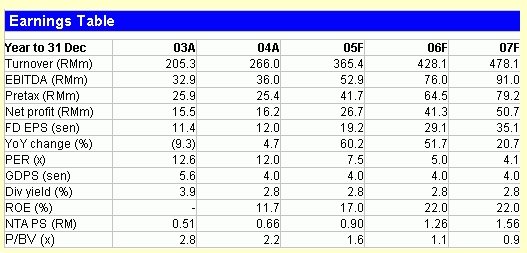
15.5 -> 16.2 -> 26.7 -> 41.3 -> 50.7million.

Fiyoooh... 41.3 million!!!

Incredible isn't it?

2005 FY projections is already perhaps a bit too optimistic at 26.7 million... but no... OSK did not based their valuations upon those numbers
but instead they based it at an even more optimistic earnings of 41.3 million!!!!!!!!!!!!!!!

Now wouldn't u say that this is a bit too optimistic?

And when they make such optimistic projections, this simply allows them to create a stock with such a great upside potential (72.7% wor!) when they make their so-called BUY recommendation!

ps. Cresbld closed at 0.795 today. (back in Nov 2005)

<=============>

And how did Crest Builder did for its fiscal year 2005? Well have a look at its last reported quarterly earnings on Feb 2006.

Crest Builder made a net profit of only 12.198 million.

And how did OSK played ze number game?

Well the table below says it all...

OSK had projected an earnings of 26.7 million! Crest Builder only made a net profit of only 12.198 million.

Now check this out, today OSK has a brand new report on Crest Builder again.

Price of Crest Builder is now 1.12 and OSK has given it a 12-month target of 1.49.

LOL!!!... yup... just 1.49! (ps. In April 2005, Price back then was 1.44. OSK gave it a price target of 2.59!)

Wait... check this out too.


Ahem.. can you see that they have projected an earnings of 31.9 million for Crest Builder's fy 2006 earnings and an earnings of 35.2 million for its fy 2007.
(last April 2005, OSK projected 41.3 million!! Does this mean they are less optimistic? LOL!)

And as stated in OSK own table, this translates to a 161.7% increase in earnings for this fiscal year!

So for a stock that had a whopping decline of 25% in fy 2005, is projected to grow 161.7% this fiscal year.

Highly incredible, isn't it?

Now check this out also...

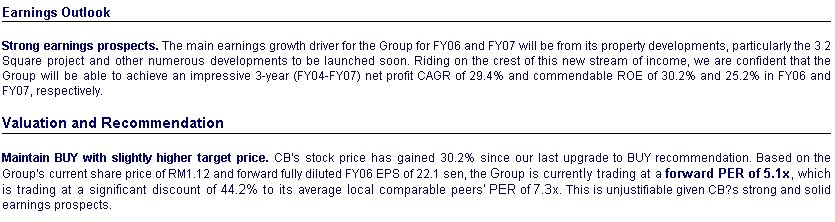
The below is a screen-shot of their reasoning...


Did I miss a report on Crest Builder since last April 2005? This is because the writer is saying:

  • CB's stock price has gained 30.2% since our last upgrade to BUY recommendation.

Ps... does someone have a copy of that report? ... cos I find it really strange since I can't even search for this report in their archives.

  • Group is currently trading at a forward PER of 5.1x, which is trading at a significant discount of 44.2%

It would be good to note that it is CHEAP because their forward PER of 5.1x is based on an earnings which is projected to grow 161.7% this year!

LOL!! Any stock which can grow so much would surely be cheap. Yes or not Shirley?

:D

Saturday, May 06, 2006

Regarding Scomi

I had actually made a posting on Scomi Group before. Let me reproduce what I have written on it.

<<==>>

Firstly, I have to say this. IPO subsribers to SCOMI would be really darn please with their investment if they held the stock from the start to now!

Scomi was offered to the public at a price of 1.38. Listed on May 2003.

In April 2004, there was a 3 for 5 bonus issue and then a 1 into 5 stock split.

  • 08/04/2004 Entitlement - Others

    For illustrative purposes, a shareholder holding 100 ordinary shares of RM0.50 each in SCOMI on the Entitlement Date shall be entitled to 60 ordinary shares of RM0.50 each in SCOMI pursuant to the Bonus Issue. Subsequently, his/her entire 160 ordinary shares of RM0.50 each shall be subdivided into 800 new ordinary shares of RM0.10 each in SCOMI.

So say, for simple illustrative purpose, someone subscribed to 5,000 shares of Scomi at 1.38 during Scomi's IPO, their capital outlay will be 1.38x5 = 6900.

So after the stock bonus, this investor would now hold 8 lots of Scomi. And after the stock split, the investor would be having 8x5 = 40 lots or 40000 shares.

So at closing price of 1.17 (this was the price of Scomi on 3rd Sept 2005), this investor's investment would be worth 46,800.00.

Which is really a darn good investment return!!!

And the picture below says it all!

So how did Scomi do since its listing?

For its fiscal year 2003, Scomi Group announced an earnings of 14 million.
For its fiscal year 2004, Scomi Group announced an earnings of 61.4 million.

Absolutely commendable. In fact, some would call it as brilliant!

So for the IPO investor, buying the stock of Scomi is looking at his/her company's net profit grow from 14 mil for fy 2003 grow to a very impressive 61.4 million for fy 2004.

Basically, isn't this what we all want in a company when we invest in it?

The company is making more and more moola each year!

Rite?

Now the question is or rather the issue is, we all know that Scomi is growing explosively via acquisition of companies or some would cynically call it the engineering of profits via acquistions.

Anyhow, I guess it would do no harm and it would makes sense if we dig deeper, rite?

And this can be done via some simple observation of its quarterly performance. Just some simple comparison of some key figures.


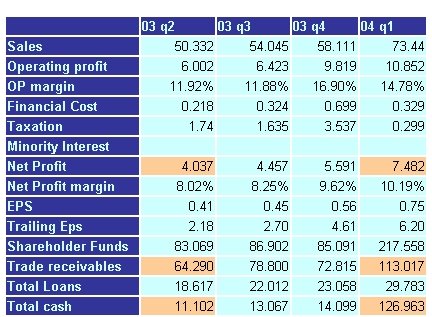
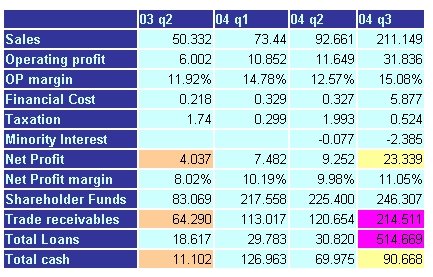
At the start (03 Q2 ), we were looking at a company with the following characteristics...

  1. Company was making about a quarterly net profit of 4 million.
  2. Cash was 11.102 million versus Total loans of 18.617 million. (a net debt position of 7.515 million)

Next we look at 04 Q1...

  1. Company is now making around 7.4 million per quarter. Fantastic.
  2. Cash is now 126.963 million with loans of 29.783. (net cash of 100.180 million). Fantastic.
  3. Slight worries. Trade receivables is now 113.017 million.

A very interesting footnote was found in the cash flow statemtent:

  • 125 million was generated VIA SHARE PLACEMENT EXERCISE and entered into the company's piggy bank.
Let's watch what happens next...


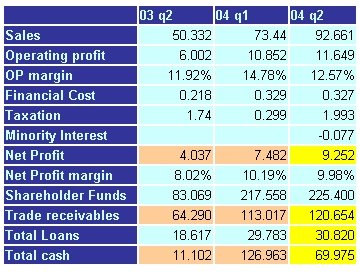
Now we are looking at 04 Q2.

Good points.
  1. Net profit is now 9.252 million. Just the same quarter, a year ago, Scomi was just a company making 4.037 million. Company is making more money isn't it?
  2. Cash stands at 69.975 million versus total loans of 30.820 million. (A net cash position of 39.155 million).
Fantastic isn't it?

But here comes the worrying part..

  1. Trade receivables is now at 120.654 million. (Hmmm... a worrying signal? Hard to say at this moment of time cos after all this quarter Scomi showed a sales revenue of 92.661 million.)
  2. Cash flow. Starting cash was at 126.963 million. A quarter after a share placement issue, in which Scomi generated 125 million in this fund raising exercise. At the end of the quarter, cash is only at some 69.975 million. Where ze Moola go???? (ah ze classical arguement of a company using leverage to expand and grow the company!)

Scomi reported that earnings on 11th Aug 2004.

Let's watch happens in Scomi's next quarter, 2004 Q3.

Good point:

  1. Net profit is now 23.339 million. 5 quarters ago, Scomi was just a company making 4.037 million. Company is making more money isn't it? Isn't this what u call explosive growth?

Fantastic isn't it?

And again, here comes the worrying part...

  1. Trade receivables is now at 214 million. (Hmmm... again a worrying signal? And again hard to say cos Scomi had sales revenue of 211 million for the quarter and since with the company made making more sales, more receivables is accumulated, rite?)
  2. Cash is now at 90.668 million but the loans is now 514.669 million. Scomi is now in debt of 424 million!!!! ( A huge worry? )

A flag has been raised, eh? Them same old worrying issues is getting more worrying, isn't it? Time to exit da bugger?

Scomi reported that set of arnings on 3rd Nov 2004.

Next quarter, 2004 Q4 was pretty dull. Pretty much the same old, same old. A neither here or there quarterly earnings report.

So fast forward to 2005 Q1 earnings. Which was really 'interesting'..


Soooooo many issues!!!

1. Net Profit is only 14 million? Big worry? Down from 20+ mil on a q-q basis...
(ahh.. again... some will argue cos on a y-y comparision.. this 14 million net profit is still much better than the 7 million it earned a year ago).

2. Trade receivables is now 333.889 million. Now this trade receivables is NOW a huge worry cos quarterly sales is now 229.236 million only. Where is that extra 100+ million of receivables coming from? What if a huge portion of these trade receivables turn bad? Bad debts then?

3. Loans? Loans is now 457 million. Down from 540 million a quarter ago.

4. Total cash increased to 118 million from 86 million a quarter ago.

5. Is 3 and 4 a good point? My answer is NO. If one looks at Scomi's Cash flow, Scomi's made yet another share placement to raise cash. A placement which saw Scomi raised 145.476 million.

So what we have is:

Scomi raised cash from placement of shares which is then used to pay off some of its loans....

But how does one evaluate Scomi's earnings performances? Surely if one is a buyer of Scomi's placement shares, one would probably not be too happy with it cos the bottom line is Scomi's net earnings declined from 20+ million to just 14+ million.

Now given 1,2, 3 and 4 and most importantly point 1, Isn't the time to really to exit this bugger?

Scomi reported this earnings on 25th May 2005.

Scomi closed at 1.40 on 25th May 2005.

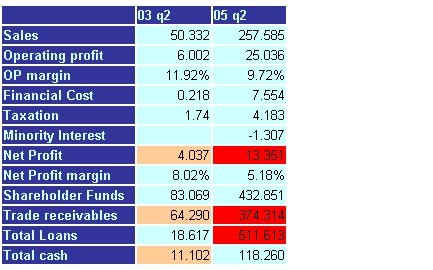
And here comes the company most recent earnings (in Sept 2005)


And how did Scomi do?

1. Net earnings came in at 13.351 million. Which was down from 20 million plus earnings it earn a couple of quarters ago...

Now why issit such a huge worry?

1. Trade receivables is now a whopping 374 million.

2. Loans. Total loans is now 511 million.Up from a total loans of 457 million a quarter ago. Hmmm.... if one looks at the bigger picture, Scomi did a placement, paid of some 80 million plus in loans but come the next quarter, it borrows yet again. Doesn't it mean that Scomi is now back at square one? At the peak, Scomi total loans once stood at 540 million!!!

How? Now Scomi has been on a sell-off since May. Down some 30% and it is not too surprising eh?

Let's re-examine what has been said.

At the start (03 Q2), we were looking at a company with the following characteristics...

  1. Company was making about a quarterly net profit of 4 million.
  2. Cash was 11.102 million versus Total loans of 18.617 million. (a net debt position of 7.515 million)

8 quarters later, after countless of acquisitions and 2 share placement and sooooooo many ESOS....

We are now looking at....

1. A company making 13 million per quarter.

Compare to the 03 Q2 in which Scomi made only 4 million. An increase of 9 million So company is making 3.25 times more moola.

2. Company cash balance is now 106.119 million. Total loans stand at 511.613 million. Company is now in a net debt of 405.494 million.

Comparison. In Q2, company net debt position was a mere 7.515 million. Now the net debt position has increased by a WHOPPING 53X.

Justifiable given its current earnings? (some would ask: Does it make sense to increase ur total debt position by 405 million to make that extra 9 million in profit???? )

how? how? how?

Would it be wrong to say that this is an insane strategy employed by Scomi????

Oh btw, Scomi now has 991,130,700 shares. How signifacnt is this? Well, back in 03 Q2, Scomi Group had just around 91 million shares! ;p

<<==>>

That was back in Sept 2005. Sorry mate to bore you with all those details but I do reckon that it is useful to understand why Scomi rose so high and why its share price was declining quite a lot late last year (Scomi traded as low as 0.95 back in Nov 2005!).

Anywayyyyyyyyy...

In Nov 2005, Scomi announced its Q3 earnings. Scomi quarterly net earnings increased to 16 million.

In Feb 2006, Scomi announced its Q4 earnings. Scomi quarterly net earnings increased to a whopping 109.539 million!!!

So let's look at how did Scomi do since its listing...

For its fiscal year 2003, Scomi Group announced an earnings of 14 million.
For its fiscal year 2004, Scomi Group announced an earnings of 61.4 million.
For its fiscal year 2005, Scomi Group announced an earnings of 151.692 million.

And there you have it mate, yes it is true that Scomi has an astonishing growth rate!

But how about them points again? Well, as at its last reported earnings...

  1. Cash is at 87.595 million.
  2. Trade receivables has increased to 438.430 million.
  3. Group's borrowings is not at 918.363 million.

And yes, I do understand your issue that leverage can be used to generate a much higher revenue but on the other hand, I do hope you realise that this leverage issue is a matter of personal views and opinions. Me, for one, believe that too much leverage can turn deadly if one is not prudent enough.

And by the way, from my live quotes, I do note that as of today, Scomi Groups' number of shares is now 996.208 million shares!!

Yup, it increased yet again. Which means based on this enlarged share base, Scomi's current eps is now 15.2 sen. Ok?

And yes, I had mentioned the perils of a company issued placement shares.

Currently, Scomi does have the earnings to justify its strategy but do remember what happened back then in Sept 2005. Look at how the share tumbled when the earnings wasn't there. Do take note of this issue. It could well happen yet again but then on the other hand, if the Scomi 'produce' those earnings, the market could well go ga-ga over the share again.

Cheers!

Thursday, May 04, 2006

Do I Dig DIGI?

In reply to Anon.

Yes, I do agree very much that Digi has announced an absolute fantastic set of results. What I think is more impressive is its cash flow.

This is where ze moola is!


under its non-cash items, could you see that non-cash items? that's the depreciation charges. And the total sum that Digi depreciated is some 194.925 million.

Watch then the net increase in cash and equivalents?

See or not?

229.948 million for the quarter.

Soooo......

Cheers dude!

My Earnings has been Shrunk!

The following post is dedicated to Anon who asked about the dilutions effects caused by placement shares, esos etc.

One of the best example I could really think of is a past discussion I had on this one stock called Integrax.

On 28th feb 2003, Integrax announced its fy2002 Q4
quarterly earnings.

It made a total net earnings of 16.159 million from a sales revenue of 25.244 million for its fiscal year.

I got a message in July 2003 asking about this stock:

==>

I have made some studies on this counter and noted some good points:

  1. stable assure income from TNB power plant (future earning will double)
  2. closely link to state goverment
  3. potential aluminiam plant project (will add on the coal transportbusiness)
  4. low PE (really fantastically low)
  5. proposed to transfer to main board.
here was my reply then.

<<==>>

my comment on integrax ...

1. those listed port stocks, their fundamentals are ok, meaning they are companies that operates on a very high profit margins. in which you have also choices like Bintulu Port. So far, from its only earnings (Integrax was a newly listed stock, which was listed via a reverse takeover of a stock called Ganz) , in its
02 Q4 earnings report, Integrax had figures like this...


2. now as you would see the numbers were fantastic. (the eps is based upon 115.656 million shares, which was stated in that quarterly earnings report). And if you annualise such performance for fy 2003, then the potential is there.. cos one is looking at a potential eps of 38-40 sen for fy 2003. And yes, I did note that folks like Ah Goh (GK Goh) was projecting 03 earnings to be lower, at around 30 million, or an eps of 26 sen based on 115.656 million shares.

( Back then Integrax trading around 1.15-1.30 and based on the projected 03 earnings, Integrax at 1.15 was trading at a super duper low PE of 4.4x based on Ah Goh's estimates.. and at such a low PE multiple, surely this would have been an ideal hidden gem right? In fact, Surf 88 back then, had a super positive research calling it a Lumut Gem!)

3. But after researching more, i found out that there were lots of ICP shares being converted into ordinary shares. This was part of the agreement under Integrax's takeover of Ganz. Now I do NOT know know the exact restriction (if any) on how these ICPs were converted but judging from KLSE announcements, they were converted on quite a regular basis. So what's important is, if you wanna invest in this stock, you need to figure out how many total ICP's were issued.
(here is where the DILUTION of shares has such an impact on the share price.)

Now these ICPs, they have this dilution effect. As I had checked out the other day (back in July 2003), the number of shares in Integrax stands at 196,762 million shares!!

Now based on the projected earnings of 30 million, Integrax projected DILUTED eps is now 15 sen. Which now means, at 1.15 Integrax is trading at a forward PE of 7.6! (compared to a pe between 4.4).

See how greatly the eps has been diluted by these ICP's?

So... if you are not carefull.... you might have actually invested in Integrax had a much higher PE multiple than you have immagined...


4. Is Integrax an average company or an excellent company? I dunno.

Too early for me to determine, plus there is really too limited info i can dig up on Integrax itself.... so i cannot comment on it.

<<==>>

That was in July 2003. Now Integrax was in a nice rally mood.

And soon in Oct 2003, it was trading around 1.90++ (which turned out to be its peak today)


And here is another extremely interesting point.

Integrax Loan Stocks and its Irredeemable Convertible Preference (ICP) shares were still constantly being converted into ordinary shares. (here is one announcement indicating
the conversion of ICP shares )

Which meant that the earnings per share were constanly being diluted at a very rapid pace.


But the share price was rocketing.

How?

Would an investor cash out back in Oct 2003? (remember, they had an opportunity to buy just in July 2003 at around 1.15)

A year later, on 27th Feb 2004, Integrax announced its fy 2003 quarterly earnings.

It made a total net earnings of 28.819 million from a sales revenue of 93.434 million for its fiscal year.

Integrax's results is pretty impressive really. And in fact it does look like a decent and very profitable company... but i guess the main question is why the share price is performing so poorly was explained clearly by the company.

  • PATMI changes are reflective of the above while EPS changes reflect the impact of a larger share capital base this quarter.

Ahh... the EPS shranked.

Diluted!

The dilution effects from the conversion of Integrax's ICP shares and loan stocks. And the more conversion are made, the large the share base becomes, hence Integrax share base is growing each quarter, which meant that unless Integrax earnings grow at a much faster than how its share base expands, the eps would become smaller each quarter and when the E in PE becomes smaller, the price 'usually' goes down to reflect the lower E.

To fully illustrate how diluted the earnings become:

Integrax number of shares now is 263.882 million shares!! (back in Feb 2004)

Which meant Integrax eps is only 10.9 sen for its fy 2003! (a huge cry from Ah Goh's estimate of 26 sen eps!.. and most important see how the net profit increased a lot BUT yet the EPS 'dropped drastically?)

Which meant that the traded shares of Integrax is now much more expensive despite a pretty impressive fiscal year earnings? (In Feb 2004, at 1.50, Integrax was trading at a PE of 13.7x!!)

Perhaps it is better to take note of all those ICP shares, right?

Example
(done on 28th Feb 2004)

Integra has 263.882 million shares
Integra LA has 31.890 million shares
Integra PA has 10.570 million shares.
Full dilution = 263.882 + 31.890 + 10.570 = 306.342 million shares.
Fully diluted eps = 28.819 / 306.342 =
9.4 sen.

So do remember.. this bugger just got soooooo many shares out there.... that you dun really know what is going.... plus since this is a RTO listed company.... so you never know the true cost of those ICP shares, etc, etc..... and do take one step back ... dig deeper back into history.... look at Ganz last reported earnings report. Ganz had only got 19.8 million shares. Compare it to now. 263.882 million shares. A lot of new shares has been issued.

<<==>>

So in July 2003.. Integrax was trading around 1.15-1.30.

It peaked in Oct 2003 around 1.90++

On Feb 2004 it traded in the 1.50 region.

now on May 2006? Less than 0.70!

The below pix says it all...
(long term buy and hold? if your initial reasoning is wrong.. holding it longer is holding in hope!)


So if one purchases a share in a company and discounts the effect of the dilution of earnings, see the drastic end result?

Of course not all companies are like that. And as mentioned in the case of IOI, the conversion of warrants did not have a negative impact on the share price. Why? IOI Corps earnings grew at a much faster pace.

It's pretty simple actually.. take the blog posting
ROI on Uchi: Part III - the ESOS issue

<<==>>

Now if you add both figures up, you will get 82,820,992 new shares, assuming full exercise of ESOS.

Currently Uchi has 372,392,800 shares. Which means there is a possible dilution in earnings per share of 22% assuming full exercise of all these ESOS.

Now let's be realistic and ask ourselves this... is 22% dilution in earnings per share a lot or not?

Simple way to look at this dilution.

Say U** has a current eps of 100 sen.
Say U** has a possibility to trade at a price earnings multiple of 18x.

Which means U** could be worth some 18.00 in market price.

Now a 22% dilution means... the eps would be 78 sen.
And using the same pe multiple assumption of 18x, U** should be trading at a market price of 14.00.

See how disadvantage it is to the minority shareholder?

<<==>>


Wednesday, May 03, 2006

Since 2000

Back in Ze High Life!!

CNN Market Report for May 2nd 2006 is titled
Stocks back in the high life. It highlights the following point.

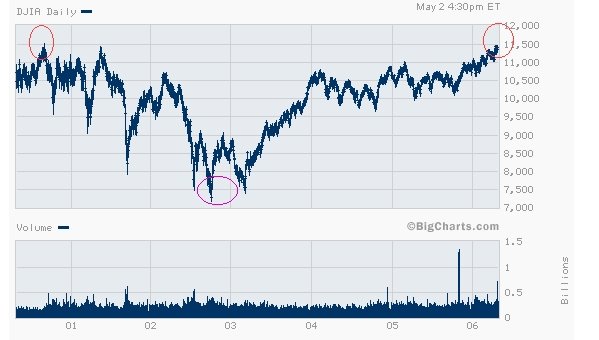
  • The Dow Jones industrial average (up 73.16 to 11,416.45, Charts) added 0.6 percent, putting the blue-chip indicator at its highest level since Jan. 19, 2000. The broader Standard & Poor's 500 (up 8.02 to 1,313.21, Charts) index gained 0.6 percent to end the session at its highest point since May 21, 2001.The tech-heavy Nasdaq composite (up 5.05 to 2,309.84, Charts) rose 0.2 percent.

Wonderful.

Six years high.

So I decided to play around... and I went on a sight seeing on CNN charts... :D

And here is how the picture looks like..


Yup, that how a six year high Dow would look like.

Would it be wrong to say that it has take six long years for DJI to recover back what it lost back in 2000?

So doesn't it mean that the Dow has done absolutely nothing since 2000.

Check this out...

So I decided to look at some of Dow's 30 component stocks at CNN website.

Here are some of the pictures I took...

For startes, it was a no-brainer decision for me to check out Exxon Mobil. And it looks like I found a hot one! If one had bought in 2000, one was looking at money, money, money all ze way!


Next I decided to check the Coke bugger and see if it was really ze real thingy onot...


waaa.... not so happening eh? Buy and hold since 2000 wasn't too happening eh?

Then I thought about Bill Gates and his Microsoft. Hmm... if one bought Msft in 2000...


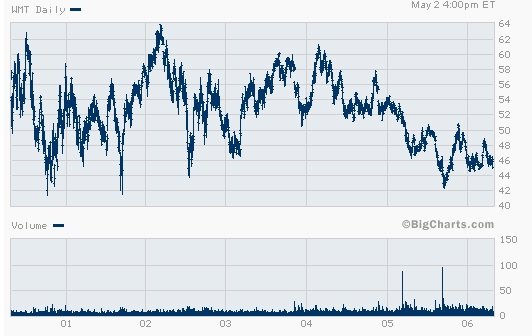
Ok... what about ze Wallmart? Hmmm... again not so happening, eh?


And what about Intel? Waaa....


Or what about ze big M.... MacDonalds?


And last but not least... this one I know is one horror story... ze General Motors...


Hmmm..... did you enjoy the tour as much as I did?

So the Dow is at its six year high... how?

Good ah?

ps... this reminds me of this blog posting: Is Ze Market for Suckers?

Hmm... let me reproduce what I wrote in that posting:

Wall Street has done an AMAZING job of creating conventional wisdom . “Buy and Hold ” is the 2nd most misleading marketing slogan ever, after the brilliant “rinse and repeat” message on every shampoo bottle. We as a country have fallen for it. Every message from every marketer of stocks tell us. Young or old, if you can hold for the long term, things will work out for you.

That is total bullshit. Its for suckers.

Totally agree!!

You cannot simply hold any shares! See this blog entry of mine: I wanna Hold your hand..

Simply put, If you buy and hold an investment gone bad, most likely than not, your investment would most likely go bad too!

So why do they want you to HOLD these shares gone bad?

Simple lor. They want you to be ze sucker!

If you are going to trade stocks, you just have to follow one rule and remember one thing. That rule is always have a definite knowledge advantage about the company you are trading, and always remember that every stock transaction has a sucker, and you have to know whether its you or the person on the other side of the trade. No one buys a stock from your, or sells one to you knowing they are leaving money on the table.

The bottom line is that unless you plan on making it a full time job to do your research and put yourself in a position to have an advantage, you are going to get your ass kicked at some point by someone who does. You just have to hope that it doesnt put a big financial hurt on you when it happens


Another good point, eh?

The same logic applies to funds. Funds are in the business of making money for themselves first. You 2nd.

Ahem! Funds are in the business of making money for themselves first.

Same rules applies here!

Repeat after me.... Funds are in the business of making money for themselves first. You 2nd!!!

Thats why I buy stock in public companies that relate to my other business entities. When i pick up the phone and call the CEO of a company i own shares in, they call me back very quickly. When I ask if there are business opportunities that make sense for the company and another company of mine to work together, I wont always get the business, but I will always get a meeting. If Im smart about the investments I make, the more important returns come from the relationships with the companies than the action of the stock.

Hmm... investing from a business perspective?

If the best you can do is buy shares that are going to be continuously diluted, then you are merely a sucker. There is a good chance that the shares you bought came from shares an insider who got stock options. You just helped dilute yourself with your first share purchase.

Ahhh.... beware very much of this issue. Private Placements, ESOS.... these stuff dilute earnings.

Very, very, very important issue hor.. Do NOT end up buying diluted earnings!

Such exercises are done at the very expense of the minority shareholder!

They make a sucker out of the minority shareholder!

Surely you do not want to be a sucker, rite?

:D

Tuesday, May 02, 2006

Reminiscences of a Stock Mumbler: IV

How bad is your bad luck?

Last April there was an article on the Edge Weekly:
The run of bad luck

  • Or perhaps it is the fact that as an industry, the expectation is that there will be one bad quarter in every three or four, where Magnum's bad run for several consecutive quarters has stuck out like a fetid sore. Reasons offered by Magnum that its risk management is not questionable (as has been asserted by several analysts) and that the bad run is a statistical anomaly, have not been well received by analysts. Magnum has argued that it cannot reduce the limit of sales on a hot number (8888 for example, or 2828 — for the interested, that's "prosperous" four times or "easy prosperous" twice) just because it's hot. This is because the statistical reality is that the hot number has as much chance of winning as a suay number (such as 4444 or 2424 — that's "die four times" or "easy die twice").

    Analysts argue, however, that other NFOs have limited sales of the hot numbers. One who did his own quick survey found that when the hot numbers were closed by the other NFOs, one could still buy them at Magnum. "This either means that Magnum has become the last choice for a lot of punters or that Magnum is keeping the number open for longer," he says. And another analyst points out: "If Magnum has been selling certain numbers up to and maybe beyond the prudential levels, it also seems to indicate it is losing market share. Top-line growth has been unremarkable year-on-year at 5.56% compared with BToto's 5.98% and Tanjung NFO's 4.85%. "If it is risking high payouts and not limiting sales of hot numbers, it sure is not showing in the top-line numbers. Does this then mean that if it were being prudent, its top-line growth would be less? Or maybe there would be a decline?" asks the analyst. Even with all the questions and the general distrust, one plus in favour of Magnum is its current share price.
I found this part to be extremely confusing and strange to say the least:
  • Magnum has argued that it cannot reduce the limit of sales on a hot number (8888 for example, or 2828 — for the interested, that's "prosperous" four times or "easy prosperous" twice) just because it's hot.
this is because if I surf Magnum's own website: http://www.magnumit.com/magnum4d/MDfaq.htm#07

and click on How much can I buy for each 4D number?

I would get the following...

Question

How much can I buy for each 4D number?

Answer

To limit its' exposure, Magnum imposes Big and Small limits on each 4D number. For each 4D number, these limits amount to thousands of dollars each per draw. For any 4D number, you can therefore buy as much as you wish until the imposed limits are reached. Once the imposed limits on a 4D number are reached, you can no longer buy tickets for that 4D number irrespective of which 4D outlet you go to.

Strange and confusing, eh?

Monday, May 01, 2006

BP Plastics

  • BTW, i also happened to read BPPlastic annual report. It looks decent for me too. What is yr take here? High growth, ability to pass price to customer, no debt, cash is piling and 20%~40% return policy. Another under research comp????

So sorry.. missed this message of yours.

Actually I have in my old stuff some write-up (from iCap) on BP Plastics.

  • Set up in 1990, BP Plastics (BPP) started its business in Batu Pahat by supplying polyethylene bags to the textile and garment industries. Since then, BPP has made significant progress to become a leading plastic film and bag packaging manufacturer.

    With a current workforce of around 280 workers and operating 24 hours a day, 7 days a week, the group has a production capacity of 36,000 tonnes per annum. This capacity is split into 9,600 tonnes for blown plastic bags and 26,400 tonnes for cast stretch film, the two product groups of BPP. Crucial to the group’s past expansion plans was the purchase of a 2.5 meter width 5-layer cast stretch film machine in 2000, followed by a 4.0 meter width 7-layer cast stretch film machine in 2003. Together with the usage of advanced resins, these allowed BPP to produce high quality cast stretch film using sophisticated multiple layer technology. The quality is measured in terms of yield, strength, load retention and puncture resistance.

    For the blown film, BPP produces plain and printed low density polyethylene (LDPE), linear LDPE, high density polyethylene and polypropylene bags, made according to the requirements of its customers. However, it is the stretch film division that has fuelled the growth of the group with sales of this division rising from almost zero in 2000 to over RM85 mln in 2004. Profit margins are higher for blown film while the printed bags generate higher margins than the plain bags do.

    BPP has over 680 local and international customers. In 2004, direct exports constituted more than 55% of BPP’s sales. The major destinations for its cast stretch film are Japan, Singapore and Australia while Singapore, Indonesia and Australia form the largest markets for its blown film. Japan alone accounts for around 20% of its export sales. The exports are priced mainly in US$ with some in Yen and S$.

    While the rise in resin prices has contributed to the rise in sales, this has affected the profit margin. The major cost item for the group is not surprisingly resin, forming about 60% of sales. The price of resin has risen from US$680 per tonne in early 2004 to more than US$1,000 by end 2004. While BPP is able to pass on the cost increase, it can only do so after a lag. In addition, the industry, both locally and regionally, is highly competitive. Despite this, BPP plans to expand further. A major portion of the RM9.6 mln proceeds from its public offering, together with more than RM17 mln from a prelisting rights issue, will be used to buy a 10-acre land in Batu Pahat, build a factory thereon and to purchase several pieces of machinery and equipment.

Well that I think should be the key issue for BP plastics. The rise in resin prices equates to higher expenses and from a business perspective, the business investor would be keen to know how well BP Plastics is able to pass the cost down to its customers.

Anyway, BP Plastics was listed on Feb 2005. So not much track record there is about this company except for the recent quarterly earnings it announced.

The following is a compiled table of BP Plastics quarterly earnings since its listing.

As can be seen, its last quarterly earnings is a concern. The operating margins and net profit profits is showing a sign of weakness. And the concern is if this is caused by the higher material costs..

However, it's first year total net earnings is 20.493 million. Which is signifcantly much higher than what it announced in its IPO prospectus (see announcement made to Bursa here ) and perhaps the following table from OSK gives a much clearer picture.

Now if one takes BP Plastics 02, 03 and04 numbers into consideration, then perhaps one could consider that BP Plastic is a high growth stock... but then some others would argue that those numbers 02, 03 and 04 should not be taken into consideration.

Total cash at 05 Q4 stood at 21.437 million, while total loans stood at 6.624 million. Pretty healthy I would suppose.

Dividends. BP has been a fair decent dividend paying stock. (see Interim Dividend, Interim Dividend and Final Dividend )

All in.. it looks decent.. but... perhaps it would more prudent to have a couple more quarterly earnings to see how BP Plastic copes with the higher resin prices.

Cheers!