Wednesday, May 30, 2012

Should Eng Teknologi Revise Back Its Privatisation Offer Back To $2.50?

One of the stocks currently enduring a privatisation saga is Eng Teknologi Holdings.

It was just in July 2011, when Eng Teknologi announced its privatisation offer. http://www.theedgemalaysia.com/in-the-financial-daily/190233-tyk-makes-privatisation-offer-for-eng-teknologi-at-rm250.html

  • TYK makes privatisation offer for Eng Teknologi at RM2.50 Written by Financial Daily
    Tuesday, 26 July 2011 11:17

    Eng Teknologi Holdings Bhd
    (July 25, RM2.28)
    Upgrade to add at RM2.28 with revised target price of RM2.50: In a Bursa announcement last Friday, TYK Capital proposed to acquire all the assets and liabilities of EngTek at an offer price of RM2.50 per share. TYK Capital is controlled by major shareholder Datuk Teh Yong Khoon and Datin Low Yeow Siang (combined 95% interest) and the remainder is held by Advance Capital. Teh and Low collectively own 23.2% equity interest in EngTek. Should the proposed takeover offer be accepted, EngTek would become a cash-rich company with about RM307.2 million cash based on its current outstanding shares of 122.8 million. It is then proposed that EngTek undertake a capital reduction exercise to return the cash to shareholders.

    The privatisation offer price is about 9.6% above Friday’s closing price, and also above its 10-year average share price of RM1.47 but short of its recent high of RM2.75 in March 2010. Based on the offer price of RM2.50, EngTek is valued at 7.6 times FY12 earnings per share (EPS), which is at a premium to its three-year mean price-earnings ratio (PER) of 4.3 times and also above its net tangible assets per share of RM2.20 as at end-1Q11.

    Even after stripping off cash of RM89.8 million or cash per share of 73 sen, the privatisation offer still prices EngTek at 5.4 times FY12 EPS. This is still at a premium to its three-year historical mean PER of 4.3 times.

    We therefore think that the privatisation offer is fair and doubt that prevailing fundamentals alone (in the absence of the privatisation offer) would have been able to re-rate the share price to RM2.50 at least over the near term.

    We believe that investors would be better off accepting the offer especially given the volatility in the global equity markets and the weak fundamentals in the sector.

    We revise upwards our target price for EngTek from RM1.69 based on 5 times FY12 EPS to its privatisation offer price of RM2.50 and upgrade our rating from a Reduce to an “add” (underpinned by the offer).

    Separately, we think that the EngTek privatisation offer could spark off interest in the remaining two larger listed hard disk drive component manufacturers — JCY International Bhd (not rated) and Notion VTec Bhd (not rated), particularly for the latter. Notion’s relatively attractive PER valuation of 6.7 times (compared with 11.3 times for JCY) and smallish market capitalisation of RM317 million could also make it a compelling target. — Affin IB Research


    This article appeared in The Edge Financial Daily, July 26, 2011.
Of course I do not agree with what was written at all. It's simple. Stock prices does not necessary reflect a company's true value. That's common sense. What a stock is trading bears no indication to a company's true worth and value. There will be times when the market over prices the stock and there will be many times the market under price the stock. Using a 10 year average stock price does no justice. An offer price should not be deemed fair just because the offer price is above the 10 year average stock price. That cannot be the basis to judge the offer. But hey, what do I know? This is just my flawed thinking. For me, to privatise at a PE multiple of 7.6 times FY 12 earnings is absurd. And more since the company is cash rich, with some 89.8 million in its piggy bank.

Then in Oct, the Thai floods happened and floods were used as a reason to delay the privatisation.

http://www.theedgemalaysia.com/in-the-financial-daily/194603-thai-floods-delay-eng-teks-privatisation.html
  • “The company and TYK Capital are working together to assess the flood situation, the impact on the financial position and prospects of the Eng Tek group (once there is clarity on the flood situation) and how this may affect the terms and conditions and/or the viability of the proposals,” it said. The Thai operations contribute about 40% to group revenue for FY10 ended Dec 31.
  • While the damage and losses could not be ascertained yet, Eng Tek said the floods would have a negative impact on its FY11 ending Dec 31 results.
  • Eng Tek increased six sen to close at RM2.00 yesterday with 441,500 shares done.
Eng's share traded at rm 2.00, well below the offer price of 2.50.

In another article: http://www.theedgemalaysia.com/index.php?option=com_content&task=view&id=194572&Itemid=79
  • Another question raised was why had Eng Tek’s shares trading at such a large discount to the privatisation offer price of RM2.50. The analyst said the concern was the market’s concern whether the privatisation could go through.
( Ah..  this Eng's case should be the perfect example on why betting on a stock with a large discount to its offer price is not a 100% sure win strategy!)

Few days later, Eng Tek issues warning of significant losses from these floods: http://www.theedgemalaysia.com/business-news/194769-eng-tek-warns-of-significant-loss-from-thai-floods.html

By late afternoon that day, Eng Tek shares fell to 1.50++.

Then on 22 Feb 2012: http://www.theedgemalaysia.com/in-the-financial-daily/209188-engtek-sinks-into-the-red-expects-pre-flood-capacity-in-3qfy12.html
  • The hard disk drive (HDD) parts manufacturer posted a net loss of RM53 million for 4QFY11 compared to a net profit of RM9.3 million a year earlier as its operations in Thailand were affected by floods during the quarter. The loss was also due to impairment and write-off of property, plant and equipment and writedown of inventories of RM45.8 million as a result of the floods.
Huge losses were recorded, much due to impairment and writedown of inventories.

But the amazing thing, as stated in the article.
  • Engtek said the insurance claims are expected to be paid in the second half of 2012. “Insurance claims have been submitted and loss adjusters surveys are expected to complete by end-February 2012,” it said.
The insurance claims that they were making, they did not disclose how much they were claiming for.

And with these huge losses ( losses should be much less, once the insurance claims were adjusted back into the books), the market sensed that perhaps a lower offer price might happen.

True enough, on March 2012, Eng made the long waited announcement: Eng Tek's takeover price revised to RM2
  • PETALING JAYA: Eng Teknologi Holdings Bhd has had its takeover price revised to RM2 per share from RM2.50 earlier.

    In a filing with Bursa Malaysia, the company said the price was lowered as the financiers were unable to justify the funding at RM2.50 after taking into account the firm's financials considering that Eng Tek's business was affected by the floods in Ayutthaya, Thailand.
Wasn't it incredible? The Thai operation only contributes about 40% of Eng's revenue. Yes, the flood caused damage but was it a justified excuse to delay the privatisation offer and then lower the offer price???

It was absurd. Totally sickening. How could corporate Malaysia behave like this? This is an outrage!

Eng made a public offer to the market and to its shareholders. It made an offer. A promise. How could it be allowed to rescind and lower its offer price?

This other article was even more ludicrous. http://203.115.229.228/edgemyjoomla/business-news/211169-eng-teknologi-board-accepts-revised-takeover-offer-to-seek-shareholders-consent-.html
  • Founders of Eng Teknologi Datuk Teh Yong Khoon, and Low Yeow Siang via private vehicle TYK Capital Sdn Bhd, have proposed to lower the offer price to RM2 from RM2.50 as their financiers were unable to justify the funding of the takeover at RM2.50, according to Eng Teknologi.
OMG! What a pathetic excuse! Unable to justify the funding of the takeover at 2.50??? What a load ...

Now I wonder. Yesterday Eng announced its earnings. On Star Biz: Eng Tek Q1 earnings surge 250% to RM16.82m
How?

Now that Eng's earnings is on the recovery, shouldn't Eng be the gentleman and do the right thing by revising the offer price back to rm2.50?

Tuesday, May 29, 2012

The Said 12 Accounting Irregularities Found At Silver Bird!

Silver Bird released its forensic report on its accounting irregularities last night.

See news report on the Sun Daily: http://www.thesundaily.my/news/391012

Here's the 12 accounting irregularities stated on the pdf file aposted on Bursa Malaysia.

http://announcements.bursamalaysia.com/EDMS/edmsweb.nsf/all/CEDDEAB10131D1DA48257A0C003CC1D1/$File/Announcement-General-forensic%20report-28.05.pdf

  • Trade Receivables
    The trade receivables of the SBGB Group have been noted to have included incorrect accounting entries that could create a false audit trail, and included the masquerading of inter-bank transfers as payments from the debtors.
( Hmm.... the trade receivables.... )
  • Bread and Supplementary Products

    Certain sale of bread and supplementary products were found not to be supported by any physical goods or complete documentation, and hence, may be deemed to exist to increase the sales figures and to possibly serve as a channel for funds as required for working capital to be brought back into the SBGB Group.
( Looks like the sales REVENUE boosted by products that does not exist!)
  • Sweetened Creamer

    Purchases for sweetened creamer included sales that were not supported by any delivery of physical goods to the premises of the SBGB Group, but appear to have been contracted with back to back sales to companies suspected to be associated with the financial irregularities of the SBGB Group. These companies include those that may have served as a front for the transactions without the knowledge of the companies concerned.
( Purchase of goods that were not supported by delivery og physical goods? Yeah.. purchase of goods that did not even exist! )
  • Multicom Sales

    The irregularities in respect of the Multicom sales are in respect of credit sales when the business was essentially cash based. Further, various credit sales created in the management accounts appear to have been replaced by two other relatively larger debtors for audit purposes.
( Cash sales being recorded as credit sales! )
  • BK Fleet Management Sdn Bhd (“BKFM”)
    Certain of the trucks used by SMSB are registered in the name of SMSB and are subject to
    service agreements with BKFM which allow for BKFM to acquire the trucks for a nominal
    sum at the end of the service tenure. Further, there is evidence that some of the trucks
    were paid for by SMSB via hire purchase and upon the expiry of the initial service
    agreement, the service tenure of the agreement for these trucks was renewed for a higher
    net service fee, with the same option for BKFM to purchase the trucks for a nominal sum at
    the end of the agreement tenure.

  • Inventories

    There is a lack of documentary evidence for certain motor spare parts, plus approximately RM986,500 of spare parts that cannot be verified by documentary and physical evidence.
( What??? A company like Silver Bird ending up with close of a million ringgit worth of motor spare parts? LOL! And now the said spare parts could not be found! )
  • Bank Reconciliations

    The bank reconciling items are numerous, including those arising from unrecorded receipts and payments.

  • Bankers’ Acceptances

    Numerous sales transactions have been made, without any physical goods, for what appears to be for the purposes of refinancing and raising of bankers’ acceptances.
( Sales transactions recorded just for the purpose of refinancing and raising bankers' acceptances!! )
  • Common Party Relationships

    Some of the principal activities of the customers and supplier companies with common party relationships would not include the transactions executed with the SBGB Group. Further, the quantum of their transactions with the SBGB Group does not appear to be reasonable when compared with the figures disclosed in the reported financials of the respective companies.

  • Destruction of Books and Records
    Upon the financial irregularities coming to light, evidence of destroyed documents were uncovered, as were the evidence of computer file deletion and physical damage to the computer hard drive.
( Holy cow!!! The destruction of evidence!!!!! What drama!!!! No wonder they call it 'forensic accounting review!!! )

More Sexy Story: Scomi's Earnings

Got the following comments:

  • yea,the article should not omit such information. Maybe the journalist is being lazy and wants to save the trouble of explaining the extreme fluctuation between the quarters. on Best Fit News: Kelington's Growth Potential
In my flawed opinion I think perhaps that there's a small trend in our financial papers to make the news sound better. (Do refer recent postings and you will get a rough idea.)

Most articles makes reference to an earnings report by comparing the current quarter versus the same quarter the previous year.

Today's article on Scomi Group's earnings does something different.
  • Scomi posts RM23m pre-tax profit in Q1
    Published: 2012/05/29

    KUALA LUMPUR: Scomi Group Bhd has achieved a profit turnaround for the first quarter ended March 31 2012, thanks to gross margin improving to 24.2 per cent, as compared with 13.7 per cent in the last quarter of 2011.

    The group posted a pre-tax profit of RM23 million for the quarter, compared with a loss of RM151.1 million in the last quarter of 2011. Revenue increased by 19 per cent to RM365.2 million.

    Scomi attributed better earnings to its marine and oilfield services divisions.

    Despite recording lower revenues of RM90.8 million, the marine services division's pre-tax profit increased by nearly threefold to RM18.3 million, from RM7.5 million in the first quarter of 2011.

    The significant rise in profit was due to costs savings achieved via increased operational productivity, following better port mix and vessel stand downs, Scomi said in a statement issued yesterday.

    The pre-tax profit for the oilfield services division climbed 30 per cent to RM22.2 million, from RM17 million in the same period last year.

    The division, which posted revenues of RM292.1 million, 29 per cent more than the the first quarter of 2011, had better earnings from its operations here, in the UK and Nigeria.
Comparison is made comparing current quarter versus its previous quarter! Why the change?

When compared to the previous quarter, we will have a massive profit turnaround. It's last quarter, Scomi had posted losses of 151 million. Comparing current earnings to that would sound rather sexy, yes?

Here's the rather less sexy version:


Monday, May 28, 2012

Best Fit News: Kelington's Growth Potential

On The Sun Daily Business: http://www.thesundaily.my/news/389928

  • Kelington's growth momentum to continue
    Posted on 28 May 2012 - 05:36am

    Kang Siew Li

    SHAH ALAM (May 28, 2012): Kelington Group Bhd, which has seen its revenue grow at a compounded annual growth rate (CAGR) of 38% from 2003 to 2011, expects the growth momentum to continue through 2012, backed by strong order inflow and growth opportunities in the emerging light-emitting diode (LED) and bioscience industries.

    Its group president and COO Steven Ong Weng Leong said the group, one of the country's largest ultra-high purity (UHP) gas and chemical delivery systems providers, is bidding for RM400 million worth of projects in Malaysia, Taiwan, China and Singapore and hopes to book some RM100 million from these tenders this year, based on past success rate of 25%.

    This would be in addition to its RM72 million new orders already secured.

    According to TA Securities, 2012 will be another record year for Kelington. It expects the group's revenue to reach RM165.2 million and RM191.9 million in its financial years ending Dec 30, 2012 and 2013, while net profit is expected to increase to RM10.4 million and RM12.2 million, respectively.

    Kelington posted a net profit of RM8.7 million on revenue of RM139.7 million for FY11.

    "The wafer industry is currently the largest revenue earner for the group, followed by the solar and thin film transistor liquid crystal display (TFT-LCD) industries. However, we see the bioscience and LED industries emerging as an important revenue source," Ong told SunBiz in an interview.

    He said demand for advanced UHP delivery systems, which are widely used in the semiconductor industry, will continue to be strong as long as technological advances continue.

    "As computer chipmakers like Intel continue to build new chip manufacturing plants or upgrade existing ones, there will be requirements for UHP gas and chemical distribution systems. This bodes well for Kelington," he added. The same goes for the TFT-LCD industry.

    "(The development of) our UHP delivery systems will also have to follow their pace. In this regard, we have a technology advantage (over our competitors) by having Linde Group and Lien Hwa Industrial Corp of Taiwan as our shareholders via Sky Walker Group Ltd," said Ong.

    Sky Walker holds 12.2% in Kelington, with Lembaga Tabung Angkatan Tentera holding another 12.6% and Palace Star Sdn Bhd 47.5%. Palace Star is owned by Ong and Kelington group chairman and CEO Raymond Gan Hung Keng with a 27% stake each and Lim Hock San (who is not involved in the management of Kelington) the remaining 46%.

    The group is also looking to newly-acquired Puritec Technologies (S) Pte Ltd of Singapore to help penetrate the bioscience market there as well as bring in new sources of income. In February, Kelington acquired Puritec for S$2.1 million (RM5.1 million).

    "The acquisition allowed us to extend our services to cover the entire value chain of a UHP delivery system. We expect Puritec to start contributing to the group's earnings, albeit in a small way, this year and make a significant contribution from next year," Ong added.

    On the potential revenue contribution of Puritec, Gan cited a major competitor in Singapore, which currently captures a 70% share of the market there and generates about S$60-70 million in revenue each year.

    "If we can capture 20% of this amount when Puritec is fully matured in three years, you can see how much its contribution to the group would be. And this doesn't even factor in contributions from other markets," he said.

    Gan said the group is also looking to venture into new markets and has started exploring Vietnam, Indonesia and the Philippines.

    "However, we will only set up our base there when the (semiconductor) industry kicks off. Until then, we are keeping these markets on our radar screen," he added.

    The group's revenue is now somewhat evenly spread among Malaysia (31%), China (20%), Taiwan (25%) and Singapore (20%).

    With net cash of RM23 million as at Dec 31, 2011, Gan believes that Kelington is trading at a lower than average price-to-earnings ratio of 8.6 times compared with its listed peers – Wholetech System Hitech Ltd in Taiwan and Hanyang Engineering Co Ltd in South Korea of 14.8 times to 10.5 times, respectively.

    Kelington shares were last traded at RM1 on Friday, giving a market capitalisation of RM79.6 million.
So much promise eh?

Let's refer the underlined points mentioned in the article.
  1. grow at a compounded annual growth rate (CAGR) of 38% from 2003 to 2011, expects the growth momentum to continue through 2012
  2. bidding for RM400 million worth of projects in Malaysia, Taiwan, China and Singapore and hopes to book some RM100 million from these tenders this year, based on past success rate of 25%
  3. RM72 million new orders already secured
  4. According to TA Securities, 2012 will be another record year for Kelington. It expects the group's revenue to reach RM165.2 million and RM191.9 million in its financial years ending Dec 30, 2012 and 2013, while net profit is expected to increase to RM10.4 million and RM12.2 million, respectively
  5. Kelington posted a net profit of RM8.7 million on revenue of RM139.7 million for FY11
  6. With net cash of RM23 million as at Dec 31, 2011, Gan believes that Kelington is trading at a lower than average price-to-earnings ratio of 8.6 times compared with its listed peers
  7. Kelington shares were last traded at RM1 on Friday, giving a market capitalisation of RM79.6 million
There is an impressive CAGR, lots of job bids, lots of orders secured, record profits, net cash, much cheaper compared to other listed 'peers'...

So good eh?

Now I saw Kelington reporting its quarterly earnings report last Friday. Why no mention of the earnings?

Well here's the bare numbers...


A net profit of 802 thousand only!

How?

Do you feel the disconnect between the article and the numbers posted by Kelingtion?

Btw here's the link to Kelington's quarterly earnings report in Feb 2012: Quarterly rpt on consolidated results for the financial period ended 31/12/2011

ps: I have no idea if this is a good stock or a lousy stock.

Saturday, May 26, 2012

Featured Article: Beware the highly priced IPO

On Star Biz: Beware the highly priced IPO sometimes

  • Saturday May 26, 2012
    Beware the highly priced IPO sometimes A Question of Business
    By P. GUNASEGARAM

    Malaysians should take heed that IPOs don't always make money as the Facebook fiasco has amply demonstrated.
    IF you think an initial public offering (IPO) is a sure way of making money, think again things can go seriously wrong and companies can open a lot lower than their IPO price.
    If anyone has delusions about an IPO automatically making money for those fortunate enough to have obtained the shares at that stage, the recent episode with Facebook should dispel any such notion.

    Barely a week into trading, Facebook is trading at an 18% discount to its IPO price at the time of writing, hardly something that inspires confidence in IPOs in this current poor market.

    Facebook was offered at US$38 per share to raise US$16bil for the vendors that included founder Mark Zuckerberg, who became a cash billionaire after the deal and whose company was valued at US$104bil based on the IPO price.

    And this for a company that had earnings of less than US$1bil and revenue of US$3.7bil, giving a historical price earnings ratio (market value divided by earnings) of over 100.

    But still investment bankers felt they had a deal, secured the IPO investors and then listed the stock on May 17, only to see a steep fall from the very first day of trading, which eventually saw a cut in value of almost a fifth.

    That's amazing for a stock pushed by some of the top investment firms in the US including Morgan Stanley and Goldman Sachs and a company with such a strong brand recognition too.

    Now disgruntled investors are crying foul and amidst reports of selective information given to some banks by Facebook, shareholders have started suing Facebook and Zuckerberg in an embarrassing development that threatens to overturn yet again how Wall Street does business.

    The entire Facebook fiasco underlines one key important lesson ignore fundamental valuation at your own risk. True, markets have their own madness and sometimes stocks trade way above what can be considered their intrinsic value.

    But they don't stay there for long if they ever do especially if the earnings stream does not start kicking in soon. And if there are any indications of problem, one can expect no less than a collapse in share prices if valuations were excessively high in the first place.

    As the Facebook saga unfolds in the US, the applications closed yesterday for Gas Malaysia's IPO here. Those who follow the situation here closely may realise that disclosure in IPOs, while it may seem better than before, need not necessarily be so.

    Try as I might I could not find a forecast for earnings for Gas Malaysia in its prospectus, a company with a blue chip reputation owned by amongst others, an MMC Holdings-Shahpadu joint venture, Petronas Gas and Tokyo Gas-Mitsui. The Petronas name attached to it gives it a certain mystic and pedigree, no doubt.

    But still I could not find forecast earnings per share or dividends for this year in the thick prospectus of over 300 pages. If it was in there and I doubt that should it not have been highlighted? And how does one value the company without such figures?

    There was a time when every IPO had forecast earnings and dividends, sometimes for more than a year. That gave retail investors a good feel for the company they were buying but apparently that's no more the requirement. In the light of the Facebook fiasco, that's a retrograde step.

    Whether it's in the US or here, there is a clear need to tighten up IPO procedures and disclosures so that all investors have equal access to information and are not discriminated against. That helps in the creation of a fair, orderly and clean capital market, which people can generally rely upon.

    In Gas Malaysia's case, some analysts put the forward price earnings ratio at the issue price of RM2.20 a share at 18 times and the dividend yield at 4.4%. It is academic now since applications have closed but those don't look particularly attractive.

    At 18 times, the price earnings ratio is above that of many Malaysian blue chips. The dividend yield at 4.4% look respectable but is based on 100% of earnings being paid out as dividends, which makes it equivalent to the earnings yield and also implies very little or no future growth because nothing is being retained in the business for expansion.

    In that context it looks less than attractive. But the Malaysian public, perceiving IPOs as a means to make money and attracted by Gas Malaysia's affiliations, including that with national oil corporation Petronas, might think otherwise.

    One hopes not, but if the valuations turn out to be expensive, then there could be nasty surprises. To reduce the possibility of that, regulatory authorities should probably revert to older, more stringent standards for IPOs which require profit and dividend forecasts to be clearly stated and verified, subject to the usual conditions, by the merchant bankers and accountants.

    That will go some way to reassure investors, and especially retail investors who are the last to know things, that there is substance in the company that supports the issue price.

    We certainly don't want a Facebook-style fiasco in Malaysia.

    Independent consultant and writer P Gunasegaram (t.p.guna@gmail.com) is not a fan of Facebook, the service or Facebook, the company.
Gas Malaysia's IPO prospectus, which is more than 300 pages, includes no earnings forecasts?

What????

Ok I have mixed feelings here.

I am not a fan of earnings forecass but despite me not being a fan, I still feel all companies should include their earnings forecasts in their IPO. Yes, these earnings forecasts tends to be over the top but for some, how theses company make their earnings forecast and how they actually perform, they do give a fair guide on what kind of a company it is.

For instance ( or shall I say let the the broken recorder repeat once more), let's use AirAsia.

Before they list, they made the following remarks:
  • AirAsia expects profit to soar
    By ALICE CHIA

    BUDGET carrier AirAsia Bhd expects net profit for the financial year ending June 30 2005 to more than triple to RM159.9 million compared with RM49.1 million before. Revenue is also expected to jump 90.1 per cent to RM746.6 million from RM392.7 million, according to its prospectus.
AirAsia expects its net profit to triple the very year its stock will be listed!

I kid you not!

And that's how AirAsia sold its IPO to the market.

Yeah, jack up the earnings forecast and the sold could be then sold to the market at a 'fairly cheap' price for its IPO. Sweet simple strategy eh?

And how did AirAsia do? Here's the snippet the next year,

  • Monday August 29, 4:09 PM
    Malaysia's Airasia Misses Yr Net Profit Forecast

    ]KUALA LUMPUR, Aug 29 Asia Pulse - AirAsia Berhad (KLSE:5099) has reported group profit after tax and minority interest of RM111.635 million (US$29.6 million) for its financial year ended 30 June 2005, up 127.5 per cent year-on-year.

    However, the net profit was 30.2 per cent below the RM159.9 million forecast for the year in the prospectus issued in relation to its initial public offering [IPO] last year, the budget airline said in a filing to Bursa Malaysia on Friday.
Anyone remember how did AirAsia IPO fared?

Featured Article: The Said Error Trade On KL Kepong

On Star Biz: More than an error?

  • Saturday May 26, 2012
    More than an error? Optimistically Cautious
    By ERROL OH

    After two weeks, Bursa Malaysia has yet to give an update on trade cancellation request.

    IT has been two weeks since Bursa Malaysia made a special announcement about a trade cancellation request. It's definitely special in the sense that such requests come along maybe only once or twice a year, if at all. What makes it stand out even more is that the stock exchange has not said much else about the latest incident.

    On May 11, Bursa Malaysia informed that it had received a request to cancel trade (or trades) arising from a “participant's error” for Kuala Lumpur Kepong Bhd (KLK) shares done at RM17. On that day, other transactions in the stock was for more than RM23.

    “The exchange will make a decision of the request and will communicate the decision to cancel the trade or otherwise to all in due course,” added Bursa Malaysia, which neither named the market participant nor disclosed the nature of the error.

    The non-disclosure of those details is consistent with the practice in similar cases in the past, but what's unusual this time is that the exchange has yet to go public with its decision on the request, or indeed, with whether the matter has been decided.

    It has since come out that the participant in question is Kenanga Investment Bank (Kenanga IB), through whom a sell order was issued for 500,000 KLK shares at a significant discount to the market price. It was an irresistible “bargain”, and the shares quickly found buyers.

    Kenanga IB says it was notified verbally on the same day that there will be no cancellation, and has acted accordingly. The next trading day, it bought KLK shares to settle the error trade. Apparently, the investment bank considers the case closed and has moved on.

    But if everything has been neatly resolved, what's keeping Bursa Malaysia from giving an update? What's different with this episode?
    A search of the stock exchange's website shows that there have been at least three other trade cancellation requests in recent years.

    In June last year, there was a request to cancel a trade in Parkson Holdings Bhd shares done at RM7.73, also “arising from a participant's error”.

    In December 2009, Bursa Malaysia was called upon to decide whether to cancel a transaction in which 200,000 shares of Ge-Shen Corp Bhd changed hands at 4 sen.

    Another case in October 2009 forms an uncanny symmetry with the latest trade cancellation request. The stock is KLK and the reason given is a participant's error. The special announcement did not state the price, but it was reported that the transaction was done at RM17! In this instance, it was above the then market price of over RM13.

    The stock exchange rejected all three requests and each of those decisions was announced on the same day the respective request was made. Does this mean the current KLK error trade is a more complicated affair? If so, is this something that the investing public and the stockbroking industry ought to know about?
    It doesn't help that there has been talk that the trade cancellation request could have been due to an unauthorised use of a dealer's account to put through the sell order for the KLK shares. Kenanga IB does not deny or confirm this, and refuses to divulge details of what it calls an “internal matter”.

    When the media had sought comments on the cancellation request and the circumstances behind it, the stock exchange twice gave this answer: “Aside from information publicly available, as a matter of policy, Bursa Malaysia does not disclose details of any market transactions.”

    Speaking of policy, Bursa Malaysia's trading manual for participating organisations explains the exchange's policy on trade cancellation arising from participants' error.

    The manual doesn't define participant error, but it does specify that this policy covers “price errors due to keying-in by participants which causes a trade to be executed at erroneous price substantially inconsistent with the prevailing market price”.

    The manual next sets out the price ranges in which an erroneous trade can or cannot be cancelled.

    It adds: “The benefit of establishing and identifying such ranges in advance will provide market participants with certainty as to the price traded and provide consistency of treatment by the exchange in handling erroneous trades.”

    Presumably, this is why the previous three cases of trade cancellation requests could be decided within hours; it was a matter of determining which price range applied to each erroneous trade.

    Given that Bursa Malaysia has had no updates on the current KLK case after two weeks, it doesn't seem that the trade cancellation request stemmed from a price error caused by somebody slipping up at the computer keyboard. This only strengthens the belief that Kenanga IB has claimed that its dealer's account had been hijacked.

    If true, when is a good time for Bursa Malaysia to reveal that this is not merely a participant's error? We can appreciate that the regulators are often unable to furnish particulars of an ongoing probe and that may well be the case here but why not be forthcoming at least about the longer-than-usual time needed to evaluate the request?
    People are prone to fearing the worst when they're starved of information. That's when it is hard to maintain a fair and orderly market.
    > Executive editor Errol Oh would love to have a chat with anybody who bought KLK shares on May 11 at RM17 each.
Exactly. The silence is truly deafening!

Other articles on this error: http://www.theedgemalaysia.com/in-the-financial-daily/213711-error-trade-may-have-cost-kenanga-rm17m.html
  • Error trade may have cost Kenanga RM1.7m Written by Ben Shane Lim
    Thursday, 17 May 2012 14:42

    KUALA LUMPUR: Kenanga Investment Bank Bhd may have lost around RM1.7 million in last Friday’s alleged error trade involving Kuala Lumpur Kepong Bhd (KLK) shares.

    According to sources, a “dormant direct market access (DMA) account” belonging to Kenanga was responsible for the sale of 447,400 KLK shares at RM17 per share at around 3pm last Friday.

    The selling price was a 27.6% discount to KLK’s closing price of RM23.50 per share on May 10 and works out to some RM2.9 million in potential losses.

    According to sources, Kenanga managed to minimise its losses to RM1.7 million by quickly buying back some of the shares.

    The trade was below the threshold of the static limit imposed by Bursa Malaysia, which will freeze trading on the stock for a short period if a stock trades 30% above or below its opening price.

    But a yet-to-be implemented feature known as dynamic limits could have prevented the allegedly erroneous trade, said a market observer. He said dynamic limits allow for multiple trigger limits which can be set with narrower price bands than the static limit. When a particular stock hits the trigger limit, matching on the stock will be paused for 30 to 60 seconds, enough time for the dealer to withdraw the order if it had been erroneously entered.

    Kenanga officials would not confirm or deny the trade. In an email response, the company said: “Kenanga doesn’t have any comments on this matter.”

    In an announcement last Friday, Bursa acknowledged there was a request to cancel the alleged error trade on KLK shares but did not name the party making the request. “The exchange will make a decision on the request and will communicate the decision to cancel the trade or otherwise to all in due course,” it said. The market regulator is still investigating the matter, said industry observers.

    Bursa declined to answer any questions from The Edge Financial Daily and wrote: “Aside from information publicly available, as a matter of policy, Bursa Malaysia does not disclose details of any market transactions.”
    While the regulator has the authority to cancel the trade, market observers argue that in practice it is typically not possible to cancel or unwind a trade, even if the trade can be proven to be a genuine error.

    “Once such an incident has happened, not much can be done. Reversing a trade raises a lot of ethical issues. There should be better measures in place to prevent such trades as it will have an immediate impact on the market,” said one market observer.

    KLK’s share price rebounded minutes after the incident but its sudden fall knocked 14.17 points off the FBM KLCI.


    This article appeared in The Edge Financial Daily, May 17, 2012.
Last Staurday: http://biz.thestar.com.my/news/story.asp?file=/2012/5/19/business/11318314&sec=business
  • Saturday May 19, 2012
    MB: Kenanga IB took swift action By ERROL OH

    PETALING JAYA: Kenanga Investment Bank Bhd (Kenanga IB) says it has acted swiftly and appropriately to address an error that had prompted it to ask for a trade cancellation last week. However, the investment bank declined to explain how it ended up the intermediary for the sale of 500,000 Kuala Lumpur Kepong Bhd (KLK) shares at a low price, insisting that this was an internal matter.

    Chay Wai Leong, group managing director of K&N Kenanga Holdings Bhd, the parent of the investment bank, said Kenanga IB bought KLK shares to settle the so-called error trade even before the market opened on the next trading day.

    We responded very quickly with the buy-in. The management dealt with it properly and neatly. As soon as possible, we were out of it, he told StarBizWeek.

    On a news report that the investment bank might have lost RM1.7mil due to the error trade, Chay said the reported figure was incorrect and that the actual amount was not big. He however refused to be specific.

    We have reviewed all our internal processes and we have put in further safeguards to minimise the possibility of a recurrence, he added.

    On May 11, Bursa Malaysia announced that it had received a request to cancel trade(s) arising from a participants error for KLK shares done at RM17. At the time, the stock was being bought and sold for more than RM23.

    The exchange said it would communicate in due course the decision whether to allow a cancellation. At press time, there has been no update on this. However, Chay said Kenanga IB was verbally notified on the same day it made the request that there would be no cancellation.

    There has been talk within the industry that the trade cancellation request might not have been due to a human error or a technical glitch as is usually the case. Instead, this could have been caused by an unauthorised use of a dealers account to put through a sell order for the KLK shares.

    Chay did not deny or confirm this, but said: Its just an internal matter. Its an error trade. As has been done with most error trades, we have done the necessary rectifications, such as the buying in, which we did on Monday (May 14). As far as were concerned, the incident is over.

    Its part and parcel of the business. There are hundreds of thousands of trades a year. One or two may slip up. The industry has a mechanism for this, and already has safeguards that protect all the brokers.

    Earlier this week, the Kenanga IB remisiers handed a letter to the management to express their concerns over the episode and to urge that preventive measures be taken. Chay said the matters raised had been addressed.

    On how Kenanga IB justified labelling the KLK trade as an error, he said: Nobody would sell shares at RM17 when they are (trading at) RM23-something. Thats an error.

    He pointed out that the fact that there were only one or two trade errors occurring every year gave the comfort that these were not prevalent. Generally, the market is fair and orderly. I believe this (the KLK error trade) was an abnormal event, he added.

    When asked about the possibility of a dealers account being hijacked, a Bursa Malaysia official said: Aside from information publicly available, as a matter of policy, Bursa Malaysia does not disclose details of any market transactions

    Friday, May 25, 2012

    Best Fit News: Texchem Sees More Revenue

    On Business Times, Texchem Resources was featured.


    • Texchem sees more revenue from restaurant division

      By Marina Emmanuel Published: 2012/05/25

      GEORGE TOWN: Texchem Resources Bhd (TRB) expects its restaurant division to continue generating large revenue streams this year, with the opening of more outlets and introduction of new cuisines.

      With a RM12 million investment to grow the division this year, the company is looking to open its first Mediterranean restaurant, a new chain of halal sushi eateries and a Japanese fusion restaurant called Waku Waku.

      "We have managed to convince around 10 of our Japanese suppliers operating in the Asean region to be halal-compliant and we hope to open the 'Sushi-Ku' halal 'kaiten' sushi chain by the second half of this year," TRB chairman Tan Sri Fumihiko Konishi told Business Times after the company's annual shareholders meeting here yesterday.

      Some of the Japanese suppliers who have agreed to be halal-compliant include soya-sauce maker Yamasa Corporation and rice vinegar producer Mitsukan Group Corporation.

      The RM3.3 million Mediterranean restaurant, which is yet to be named, will open its doors before Christmas and will occupy some 500 sq ft of space, close to the link bridge connecting MidValley Megamall and The Gardens in Kuala Lumpur.

      He said the Texchem group is currently focusing on improving operational efficiencies as well as expanding its market share, particularly in its restaurant division.

      "We are looking at adding another seven Sushi King outlets this year and each will see a RM500,000 investment," he said.

      For the 2011 financial year ended December 31, the group achieved revenue of RM1.08 billion, a 2.0 per cent increase from the previous year's performance and a higher a pre-tax profit of RM4 million.
    The very last line... it describes Texchem as a billion dollar company, making money somemore...

    So how true is this?

    Well this is the Q4 announcement: Quarterly rpt on consolidated results for the financial period ended 31/12/2011


    How?

    Texchem losses for the year was 5.174 million.

    The most recent quarter in April 2012? Losses again.

    Quarterly rpt on consolidated results for the financial period ended 31/3/2012

    So .. LOL!

    Yeah... more revenue indeed.

    Thursday, May 24, 2012

    Best Fit News: AirAsia's Earnings

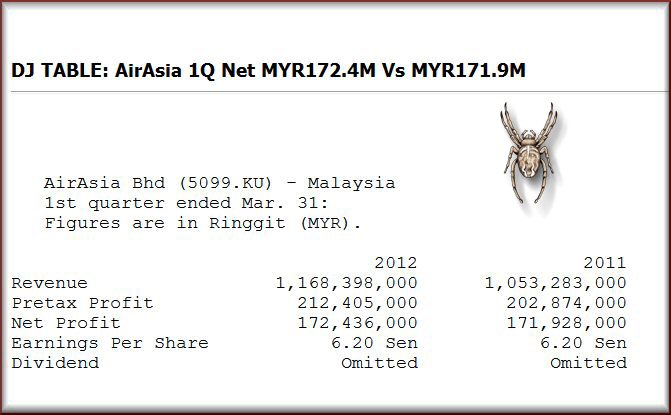
    Here are the numbers...


    Here's the article on Star Biz: AirAsia net profit up on higher passenger volume
    • Thursday May 24, 2012
      AirAsia net profit up on higher passenger volume

      PETALING JAYA: AirAsia Bhd's net profit for its first quarter ended March 31 was up a marginal 0.3% to RM172.44mil against RM171.93mil in the same period last year, but revenue grew a more robust 10.9% to a record RM1.17bil from RM1.05bil led by higher passenger volumes.

      The airline's net operating profit increased 4% to RM167.97mil from RM161.9mil, while earnings per share was unchanged from a year ago at 6.2 sen.

      In the notes accompanying its financial results, AirAsia attributed the improvement in revenue to a 12% growth in passenger volume and 7% higher average fare of RM177 compared to RM164 achieved last year.

      Both its ancillary income per passenger and load factor were unchanged at RM40 and 80% respectively.

      Its capacity climbed 12% in the quarter under review to 6.06 million passengers from 5.42 million. Revenue per available seat km was 16.92 sen against cost per available seat km of 13.44 sen. This was on the back of a 9% increase in its average fuel price.

      The margins for its earnings before interest, taxes, depreciation, amortisation and rent as well as earnings before interest and taxes are at 35% and 21% respectively.

      “We have defied industry trends again by achieving a 4% growth in net operating profit. This remarkable performance, relative to our peers', signifies our resilient business model in the volatile and cyclical airline business coupled with the current stubborn high oil prices,” group CEO Tan Sri Tony Fernandes said in a statement.

      He added that AirAsia was able to equity account RM2.3mil from its soon-to-be-listed unit, Thai AirAsia, in the first quarter as the unrecognised losses in its Thai affiliate have been reversed.

      The group's cash from operations was RM100.5mil at end-March compared to RM538.2mil in the preceding quarter ended December 2011, while net cash flow amounted to RM47.9mil outflow as cash flows from investing and financing activities exceeded operating cash flows.

      Its total debt stood at RM7.5bil, with net debt at RM5.44bil after offsetting cash balances. This translates to a net gearing ratio of 1.26 times, 11% lower than the preceding quarter.

      In terms of its outlook, AirAsia said that based on the current forward booking trend, underlying passenger demand in the second quarter for the Malaysian, Thai and Indonesian operations remained positive.
    Here's the other version or is it poison:

    http://www.theedgemalaysia.com/in-the-financial-daily/214175-airasia-1q-profit-flat-on-higher-expenses.html
    • AirAsia 1Q profit flat on higher expenses
      In The Edge Financial Daily Today 2012
      Written by Chong Jin Hun
      Thursday, 24 May 2012 14:50

      KUALA LUMPUR: AirAsia Bhd’s 1Q net profit came in flat from a year earlier as higher revenue and foreign exchange (forex) gains failed to offset higher operating expenses and losses from its global units.

      In a statement to the exchange, the low-cost carrier said it posted a net profit of RM172.44 million in 1QFY12 ended March 31 against RM171.93 million previously while revenue rose 11% to RM1.17 billion from RM1.05 billion a year ago.

      “The outlook for 2Q should be seen in the context of the current high prices of oil and aviation fuel.

      “However, barring any unforeseen circumstances, the directors remain positive on the prospects of the group for 2Q and remainder of 2012,” AirAsia said.

      The company said operating expenses, which included costlier jet fuel, rose 10% to RM943.83 million in 1Q from RM854.3 million a year earlier. Bottom line was also helped by a significant increase in forex gains to RM83.58 million versus RM40.97 million previously.

      Quarter-on-quarter, 1QFY12 net profit rose 27% from RM135.66 million in 4QFY11 ended Dec 31 while revenue was down 8% from RM1.27 billion.

      AirAsia’s operating unit in Thailand was profitable in 1Q while its other three entities, each in Indonesia, the Philippines and Japan, had registered losses, the company said.

      Based on the current forward booking trend, the company said underlying passenger demand in 2Q for its operations across Malaysia, Thailand and Indonesia remains positive.

      “Load factors achieved in April were in line with the previous year in Malaysia and Thailand and slightly lower in Indonesia though with higher capacity aircraft.

      “Average fares were higher in Malaysia, in line with the previous year in Indonesia and slightly lower in Thailand,” AirAsia said.

      The budget airline said it will, in 2Q, take delivery of three A320 aircraft for its operations in Malaysia, Indonesia and Japan. The aircraft will be used to serve new routes from Bandung, Indonesia, and from Tokyo, Japan; and to increase frequency for current routes in Malaysia.


      This article appeared in The Edge Financial Daily, May 24, 2012.
    Yeah, choose your own poison.....