Monday, April 10, 2006

It's the business.. Part III

In the previous post, Its the business.. Part II the example discussed was based on the assumption one had purchased Multicode on 20th Sept 2001. I wrote the following.

  • It announced its 2001 Q4 quarterly earnings on 20th Sept 2001. The traded prices at that time was 1.52. At that time Multi-co had around 39 million shares. So for fy 2001, Multi-code had an eps of 26 sen. Based on a price of say 1.52, this meant that Mutli-code had an PER of 5.8x and with a dividend of 10 sen tax exempt, Multicode had a dividend yield of 6.6%. This makes an investment case, right? The reason to invest in Multi-code was there.... rite?

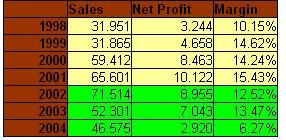
Now assume that one purchased the stock in 2002, instead of 2001. Here is Multicode's 2002 Q4 quarterly earnings. The year low for Multicode in 2002 wass 1.88.

1. company's net profits are down. Is it a blip? (net earnings was only 8.9 million vs 10.1 mil)
2. company's profit margins showed some weakness.. 15.4% to 12.5%
3. there is a 10% tax exempt dividend yearly.
4. net cash also.

So if say at 1.88, was there a justification to buy the stock?

One could have argued that perhaps fy 2002 was just a blip. A single one-off poor result. And because the company is a nett cash company and pays their 10% tax exempt dividend like clock-work, the investor is seduced to buy the bugger. Earnings per share was 20.4 sen and at 1.88, per was around 9.2x and dividend yield would 5.3% assuming 10% company continues paying their 10% dividend.

So the investor ignores the poor business performance and focused on the issue of dividend and that the company is in a net cash position...

Assuming one had purchased Multicode back then at a price of 1.88.

Cost of investment of 10,000 shares at 1.88 = 18,800.

Dividends received.

2002
10 sen (10 x 10 = 1000) (NO bonus issue entitlement lor..)
2003
10 sen (10 x 10 = 1000)
2004
7 sen ( 10 x 70 = 700)
2005
8 sen (10 x 80 = 800)

So total dividend received would be 3,500.

So total dividends received after holding a stock for 4 years = 3500. And based on an investment outlay of 18800, this means that the investor has recieved back 18.6% of their invested money.

But... the current share price is 1.10. And since one now have 10,000 shares, the current market value of the shares based at a price of 1.10 is 11,000.

And if you add up the dividend received.. 11,000 + 3500 = 14,500!

Ahem... see the end result now?

An investment of 18,800 would mean that based on current price of 1.10, the investor is holding a paper loss of 4,300!!!

What's your opinion on It's the business that counts... now ?

I really do think that O'Neil have taught us something good here. Do not hold or buy a just because of its dividends. If the stock earnings performs poorly, the stock will STILL get hit.

Sunday, April 09, 2006

It's the business.. Part II

It's the business that counts.. says Teh Hooi Ling and according to her, ultimately it is the business that drives the share price.

Ok, Teh Hooi Ling demonstrated why investing because of the cash per share is not a 100% fool-proof method of investing. What about dividends? If a company pays good dividends, will it be a good reason to buy and hold long term to the stock?

Take these comments from William O'Neil, author of ' How To Make Money In Stocks '

  • One of my goals is to get you to question and change many of the faulty investment ideas, beliefs, and methods you have heard about or used in the past.

    One of these is the very notion of what it means to invest. It's unbelievable how much erroneous information is out there about the stock market, how it works, and how to succeed at it. Learn to objectively analyze all the relevant facts about a stock and how the market is behaving. Stop listening to and being influenced by friends, associates and the continuos array of experts' personal opinions on daily TV shows.

    It's also risky and possibly foolish to say to yourself, "I'm not worried about my stocks being down because they are good stocks, and I'm still getting my dividends." Good stocks bought at the wrong price can go down as much as poor stocks, and it's possible they might not be such good stocks in the first place.
    It may just be your personal opinion that they're good.

    Furthermore, if a stock is down 35% in value, isn't it rather absurd to say you're all right because you are getting a 4% dividend yield? A 35% loss plus a 45 income gains equals a whopping 31% net loss.

    To be a successful investor, you must face facts and stop rationalizing and hoping. No one emotionally wants to take losses, but to increase your chances of success in the stock market, you have to do many things you don't want to do. Develop precise rules and hard-nosed selling disciplines, and you'll gain a major advantage.
Let's look at a real example..


in which... one can easily say that justification to invest in the stock is there...

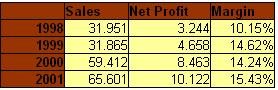
1. company's net profits are growing yearly...
2. margins are decent
3. there is a 10% tax exempt dividend yearly.
4. net cash also.

now the company mentioned is MULTI-Code.

It announced its
2001 Q4 quarterly earnings on 20th Sept 2001. The traded prices at that time was 1.52. At that time Multi-co had around 39 million shares. So for fy 2001, Multi-code had an eps of 26 sen.

Based on a price of say 1.52, this meant that Mutli-code had an PER of 5.8x and with a dividend of 10 sen tax exempt, Multicode had a dividend yield of 6.6%.

This makes an investment case, right? The reason to invest in Multi-code was there.... rite?

Justifiable? Let's ass-u-me that one does make such an investment.

so what happen to such an investment?

If one got in Sept 2001.... one would have done really wll.... consiering that Multi-code did manage to edge past 3, for close to a 100% gain, within the next six months...

Brilliant!!! Fantastic!!

but.... imagine if one had used ze "I'm not worried about my stocks being down because they are good stocks, and I'm still getting my dividends."

look at how this investment would have fared.... !!!!!


See how the stock dived after hitting the rm3.00 peak in 2002?

So what happened?

What about looking at the it's the business that counts.. issue?

From a business perspective, could one have knew when was the time to exit?

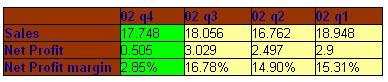
Take a look at the quarterly earnings table below.. read from left to right.. look at the 02 Q4 numbers .. the one highlighted in lime-green. Could one see the drastic change in its quarterly earnings shown in 02 q4 earnings?


Was this the right time to get out? Just from the quarterly earnings, we could sense that there was something drastic happened with Multi-code's business. Its quarterly net profit margins slumped from the 14-16% to a mere 2.85%!

look at the yearly earnings achieved by Multicode after fy 2002.


Wasn't it the right decision to make? To EXIT AFTER fy 2002?

Here's something more intersting..

Multicode announced their Q4 2002 earnings on 24th Sep 2002.

If an investor takes this key to exit, the investor could have had exited at between 1.90-2.00++. (Please verify from these data)

So the investment return was not too bad... entry at 1.52, one could have exited a year later at least 1.90, plus a dividend of 10 sen.... not too shabby at all... :D (and there was a 1 for 10 bonus issue in early 2002)

but.... butt.... buttttt....

if one held on... and applied what William ONeil is suggesting... ie I'm not worried about my stocks being down because they are good stocks, and I'm still getting my dividends ...... let's examine how one is doing.

let's consider one making an investment of 10,000 shares at 1.52 on Sept 2001, after the
Bonus Issue , one would have 11,000 shares. Cost of investment at around 15,200. Multicode last traded at 1.10

let's count the dividends received...

2001
10 sen (10 x 100 = 1000)

2002
10 sen (11 x 10 = 1100) (num shares increased due to bonus issue)

2003
10 sen (11 x 10 = 1100)

2004
7 sen ( 11 x 70 = 770)

2005 8 sen (11 x 80 = 880)

So total dividends received after holding a stock for 5 years = 4850. And based on an investment outlay of 15200, this means that the investor has recieved back a whopping 31% of their invested money.

Fantastic!!!

But... the current share price is 1.10. And since one now have 11,000 shares, the current market value of the shares based at a price of 1.10 is 12,100.

And if you add up the dividend received.. 12,100 + 4850 = 16,950.

Which means, the investor is up some 1750 from their original outlay of 15200. A return of 11.5%.

(ps... this works out to an annual compounded return of only 2.14%!!)

So holding a stock for 5 years.... do you reckon that this is good or is it bad?

How?

Does this sound like a super duper investment idea now?

Or do you agree that it's the business that counts.. ?

And to make it more complicating.. Multi-code reported its 2005 Q4 earnings last Sept.

Net earnings was 4.137 million versus fy 2004 earnings of just 2.889 million. Just imagine what if Multicode did not show such a business recovery.. I am saying this because Multicode last year's low was a mere 1.01. And if I had used 1.01 as the gauge, the five year result would have been more gloom.

It's the business that counts .. right?

Hmmm... anyway let's look back at what O'Neil wrote:

  • It's also risky and possibly foolish to say to yourself, "I'm not worried about my stocks being down because they are good stocks, and I'm still getting my dividends." Good stocks bought at the wrong price can go down as much as poor stocks, and it's possible they might not be such good stocks in the first place. It may just be your personal opinion that they're good.

I think O'Neil teaches us something good here. Do not hold onto a stock just because of its dividends. If the stock earnings performs poorly, the stock will STILL get hit. Which means our investment in the stock will most likely perform rather poorly over the years as shown in this Multicode example.

Now of course, do not misunderstand what I am saying here...

Dividends is indeed great, but for my personal choice, I want that something extra. I would want to see the business of the stocks doing great as well. And the great business will most likely be the catalyst to drive the stock higher.

Saturday, April 08, 2006

It's the business..

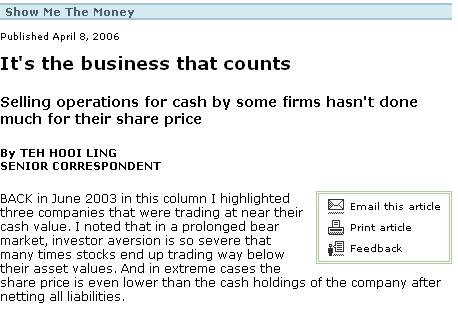
Saw this very interesting article, it's the business that counts , posted on the Business Times. It's written by Teh Hooi Ling. Her column's name is very special for me for it's called Show Me The Money. Here is a snapshot of the column.


Anywayyy... I really enjoyed her write-up today.

  • 'Of course, if the company has no intention to return the cash to shareholders and its operations are bleeding cash, then the share price may well have reason to be trading below the cash net of liabilities per share,' I wrote. 'Unless there is a turnaround in the business, the cash will eventually be depleted.
Hmm.. the intention to return the cash!

Very important issue, eh?

What can the minority shareholder or speculator do if the management has NO INTENTION to return cash or unlock its assets?

Think about it hor...

Err... just like that CIMB statement for Worldwide..
  • Also, the group does not appear keen to unlock the value of its assets, including its stake in Genting Sanyen, unless it can put theproceeds to good use.
She continues by saying..
  • 'But if a company's share price is significantly lower than its cash net of liabilities, and there is no shareholder with a more than 50 per cent stake, then there is a possibility that a corporate raider may come in to scoop up the bulk of the shares, gain control, strip the assets and take hold of the cash.

    'Yet another possibility is for the controlling shareholder to take the company private, paying a premium to the market price.

    'Even if none of these corporate manoeuvres takes place, a company flush with cash and with operations that are profitable and generating cash will have no reason to trade below its net cash value per share for long. Thus a look at a company's cash position, coupled with an analysis of its operations, is a rather clear-cut way to ascertain the extent of under-valuation of a stock.'
hmm... two possibilities.

A corporate takeover or the company being taken private.

I will add two more issues.

  1. The time-frame - how long does one have to wait before an offer materialise?
  2. Will the offer price being a fair and just offer to the minority investor/speculator?
She also mentions the issue of management trust and integrity. (see past blog posting on management integrity )

  • 'So if you decide to buy into its shares now, you are, in fact, putting your trust in the management to invest the money wisely and in projects that will yield attractive returns.
  • But again, it boils down to one's assessment of the management, whether one believes it will make a wise choice of business to buy into, and at a reasonable price, and subsequently how it can add value to the business.
    At the moment, all of this is unknown. And it seems the market currently prefers the certainty of an existing thriving business to the uncertainty of an unknown one.

She then elaborates on what happened to the three Singapore stock examples she gave back in 2003 and she concludes from her examples by saying...

  • The above examples underscore the fact that ultimately it is the business that drives the share price. That conclusion is further reinforced by the price movements of a few companies that have sold their operations for cash.

Friday, April 07, 2006

Value or Value Trap in Worldwide: Part VI

Hmm.... it seems that CIMB wrote a write-up on WorldWide today and with that write-up, it proved to be a catalyst itself, driving the stock by as much as 14 sen today!!!

And the Edge had an article based on that
write-up...

  • CIMB Investment Research reported that Worldwide has RM249 million net cash and equivalents and valuable stakes in the power and waste management businesses.

    The research house said Worldwide shares are backed by RM1.45 cash per share.

    "Based on our RM2.8 billion valuation for the 720MW Genting Sanyen IPP, Worldwide's 20% stake alone is worth a massive RM560m or RM3.27 per share, well above the share price," it said.

    It said investors were getting the RM249 million net cash (RM1.45/share), property land bank and waste disposal businesses for free and more.

    It estimated Worldwide's revised net asset value per share at RM6.09 more than triple its share price. It said the stock was also trading at a hefty discount to its NTA/share of RM4.23.

    "Although Worldwide is cheap on discount to asset backing and P/E basis (6 times historical), the key problem is the lack of share price catalysts," it said.

    Worldwide offers good value to long-term investors with the patience to wait for an eventual re-rating, it said.
First of all.. if one refers back to this blog posting Part III , one would have noted that these are the 'almost' the same exact issues mentioned back in June 2003. See the Edge article: Worldwide Pt 2 – assured earnings, undervalued assets

But in today's CIMB write-up, CIMB is declaring that the Genting Sanyen stake is worth so much more.

  • Based on our RM2.8bn valuation for the 720MW Genting Sanyen IPP, Worldwide’s 20% stake alone is worth a massive RM560m or RM3.27 per share, well above the share price.

Hmmm.... rm 560 million wor!

And then it mentioned that Worldwide has RM249 million net cash and equivalents..

Ah... I discovered something new today.

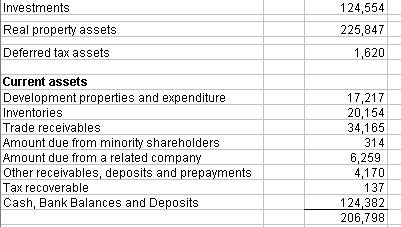
The following is a screenshot of Worldwide's balance sheet.


Ahh... as can seen, under current assets, Worldwide's cash, bank balances and deposits totals only 124.382 million.

And on the first line, you would see an entry of 'Investments' totalling some 124.554 million.. same period a year ago? Worldwide's such investment was only 69.075 million!!

And according to CIMB ( see a screenshot of their report below) these 'investments consist of unit trusts and bonds!)


Ahem... unit trusts and bonds!!!... and the obvious point of debate is why should a company like Worldwide (which had a poor history in investing... such as their theme park debacle recently) be dabbling in such investments??

Now if I check on Worldwide earnings notes, I could NOT find Worldwide's explaination on how and why such investment increased by so much. Lack of transparency???

What unit trusts did Worldwide buy?

What kind of bonds did Worldwide invest in?

And also... since such investments consist of unit trusts and bonds, how reliable is CIMB's value of rm249 million in cash and equivalents?

Ahh... anywayyyyyyyy.......remember me stating the issue of Worldwide's poor investment history?

Well... just for your information... Worldwide does dabble itself in the sharemarket too!!!

Yup!

And again, considering the issue of Worldwide's poor performance as a property developer, would the investor be faulted for questioning why Worldwide is dabbling in purchase and disposal of listed securities? Shouldn't the company management be more focused on their jobs? Would it be wrong to be so cynical? Well, consider the fact that Worldwide's value of investment in bonds and unit trusts totals some 124.544 million is more than Worldwide's sales revenue for its fiscal year 2005.

How?

anyway... do u wonder their performance in their purchase and disposal of quoted securities? Think they are good ah?

well the following table... err... u better have a look urself at those figures...


Err... how?

And another issue.. is the following statement from CIMB is not mentioned in the Edge article.

  • Although Worldwide is cheap on discount to asset backing and P/E basis (6x historical), the key problem is the lack of share price catalysts. Earnings outlook for FY06 is flattish as contribution from waste management will likely dip temporarily due to relocation to a new site. Also, the group does not appear keen to unlock the value of its assets, including its stake in Genting Sanyen, unless it can put the
    proceeds to good use.

See the points in red. Do you think that these two issues are rather important?

how? Should the Edge be omitting such issue?

(ps... and if consider the fact that Worldwide's management INCREASED their investment in bonds and unit trusts from 69.075 million to 124.382 million in their fiscal year 2005, does it appear that Worldwide is keen to unlock the value of their 'assets'?)

Anyway... what do you think?

Value Trap?
Or there is really VALUE as statetd by CIMB!

How?

Oh... some of the points made by hhc in part IV is worth noting now... :D

  • 2)Small time trader or ikan bilis
    Rule one to rule 9 are still attractive stories. They dont care what is it but as long as there is a renewed interest in this stock, they will swarm in. Most of them will be eaten by the ikan besar. Some of the nible one will managed to snatch the bait put out by big fish.

    OK back to TA.

    For the last whole year, Wldwide has been building base at around 1.8 region. IN the last 3 months, the vol is increasing and it's now trading close to its resistance area at 1.9 area and inside its mini uptrend established on Oct last year.

    Its technical stand is interesting but i would pay attention if i can break and hold at above RM2 area. IN the mean time, i would say the bull and bear are fighting out. The outcome is still unclear. (chart pictures are contributed by hhc... many thanks!!)


------


past mumblings on Worldwide:

  1. Worldwide Holdings: Value or Value Trap?
  2. Worldwide Holdings: Value or Value Trap?: Part II
  3. Worldwide Holdings: Value or Value Trap?: Part III
  4. Worldwide Holdings: Value or Value Trap?: Part IV
  5. Worldwide Holdings: Value or Value Trap?: Part V


Top of Ze World: Part VI

Edited: April 7th. 7.20 pm

Let me bore everyone with numbers and more numbers for Top Glove.

1. FY 2001.
Shareholders Equity = 93.170 million. Total loans = 13.958 million.
Total capital used = 107.128 million.
Earnings generated = 17.217 million.
Return of total capital used for 2001 = 17.217/107.128 = 16.1%

2. FY 2002.
Shareholders Equity = 109.136 million. Total loans = 13.440 million.
Total capital used = 122.576 million.
Earnings generated = 18.036 million.
Return of total capital used for 2001 = 18.036/122.576 = 14.7%

3. FY 2003.
Shareholders Equity = 130.471 million. Total loans = 39.289 million.
Total capital used = 169.760 million
Current earnings generated = 25.222 million
Return of total capital used for ttm = 25.222/169.760 = 14.9%.

4.. FY 2004.
Shareholders Equity = 162.006 million. Total loans = 63.063 million.
Total capital used = 225.069 million.
Earnings generated = 39.509 million.
Return of total capital used for 2001 = 39.509/225.069 = 17.6%

5. FY2005.
Shareholders Equity = 216.082 million. Total loans = 154.191 million.
Total capital used = 370.993 million
Current earnings generated = 58.141 million
Return of total capital used for ttm = 58.141/370.993 = 15.7%.

6. TTM (Trailing Twelve Months or most recent 4 quarters).
Shareholders Equity = 255.538 million. Total loans = 199.478 million.
Total capital used = 455.016 million
Current earnings generated = 69.666 million
Return of total capital used for ttm = 69.666/455.016 = 15.3%.

How?

How would you want to evaluate such numbers?

On one side of the coin, a ROTC of 15.3% is still pretty impressive despite the huge debts being employed to fun the expansion. And because the ROTC is 15.3%, surely this simply vindicates that all the spending, the negative cash flow and all the borrowings is justifiable.

But.... butt.... buttt....

On the other side of the coin, one could argue that since hitting the peak in FY 2004, with a ROTC of 17.6%, Fy 2005 only showed a ROTC of only 15.7% and the most recent 4 quarters numbers are only showing a ROTC of only a 15.3%. Although the numbers is still impressive, one could argue that a visible downtrend can be seen. And the interpretation could be, yes the initial expansion is justifiable but pace of expansion has grown way too fast and that the company could not generate enough returns to justify the huge outlay in its expansion.

Again... two sides of a coin.

How would one interpret this?

And here is another more interesting issue. Blogger Ichi The Killer , mentioned the following:

  • I have many of the same reservations about it, but still it keeps going up ... so what can we say, right?

Ahh... this one issue that will forever exist in the share market and it depends so much on how the individual handles such situation.

Take Megan Media last quarterly earnings. Despite it reporting a huge jump in earnings, the investor finds their earnings so suspect since the main catalyst for the huge jump in the earnings is caused by a shift in accounting. Crudely put, it was simply an earnings made by the accountants.

And the market reaction? The stock went zoom, zoom, zooooom from 60 sen to 70 sen.

How?

Well stuff like this will always happen. Take trading for example. A trader could find a whole bunch of stocks that he or she is not comfortable with it. And yet, these stocks yet went zoom, zoom, zooooom too!

How?

Should the investor or even trader adjust their strategy/game plan to try to catch every uptick, every stock movement?

My say? I believe in sticking to what I am comfortable with. Stick to my comfort zone and play the game that most suits me.. yup, play the game where my chances of winning is good!

Oh... remember the story of the 3 legged mahjong and dead dummy mention in this blog posting?

Let me repeat here again... :D

Now my Granny simply loves playing either Mahjong or Dead Rummy. Now she really excels in the game of mahjong, especially the 3-legged mahjong, in which I would say that she wins probably 7 out of 10 times whenever she plays. Her winning average is about 70%. In the game of dead rummy, she ain't as hot. (not so geng wor!) She has probably a winning average of about 30%. And because of her knowing exactly what she's good at, she always, always insist to play the game of 3-legged mahjong, because she knows winning is much easier for her.

So what about me?

Me? LOL!.. Firstly, I am good at Dead Rummy and my best strategy is to avoid her at all cost at the mahjong table and wait patiently to play Dead Rummy with her. LOL!.. yeah, I am indeed being very snake here (ho ho ho) but by playing only Dead Rummy with my Granny, I know very well that I am playing my best game verus her worse game. Won't this improve my chances of winning? (else? I will be slaughtered at ze mahjong table and be ze water fish!)

----------------------------------------------------------------------

Some interesting comments from hhc. April 7th. 7.20 pm

  • Let's look at the sector Topglov is operating with. It's a volume game business with pretty tight margin which means anymore price cut will hurt its bottomline.

    Imagine what will u do if u r the owner? (of course we can just DONT invest in it). But, as the owner, the only logical way is to make yrself HUGE before anyone else and elbow them out. If u r the number one in these kind of volume game, u can control a lot of things to protect yr margin.

    ok then, how to increase size?
    1)Build new plant and reinvest yr profit (too slow , i think)
    2)Leveraging and M&A. fast but will attract a lot of attention and risk of indigestion.

    Topglov chooses the 2nd part which is , i will say pretty well run, at least until now.

    I dont like its balance sheet but i do admire that Topglov boss has the gut to face the world. If i m not mistaken, MR Lim stil hold a lot stake in topglove.

    And generally, no hanky panky deal between major shareholder and company so far which is the sign that the owner is willing to share the wealth with minorities.

    Maybe that's why fund managers like it and it's all in its price. If they are not long term investor, u wont see topglov volume is decreasing a lot from last years. One explanation is that ppl are holding the share.

    Lastly i fully agreed with yr concern and i was out from topglov not so long ago. There are value elsewhere...

Thursday, April 06, 2006

Top of Ze World: Part V

Back in 2001... that was the year Top Glove was listed on KLSE. On Oct 2001, they announced their 2001 q 4 earnings. (it would good to note the announced their very aggressive ambition, Top Glove Forecasts 40% Sales Growth two days after releasing their 2001 results)

total sales. 138.662 million
net ytd profit. 17.217 million
Cash & equiv 9.824 million
total debts 13.958 million

Did it deliver? A year later on Oct 2002, they announced their 2002 q4 earnings.

total ytd sales. 181.055 million
total ytd net profit. 18.036 million
Cash & equiv 21.214 million
total debts 13.440 million (net cash 7.774 million)

Sales revenue increased a lot but profit were flat. Ahh.. cash grew nicely.

Under the title of Margin Pressure, dated 22 Oct 2002, Surf 88 wrote the following...

  • Margin squeeze. In our previous result commentary (see ), we highlighted that Top Glove (RM2.12, stock code 7113) could have locked in rubber stocks at lower prices and hence the impact of higher rubber prices would only manifest in Jun-Aug 2002. This appears to be the case, as operating margin dropped to 13.9% in Jun-Aug 2002 from 16.0% in the preceding quarter. As such, pretax profit only rose 6% despite 19.0% turnover growth. Deferred taxation further depressed net profit to show an 11% decline.

    Results in line. Overall, the full-year results were within our expectations, where topline growth was largely driven by a 23% capacity expansion but profits did not keep pace as margins fell from 17.3% to 14.9% due to higher raw material costs.

And here is a snippet from a Star interview back in 2002...

  • According to Lim, Top Glove’s second factory in Thailand is scheduled to begin operation next month while the one in China will start in March next year. Top Glove currently also has five factories in Malaysia.

New 2nd factory starting in Thailand... the start... the begining of the explosive, promised growth in earnings.

Here is Top Glove's 2003 Q4 quarterly earnings.

total ytd sales. 265.089 million
total ytd net profit. 25.222 million (ahh... ze big jump in net earnings!!!)
Cash & equiv 22.051 million
total debts 39.289 million (net debt of 17.238 million)

point to note... last fiscal year, Top Glove was in a net cash position. To achieve the jump in net profit, from 18.063 million to 25.222 (or an an increase of 7.159 million), Top Glove went from a net cash position of 7.774 million to a net debt of 17.238 million.

So, a year later... the big jump in earnings happened and Top Glove delivered.... but alas.... Surf 88 sudah bungkus by then .... anyway we now see that this company has really, really been aggressive. Many new production lines were set-up, new plants... and most of all.... we have Ze birdie thingy!

Ahhh.... good birdie fortunes + aggressive expansion = fantastic growth for 2003.

Now, here is Top Glove's 2004 Q4 quarterly earnings.

total ytd sales. 413.967 million
total ytd net profit. 39.509 million (wow.. bigger jump in net earnings!!!)
Cash & equiv 30.226 million
total debts 63.063 million (net debt of 32.837 million)

again some points to note... last fiscal year, Top Glove was in a net debt position of only 17.238 million. To achieve the 'additional growth', from 25.222 million to 39.509 (or an an increase of 14.287 million), Top Glove went from a net debt position of 17.238 million to a net debt of 32.837 million. (or it increased its net debt position by 15.599 million). How was their expansion justifiable?

anyway how was Top Glove achieving its super duper Top Glove? Here is some RHB notes which indicates that the growth is via acquisitions of new factories and starting of new production lines...

  • It has commissioned two new lines each in Factory 5 in Ipoh and Factory 6 in Phuket at end-August 2004. In Factory 5, Ipoh, the target is to install 10 new lines, bringing its capacity to 175m pieces a month, from the current level of 110m pieces a month. In Factory 6, Phuket, the plan is to replace the existing seven production lines with 10 advanced production lines, lifting capacity from current level of 35m pieces a month, to 65m pieces a month. Meanwhile, installation of new lines in Factory 10 is in progress while construction of Factory 11, Klang is going on full steam. It aims to commission a total of at least 155 production lines with annual capacity of 13.0bn pieces a year by end-2005. It has identified two new sites for two new factories which will be constructed in CY2005 and CY2006, respectively.

    It has completed the acquisition of the remaining 40%-stake in Factory 7 in Hatyai, Thailand on 11 October 2004. Plan is in place to increase its capacity from current level of 1.08bn pieces a year to 4.8bn pieces a year by end-FY06. Its proposed acquisition of the remaining 45%-stake in the China plant is expected to complete by end-1QFY05.

How?

ok ... let me try to give an unbiased view on what is happening... :D.... try hor...

Firstly when there is huge spikes in sales & net profit, the first thing i always check on is whether there was any company acquisition which might have caused the spike in earnings.

Well, what i saw is TG is simply a very aggressive and ambitious company. It started off by buying a couple of factories in Malaysia and started expanding its production lines. It then moved on to Thailand and it even moved into CHina.

So over the years, TG focus was simple. Aggressive growth thru acquisitions and organic growth. And plans to stick to this gameplan for the next few years.

And of course all this has been helped by the birdie issue in 2003.

And the end result, although we are seeing the fantastic growth in earnings, TG is paying a hefty price for their expansion.

And last year, Oct 2005, Top Glove reported its 2005 Q5 quarterly earnings.

total ytd sales. 641.827 million
total ytd net profit. 58.141 million (wow.. earnings still very good!!!)
Cash & equiv 31.755 million
total debts 154.191 million (net debt of 122.436 million!!)

How?

Let's look at those issue or rather those points again.... last fiscal year, Top Glove was in a net debt position of 32.837 million. To achieve the 'additional growth', from 39.509 million to 58.141 million (or an an increase of 18.632 million), Top Glove went from a net debt position of 32.837 million to a net debt of 122.436 million. (or it increased its net debt position by 89.599 million).

How was their expansion justifiable?

Which was why I blogged that posting in Oct 2005. And let me repeat the main issues.

Sooooooooooo despite it’s great sales and net profit growth… it’s bottom-line certainly ain’t too top-looking for me.

Btw…in my opinion, the need to have some sort of understanding of the explosive growth in Top Glove is kinda important.

So far, it looks to me it has been 'quite' prudent in the number of factories it has been adding per year. Yes, adding a new factory per year is indeed aggressive but i think it has not been too aggressive. (tiok boh?) From a management point of view, consideration should be given regarding the ability for Top Glove to manage the growth in its factories. (Layman's view: Buying and managing a business is always manageable, but if u buy 'too much' businesses, then the very obvious issue, is can we manage all these factories?) Yup, the issue of managing and cordination of all factories in a profitable and efficient manner becomes a concern if the company increases the number of factories too fast.

Whereas, the increment in production line should be a much easier task to handle compared to the number of factories.
(tiok boh?)

Now one probably ask why all this? Growth in a company is always good however commonsense would tell us that excessive growth might pose some danger too. As such, this is why I am not discounting this issue.

Which is what is happening in Top Glove isn’t it? The company is expanding and expanding and expanding. Buy/adding a new factory here and there… but all these capex comes with a huge borrowing cost… and in me opinion…i the end result just does not justify all these expansions. Take a look at their Thailand and China segmental results. Does it justify all the moola spend expanding into these markets?

How? What say u?

Am I too prejudiced against what Top Glove has achieved so far?

Is all my mumblings not valid? Or am I mumbling just for the sake of mumbling?

:D

Wednesday, April 05, 2006

Top of Ze World: Part IV

Last edit: 6th April 9.35 am

Found the following comment in my blog entry Top of Ze World: Part III

  • Strictly followed Ben Graham, "a good company is a company made more money than it spend", i have no objection to this. But, sorry to say that this statement is too general. Stocks are different from each other, we cannot apply this rule across the board. On the Topglove case, i am of opinion that a good company should employ the profit/equity wisely, either thru' business expansion or returned to shareholders. I personally prefer business expansion. Pertaining to debt, a am of the opinion that some manageable debt is acceptable. Of course borrowings come with a cost. I do agreed with U that the pace Topglove is expanding is to fast.

And here is my reply:

  • You see, yes I do agree very much that a good company should employ their profit/equity wisely, which as you have said, either thru business expansion or returning the excess cash back to the shareholders.

    And this is the very issue here in Top Glove.

    Is Top Glove expanding their business wisely?

    Take a very good look at their cash flow.

    Based on current numbers... Top Glove recorded a record half year earnings of 38.360 million.

    And the very same question I asked back in first posting in Oct 2005, I asked again yesterday, where is the Money? Where is the wealth generated?

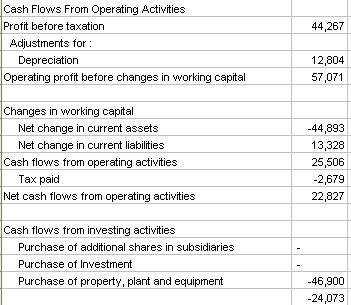
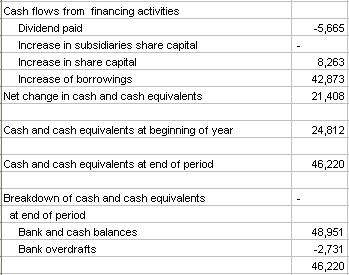
    In this quarterly earnings, Top Glove mentioned that it's piggy bank cash at the start of the year was 24.812 million. At the end of this quarter, yes cash increased to 46.220 million BUT this was aided by an increase in borrowings of 42.873 million. If you minus out the borrowings, where did that earnings of 38.360 million go? And what if you take into consideration of the depreciation charges of 12.804 million?

    Should one be worried that in Top Glove example, we are seeing a company that has been constantly consuming more cash than it generates?

    And then what about the end results from Thailand and China?

    And asked in the blog postings: 'And how did their current Thailand and China plants results appeal to you?'

    Now these are the issues I have raised...

    What's one opinion on it?

    Do you agree or do you disagree?

    For some.. they get worried... company cash flow has not been positive for a long time already, so is it wrong to be worried? Is the justifications to be worried valid?

    However... ahhh... the differing opinions.... :D

    For some.. it is considered OK.. since they consider that because Top Glove is expanding and has the inspirations to be the TOP GLOVE MAKER in the world. And to be no.1, some sacrifices needs to be made. The company has to use their cash flow to fund the expansions. And if that is not enough, the company has to borrow more to fund the expansions.

    Ahh... do you see the differing opinions?

    Which is right?
    Which is wrong?

    I have no idea... me just raised the issues only via my mumblings...

here's a reply from 2nd brother on this issue.. 6th April 8.00 am

  • Accordingly to Robert Hagstrom in (The Warren Buffett Way) and Phil Fisher in (Common Stock Uncommon Profit), how a company employ its cash depend on the stage of a company/business. At Topglove, it is at growing stage (Stage 2). It is growing so fast, every dollar they made have to plunge back for expanding the business. The profit itself is not sufficient enough for increasing production capacity, Topglove need to borrow more money to expand. Therefore, cash in hand is not a good tool to measure the company.

    As business expand, of course the increased of working capital is a by-product. Strictly follow the latest quarter report, there was an increse of 30++million in working capital. Another 45 millon was spend on the production lines.

    Althought the cash flow is not "pretty enough", i personally feel that it is not a alarming sign yet.

    What i want to say is all these cashflow/ debt level are depend on the stage of a company.

    Strictly followed Phil Fisher and Micheal Porter, low-cost producer would win especially in the commondity game. Since Topglove is the low-cost producer, i think they would win in this game.

    In glove industry, scale of economy is crucial. Topglove yet to achieve scale of economy in China, so the reported profit would not be impressive. Maybe we would see some improvemnt in the offing.

Reply (April 6th 9.35 am):

For me, it depends on what one seeks for when they invest in a company. Now as mentioned many times before, the key to a successful investing is pretty much simple. One seeks to invest in a good company at a cheap price. And obviously the very key to this simple statement is the definition of 'good' and 'cheap'.

Now let's take the issue of good. What is considered good? Some wants to see the creation of wealth and on the other hand, one wants to see the company simply grow. And on the other hand, some see both as a must in their definition of a good company. They want to see the creation of wealth and they also want to see the company grow. And of course, such opinion simply varies.

Me? I would want to see the creation of wealth but yet I also want to see growth... LOL!! ... yalor.. I am way too demanding... :D

Ahh... am I wrong to be so selective?

For sure, some finds it acceptable to have an aggressive company, deploying every single cash back into the business for the sake of expansion. And if they have to, borrowing is needed. As mentioned again, such sacrifices is a must if the company wants to grow.

For some, they might ask if such management practise is prudent? For they would argue that expansion is a must BUT it must not be made at all costs. Spending all the cash flow and incurring loans to fund such expansion might be considered excessive. The arguement is that nothing truly great is made via fevered acquisitions of companies and that frequent acquisitions are a sign of weakness, of misplaced priorities and of the inability to enhance worth from within. For them they would rather see their company grow from their own funding. For them this is the real worth. Else they consider it as artificial engineered growth.

How?

Two school of thoughts. Yes?

Well, since I am one that wants to see the worth and yet one want to see the growth, perhaps it would be better if I explain more in terms of my views on what is happening in Top Glove.... (sorry.. let me start a whole new posting else this posting will be way too long..!!)

~~~~~~~~~~~~~~~

ps... I have turned this into a whole new blog posting into a discussion and if any1 wants to have their say, you are more than welcomed......

Tuesday, April 04, 2006

Top of Ze World: Part III

* edited 5th April 2006 *


Past postings:

Flashback:

In the first posting, I wrote the following..

  • However….what puzzles me is… where is ze Moola?

    Mana pergi tok?

    If i remember correctly, Jason Zweig stated somewhere (cannot remember which page lah) in the Fourth Revised edition of the legendary Benjamin Graham’s book, “The Intelligent Investor”…the best definition of a good business is that the good business generates more cash than it consumes.

    The good business is generating more cash of the company’s piggy bank and the company’s piggy bank grows at a healthy pace.

    Think about it.

    Isn’t this what we want for our investment?

    Now if a company keeps growing in size and expanding and expanding….sales is growing lah, net earnings is also growing at a fantastic rate….but then... somehow the end result is not there.. cos the company’s piggy bank is NOT reflecting the excellent result. Yup, company sales are increasing, net profits are increasing BUT cash is depleting. And in some drastic cases, the company’s loans are increasing too.

    And this is my current prejudice against Top Glove.

    Where is ze Moola?

    Top Glove announced it MADE a net profit of 58.1 million for the current fiscal year 2005.

    Fantastic! Bravo! Superb!

    However.. open the company’s earnings excel file.. and look at the CF worksheet.


    Line 41: Cash and cash equivalent at beginning of the year was 16.168 million

    Line 43: Cash and cash equivalent at end of end of period was 4.616 million.

    Ahem.

    4.616 million wor… and according to the company it MADE 58.1 million. Isn’t the company consuming MORE cash than it generates? How? Would u justify Top Glove being a top business?

    And Top Glove’s total borrowings now total 154 million. Errr… a year ago… how much ar?

    Sooooooooooo despite it’s great sales and net profit growth… it’s bottom-line certainly ain’t too top-looking for me.

    Btw…in my opinion, the need to have some sort of understanding of the explosive growth in Top Glove is kinda important.

    So far, it looks to me it has been 'quite' prudent in the number of factories it has been adding per year. Yes, adding a new factory per year is indeed aggressive but i think it has not been too aggressive. (tiok boh?) From a management point of view, consideration should be given regarding the ability for Top Glove to manage the growth in its factories. (Layman's view: Buying and managing a business is always manageable, but if u buy 'too much' businesses, then the very obvious issue, is can we manage all these factories?) Yup, the issue of managing and cordination of all factories in a profitable and efficient manner becomes a concern if the company increases the number of factories too fast.

    Whereas, the increment in production line should be a much easier task to handle compared to the number of factories. (tiok boh?)

    Now one probably ask why all this? Growth in a company is always good however commonsense would tell us that excessive growth might pose some danger too. As such, this is why I am not discounting this issue.

    Which is what is happening in Top Glove isn’t it? The company is expanding and expanding and expanding. Buy/adding a new factory here and there… but all these capex comes with a huge borrowing cost… and in me opinion…i the end result just does not justify all these expansions. Take a look at their Thailand and China segmental results. Does it justify all the moola spend expanding into these markets?

    How? What say u?

    Am I too prejudiced against what Top Glove has achieved so far?

Top Glove announced its quarterly earnings tonite.

Let's look at their cash flow...


how?

And again.. Where is Ze Moola?

Did Top Glove's cash flow improved?

Was my earlier concern still valid?


Take a look at their balance sheet...

See how the total loans have increased a lot?

Short term Loans is now 47.934 million. Long term borrowings is now 81.544 million and Top Glove has issued bonds amounting 70 million.

And how did their current Thailand and China plants results appeal to you?


And how would one evaluate the following past comment below?

  • Which is what is happening in Top Glove isn’t it? The company is expanding and expanding and expanding. Buy/adding a new factory here and there… but all these capex comes with a huge borrowing cost… and in me opinion… the end result just does not justify all these expansions. Take a look at their Thailand and China segmental results. Does it justify all the moola spend expanding into these markets?

Am I Wrong?

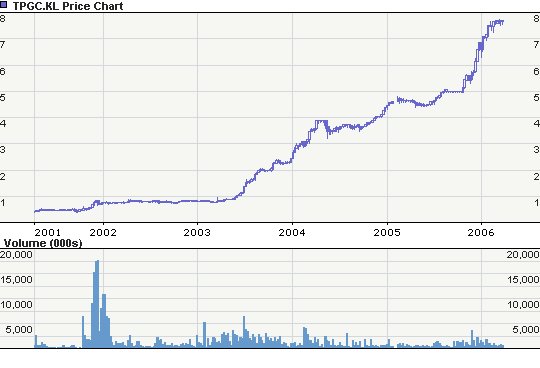
Btw... Top Glove is now at 7.70.... and all this is a mere mumbling from me... i have no idea what the share will do... will the so-called improved earnings seduce some demand today? I have no idea dude...